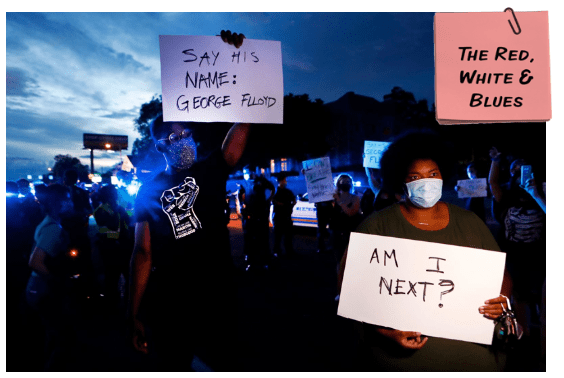
I’m a middle aged white guy who grew up with that privilege. Sometimes I’ve been aware of it and sometimes I’ve been blithely unaware. Right now, well, it’s hard not to be fully awake.
Many tens of thousands of us of all colors have taken to the streets this week, both physically and virtually, both non-violently and occasionally violently, to demand consequences for the death of a 46-year-old Black man, George Floyd, at the literal hands (well, knee) of a Minneapolis police officer as three of his fellow men in blue watched.
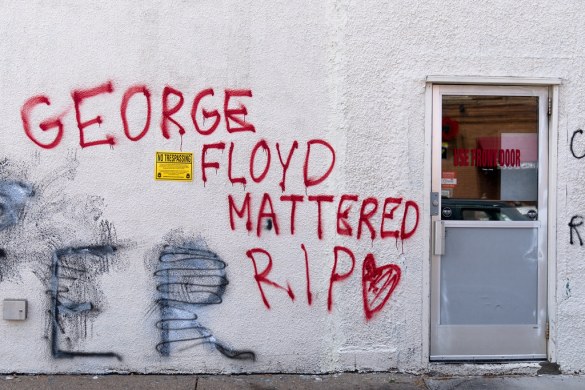
Found in Minneapolis
I dislike violence but I’m not surprised or even OUTRAGED by it. Frankly, I wouldn’t blame many of us if we burned numerous landmarks in numerous cities down at this point.
Don’t take this as an endorsement of violence but more as an observation of the breaking point of human nature and what it seems to take, now and at various points in our history, to achieve any sort of meaningful social change.

Target will recover, trust me
Mr. Floyd, compliant and handcuffed, was nevertheless prone in the gutter with that police officer’s knee to his neck for a full EIGHT MINUTES, cutting off his air. As Mr. Floyd pleaded that he couldn’t breathe and called to his dead Mom for help, the officer kept pressing down, on his neck.
In the last three of those minutes Mr. Floyd was no longer breathing and likely dead as the officer blithely looked around him and up at the sky, just sort of passing the time. Yet his knee never moved, nor did any of his fellow officers.
It’s all captured on video from numerous angles and on numerous cameras. So don’t even try arguing about it.
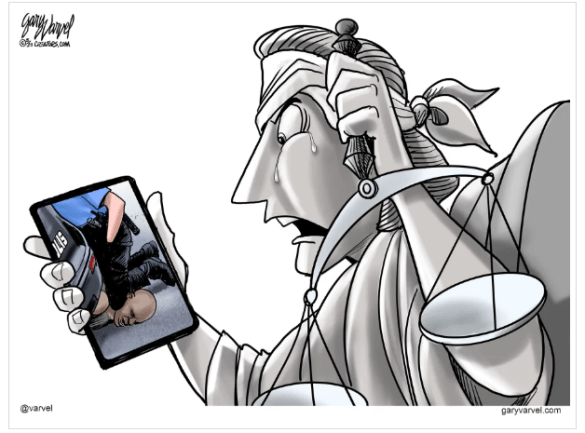
The impact of the iPhone cannot be understated
Mr. Floyd’s death is the latest of dozens and dozens and dozens – and dozens – of similar acts perpetrated by police all across the country on an ever-growing list of Black and Brown men, and sometimes women, in the last number of years. They have crossed over the line of guilt or innocence to techniques of interrogation engagement that end in viral recordings of Roman Coliseum-type murders.
What once seemed to many of us informed white Americans as complicated, perhaps nuanced issues of policing are now live examples of what is being perpetrated by representatives of the white patriarchal power structure in our names. It’s the cost of doing business and what’s perceived as being needed to keep us at the top of the social order and ensure our continued and absolute white privilege.

It’s time to listen
I used to think as an openly gay, Jewish guy from New York City who could never hide who he was because of my surname and less than macho affect, I was not truly the beneficiary of all of this.
But over the years when I’ve considered the fact that I’ve never feared the police, have never been suspected or questioned by law enforcement about crime, and have certainly NEVER been warned by any relatives or friends on how to behave if a policeman happened to pull me over or approach me, I began to recognize the undeniable.
From the perspective of the law, I am LUCKY to be white.

Recognizing your privilege is step 1
Not only was that revelation embarrassing, it was enraging. Until I indulged in the luxury of partly forgetting about it until the next viral act of racial injustice at the hands of the law came along.
These days it happens if not daily, then weekly or monthly. So while I am more than able to forget where I put my keys and my wallet I’m seldom EVER able to misplace my white privilege.
What a sorry turn of current events.
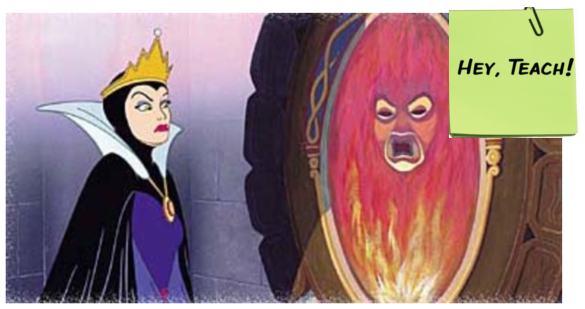
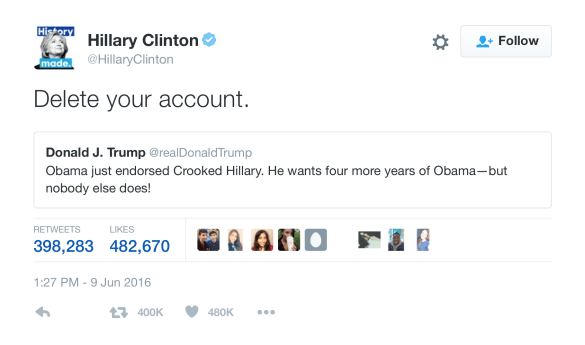
Watching spots in Minneapolis and other cities burn as our POTUS fanned the flames of racial injustice and re-tweeted old law and order threats from the 1960s designed to incite more rioting and thus distract from his epic failures in so many other areas, everything seemed hopeless.

It’s hard to even look at a cartoon of him…
But then I began thinking about the death of Larry Kramer, a writer, AIDS activist and one of my personal heroes of courage, and I somehow began to have a vague scintilla of hope – and change.
To call Mr. Kramer a mere AIDS activist is, of course, to sell him short. By all accounts he was THE FIRST AIDS ACTIVIST in the early 80s, someone who possessed a personal, unrelenting megaphone of activism so loud, unpleasant and in your face that it demanded to be heard until it finally was.
Don’t take my word for it. Read his NY Times obituary.
and consider the words of the leading voice of our medical community (Note: And one of Mr. Kramer’s chief nemeses) in 2020, Dr. Anthony Fauci: There is no question in my mind that Larry helped change medicine in this country.

The reason Larry did this was that, as he looked around the streets of his neighborhood, he saw dozens and dozens and dozens – and dozens – of his friends being brutally murdered by a relentless foe – the AIDS virus. But crazy as it was, the white power structure, of which he was theoretically a member of like myself, was doing little to nothing about it.
Worse yet, they seemed to have little interest to radically change their ways and pay more than a little lip service to it despite the pile up of bodies not only in his neighborhood but all across the country.
So he realized if anything were to get done he and his comrades in arms (nee other potential victims) had to take to the streets and do it themselves.

1989, ACT UP protest, Wall Street #thanksLarry
Mr. Kramer founded the Gay Men’s Health Crisis and later ACTUP, two organizations that slowly, and eventually in very impolite ways, pushed AIDS activism and solutions into the public square by EVERY means necessary.
ACTUP, and Mr. Kramer in particular, set a road map for the modern day, post-1960s activists, creating loud, live events that were so disruptive they couldn’t be ignored. These included theatrical demonstrations that interrupted Mass presided over by unsympathetic priests inside St. Patrick’s Cathedral and other Catholic Churches; die-ins at the White House and on Wall Street; name-calling political leaders murderers and much worse on national TV (Note: Dr. Fauci included); as well as very publicly outing any closeted gay person (or suspected gay person) in power who he deemed hiding (nee murdering us) instead of helping.
Combine this with more cutting-edge research done by younger people in the movement that backed up his demands with black and white science, and proposing well thought out solutions for improving current policies using logic, medicine and, most of all common sense.
Rather than say something was impossible based on what had happened in the past, they saw things that were possible by dreaming of and then inventing a better future.
It was yet another iteration of any number of American protest techniques that came before but at a different speed and adjusted to yet another time. Think Dr. Martin Luther King’s March on Washington and the Freedom Riders of the 1960s demanding civil rights, the Suffragettes before them fighting for a woman’s right to vote and to use birth control and then go back a century and a half to the Boston Tea Party and the birth of the American Revolution.

The Boston Tea Party, or as POTUS would say, “Thugs”
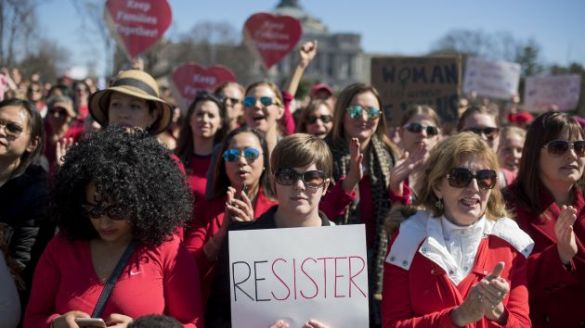
Americans have ALWAYS been all about taking to the street, rattling the cages and engaging in very public, and yeah sometimes a bit over the line and occasionally violent (Note: On BOTH SIDES) social protests.
Of course, those were the pre-social media days, not to mention even pre-Internet, so cutting edge radical solutions look quite different now. In these times we intellectually refer to it as the weaponization of social media via sophisticated disinformation campaigns using fake bots, algorithms and any other means necessary to achieve our agendas.

That friggin bird
If it’s receiving help from foreign actors, such as Russia, China and North Korea, states hoping for the devaluation of our country, it’s never been more available for the average protestor. We’re all just any number of clicks and screen windows away from marshaling aid from any where in the world.
The ends justify the means is much more than a dusty old bromide of how to get ahead these days. In many circles it’s a contemporary marching order that you WILL achieve your agenda by any means necessary, dire consequences of their domino effect into any other areas be damned.
And we’re bridling at people blocking traffic and setting fire to a few landmarks??
What is it that writer and philosopher George Santayana, once said: Those who cannot remember the past are condemned to repeat it?
Exactly. And in endless iterations over time.
Hozier featuring Mavis Staples – “Nina Cried Power”


 notes from a chair