Forward Backward Thinking

The many fans of writer extraordinaire Aaron Sorkin’s TV fantasy of the presidency, The West Wing, were able to luxuriate in nostalgia this week.

Simpler times

In support of Michelle Obama’s When We All Vote, a non-partisan (Note: Ahem) organization that seeks to encourage voting in groups that too often sit out elections (e.g. young people, communities of color), HBO Max presented a staged reading, with the original cast, of Sorkin’s favorite WW episode — season 3’s Hartfield’s Landing.

This is where senior White House staff obsess about what the first reported presidential primary vote will be in a fictional 48-person New Hampshire town.  After all, the results will dominate the news all day and, if it goes well for the POTUS, it will set a positive tone for all the hoped for favorable press their boss will receive.
LOL remember when there was no news?

And, as we all now know, there is nothing more urgent than setting an upbeat tone in order to win the White House.  Right?

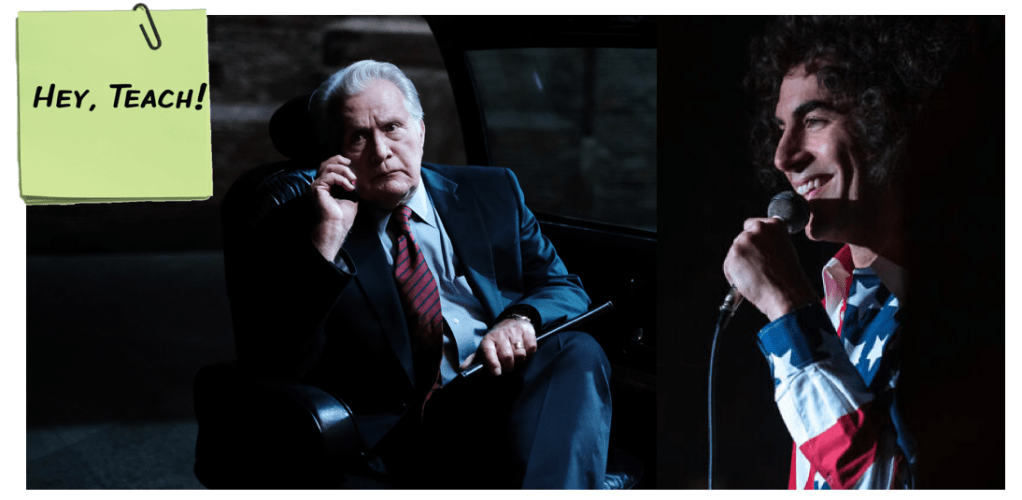
Well, history turns on a dime and what seemed urgent in 2002 and then became just plain silly in light of 2016 could easily, once again, become necessary in 2020.  Right?

Right Jon, right???

Sure!  As I explained to my students this week online via Zoom, because there’s been a deadly pandemic going on for the last eight months and we couldn’t possibly all be in the same room or breathe the same air, history swings like a pendulum – from left to right and back again.

To which one of them blurted out:

So,  when IS it going to swing back?

Yikes, good question #teachablemoment?

I, of course, immediately blurted back that they had to go out to the streets and, while safely socially distanced, swing it back the way they wanted.  Until I realized this was not only likely impossible but sounded like a Grade C imitation of the response Sorkin himself would give. 

Nor do I even believe it in the darker days of 2020.  Which, I confess, is most all of them.

Still, when you live in a purported democracy that’s about all you have, isn’t it?   It’s really just in how inspiring a way you can express it. 

Like a bad haircut, maybe it just needs time.

Well, Mr. Sorkin’s once again done an excellent job on that score as both writer and director in his latest film, The Trial of the Chicago 7. (Note…. the segue).

Dropping on Netflix just one day after the gauzy West Wing redux, his new Netflix offering (Note:  Because, well, our pandemic politics has shuttered most movie theatres and shoved this planned major theatrical release from Paramount right into your home stream) is anything but delicate.

Instead, it’s a theatrically cynical look back into history when the U.S. government was intent on using politics and every piece of the legal system, whether illegally or not, to punish and jail those who dare to take their protests onto the streets.

Look back? Who’s gonna tell him?

Side Note:  It seems particularly fitting it dropped after a week of Senate hearings aimed at putting arch Conservative (and self-possessed handmaid) Judge Amy Coney Barrett on the US Supreme Court.  When asked this week by a Republican senator to name the five freedoms the Bill or Rights guarantees for all Americans, Ms. Barrett could only think of four – freedom of speech, freedom of religion, freedom of the press and freedom of assembly.

The one freedom that stumped her?

The right to petition the government for redress of grievances, OR, freedom to protest.

And there was laundry talk!

Fittingly enough, the clairvoyant Mr. Sorkin’s new legal drama takes us back in time to the late sixties, when this very issue was very, very VERY publicly spotlighted.  This was a time when the federal government, newly controlled by the uber conservative and freedom of protest loathing Richard Nixon, decided to charge a group of young and somewhat renowned and popular anti- Vietnam War protestors for conspiracy and crossing state lines with the intent to incite riots at the site of the 1968 Democratic Convention in Chicago.

Your next Netflix watch

Take the antics of this cross-section of long and short-haired, hippie and preppy, respectful and comically stoned and disrespectful young people – and mix it with a real-life first amendment-hating and often blatantly racist judge tasked with carrying out those charges by newly installed and diabolically fascist federally empowered Nixon flunkies and, well, you can see where hilarity and mass national conflicts could ensue.

And where the comparable present-day hyperbole might begin.

It’s not a particularly pretty story to look back on, even with the much hoped for and very pithily delivered Sorkin bon mots.  But even if you don’t love Sacha Baron Cohen’s Borat movies or his borderline irredeemable prankster antics, you couldn’t experience anyone better portraying the late Yippie leader Abbie Hoffman, who famously feasted on yanking the chain of the establishment and even of his co-defendant Tom Hayden, the more straight-laced founder of Students for a Democratic Society so well evoked by Eddie Redmayne.

Also big hair moment

Ditto for so many others, including Frank Langella’s racist persecutor/Judge Hoffman, whose shared last name with Abbie is an ongoing joke, as well as a brief but memorable appearance by Michael Keaton as Ramsey Clarke, the much more liberal former attorney general from the previous Johnson administration.

It is the shifting of the pendulum of justice between left and right, liberal and conservative, and everything in between that gives the story of this Trial of the Chicago 7 its present day resonance.  At least for those of us hoping that this Election Day is about to once again cause a major shift back to what we used to think of as American sanity.

This. This. This. This. #VOTE

Yet at the same time it’s also this very issue that makes this movie inescapably scary.  As one watches the absolute conviction a single judge, backed by a new presidential administration, has towards enforcing racist and regressive views, and notes how willing both are to twist or even ignore the very laws it’s charged with enforcing in order to permanently silence those who oppose them, one can’t help but wonder — how many times CAN the pendulum shift back and forth before it all together cracks apart?

Sorkin’s courtroom antics and filmmaking dexterity do a great job of zeroing in on the core issues at stake and give us a happy ending from five decades ago that ensures American democracy will continue.

But this week’s US Supreme Court hearing, the one that will very likely (and somewhat dubiously) enshrine perhaps the most conservative judge in American history onto OUR Supreme Court, combined with the challenge for the umpteenth time of once again shifting the American presidency away from, well, fascism (Note: Fascism being the kind word), is a very steep, real life, hill to climb. 

Holding on tight to that last shred of hope

Especially in the middle of a global pandemic.

Where our ability, and even right to vote as we can, is being challenged at every turn.

Sorkin has written and imagined the way forward for us by going back in time.  But we now have to figure how to carry it out.

Another pat answer from me that borders on the cliché. 

Still, life’s never been quite as efficient, or satisfying, as any one Sorkin movie or TV series, much as we all (Note:  Well, the majority of us), would like to continue to pretend it to be.

Bob Marley – “Get Up Stand Up”

OK Fine, It’s Me

It was confirmed to me this weekend that I am, indeed, a coastal elite.

How else to account for my amusement and constant head-nodding recognition of me and mine while watching HBO’s sort of movie/Zoom session/play turned into a cable film of the same name?

Guilty as charged

Written by Paul Rudnick, a guy who is funny but yet not someone whose work I’ve ever much liked (In and Out, Adams Family Values, even his gay play/movie Jeffrey didn’t speak to me with much honesty),  no one is more surprised by my reaction to his above mentioned – okay, let’s just call it a Zoom-A-Thon – than liberal me.

Of course, that could be the reason.  Because these days I find that I’m not really liberal at all.  That’s how well I know myself.

Instead, I’ve been categorized as a slightly left of center traditional Democratic voting white guy with privilege who has spent the majority of his charmed life living  in big cities on either coast.  Sure, I sweat about things but mostly I rant, complain and sort of stand up for my principles when and if I’m pushed hard enough – but only if that push is a shove.

At least I still look cute

Granted, I am some of those things on any given day.  I mean, which of us does not embody some stereotype of our particular census group at a specific moment in time.  But I’m also a lot more than that.  Plenty more.  Not to mention I stand up for sh-t far more than my friends and family would like.  And often in public.

This seems to be the issue the majority of critics are having with Coastal Elites. It presents as five separate monologues by the kind of people I know or have met or might cross paths with, via what looks like five separate socially distanced chats, four of them on Zoom.

The Fab Five

The monologues are incredibly well-delivered by the likes of Bette Midler, Dan Levy, Issa Rae, Sarah Paulson and Kaitlyn Dever.  In turn, they play a NY Jewish “liberal” retired teacher gone ballistic; a gay unemployed actor melting down in West Hollywood; a philanthropist trust fund kid trying to contain her fury and fears; an online meditation guru unhappily dealing with her conservative family; and a thoroughly overwhelmed Wyoming nurse temporarily working in a New York City hospital.

With that cast playing those characters, all in the midst of this mess of 2020 politics and pandemic, how could you go wrong?

Okay, the truth is most critics, social media commenters and audiences have had it with Zoom.  Isn’t it enough we have to live it?  Must we now have it shoved down our throats in a cable movie?  What could possibly be fun or even meaningful about SEEING that small screen on our clearly larger screen.

Sorry, Marcia. #moreofaJanfan

Right, I get that but mostly, well, I don’t.  I’ve sort of come to appreciate Zoom communication.  For one thing, it sure beats sitting in a meeting live with lots of people you’d prefer not to ever have to deal with again live, or at least pretend to enjoy sitting through or next to at any office meeting.

Zoom or otherwise!

Would that you could turn off your inner camera and actually disappear from a room.  How cool would that be?

For another, Zoom has gotten us all to learn a piece of technology we all would have previously avoided like, well…the plague.

Sorry, too soon?

Well, that seems to be the problem for many of the naysers.  The tone of Coastal Elites is somewhere between comedy and drama.  A mix of theatre tweaked laugh lines honed for TV that move the tone up, down, around and through everything from the Menace that is POTUS, the pandemic that will soon have killed 200,000 Americans (Note: Yay, we’re #1! 😒) and the existential angst that only elites like me and these characters have the time to worry about.

My new inspirational poster

I don’t know, after spending the last six months working and living at home, and being told by medical professionals that in the next 12 months don’t count on the prospects being much better, I’m getting a bit freaked out in the mind here.  What the f-k is wrong with characters that feel the same way?  And since when can’t social commentary be, um, amusing and yet on another level, be about something?

Remember the Tony Award-winning play Six Degrees of Separation?  Sure, it was a lousy movie but the source material was pretty good.  And speaking of lousy movies most of the critics once thought was meaningful, have you seen the Oscar-winning best picture Crash lately?  Or revisited the Oscar-nominated Grand Canyon?

Perhaps those critics should (Note:  But you don’t have to, save yourself) and not get back to me.

Don’t even get me started

Bette Midler delivers one of her best screen performances in years as this New York Jewish lady of a certain age coastal elite.  Someone who couldn’t contain herself any longer and ripped that red MAGA hat right off the head of the smirking, Trump-loving provocateur who dared cross the line with her at her local Manhattan Starbucks.

I knew that woman and love that woman because, well, I AM that woman.  Or my mother and aunt sort of were.

Well, now I’m just being redundant.

In addition, who better but Schitt’s Creek’s Dan Levy to be an out gay actor fretting about queer representation at his most recent audition.  Try not thinking about your gayness with White, I mean, Mike Pence in and around the White House.

I never would’ve imagined Issa Rae playing a wealthy young woman who went to boarding school with Ivanka Trump but that’s probably because I have a middle-aged, late sixties/early seventies view of who went to boarding school.  If anything, that makes me far, far, FAR from being part of any elite.

She sure is

Sarah Paulson can make us believe pretty much anything but presenting this sort of new age guru who can barely deal with her Trump-loving family in the Midwest on a recent trip was an unlikely yet kind-of-inspired juxtaposition with a twist.

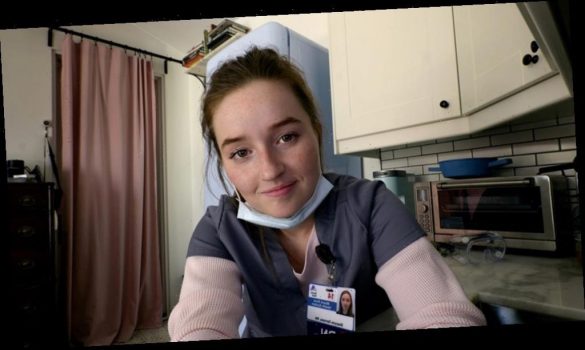
And in the clean up position, Kaitlyn Dever really delivers as a young, out-of-town nurse working in a NYC hospital at the height of COVID in April.  The young star of Netflix’s Unbelievable as well as last year’s best buddy flick, Booksmart, more than anyone else, brought a certain kind of even-handed pathos that was able to wrap up the show and make it, in total, much more of a journey than simply a series of rants and clever monologues.

A star on the rise

But that’s my take.  One from a coastal elite who is clearly the target audience for this type of thing. So sue me if these days we want some meaning but also want to be amused for just a few secs on and off.   That doesn’t minimize the issues if, at the same time, you accept that no one piece of art can possibly generate the depth to deal with it all, or even huge chunks of it, effectively.

You can’t even address it all on social media, try as so many of us might, and think as so many of us do.

Me, on my better days

Take it from the source but to my mind what myself and likely more than a few of those non-elites out there are looking for right now onscreen, in a movie (Note: Remember those?) are at least a few glimpses of  honesty – a sense of some angsty reality mixed in with… maybe a smile or two we may, or likely may not, be getting in real life.

If that doesn’t please the critics, well, tough sh-t as me and mine might say.  It certainly gave me/us some relief and something to think about for 90 minutes.

Bette Midler – “One Fine Day”