Did I Almost Forget about the Oscars?

I’ve been excited for the announcement of the Oscar nominations every year for more than half a century.  I’m not sure exactly when and why it started but my earliest memory is being a really, really happy little boy when I heard Mary Poppins got a ton of nominations AND several months later literally  jumping up and down screaming when Julie Andrews walked up to the stage to accept the trophy as best actress.

Thinking about it now I wonder:

How did they not know I was gay?
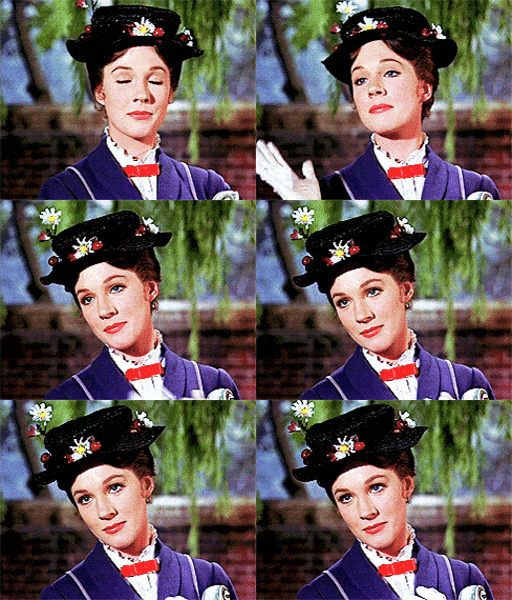
Oh Mary!

Well okay, that’s not the only thought I have in my head. 

I am also recalling years when I rehearsed my own Oscar speech (in anticipation of a win even though I had yet to ever work on a movie); others when I was a reporter and actually had to get up at 5 in the morning to cover the damn thing live at the Academy (Note: Be careful what you wish for); and still others where I voluntarily woke up at 5 in the morning at home to watch it on TV and not miss a moment of elation or outrage.

And I’m only slightly embarrassed to admit that I was still doing that last one as a recently as, well, ahem, not that long ago.

Why? 

OK well yes…

I don’t know.  Why do you care about the Super Bowl or the World Series; the NBA Playoffs, Wimbledon or Monday Night Football; Paris Fashion Week, the Cannes Film Festival, the Grammys or the winner of Eurovision?

Maybe you don’t or maybe you do but in life it’s nice to look forward to something.

Finding joy where we can

Well, that ended this year.  It’s not that I wasn’t tracking potential nominees but on the twice-postponed Oscar nomination announcement day I woke up, did my morning routine (Note: Use your imagination), hung out and, right before leaving the house at 11 suddenly thought, ‘oh right, the Oscars. I better…check?’

It was kind of surreal.

Who am I?

Perhaps it’s age or the movies, but I don’t think so.  Maybe it’s the fact that parts of L.A. were on fire several weeks ago hastening the delay (Note: During which I did have to evacuate my house) so I got that and a lot of dates confused.  Not likely.

Mostly it was because I was keeping my mind on a bunch of other announcements that didn’t involve a svelte golden statuette but an engorged orange (and profoundly non-statuesque) one. 

Ugh

But these announcements were actually orders for actions that were not democratically voted on.  Things like:

  1. Releasing more than 1500 violent criminals from jail who severely beat up cops and broke into and entered the Capitol building, where they hunted down members of Congress (Note: And occasionally stopped to smear feces on the walls and destroy offices) all in order to subvert the peaceful transfer of power to a new president they didn’t vote for four years ago.
  2. Revoking President Lyndon B. Johnson’s 1965 order that guaranteed people of color and women equal opportunity to be hired, trained and employed by any agency in the federal government or any company or person who has a contract with said government, and
  3.  A termination to birthright U.S. citizenship even though it is literally written into the 14th amendment to the U.S. Constitution that anyone born in the U.S. IS a citizen of the U.S.

For further elucidation and analysis of said announcements and their implications you can also check out these articles in Axios and the NY Times.  Or simply use the google with the key words: recent executive orders for the source of your choice.

Do not judge me

As for the Oscar nominations, anyone who follows these things or longs for a little competitive glamour or excellence in their lives courtesy of the movies, or is simply slightly film obsessed, has their favorites and their inexcusables.  For me, it’s Timothée Chalamet’s performance in A Complete Unknown because I’m not sure how anyone can sound and act exactly like Bob Dylan, pretend they’re a young guy in the sixties, croon a tune to a pretend Woody Guthrie and go on to sing with and make love to a fake Joan Baez without making it a complete parody.  (Note: Also because his best actor Oscar for Call Me By Your Name got stolen by Gary Oldman seven years ago.  And no, I don’t forget).

Was this the most important cinematic moment of the year?  Certainly not.  But for me it was the most impressive and, anyway, as we all should know by now, that’s not what the Oscars are all about.

Nor should it be.
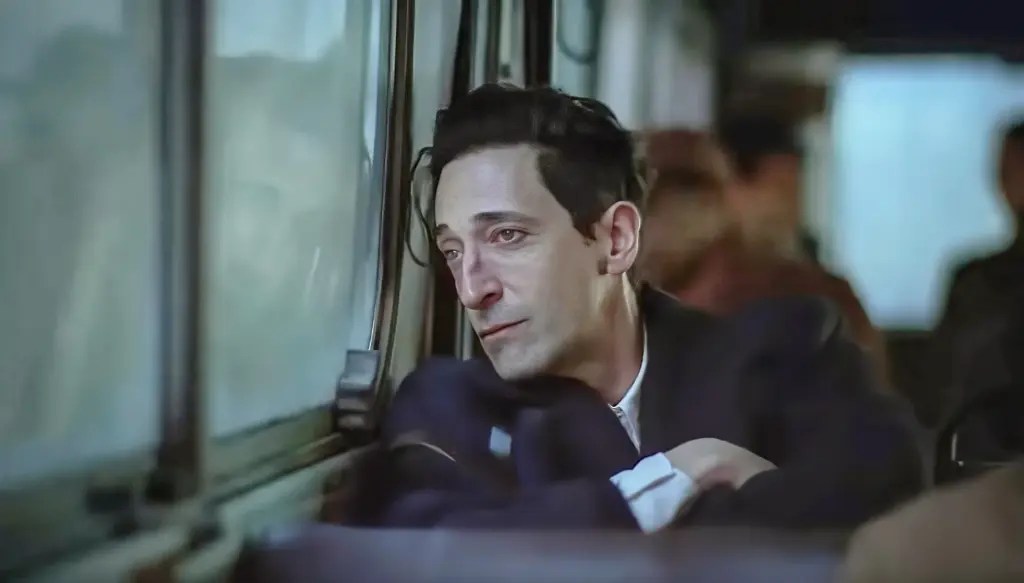
Also… sorry Timmy but better luck next time

The importance monicker is usually most omni-present in the best picture category, which pretty consistently reserves slots for movies that say something about social issues (Note: Forgetting the fact that ALL movies are social comments on our world), as well as advance the best of technology, execution or contemporary messages to be had from movies during that year. 

Personally, I think expanding the best picture category from a limit of five nominations to these days as many as TEN nominations (Note: It works through a weighted scale the Academy concocted that is too cumbersome to explain in anything less than a term paper) is somewhat equivalent to being awarded a yearly participation award in a small, local day camp.

“And you get an Oscar… and you… and you!”

Okay, perhaps that’s a bit much but AMPAS voting to expand the list of possible nominees in 2009 seemed more like a marketing tool for studios due to lagging box-office than anything else.

But in an age where our new 78-year-old POTUS just announced that Mel Gibson, Sylvester Stallone and Jon Voight are to serve as his special ambassadors to Hollywood (Note: News to them, since it was relayed only in a tweet, but fitting since they all reached stardom in those regrettable, greed is good eighties), it’s a welcome relief.
I will not go!

See, unlike MAGA voters the vast majority of all 10 best picture nominees this year focused on stories about diversity, equity and inclusion in regards to immigration, race, trans/LGBT representation, ageism, economic inequality and/or religious persecution.  And if you look back in history that tends to happen when political leaders spend their time taking away rights or lashing out at specific communities for power, or profit or simply because they can.

As I tell my students, movies are not life but, on the whole, they tend to absolutely reflect real life and the issues we, as a society are concerned about in that moment.

AMEN

This is why this year I am thrilled to have as many as TEN, if not more, best picture nominees vying for the Oscar.  I might be selling out my long-held views for political gain, but hey, at least it’s not to stay in office.

As for the list of this year’s films, they are: Anora, The Brutalist, A Complete Unknown, Conclave, Dune: Part Two, Emilia Perez, I’m Still Here, Nickel Boys, The Substance, and Wicked.
Let the voting begin

I’d be happy with any of them winning.  And not only because Gibson, Stallone, Voight had absolutely nothing to do with any of them, and they address rights and issues they and the guy they will be ambassador-ing for want to roll back and, preferably, erase.

Though, that helps. 

A lot.

Jonathan Bailey – “Dancing Through Life” (from Wicked)
A Complete Unknown

I was nowhere close to voting age through the entirety of the sixties but even then it never struck me as a simple time. 

My earliest memory of politics was sitting on my Dad’s shoulders in a crowd so I could see about-to-be  Pres. John F. Kennedy when he campaigned in the Bronx, and later hearing about the issue of the “Negro.”  That was followed by the assassination of our youngest president, bloody images from the Vietnam War on TV, and the assassination of Dr. Martin Luther King Jr. and Robert F. Kennedy.  By the time the seventies rolled around I was anxious daily and secretly terrified on the worst of those days.

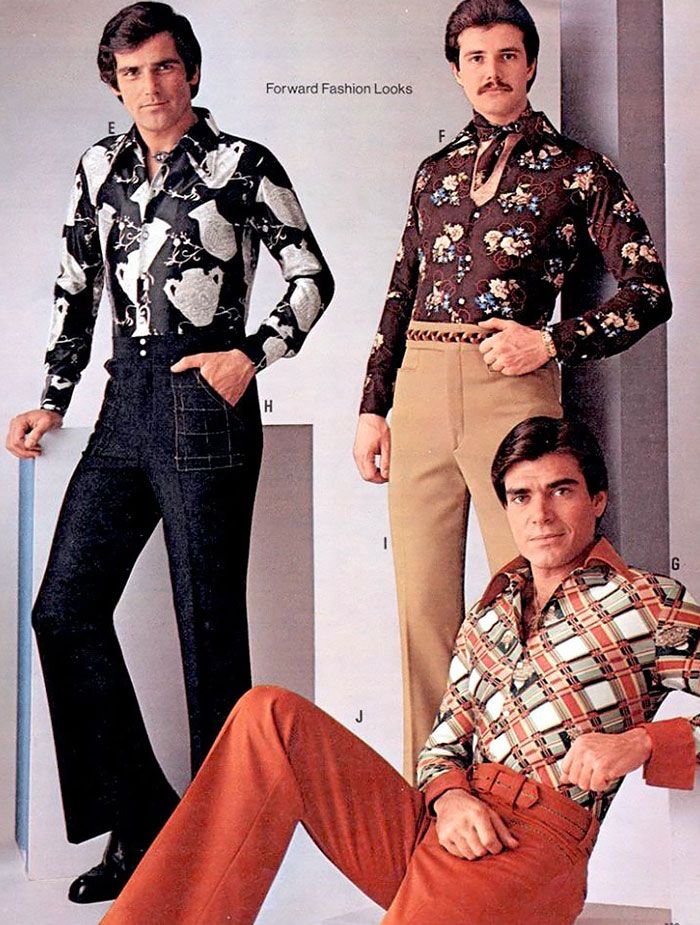
Imagine having anxiety and fear and wearing this? #darktimes

Until I grew up and went into therapy.

That’s why it’s been strange to lately look back on the sixties with such longing nostalgia.  This is likely because despite all the turmoil, the counter culture youth movement offered mantras of peace, love and hope if WE managed to bring the world together.  It never occurred to me in my late teens that things wouldn’t work out, especially after we, and many others, got Nixon to resign and the world to “sort of” move on.

Did we though?

At that time I didn’t realize history was, indeed, cyclical, and likely all those terrifying occurrences would occur again, albeit in different forms.

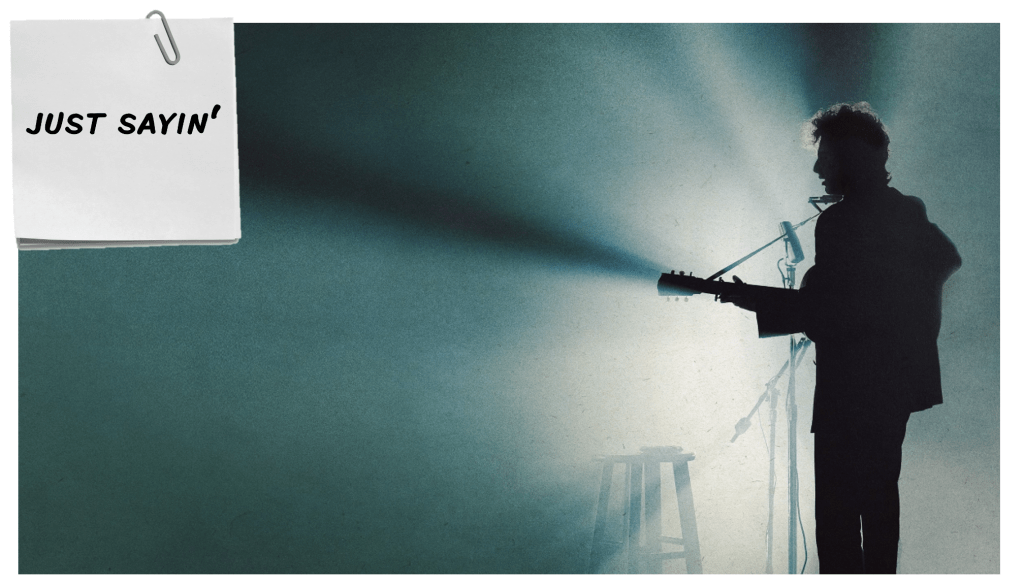
Given this perspective, it was still surprising for me to have found comfort in the new, “sort of” Bob Dylan biopic, A Complete Unknown, and how masterfully Timothee Chalamet captured not only the “original vagabond” (as his onetime girlfriend, Joan Baez, once referred to him in song), but the unflinching spirit and infinite possibilities of change the music of those times, led by Dylan, offered.

Not an extra from Newsies

Not only does he play Dylan but he offers an uncanny spiritual interpretation of the essence of Dylan and those times.  The film is wisely set over only five years (1960-1965), beginning at the moment a 20-year-old Dylan arrives as a committed, near obsessive singer-songwriter in Greenwich Village who can barely contain his expression of those times through the poetry of his words, guitar chords and embrace of multi-cultural musical history.  By the end of that period, it makes perfect sense that it was the unrelenting creative observations of an unknown kid in his early and now barely mid-twenties to not only move the music industry and the world towards evolution – but to take a cold look at reality and join everyone together for some sort of better tomorrow.

Religions have been started with more.  Or, so they like to say.

Quickly putting Timothee prayer candle on my Christmas list

But back to the sixties —

Perhaps in a world where you actually had to put a dime in some available phone booth to make a call, or better yet simply show up on someone’s stoop to hang out, it was a little easier for singer-songwriters to create an endless series of anthems that spirited a movement of social change.  Yet what saves A Complete Unknown from being some sort of Hollywood fairy tale of social revolution is that Dylan’s self-expression was merely that, something he never meant to shove him to the forefront of a “cause,” especially as a young guy.  In this telling, which seems close to the reality and not the elusive enigma of the Dylanesque legend, all he really seems interested in is music and girls. 

Chicks, man

Sure, he wanted to be recognized but not as the hot tip of the spear of societal transformation with so much of the controversy, politics and love/hate of power brokers and ardent, often crazy, admirers that came with it.  He had no idea how to handle it and retreated within.

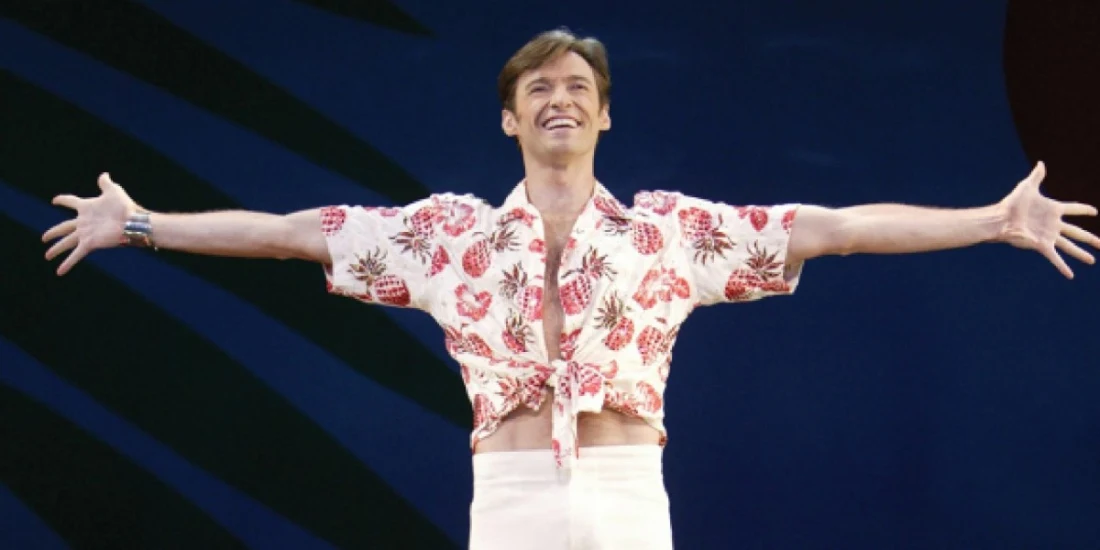
Chalamet’s performance is reminiscent of what Joaquin Phoenix did on film with Johnny Cash in Walk the Line and how Sissy Spacek so uncannily brought to life Loretta Lynn in Coal Miner’s Daughter.  The closest to it I’ve ever seen onstage was how completely Hugh Jackman conjured up the spirit of gay cabaret, and later Broadway star-songwriter, Peter Allen in The Boy From Oz.  Not only did they all do their own singing but they didn’t get hamstrung by trying to be an exact carbon copy of the phenom they were portraying.  Instead, they found the essence of who they were and evoked their humanity.

How much we love these performances

What’s particularly great about Chalamet’s Dylan is it’s a guy with a lot of emotional flaws, someone who excels at expressing himself in words and music but is often inarticulate, withholding or simply, and even perhaps purposefully, falling short in person.  He feels like a lot of young guys in their twenties who exist too much inside their heads and are not sure exactly how to live.  Were it not for his talents and a desire to get laid that sometimes pushes him out of his comfort zone, you’d likely pass him by in the street. Which is exactly what you want from an actor taking on the task of playing a legend.

He’s helped a ton by director/co-writer James Mangold, who does not fall into the “cutesy sixties” trap of filmmaking but simply presents the time period as he would any decade – blunt, historical accuracy (Note: Mostly) and without over-reverence.  There are a few stylized newspaper headlines and some edited television coverage but they’re minimal and don’t take over.  The atmosphere on the Manhattan streets, the clothes people are wearing and the stoops they sit on reminded me of the ones I experienced as a little boy.  I also appreciated that much of the New Yawk accents were kept in check.  (Note:  Seriously, so many of us did NOT TAWK like there was a “w” in every other word.  Not that there is anything wrong with that…).

Calm down, Linda

Three final points. 

  • At a talkback after the movie, Mangold related that despite recording all the music beforehand in a studio, he honored Chalamet’s request the first week of filming to try and do his own singing live on set in his first scene.  It was so good he allowed him to do so on every song, which led to all of the other actors in the film choosing to do the same.  It shows and far exceeds anything you’d get with pre-recorded tracks.
If he nails the harmonica, give him the Oscar
  • The project was originally at HBO with a different script, got put into turnaround and was picked up by Fox Searchlight.  At which point Mangold agreed to do it but only if he could rewrite the screenplay and include more of Dylan’s personal life.  They didn’t have those rights but like most savvy people in the industry Mangold did it anyway and hoped for the best.  The studio read it, liked it but was terrified of Dylan’s reaction. At which point, Covid happened, the world was put on hold, Dylan asked to read the script everyone was “afraid” of and wound up really liking it, when shooting was postponed once again due to almost a year of various Hollywood union strikes. Yet through the months and years, the many accomplished actors and department heads, working for far less than their usual salaries, agreed to stay on, supporting the notion that “if you build it well and build it properly they WILL come. ” And in some cases stay with you.  Even in 2023 and 2024. 
And hey Timmy got to make Wonka!
  • Finally: I imagine through the holidays and in awards season, there will be any number of showy, gritty, intense, timely, torturous and generally over-the-top meaningful films that will get written about, lauded and garner the lion’s share of the attention.  But none for me, and I bet any number of you, will be as evocative as A Complete Unknown.  It’s a reminder of a still troubled but very different America.  A time when lots of stuff was wrong, scary and hard but the music of people who cared was actually listened to en-masse and helped lead a thinking revolution that was not seen as corny, quaint or UN-American by most of us.  In fact, it was exactly the opposite.

“A Complete Unknown” – Timothee Chamalet and Co.