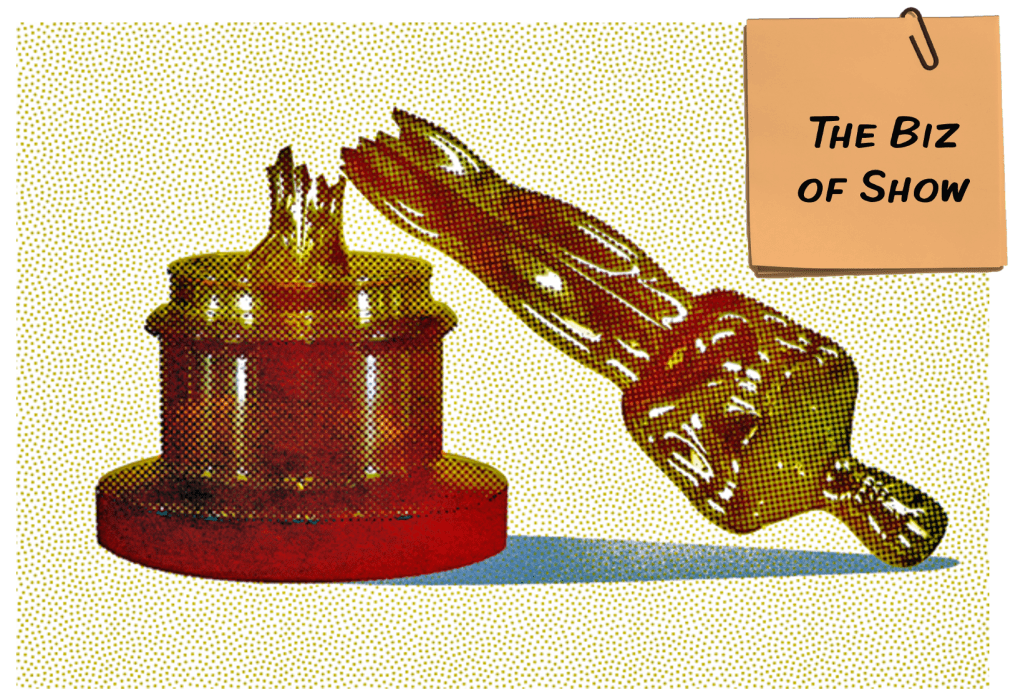
Did I Almost Forget about the Oscars?

I’ve been excited for the announcement of the Oscar nominations every year for more than half a century.  I’m not sure exactly when and why it started but my earliest memory is being a really, really happy little boy when I heard Mary Poppins got a ton of nominations AND several months later literally  jumping up and down screaming when Julie Andrews walked up to the stage to accept the trophy as best actress.

Thinking about it now I wonder:

How did they not know I was gay?
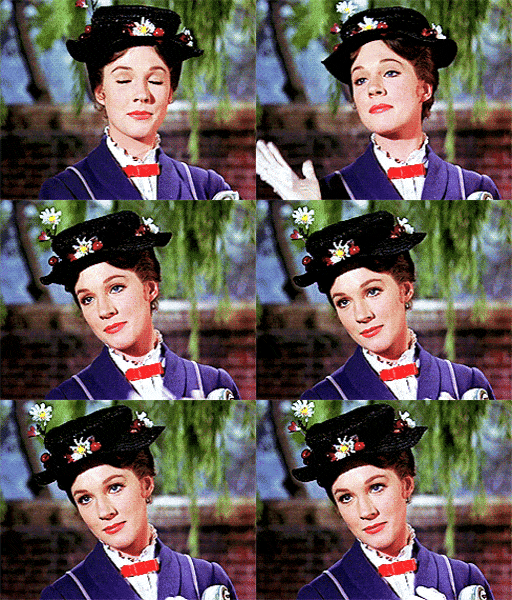
Oh Mary!

Well okay, that’s not the only thought I have in my head. 

I am also recalling years when I rehearsed my own Oscar speech (in anticipation of a win even though I had yet to ever work on a movie); others when I was a reporter and actually had to get up at 5 in the morning to cover the damn thing live at the Academy (Note: Be careful what you wish for); and still others where I voluntarily woke up at 5 in the morning at home to watch it on TV and not miss a moment of elation or outrage.

And I’m only slightly embarrassed to admit that I was still doing that last one as a recently as, well, ahem, not that long ago.

Why? 

OK well yes…

I don’t know.  Why do you care about the Super Bowl or the World Series; the NBA Playoffs, Wimbledon or Monday Night Football; Paris Fashion Week, the Cannes Film Festival, the Grammys or the winner of Eurovision?

Maybe you don’t or maybe you do but in life it’s nice to look forward to something.

Finding joy where we can

Well, that ended this year.  It’s not that I wasn’t tracking potential nominees but on the twice-postponed Oscar nomination announcement day I woke up, did my morning routine (Note: Use your imagination), hung out and, right before leaving the house at 11 suddenly thought, ‘oh right, the Oscars. I better…check?’

It was kind of surreal.

Who am I?

Perhaps it’s age or the movies, but I don’t think so.  Maybe it’s the fact that parts of L.A. were on fire several weeks ago hastening the delay (Note: During which I did have to evacuate my house) so I got that and a lot of dates confused.  Not likely.

Mostly it was because I was keeping my mind on a bunch of other announcements that didn’t involve a svelte golden statuette but an engorged orange (and profoundly non-statuesque) one. 

Ugh

But these announcements were actually orders for actions that were not democratically voted on.  Things like:

  1. Releasing more than 1500 violent criminals from jail who severely beat up cops and broke into and entered the Capitol building, where they hunted down members of Congress (Note: And occasionally stopped to smear feces on the walls and destroy offices) all in order to subvert the peaceful transfer of power to a new president they didn’t vote for four years ago.
  2. Revoking President Lyndon B. Johnson’s 1965 order that guaranteed people of color and women equal opportunity to be hired, trained and employed by any agency in the federal government or any company or person who has a contract with said government, and
  3.  A termination to birthright U.S. citizenship even though it is literally written into the 14th amendment to the U.S. Constitution that anyone born in the U.S. IS a citizen of the U.S.

For further elucidation and analysis of said announcements and their implications you can also check out these articles in Axios and the NY Times.  Or simply use the google with the key words: recent executive orders for the source of your choice.

Do not judge me

As for the Oscar nominations, anyone who follows these things or longs for a little competitive glamour or excellence in their lives courtesy of the movies, or is simply slightly film obsessed, has their favorites and their inexcusables.  For me, it’s Timothée Chalamet’s performance in A Complete Unknown because I’m not sure how anyone can sound and act exactly like Bob Dylan, pretend they’re a young guy in the sixties, croon a tune to a pretend Woody Guthrie and go on to sing with and make love to a fake Joan Baez without making it a complete parody.  (Note: Also because his best actor Oscar for Call Me By Your Name got stolen by Gary Oldman seven years ago.  And no, I don’t forget).

Was this the most important cinematic moment of the year?  Certainly not.  But for me it was the most impressive and, anyway, as we all should know by now, that’s not what the Oscars are all about.

Nor should it be.
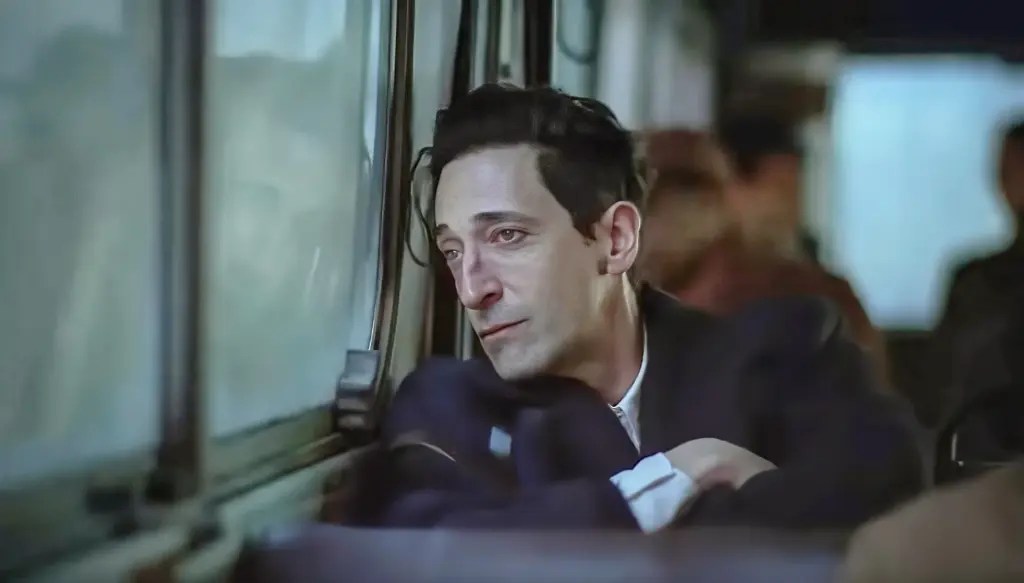
Also… sorry Timmy but better luck next time

The importance monicker is usually most omni-present in the best picture category, which pretty consistently reserves slots for movies that say something about social issues (Note: Forgetting the fact that ALL movies are social comments on our world), as well as advance the best of technology, execution or contemporary messages to be had from movies during that year. 

Personally, I think expanding the best picture category from a limit of five nominations to these days as many as TEN nominations (Note: It works through a weighted scale the Academy concocted that is too cumbersome to explain in anything less than a term paper) is somewhat equivalent to being awarded a yearly participation award in a small, local day camp.

“And you get an Oscar… and you… and you!”

Okay, perhaps that’s a bit much but AMPAS voting to expand the list of possible nominees in 2009 seemed more like a marketing tool for studios due to lagging box-office than anything else.

But in an age where our new 78-year-old POTUS just announced that Mel Gibson, Sylvester Stallone and Jon Voight are to serve as his special ambassadors to Hollywood (Note: News to them, since it was relayed only in a tweet, but fitting since they all reached stardom in those regrettable, greed is good eighties), it’s a welcome relief.
I will not go!

See, unlike MAGA voters the vast majority of all 10 best picture nominees this year focused on stories about diversity, equity and inclusion in regards to immigration, race, trans/LGBT representation, ageism, economic inequality and/or religious persecution.  And if you look back in history that tends to happen when political leaders spend their time taking away rights or lashing out at specific communities for power, or profit or simply because they can.

As I tell my students, movies are not life but, on the whole, they tend to absolutely reflect real life and the issues we, as a society are concerned about in that moment.

AMEN

This is why this year I am thrilled to have as many as TEN, if not more, best picture nominees vying for the Oscar.  I might be selling out my long-held views for political gain, but hey, at least it’s not to stay in office.

As for the list of this year’s films, they are: Anora, The Brutalist, A Complete Unknown, Conclave, Dune: Part Two, Emilia Perez, I’m Still Here, Nickel Boys, The Substance, and Wicked.
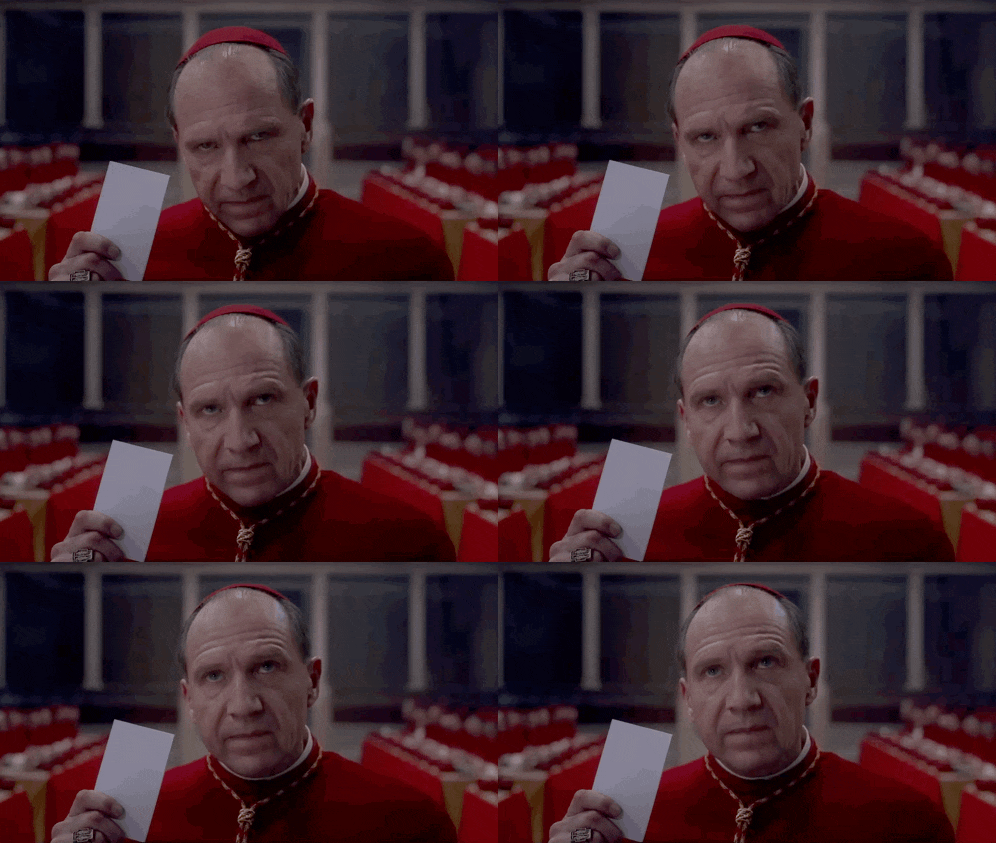
Let the voting begin

I’d be happy with any of them winning.  And not only because Gibson, Stallone, Voight had absolutely nothing to do with any of them, and they address rights and issues they and the guy they will be ambassador-ing for want to roll back and, preferably, erase.

Though, that helps. 

A lot.

Jonathan Bailey – “Dancing Through Life” (from Wicked)

The One and Only David Lynch

David Lynch, one of the most creative and original American filmmakers we will ever know, died this week and it prompted numerous conversations between my husband and me about his work.  They weren’t profound analyses but more reminiscences of our gleeful shared reactions of awe to the signature style and singular way he told stories in each successive piece of work. For us, the first time seeing a Lynch film was always an exciting, brain-breaking experience, partly because there was no telling where he would go or if you could even fully understand where it was he took you after just one viewing.

Hang on ladies!

Blue Velvet and Mulholland Drive were his most lauded and our favorites, but there is also something to be said for Lost Highway (Note: Robert Blake popping up from out of nowhere to haunt you takes on new meaning in the 21st century), Wild At Heart, The Elephant Man, Eraserhead  (Note: His mind-bending first film, which prompted producer Mel Brooks to recruit and fight for him to direct one of Lynch’s most traditional and excellent movies, The Elephant Man) and The Straight Story. 

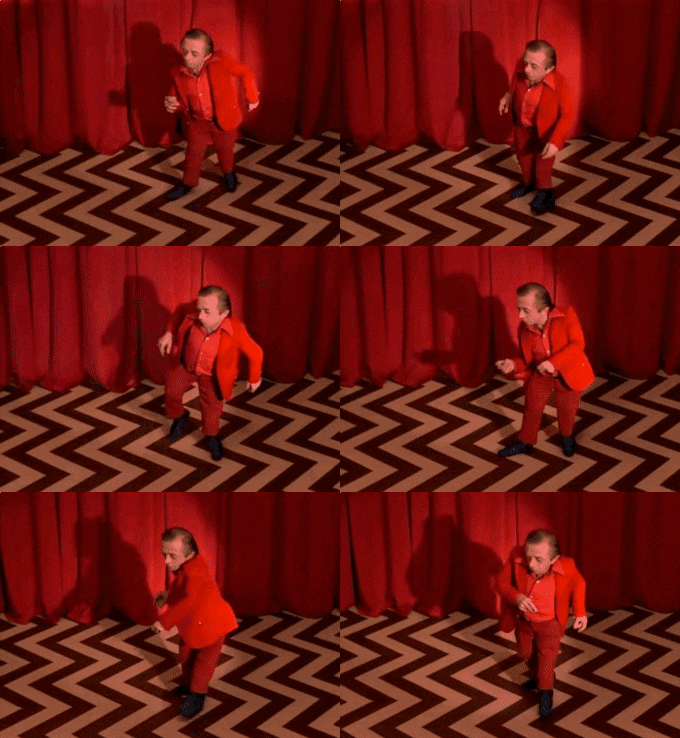
And where do you start with the original Twin Peaks TV series and all of the various incarnations of that world?  Can you imagine that this was a weekly show on ABC in 1990?   Before the explosion of cable programming, and at a time when the term streaming was basically used to describe a state of consciousness? 

We’d dance with you in the Black Lodge anyday

None of my students can, and to this day many of them are huge fans of the show.  Though when I try to explain how both its audaciousness and Lynch’s determination to have it remain in a fugue state amid so many unanswered questions that drove network executives completely bonkers, they do usually meet me with a Twin Peaks worthy half-smile.

That is, of course, the real victory.  That somehow the idea of this kind of boundary breaking insurgence that so annoys the gatekeepers (Note: Especially when it becomes so provocatively successful) will continue, albeit in a different form. 

I wonder what the network had to say about Log Lady

Granted, that’ll take a bit of time.  Which is what must’ve prompted my husband to say at the end of our Lynch discussion, “We should just push pause for the next four years.”   

Among other things.

my inner thoughts

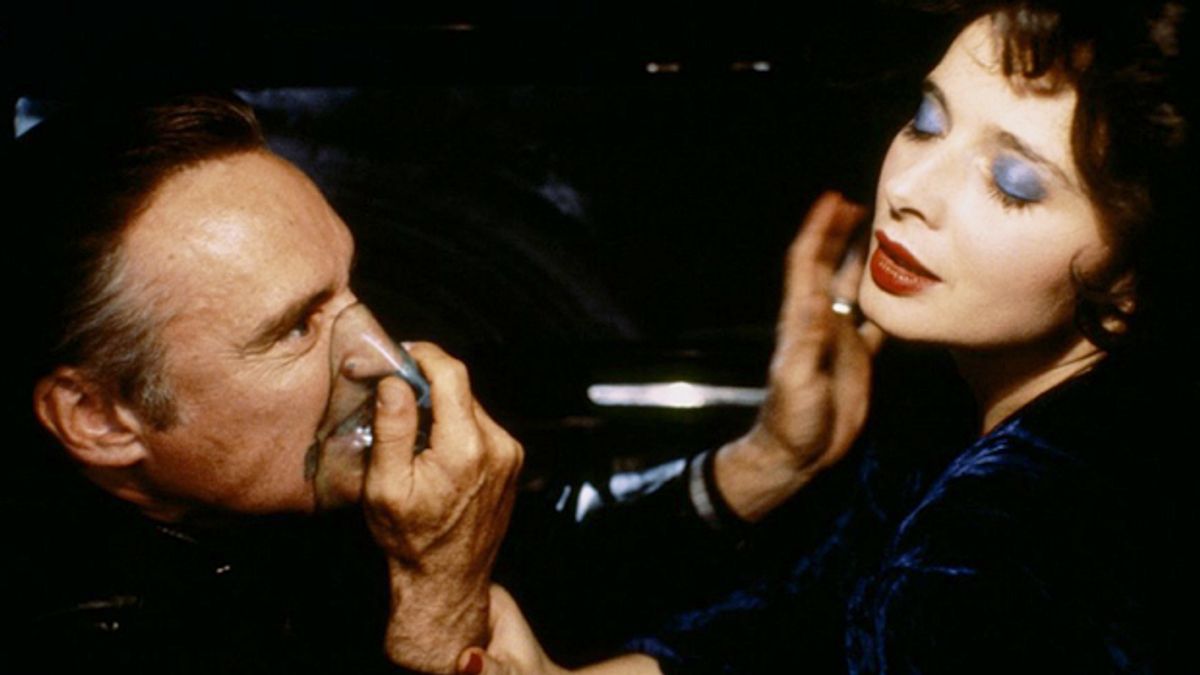
Speaking of which, I decided that the first film my thesis screenwriting students would view this semester would be Blue Velvet, the breakout film that cemented Lynch’s visually alluring, darkly comic and disturbingly dramatic approach to creating a narrative you at times wanted to but couldn’t look away from. 

On the surface it’s a boy-meets-girl story that starts when a college boy, who is home visiting his sick father, finds a severed ear among the many blades of grass in a field near his house and decides to bring it to a detective that turns out to be father of said perfectly wholesome teenage, blonde, hometown high school girl. 

with the great Laura Dern and Kyle MacLachlan

Naturally, they’re both warned time and time again to leave the real crime behind this ear alone, if for nothing else than the sake of their reputations.  But like almost every film before it about such people, they can’t.  Sure, they may be good, (Note: Perhaps too good) at heart but that’s the real issue.  What Lynch posits is that even the good among us are curious about the bad and, on the right day, might even indulge in a bit, or even a lot, of the bad.  Especially when we’re teenagers.  So these two decide to take it upon to themselves to investigate and what they uncover in their small town is a whole lot of bad that, up until that point, we’ve seldom been shown in such iconoclastic, nightmarish and yet bizarrely believable detail by a mainstream American filmmaker to, at times, such strangely comic effect.

I was privileged to be at one of the first screenings of Blue Velvet in L.A. 38 years ago (Note: Yikes!  And… Yikes!!) I took a friend and we knew nothing about it other than it was a mystery. 

And yes, those were the days when you actually could know absolutely nothing about a movie by a major filmmaker.

Definitely wasn’t expecting this

No spoilers at all but for those who don’t know it begins with slow motion shots of a small town where everything is a bit off and almost artificial, as if John Waters and Fritz Lang had a child, named it Lynch (Note: This would be possible under a full moon in a Twin Peaks adjacent world) and decided to give it carte blanche creative control of an opening sequence.

A lawn mower accident in a 1950s town that exists in the 1980s with period-looking people who speak in halting, stilted dialogue out of a B-movie melodrama?   It was hilariously bad in a purposeful way but most of the audience didn’t know what to make of it.  Yet my friend and I couldn’t stop cracking up and had to stifle chuckles that we were sure Lynch himself would have approved of because of all the dirty looks we were getting from those around us. 

God, Laura Dern’s cry face is iconic

But it didn’t matter because as the film unfolded my friend and I quieted down naturally since what we were seeing was like nothing we’d ever seen before, especially at a Hollywood screening, and, by the end, we were not necessarily sure if we wanted to see it again.  Themes of rape, drugs, sadism, violence, with smatterings of raw, offensive language no major studio head would willingly give a green light to.  Except, well, it was all to a point, in service of something and, let’s face it, a small group of people…somewhere… had to have approved. 

Lucky for all of us. 

Nothing could be better than entering his strange and wonderful world

By the time the film was over not only did my friend and I want to see it again but, after its release, so would millions more filmgoers.  Not to mention, Blue Velvet would also go on to win many major critic awards, land on numerous top 10 best lists and become the cult favorite of the year, eventually winning Lynch (who also wrote the screenplay) his second Academy Award nomination as Best Director. 

I watched the movie again last night (Note: My fifth or sixth viewing since its 1986 release) and, once more, I was fascinated, upset, amused and extremely uncomfortable.  But sadly I also wasn’t sure if any director in Hollywood could get away with it today.  Maybe an indie person somewhere, but would it even gain any sort of mainstream acceptance before being deemed problematic, demeaning, offensive, triggering and cancelled?

I’m not sure.

There really will never be another

What I do know is that its incorrectness was used to shine a light on the disturbing, the ugly, the tawdry, the overlooked and the self-righteousness of unexamined societal goodnessA David Lynch-told story, to me, always served as a bit of a disinfectant.  As if to say, no one and nothing is THIS TRULY GOOD, and yes, the world can be quite that BAD.  But none of it will go away if we bury it.  We need to confront it – them – the baddies – out in the open and risk our reputations in order to come out the other side with insight.  At least that will give us enough familiarity with the bad to recognize it and perhaps prevent it from happening if we ever see it again.

My words, not his.

The many worlds of Mr. Lynch

What I love most about Lynch’s work is that he asks you to give yourself permission to go through the darkness and not be repelled by it.  To tolerate the quixotic because, like life, not everything gets instantly answered or is made apparent for you.  It needs to be absorbed, over time and through various moods, endured until the totality of it slides open a window of understanding that finally allows you to say, Oh, I get it.  Now, I get it.. I finally get it.

This is why I just decided I’m showing Blue Velvet to not one, but two, classes this semester and why I will probably get crap about it from someone.  It may not be p.c. on the surface but it’s the most p.c. journey you will take overall.  It doesn’t hide what it is but, at the end of the day, is an advocate for good, in all of its tawdriness.  Meaning actual, real life good – not some technicolor movie version of it.

Would that our 2025 world could be that way.  Well, it can be.  Lynch gave us a sort of existential playbook of self-discovery that we can watch over and over and over again to guide us.   Though the end of time.  As opposed to the end times.

Isabella Rossellini – “Blue Velvet”