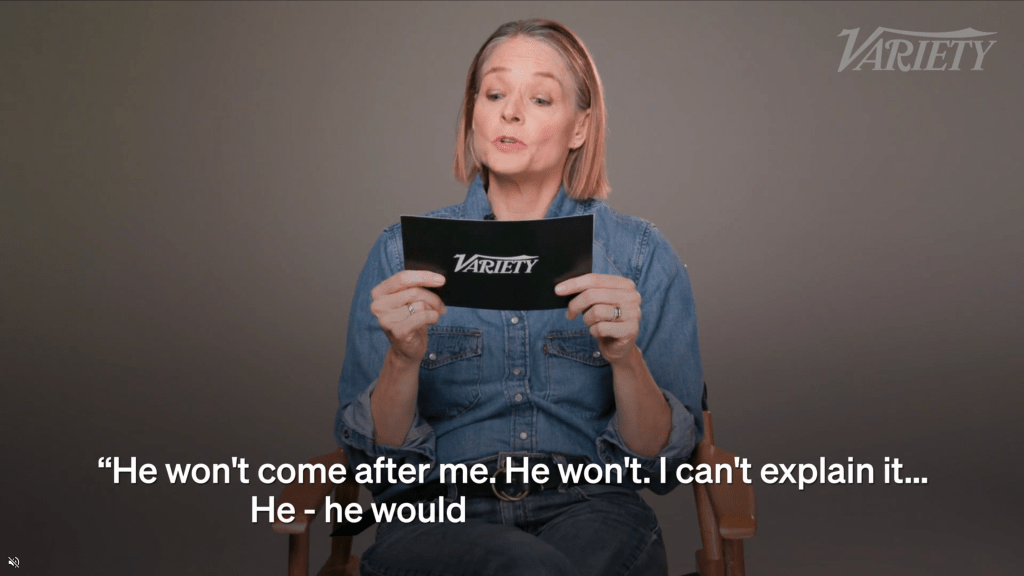
I was watching Jodie Foster play a game in a Variety video called Does Jodie Foster Know Her Lines? The gist was her holding some oversized black index cards (Note: With the Variety logo facing camera front in case we forgot who thought up this game), reading a line she’s said in one of the 50 plus films she’s made in the last half-century, and then guessing which movie it was from and which character said it.
Needless to say, Jodie scored 100%, not because she’s always perfect but due to the fact that she seems to have been smart and present in her life. And has always been a storyteller.
Click here to see the full video
The latter really got to me as I begin to plunge back into writing a new, very extended story project of my own that I honestly have some trepidation about. It’s not that I don’t want to tell this story but more that I have some fears about telling it right; and doing it justice.
As if that isn’t the way it always is. Or that there is ever a right or a just way to tell a story.
Because all stories have some lies in them. The question to always ask yourself is if you are telling some basic truth.
At least as you see it.
But more importantly, as you know it.
Masks off — for real
Unvarnished.
And honestly.
Like she did in such classic movies as Taxi Driver, The Accused, Silence of the Lambs and, more recently, Nyad.
You don’t have to be a teenage prostitute to play one in Taxi Driver but you do have be confident and a bit no-nonsense, or at least able to project it. That’s the reason Martin Scorcese cast her in the film in the first place. When he first worked with her at the age of 11 years old (Note: In Alice Doesn’t Live Here Anymore) he said he’d seldom seen anyone be so professionally direct and confident while working on a movie set.
Not in an obnoxious, braggadocio way. Just in a direct and honest way.
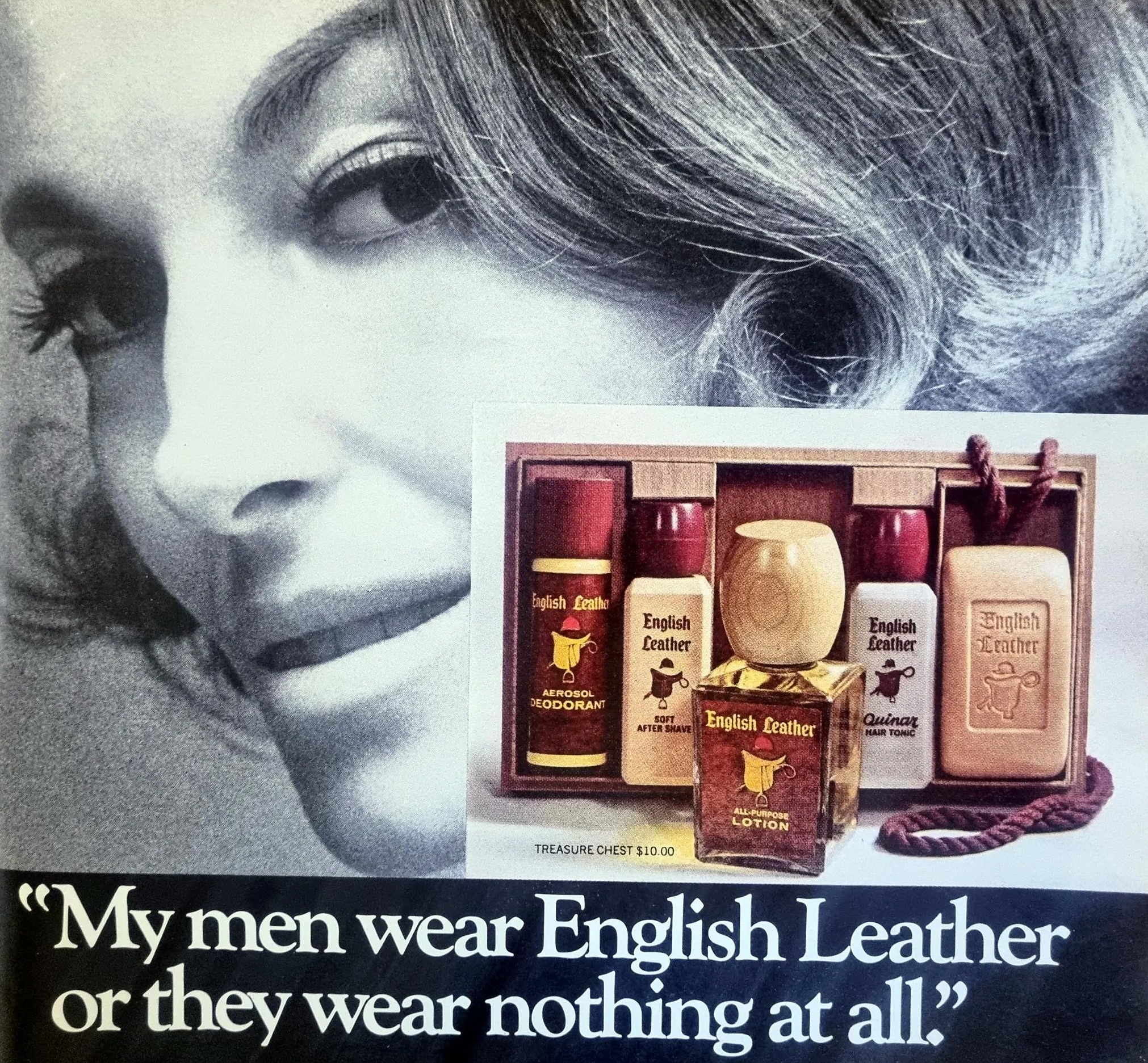
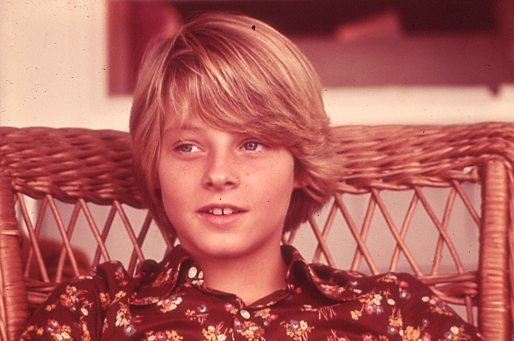
That 70s hair! #jealousevennow
It makes me wonder whether my reservations have not so much to do with justice and rightness but in the ability to be unvarnished and real to some very personal situations, as I know them, when I write about them.
It seems to me that if you have a modicum of skill in any type of artistic endeavor, allowing that essential truth to “come out” is the most essential element.
How you get there, well, that’s another story. It involves who you are and the type of storyteller you want to be. Or, truly, ARE.
Who am I?
Being present helps because you can draw on what you recall, what you saw and, most importantly, how you felt. Memories and visuals are all well and good but they can be deceptive and elusive and precious. But how those make you feel, well, that’s something else.
Being smart is also valuable since it helps you perceive stuff below the surface. Though that too can get in your way if you become too intellectual about a situation because it leads you to believe that life, and the people who inhabit it, are always logical.
It is not and we all definitely will not be all, most, or even some of the time.
Going for “movie logic” only
Depending on who we are, the lives we’ve had, the genes we’ve inherited and the behaviors we’ve learned.
I think that’s the artistry Jodie (Note: Sorry, can’t help calling her by her first name in print, even though I’ve only met her twice for about 30 seconds in total) brings to everything she does professionally, as well as how she’s navigated her personally, very private life.
She may not have always been the “out” celebrity everyone wanted to have but, at the same time, none of us have lived her very private life. And before counter-arguing consider what it must have been like to be both an Oscar nominee and the very public inspiration behind a very internationally public, attempted presidential assassination at the very beginning and very end of your teenage years.
That’s a big yikes
I barely got through mine with acne and the death of Janis Joplin.
As I venture into new artistic territory at the start of Pride Month I find it interesting to be instinctually drawn back to the expression of truthful storytelling and the films, and life, of Jodie Foster.
And marvel at how the organizers of the annual West Hollywood Gay Pride Parade could have EVER thought naming MAGA adjacent Real Housewife Kathy Hilton its grand marshal brought any justice, rightness and collective truths to our stores…
At least if they’d asked Jodie, she would have given them an honest answer.
The following is a piece in defense of thoughtful journalism and the people who practice it. You know who you are even though we may not. This is in spite of the fact that, given today’s technology, we have all rightfully or wrongfully been baptized de facto citizen journalists or amateur reporters.
It makes no difference to me which moniker you choose because each can be either somewhat effective or dangerously ineffective depending on the circumstances. But mostly I am writing this in honor of my unapologetic love for Aaron Sorkin’s The Newsroom – a show that is about to end its run but still dares to romanticize the high-reaching values of a somewhat liberal cable news station akin to (but not exactly like) MSNBC in much the same way The West Wing was a wonderfully polemic love letter to the executive branch of government.
Sometimes I forget he wasn’t the President
It is quite popular to lump the talking heads of cable news – or any sort of contemporary journalism for that matter – all together and to dismiss its veracity or even relevance to anything real in the world. But in truth Rachel Maddow and Fox’s Bill O’Reilly are as different as…well…Rachel Maddow and Fox’s Bill O’Reilly. Watch and measure how each covered the nationwide protests we’ve seen this week due to the recent refusal of law enforcement and the grand jury system to in any way prosecute the various police officers responsible for shooting and killing three very different Black males – two of whom were under 18 years of age – under similarly controversial circumstances in three very different cities in Missouri, Ohio and New York, and judge for yourself.
Yes, somehow these two exist in the same universe
The latter is the job of every citizen choosing to vote or complain about the state of the world to friends, neighbors or enemies – to weigh the information and then make a determination. That is why who gives you the facts, how they give you the facts, and if indeed they are giving you facts at all matters. Correction: really matters.
After watching Jake Gyllenhaal coyote his way through his current breakout role as a brilliantly immoral freelance television news photographer prowling the dark, accident-ridden streets of contemporary Los Angeles in Nightcrawler, I couldn’t help but recall my own quaint, early days as an aspiring journalist. Bear with me and forget this was several decades before Rachel Maddow was even born. I know I have, that is if I ever previously admitted it at all until just now.
How far is too far?
No, unlike Jake or his character, I certainly didn’t lose 30 pounds, slick back my then full head of hair or scour the Internet for leads and information in order to educate and advance myself in my field. For one thing, there was NO INTERNET and I had already lost 30 pounds in high school because I was too cowardly, vain and hypochondriacal to face a life where I was for one more second what anyone else would consider to be fat, chunky or even slightly overweight. Certainly I am not particularly proud of this fact but fact it is nevertheless.
As for my education, here’s another fact. It actually began in a corny old cocoon called SCHOOL. That started with writing for the high school newspaper, segued into becoming arts editor of my college radio station and then continued on to graduate school — Northwestern University’s Medill School of Journalism, to be exact.
Those hallowed grounds
This was the post-Watergate age of the late seventies when journalism was seen as the noblest of professions and most everyone else aside from Mother Teresa and a few doctors who worked gratis in clinics was viewed as morally, and woefully, lagging behind. Not only that, Medill was then, and still is now, one of the best j schools in the country. Again, no bragging but fact – though one that I am particularly proud of. And full disclosure: I still feel fortunate to have even gotten in.
Self five!
I bring this up because my intensive one year at Medill – which had me not only in the classroom but working as a reporter in both suburban and urban Chicago as well as on the streets of Washington, DC and the surrounding areas of Virginia – taught me a lot about truth, morality, honesty and integrity. You might think you know the truth and what you’re dealing with, as John Huston’s villainous Noah Cross tells Jack Nicholson’s hard-boiled yet somewhat naive Jake Gittes in Chinatown, but as a reporter you also have an obligation to consider you might really not have the truth and not know what you’re dealing with, as Noah Cross so ominously, and rightfully warned. Yet unlike Jake in Chinatown, it didn’t have to cost me (Spoiler Alert!) the life of a lover. I was allowed to make those kinds of mistakes as a younger student since under no circumstances would I ever be trusted to cover life or death stories alone.
Plus I could never pull off this look
I realize that in itself sounds almost quaint these days, especially since I was always much more interested in the entertainment industry while it was my j school friends and colleagues who wanted to be Woodward and Bernstein. Still, as it turned out this background came in quite handy and in ways I could have never imagined. My first journalism job was for Variety and Daily Variety and in a matter of just a few years I became one of their lead reporters. Serious hard news reporting on the film, TV and music industries was just on the verge of becoming popular beyond the entertainment pages and I found myself quickly thrown into a world where I had to have clandestine early morning breakfast meetings at the homes of seven-to-eight figure salaried board chairmen, CEOs and presidents of major American entertainment corporations in pursuit of the news. Lying came as easy for them as weight reduction was for me in high school and telling the truth as difficult as I found gym class. Perhaps they were afraid of the same things I was back then – not being accepted, keeping up appearances, not fitting in with the cool kids – but I didn’t know it. And had I not been trained to cross check my facts, no matter how powerful or reliable the source, or not fool myself into ever thinking I was even a smidgen as important as the very wealthy and powerful people I was covering, I would have been eaten alive right there and then by each and every one of them.
.. but what I told myself in my head was a different story.
I certainly would never, ever have been able to start the country’s first weekly column on the national film box-office grosses of just released films. You know – the ones you now read online almost everyday and hear each Monday on practically every entertainment “news” show across the country? Well, it wasn’t Watergate but it was still about getting to the honest truth, which on this subject was quite rare. We’d get these press releases with inflated figures on the opening money levels of movies that would be published almost verbatim without anyone knowing what the hell they meant in comparison to anything else. I told my resistant editor at the time:
“I don’t know what the heck (not hell, I wouldn’t dare) these figures mean and neither does anyone else. We have to at least try to report this accurately so studios can stop lying so easily about how good or badly theirs and everyone else’s films are doing.”
Finally, he saw the light and we began something that, admittedly, has gotten out of control. But it’s helped get beyond the hype in a more realistic dollars and cents way that was previously non-existent – not only for the general public but for everyone else other than the most inside movie studio executives to see.
Unless you’re reporting on the gross of the Hunger Games
That is what training in controlled circumstances will do prior to you going into the field. It’s not the only way to be trained – there is something to be said for being thrown straight into the fire – but the latter often comes with the ultimate journalistic cost of printing untruths, half-truths and out and out lies that hurt people and society. Or, to put it another way, in many other professions you’d be guilty of malpractice.
Certainly, training and the right experience don’t guarantee 100% accuracy but they will also likely prevent any number of our current journalistic fatalities (Note: see lies and untruths above – of your choice). If you consider that to be a bunch of bull, then think of it like this. It is certainly possible that a person who is merely an aficionado of teeth could perform a successful emergency extraction of your infected molar – or a medical neophyte might be able amputate your gangrened arm with merely a broken spear in the Amazonian jungle – but would you choose either in the long run if a more trained and/or experienced option were available?
Meaning yes – everyone can write and observe. But not everyone can report.
At the risk of sounding older than Woodward and Bernstein (Note: And those under 25, please, please don’t continue to say Who? OR Who cares?) – times and standards have changed but truth remains pretty much the same.
You know.. those guys played by Robert Redford and Dustin Hoffman… with the haircuts you all want.
It’s great that we all can raise up our smart phones and record reality, or type our truths on social media, or on such ridiculous forums as….dare I say it…a blog. But these are all only recording and commenting on partial truths or shaded truths or the lies or partial lies we might be unwittingly interpreting as truth. The best journalists in the world (who are not necessarily the most popular) understand the difference. The average person – and viewer – does not. It is the job of the journalists to put things in a way that the most people can understand. To unfurl the facts and truisms and falsehoods as objectively as possible – then offer the information in a context or at least order that will allow the public to comprehend the whole story and ultimately judge what, if anything, to do about it.
It is an essential and difficult and, in the end, honorable profession when done right – which that doesn’t happen often enough.