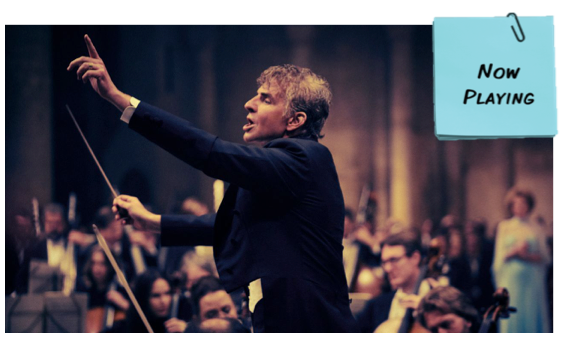
I spent my birthday this weekend with Bradley Cooper and it was more than I could have hoped for.

He spoke after the screening of Maestro, a film he directed, co-wrote and stars in which I will happily tell everyone is original, riveting and at times even brilliant.
There, I said, it – the B word. It no longer means Bradley or Bernstein. And it’s not a word that I throw around lightly or, really, very much at all.
Brilliant literally means radiant, excellent or intelligent and the film is alternately all of those three, sometimes even at once.
You may quote me.

Maestro is a sort of biopic of famed conductor, composer, musician and teacher Leonard Bernstein, told through the lens of his long and complicated marriage to actress Felicia Montealegre. It was a marriage of two people who were turned on by creativity and creativity energy, which are not necessarily the same thing.
To say the pair loved each other would not be an over-exaggeration. But, as the movie so ably demonstrates, the dynamism of people like Bernstein, whose personalities and creativity and egos burn so bright on everything and everyone they touch becomes crushing, to both themselves and the people around them.

Somewhere down the line, in a partnership or a marriage, the latter being the ultimate partnership, someone cedes center stage publicly and privately and, in this case, it was the unique and charismatic Ms. Montealegre.
Until it wasn’t.

The strength of the film is that as riveting as the unexpected magical realism of the first half is – aka the rise of Bernstein the show biz “star” and the his courtship of love and life – it’s the second half that gives the movie it’s weight. That happens because of the storytelling ability of Cooper and co-writer Josh Singer and the qualities and actions of Ms. Montealegre herself, which are brought sharply into focus by the depth of the performances of Carey Mulligan and Cooper and the dynamic shifts they employ as a flesh and blood, and even occasionally pretentious, couple onscreen.
It’s an unexpected and truly original mix of drama, comedy and subtexts all played out to a series of carefully chosen musical cues of some of the composer’s best-known and perhaps not as well-known music.

So much so that once Cooper and his co-writer, Josh Singer, were introduced at the Writers Guild Theatre for a talk back post-screening, they received a spontaneous and quite unexpected standing ovation.
Side Note: The Writers Guild Theatre audience is a notoriously TOUGH crowd. I’ve been going to these screening for years and there is seldom, if ever, a standing O. As the recent WGA strike demonstrated, scribes DO NOT give it up for just anyone or anything. Nor are we a crowd of star f-ckers. As a group, writers are singularly unimpressed with movie stars in person unless it’s one-on-one and we think they might like something we wrote. But in an en masse group directly after a screening, the work has to really put out, as they say, in order to receive anything more than professional, polite, or even mildly enthusiastic applause.

In the case of Maestro, I think it’s the mere risk taking and audacity the film traffics in that the crowd admired. And once its two writers started answering questions from writer-director/moderator Rian Johnson (Note: Yeah him, you could tell he liked it too), it became apparent why.
The pair explained they spent almost five years writing the screenplay, immersed in research and determined to dig out some sort of narrative structure to tell a pretty unwieldy story. They also clocked interminable hours figuring out how to relate the composer’s vast music library to what was going on in the moments of his life they chose to dramatize; or chose to leave out when it wasn’t pertinent. Until finally, it miraculously became some sort of seamless, inevitable and occasionally tough to take story with a relatable beginning, middle and end.
It takes a room of ink-stained wretches (Note: That would be EVERYONE in the WGA) to know just how nearly impossible it is to get all of the above right on paper, much less in a final edited film.

In fact, at one point Singer, who won an Oscar in 2015 for writing Spotlight, verbalized what was likely on every writer’s mind. None of that would have been possible were he not co-writing and conceiving all of this with the person who would be directing the script AND starring as the title character. Or had both Steven Spielberg and Martin Scorsese not been producers.
Nevertheless, the rest of us wretches can still dream, can’t we?

There is one more element to Maestro that allows it to soar in a way that movies during the period Bernstein and his crowd existed in never could.
His homosexuality — or, I guess, bisexuality. It’s hard to tell what’s what for men of certain tastes who were young adults in the forties, fifties and early sixties.
Yeah, there have been a lot of films with gay characters in the last thirty years. But, well, not ALL that many compared to how many stories there are. The fact that Maestro makes Bernstein’s continuous and clearly insatiable hookups, relationships or whatever you want to call them with men an integral part of the narrative unlocks an essential element of conflict, compromise, respect and more than a little self-loathing from both members of this couple’s perspectives.

Their keen awareness yet simultaneous lack of self-awareness when it came to themselves and their partnership occurred in a delicate dance of acceptance and denial that a gay person like myself couldn’t help but feel was at the center of so much of this story. It likely would not have even been possible to have employed it with so much deliberate casualness in a big budget studio feature as recently as, say, 10 years ago. You’d have seen it but it would have been skewed or soft-pedaled to one side or the other. As Maestro portrays Bernstein, it was a major moment, or shall we say a major series of moments, of a major life, which had so many more the film chose NOT to go into.
All of which contributed to earning Leonard Bernstein and this re-telling of his life the title of Maestro, and the movie all of the inevitable praise it so richly deserves.
Okay, now cue the detractors – because certainly they are coming too.

But whoever they are, and misguided as I might say they will be, watch it yourself, preferably on a big screen, stay with it, and decide on your own.
As we should all be doing about so many things that matter these days.
Candide Overture – Leonard Bernstein conducting




 notes from a chair