The One and Only David Lynch

David Lynch, one of the most creative and original American filmmakers we will ever know, died this week and it prompted numerous conversations between my husband and me about his work.  They weren’t profound analyses but more reminiscences of our gleeful shared reactions of awe to the signature style and singular way he told stories in each successive piece of work. For us, the first time seeing a Lynch film was always an exciting, brain-breaking experience, partly because there was no telling where he would go or if you could even fully understand where it was he took you after just one viewing.

Hang on ladies!

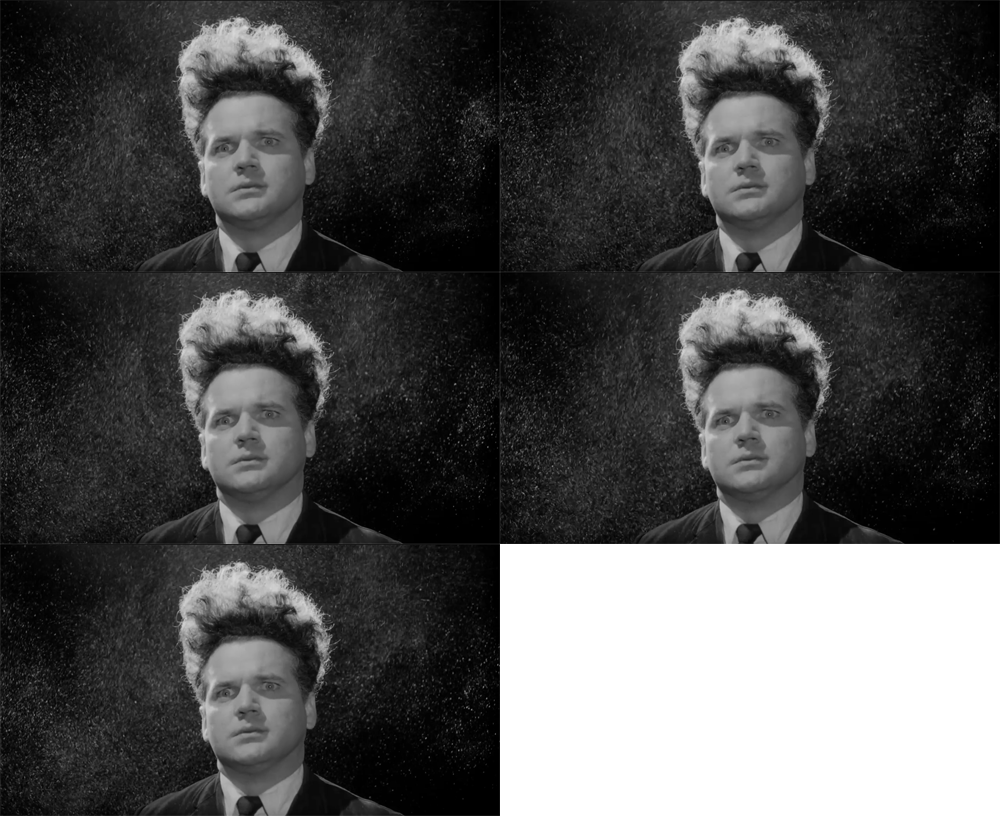
Blue Velvet and Mulholland Drive were his most lauded and our favorites, but there is also something to be said for Lost Highway (Note: Robert Blake popping up from out of nowhere to haunt you takes on new meaning in the 21st century), Wild At Heart, The Elephant Man, Eraserhead  (Note: His mind-bending first film, which prompted producer Mel Brooks to recruit and fight for him to direct one of Lynch’s most traditional and excellent movies, The Elephant Man) and The Straight Story. 

And where do you start with the original Twin Peaks TV series and all of the various incarnations of that world?  Can you imagine that this was a weekly show on ABC in 1990?   Before the explosion of cable programming, and at a time when the term streaming was basically used to describe a state of consciousness? 

We’d dance with you in the Black Lodge anyday

None of my students can, and to this day many of them are huge fans of the show.  Though when I try to explain how both its audaciousness and Lynch’s determination to have it remain in a fugue state amid so many unanswered questions that drove network executives completely bonkers, they do usually meet me with a Twin Peaks worthy half-smile.

That is, of course, the real victory.  That somehow the idea of this kind of boundary breaking insurgence that so annoys the gatekeepers (Note: Especially when it becomes so provocatively successful) will continue, albeit in a different form. 

I wonder what the network had to say about Log Lady

Granted, that’ll take a bit of time.  Which is what must’ve prompted my husband to say at the end of our Lynch discussion, “We should just push pause for the next four years.”   

Among other things.

my inner thoughts

Speaking of which, I decided that the first film my thesis screenwriting students would view this semester would be Blue Velvet, the breakout film that cemented Lynch’s visually alluring, darkly comic and disturbingly dramatic approach to creating a narrative you at times wanted to but couldn’t look away from. 

On the surface it’s a boy-meets-girl story that starts when a college boy, who is home visiting his sick father, finds a severed ear among the many blades of grass in a field near his house and decides to bring it to a detective that turns out to be father of said perfectly wholesome teenage, blonde, hometown high school girl. 

with the great Laura Dern and Kyle MacLachlan

Naturally, they’re both warned time and time again to leave the real crime behind this ear alone, if for nothing else than the sake of their reputations.  But like almost every film before it about such people, they can’t.  Sure, they may be good, (Note: Perhaps too good) at heart but that’s the real issue.  What Lynch posits is that even the good among us are curious about the bad and, on the right day, might even indulge in a bit, or even a lot, of the bad.  Especially when we’re teenagers.  So these two decide to take it upon to themselves to investigate and what they uncover in their small town is a whole lot of bad that, up until that point, we’ve seldom been shown in such iconoclastic, nightmarish and yet bizarrely believable detail by a mainstream American filmmaker to, at times, such strangely comic effect.

I was privileged to be at one of the first screenings of Blue Velvet in L.A. 38 years ago (Note: Yikes!  And… Yikes!!) I took a friend and we knew nothing about it other than it was a mystery. 

And yes, those were the days when you actually could know absolutely nothing about a movie by a major filmmaker.
Definitely wasn’t expecting this

No spoilers at all but for those who don’t know it begins with slow motion shots of a small town where everything is a bit off and almost artificial, as if John Waters and Fritz Lang had a child, named it Lynch (Note: This would be possible under a full moon in a Twin Peaks adjacent world) and decided to give it carte blanche creative control of an opening sequence.

A lawn mower accident in a 1950s town that exists in the 1980s with period-looking people who speak in halting, stilted dialogue out of a B-movie melodrama?   It was hilariously bad in a purposeful way but most of the audience didn’t know what to make of it.  Yet my friend and I couldn’t stop cracking up and had to stifle chuckles that we were sure Lynch himself would have approved of because of all the dirty looks we were getting from those around us. 

God, Laura Dern’s cry face is iconic

But it didn’t matter because as the film unfolded my friend and I quieted down naturally since what we were seeing was like nothing we’d ever seen before, especially at a Hollywood screening, and, by the end, we were not necessarily sure if we wanted to see it again.  Themes of rape, drugs, sadism, violence, with smatterings of raw, offensive language no major studio head would willingly give a green light to.  Except, well, it was all to a point, in service of something and, let’s face it, a small group of people…somewhere… had to have approved. 

Lucky for all of us. 

Nothing could be better than entering his strange and wonderful world

By the time the film was over not only did my friend and I want to see it again but, after its release, so would millions more filmgoers.  Not to mention, Blue Velvet would also go on to win many major critic awards, land on numerous top 10 best lists and become the cult favorite of the year, eventually winning Lynch (who also wrote the screenplay) his second Academy Award nomination as Best Director. 

I watched the movie again last night (Note: My fifth or sixth viewing since its 1986 release) and, once more, I was fascinated, upset, amused and extremely uncomfortable.  But sadly I also wasn’t sure if any director in Hollywood could get away with it today.  Maybe an indie person somewhere, but would it even gain any sort of mainstream acceptance before being deemed problematic, demeaning, offensive, triggering and cancelled?

I’m not sure.

There really will never be another

What I do know is that its incorrectness was used to shine a light on the disturbing, the ugly, the tawdry, the overlooked and the self-righteousness of unexamined societal goodnessA David Lynch-told story, to me, always served as a bit of a disinfectant.  As if to say, no one and nothing is THIS TRULY GOOD, and yes, the world can be quite that BAD.  But none of it will go away if we bury it.  We need to confront it – them – the baddies – out in the open and risk our reputations in order to come out the other side with insight.  At least that will give us enough familiarity with the bad to recognize it and perhaps prevent it from happening if we ever see it again.

My words, not his.

The many worlds of Mr. Lynch

What I love most about Lynch’s work is that he asks you to give yourself permission to go through the darkness and not be repelled by it.  To tolerate the quixotic because, like life, not everything gets instantly answered or is made apparent for you.  It needs to be absorbed, over time and through various moods, endured until the totality of it slides open a window of understanding that finally allows you to say, Oh, I get it.  Now, I get it.. I finally get it.

This is why I just decided I’m showing Blue Velvet to not one, but two, classes this semester and why I will probably get crap about it from someone.  It may not be p.c. on the surface but it’s the most p.c. journey you will take overall.  It doesn’t hide what it is but, at the end of the day, is an advocate for good, in all of its tawdriness.  Meaning actual, real life good – not some technicolor movie version of it.

Would that our 2025 world could be that way.  Well, it can be.  Lynch gave us a sort of existential playbook of self-discovery that we can watch over and over and over again to guide us.   Though the end of time.  As opposed to the end times.

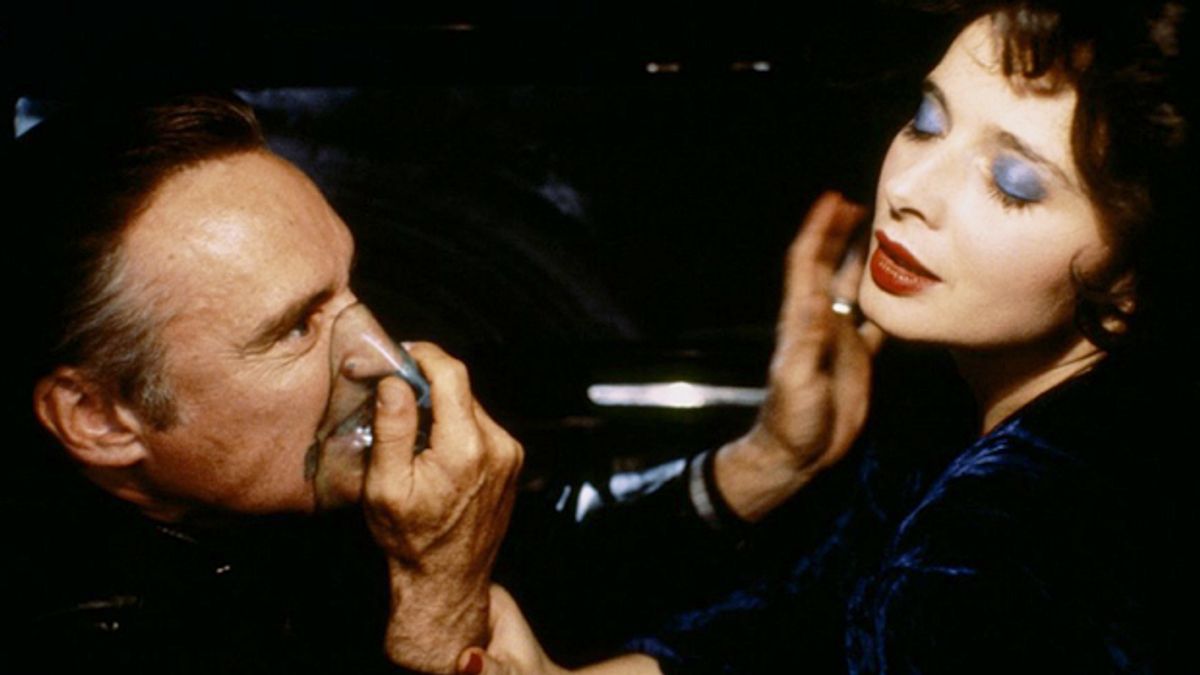
Isabella Rossellini – “Blue Velvet”

We Alone Can’t Fix This

I spent the last several weeks reading all 500 plus pages of the #1 NY Times bestseller, I Alone Can Fix It: Donald J. Trump’s Catastrophic Final Year, by the extremely thorough Washington Post reporters Carol Leonnig and Phillip Rucker.

The book is alternately fascinating, disturbing, infuriating, disorienting, dull, sick, perplexing, darkly humorous, scary and long. 

At times I wished it were a little less even-handed and journalistically proper.  But when you write something so exhaustive on a subject and subject matter such as this I suppose the true gangsta move is keeping your reportorial cool.

This is the energy I bring to writing about Trump

It brought back how I felt watching David Lynch’s very straightforward 1999 film, the very aptly titled A Straight Story. 

Why would the creator of cutting edge classics such as Eraserhead, Blue Velvet and Twin Peaks, and the director of such oddly entertaining works as Lost Highway and Wild at Heart, make a G-rated movie about the true story of an old man who drives his lawnmower from Iowa to Wisconsin to visit his sick brother?

Well, as Lynch himself explained to us (Note:  Okay, me) at the time, it was for that very reason.  By just sticking to a straight narrative of facts, it actually was his most daring, his most experimental film.

Believe it!

In that same way, there was no other course for Leonnig and Rucker to take in chronicling Trump’s last 12 months in office and have it land in any more of a meaningful fashion.

After all, how do you even begin to get any more twisted and salacious than Trump himself? 

And what would be the point in trying? 

This brings to mind the response I received, in various forms, from EVERY ONE OF THE SEVERAL DOZEN PEOPLE I told I was reading this book over this period time.

WHY WOULD YOU WANT TO?

This is an approximation of what they looked like

Of course, not everyone said it exactly that way.  Some just gave me a look, or silently nodded their heads, or explained they couldn’t because they lived it, or apologized they wouldn’t because it was too upsetting and their mental health was already precarious, or responded in person or on the phone with the kind of thick stony silence that tells you the person you’re speaking with has ZERO interest in pursuing this discussion or subject any further (you can hear editor Holly’s reaction on our newest podcast).

In other words, Chairy, BACK OFF!

And then this happened…

Nevertheless, that didn’t stop me from sometimes throwing a few tidbits in.

As Stefon might say, this book and that year had everything –

a. A pandemic the Leader of the Free World ignored, downplayed and lied about.

b. A litany of dictatorial edicts spewed by the POTUS himself to send the military out into the streets to take over cities and ARREST (Note: Or worse) protestors that his own military leaders ignored and refused to carry out.

c. A ton of cursing, blame gaming of others and dangerous lies and/or conspiracy theories launched from the bully pulpit and via social media from the resolute desk in the Oval Office all in service of one single cause – his 2020 re-election.

AND

THERE’S MORE??

d. An actual planned mob of many THOUSANDS that #45 personally spurred on in a prepared, fiery speech on Jan. 6 that caused said group to violently attack and rampage though the U.S. Capitol Building, kill and maim a bunch of policemen, as well as hunt and threaten to hang the sitting vice-president before he could actually ratify the Electoral College results that would declare Joe Biden the new POTUS and thus brand Trump now and forever the official LOSER of the 2020 race.

Oh right

No amount of arm twisting, phone yelling, or even frantic yet calm talks from first daughter Ivanka (Note: Referred to by one advisor as a stable pony, as in when the racehorse gets too agitated, you bring in the stable pony to calm him down) would ever get Trump to tell his supporters they were doing ANYTHING wrong. Even as they threatened lives and destroyed objects that had stood the test of time over SEVERAL CENTURIES in the Capitol and through dozens of other presidencies.

In fact, the most he would ever do was tell them to go home while simultaneously reminding them we love you.

Oh, and the other thing he NEVER DID, as the book details, was to call a single Senator, Congressperson, Aide or even Vice President to inquire if they were okay.  Not on that day and, as far as we know, not to this day.

Is this insulting to Thelma and Louise? #sorryCallieKhouri

Of course, none of this is shocking at this point, even as it remains scary and disheartening.  Worse is that, according to the book, Trump not only knew about the virulency of COVID-19 back in Jan. 2020 but totally bungled a phone call at the time to China President Xi Jinping when he attempted to get representatives of the US medical community into China in order to examine, study or in some way help or contain or accrue information to contain and/or treat Covid-19.

Afraid to jeopardize a trade agreement between the two countries that he thought would win him economic points from his supporters, Trump soft-balled his ask to the point where the head of Communist China simply avoided and/or refused to allow anyone from the US medical establishment into his country.  Then he very calmly ended the call.

Missing a comma, but still true

And when the virus raged on for months and months in the first half of 2020, infecting and killing tens of thousands, the book chronicles how not only Trump but Treasury Secretary Steve Mnuchin as well as Larry Kudlow, his National Economic Council advisor, refused to the very bitter end to take the obvious steps to close the economy that everyone else in the Trump administration was demanding.

Still, none of this is even quite as surprising as who Loennig and Rucker position as one of the unlikeliest of heroes of the administration – Gen. Mark Milley, Chairman of the Joint Chiefs of Staff. 

Previously we all knew Milley as that military guy in fatigues who followed POTUS through the street to that Church where Trump held the Bible upside down in some sort of victory over citizen protestors.

Cue world’s longest eyeroll

That was because right before, under Trump’s orders, the National Guard had marched onto the DC streets and used tear gas and pepper spray to clear a path for him and wipe away any traces of the Black Lives Matter protestors that had peacefully demonstrated for several days so he could have a photo op. 

Old history, right?  Except what we didn’t know is that Milley, who felt “used” and publicly apologized some days later in a video for that appearance, then began a full out, shadow campaign to make sure #45 would never again use the military to further his personal political agenda… or worse.

According to the book, from that day forward Milley regularly shot down Trump’s requests for firepower in the streets; at one point told Trump’s ultra right wing chief speechwriter Stephen Miller to shut the f—k up; and enlisted as many present and former cabinet officers and military men as he could to keep the country from imploding.  Or exploding.

Everything was fine

When the events of Jan. 6 happened, it was Milley who had to strong arm the slow-moving acting Defense Secretary and finally order troops to save the Capitol building.  And when his orders weren’t immediately carried out, it took Vice President Pence’s demands for reinforcements to finally cause the powers-that-be to act.

But the one person who never requested any troops, military or otherwise, to defend the Capitol building was Trump.  In a blistering recounting of Insurrection Day, the book chronicles POTUS’ primary post-speech activity to be watching it all unspool live on TV in sheer awe.

What particularly irked a military guy like Milley, who has advanced degrees from both Columbia and Princeton, was seeing right wing fascist groups like The Proud Boys, as well as other Trump MAGA supporters, many of whom shouted racial epithets and were armed with military style weapons, so swiftly and threateningly move into the sacred halls of government without seemingly missing a beat.

Never Forget… really

Several weeks later, after it was all through and it was his responsibility to plan and maintain an ironclad safe and secure inauguration site for Joe Biden, he thus didn’t hesitate to make the same analogy myself and many of my more mouthy, Trump-loathing friends dared to speak back in 2016 the moment it became apparent that Trump et al would actually rule the presidency, the White House and the rest of us along with it for an entire four years.

HITLER.

Yeah, I said it.  It’s been our POV from the beginning and it still is.  It doesn’t have to be yours or those close to you.  But just know that leading up to Inauguration Day 2021, it also began to be the POV of the highest-ranking military officer in the U.S. 

And it still is.

Speaking to dozens of military and law enforcement leaders at a large gymnasium as they planned for the ceremony to swear in #46, Milley noted that thousands of Trump supporters were already organizing via social media a return to D.C. for a week of siege that would culminate in the disruption of Biden’s inauguration.  And, he wanted them to be ready.

Here’s the deal, guys.  These guys are Nazis, they’re boogaloo boys, they’re Proud Boys.  These are the same people we fought in World War II.  Everyone in this room, whether you’re a cop or whether you’re a soldier, we’re going to stop these guys to make sure we have a peaceful transfer of power.  We’re going to put a ring of steal around this city and the Nazis aren’t getting in.

Yikes

And they didn’t.

And Milley still chairs the Joint Chiefs.

And Trump’s out of office.

For now.

The Who – “Won’t Get Fooled Again”