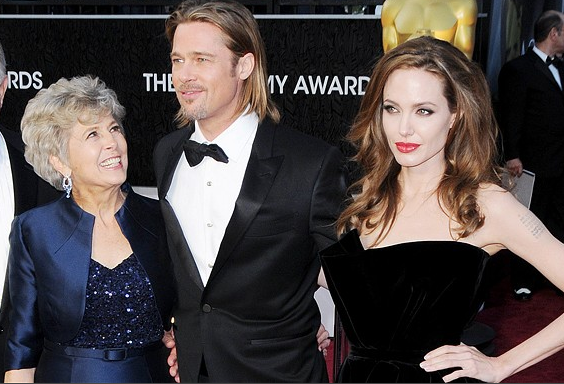
Mommie Dearest.
When Brad Pitt’s mother came out as virulently anti-Obama (that’s Barack HUSSEIN Obama, to use her exact words), anti-choice (“the killing of unborn babies,” as she puts it) and anti-gay marriage, (she cites “Christian conviction concerning homosexuality”) in a letter to Missouri’s Star-Ledger this week, all I could think about was:
- What is it like when Brad comes home for the holidays?
- What was it like when he came home with Angie for the first time (assuming he has)?
- And how can he be so liberal while his mother is so intransigent, nasty and, well, small-town ignorant???
Despite my better instincts, I’m still wondering about the first two. (OH, COME ON, I’M NOT ALONE!). As for the third, well – I should know better than to categorize people I’ve not met as ignorant and am profusely embarrassed (well, at least slightly) for thinking it, much less writing it publicly.
I mean, for all I know, Jane Pitt has many wonderful qualities (well, at least one we can speak of) and might just be the kindest woman in town if we were to get off the subject of politics. As for Brad, I know him as well as Jane, so despite the fact that I like a lot of his movies and the things he’s done to build houses in New Orleans as well as his fight for gay marriage ($100,000 to defeat CA’s Prop 8) he could be even more jerky than Mom if we get him on the right subject.
As could all of us. Which is the point.
How did we get here?
These differences are what the United States is and always has been composed of and, up until recently, was one of the selling points of the country. That like a big dysfunctional family — mine, yours or the Pitts — you could disagree and still be related. You could also do or say or be as rude or politically incorrect or culturally diverse or short sighted, or communistic/tree hugging/eco-friendly and radically vegan-istic as you like and, at the end of the day, you had just as much a right to be here and act that way as anyone else. Perhaps this is even still the case for those of us not overdosing on the red state/blue state thing after two or three decades of growing alienation from each other.
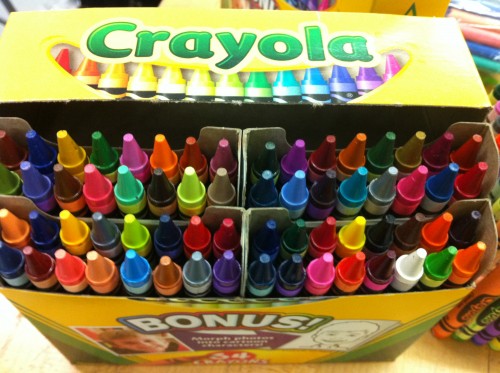
That’s why there are 64 colors in every box.
Was it the rise of the Christian right after the social revolution of the sixties that started it? Or the wave of the let ‘em eat cake Reagan conservatism followed by a tidal wave of Clintonistic separation of politics and morality? Or the post 9/11 Bush years of attack, invasion and collapse? There are theories but we’ll never know for sure. What we do know is that our chief attraction, and export across the world, depends on this not being quite so. Because what we’re really best known for is the international production of “a dream.” An American dream. But if not fading, it does feel that this particular dream has gone a bit – well, awry.

A dream as American as apple pie.
The entertainment industry particularly depends on this export, this idea of who we are, whether it’s true or not. Films, television, music, art – America’s chief image is of a country where anything is possible for anyone. And just when the world begins to think it isn’t, we as a country seem to always do something to save the dream from the jaws of destruction. Most recently it was electing our first African American president despite the odds against it, especially when you consider the man’s middle name is the same as the Middle East dictator whose country we had just invaded in order to….well, to do something – but that’s not the point.
Anyway, politics aside, if there were ever an American dream scenario played out publicly in the last two decades to counter the cynicism, President Obama’s biography would be it. Lower middle class, son of divorced parents, raised in Hawaii and Kansas, a community organizer who until recently smoked cigarettes and admits that he even used to smoke marijuana. Not to mention his like of arugula salads and other designer foods as well his upbringing in…Hawaii? (yes, it’s a state even though it’s not on the mainland). I mean, who would’ve thunk it?

Young Obama or Brooklyn Hipster?
As he likes to say — on paper, it doesn’t make sense that he’d become president anywhere else in the world. And even highly unlikely he’d rise up here. But there are lots of unlikely things that happen in the USA, and in life, everyday.
This same unlikeliness rings true with some of our biggest celebrities. Certainly a motherless girl dancer from Michigan with a passable voice and the given name of Madonna was not a shoo-in for a three decade musical megastar who helped reinvent the recording industry with what used to be cutting edge videos and sex books.
Nor was a poor, unabashedly gay kid from the Depression era south with the ordinary name of Thomas Williams likely to be one of the great playwrights of the 20th century, writing under the new, and even more unlikely, first name of Tennessee. Nor would it seem probable that two very young men who chose to make fun of religion in a short film called “Jesus vs Frosty” would go on to change animation and television AND now the Broadway musical with “South Park” and “The Book for Mormon” but that is exactly what Trey Parker and Matt Stone have done. Not coincidentally, all three (four?) have done so by challenging, some might say attacking, what we consider to be our “traditional American values.”
True, some might cite these performers and their work as symptoms of our obvious moral decay. I, however, look at it as necessary generational progress. In fact, essential.
Not to get all post-Fourth of July, but what seems to allow the idea of the American dream to endure is the fact that we have always permitted ourselves to make fun of our sacred cows, ensuring that no one of us is particularly more precious than another on any given day or decade. In fact, we’ve even reveled in it. We can be in bad taste, politically incorrect, intolerably small-minded and even on occasion morally offensive to one group. If we go too far, society will correct itself and eventually pass a law outlawing our action or create another one loosening up standards to accommodate a group shift in behavior. There are real human costs for this – loss of lives, loss of livelihood, and worse – loss of ones sense of self and one’s humor in battle and in support of our own particular “cause.”
That seems to be what’s happening now in our current age of polarization. But I can only say “seems” because this is the argument everyone in history falls back on at different points in time when society is so “at odds.” However, and speaking only for me, there does seem to be something about right now that feels different. Something is off. Something that’s not quite…well, for lack of a better word — right.
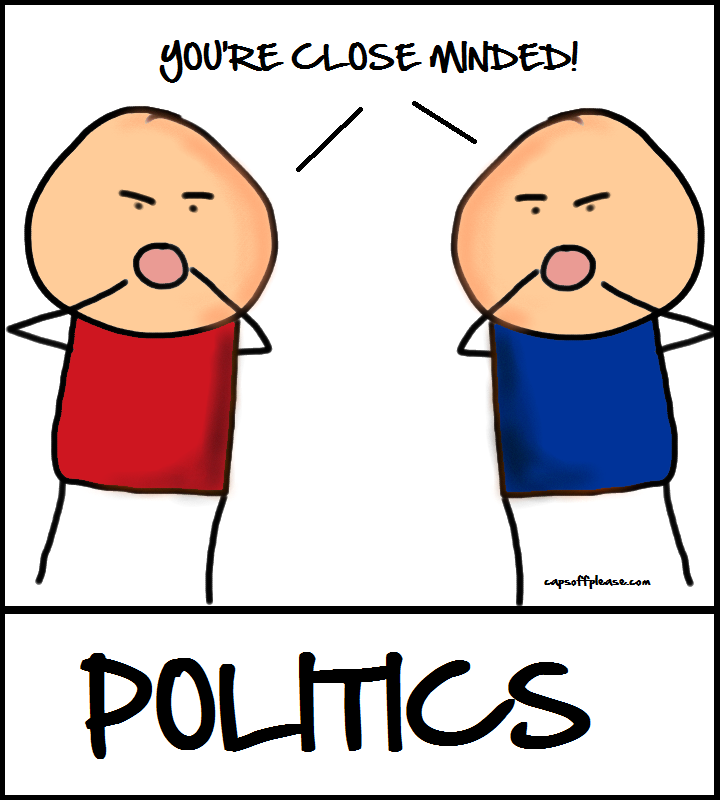
Sad, but true.
When I read Jane Pitt’s letter I initially dismissed it as a statement of someone who believes very differently than I do. Someone who is at least a generation older who grew up in a different time and can’t or chooses not to understand societal shifts and changes that have occurred since she was young and was, perhaps, more malleable and open-minded.
After thinking about, though, I feel differently. There is something ugly in it. Disagreeing with a president is one thing but purposely using his middle name of “Hussein” to somehow paint him as some kind of “other” is viciously unacceptable. As is calling people who believe in the right to choose “baby killers.” As is suggesting that one group’s personal religious views against another particular group should be used to deny rights in a country who several centuries ago freed itself from its oppressor partly so all of its people would have the choice to worship, or NOT to worship, exactly as they all would so choose so long as it didn’t interfere with anyone else.

Fierce.
We live in a celebrity culture where, as Andy Warhol prophesized many decades ago, everyone will be (or at least can be) famous for about 15 minutes. This means that although you don’t have to be related to one of the select few celebrity elite to be heard, it certainly adds to your marquee value – whether you like it or not. Surely, Jane Pitt knew this quite well when she wrote her letter. She and her views now have their 15 minutes of fame. Or perhaps more. She’s now in the uber argument. Inevitably, there will be others, countless others. But right here and now it is up to her and us what we choose to do with it. We can ignore it and proceed as we have been. We can also use it as yet another moment to pull us further apart. Or we can engage in some way and employ it to draw us closer together and begin to reshape, just a tiny bit, something we used to call the American dream.
History – as well as “Extra,” “Entertainment Tonight,” “TMZ” and “The Huffington Post” – is watching. For at least 15 minutes or so.


 notes from a chair