Not Dead Yet

still got a lot left to burn...

“When you’re dead, lie down,” said an old flame of mine about the performance of an older movie star of the sixties in a film several decades later.  I didn’t think the performance was good but neither was it particularly awful.  However, I did sort of chuckle (or perhaps belly laughed) at the comment because not only was it snide and amusing but it came from the lips of a person who at the time I thought could do no wrong.

Well, now that I’m decades older and much closer in age to the movie star (who it turns out wasn’t that old) – and now that the old flame has flickered out of my life and chronologically is what many of us consider old, or at the very least much OLDER than the sixties movie star (and certainly a lot less rich and famous) – I have to admit that on the subject of “lying down” both of us wiseacres were WRONG – DEAD WRONG.

There is really never a time to stop doing what you love to do simply because your hot streak is over and others think you have overstayed your welcome.  Just as it is never a great idea for the powers-that-be to blanketly ignore people who have mastered their craft solely on the basis of their age (be it young or old) for what is perceived to be the next LIVE thing.

A case in point is Oscar-winning screenwriter Frank Pierson, who turns 86 next month.  Mr. Pierson won his Academy Award for a movie starring Al Pacino that you might know, “Dog Day Afternoon” (1975). In addition, he was also nominated two other times for “Cat Ballou” (1965) and “Cool Hand Luke”(1967).  More recently, Mr. Pierson directed the acclaimed HBO TV movies “Citizen Cohn” (1995), “A Soldier’s Girl” (2001) and “Conspiracy” (2003), served as president of the Writers Guild of America from 1981-1983 and as president of the Academy of Motion Pictures Arts and Sciences from 2001-2005.  On a personal note, I can also tell you Mr. Pierson is an extremely smart and gracious man who extends himself to young writers but can also gloriously cut his cowardly peers down to the quick as I once witnessed at a very contentious open Writers Guild meeting in the nineties when he publicly challenged his fellow scribes to “grow a pair” (my words, his were a little more colorful) and stand up to the studios because “no one else will and, damn it, that’s what writers have always done” (again, cleaning it up for blog audiences).

Mr. Pierson tells it how it is.

This past week Mr. Pierson had another career triumph for his writing of the fifth episode of the current season of AMC’s “Mad Men” – a disturbing, gutsy, self-possessed hour entitled, “Signal 30.”  Though all of the episodes this season shine for various reasons, this particular one, penned by an 86 year old, has upped the game and officially made the 2012 version of “Mad Men” the BEST WRITTEN SHOW ON TELEVISION.
for Frank's a jolly good fellow!

Without getting too far into the plot elements for non-watchers, suffice it to say any hour-long episode of TV set in 1966 that dares to feature and pull off all of the following:

  • a real live fist fight between two of a company’s wimpiest executives
  • a thirtysomething married man lusting after a young girl in a driver’s ed class only to loser her to a teenage hunk literally named “Handsome”
  • a news report on the real life murderer of young women in Texas that scares the bejeesus out of most of the girls in NYC
  • a bunch of British soccer players winning the World Cup as watched by a group of bar cheering British expatriates
  • an Upper East Side brothel owner deciding on whether to buy a television set to liven up her place
  • And an account guy who moonlights as a science fiction writer of gem-like short stories about a working man who is a mere cog in the machine of the universe

Well, that’s is okay by me.
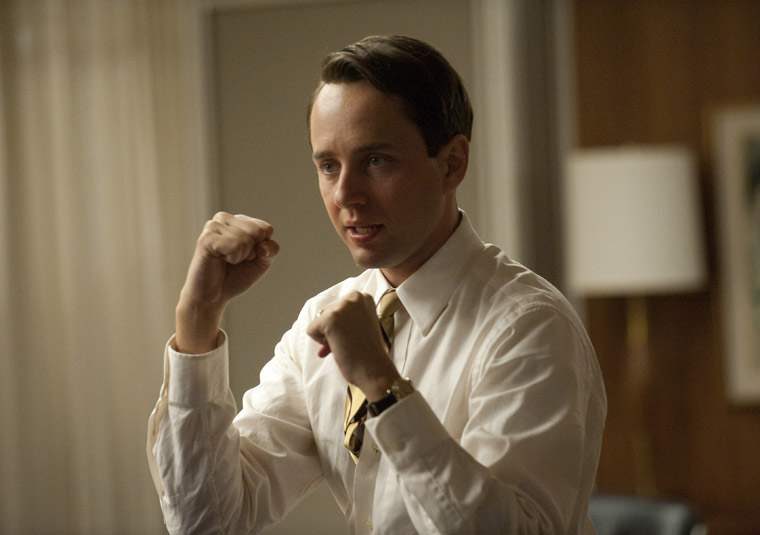
a real knockout

Actually, it’s more than okay.  It’s pretty terrific.  And not only because of what that episode says about American culture right before the social revolution of the late 1960s but for what it shows us about American culture five decades later.  More than the obvious fact/fiction of the past, the present day workings of the actual television show “Mad Men” prove to us that rather than being dead or basically put out to pasture, it actually is possible to be relevant as an artist in commercial Hollywood once you get past the age of ________ on a non comic-book, non-sequel, non-high concept, non-sitcom piece of material that isn’t based on the life and times of your children, or even grandchildren.

Matt Weiner, “Mad Men’s” creator and show runner, is responsible for Mr. Pierson’s hire and part of the brilliance of his work on the show is that he boldly takes chances not only on the creative direction of each season but on who he chooses to hire.  Given conventional TV wisdom, there is no reason in the world for Mr. Weiner to employ Mr. Pierson except that Mr. Weiner is smart enough to know

a. Mr. Pierson started his writing career in advertising near the time “Mad Men’s” world is set.

b. Mr. Pierson grew up in Chappaqua, N.Y., which is pretty close to the area where many of the series characters reside, and

c. Mr. Weiner is secure enough in his writing talent and stewardship of his show to not be threatened by the talent and reputation of an old war horse like Mr. Pierson (who, by the way, famously stood up to the then uberpowerful Barbra Streisand and her producer-boyfriend Jon Peters as the writer-director of their 1976 version of “A Star Is Born”)

Oh yes, there is also

d. Mr. Weiner always has the prerogative to rewrite any writer on his show.

the order says it all..

Of course, so do any other show runners on any other show and you don’t often see them digging in and doing much out of the ordinary. In full disclosure, Mr. Weiner did rewrite Mr. Pierson a bit (as he does with almost everyone on the program) and shares writing credit (as he also does with almost everyone).  But in Mr. Pierson’s case it was not more than 40% of the script (and probably less) since Mr. Pierson’s name is listed first before Mr. Weiner as the writer of that particular episode.  How do I know the percentages?  Mr. Weiner publicly announced it in more than one interview.

I’m not saying Matt Weiner deserves yet another award for hiring Mr. Pierson (who was also a consulting producer on “The Good Wife” sans writing credit in 2010), or for not rewriting him entirely.  But he does deserve high praise for keeping a terrific television show afloat by trying to do something different from the norm both onscreen and off.

It would be nice and perhaps even smart if others took note and followed his lead.

Big Dreams

There’s a great scene in the first act of “A Star Is Born” where the established star, Norman Maine, advises the young talented unknown, Esther Blodgett, about her career.  She admits her big dream is catching a lucky break, getting discovered by a talent scout and having a number one record but also freely admits, “It won’t happen.”  The veteran, a great fan of her work (among other things), counters, “No it might happen very easily.  Only — the dream isn’t big enough.”

He then goes on to tell her, “A career can turn on somebody saying to you,  ‘You’re better than that.  You’re better than you know.’  Don’t settle for the little dream.  Go on to the big one.” (for more go here)

In Esther’s case, having the number one record was not necessarily the wrong dream (she does go on to get a number one record AND a lot more) – just not the right dream at the right time.  In other words, to quote a wise old adage, “there’s more than one way to skin a cat.”

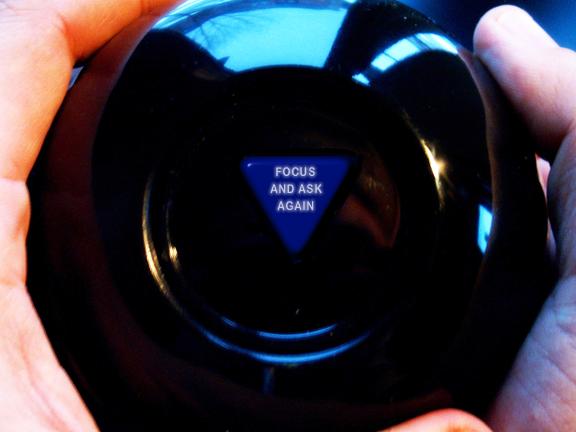
Aside from the fact I’m a sucker for old Judy Garland movies, I’ve been thinking a lot about dreams lately.  Do you get just one?  Is working hard and profusely wanting something enough to push you towards your goal?  What if it is the WRONG time?  Or, perish the thought, the WRONG dream?   But wouldn’t I know what the right and wrong dream was for me – I mean, it’s my dream!!  Well, not necessarily.  I mean, no one is right 100% of the time except, well, the 8 Ball– and even it has its occasional limitations.

Hold on, let me get my glasses.

Taking that into the realm of high-class problems, what if you’ve already achieved your dream and you’ve still got half or two-thirds of your life left, and don’t plan to die early.  Do you just coast and sit on or in your mountains of money (while you’re spending it and it keeps magically replenishing through endless tax cuts for you and your millionaire/billionaire friends)?  Do you continue to try and top yourself in your own field even though you feel like you’ve “done it” and it no longer holds its mystery because you’ve reached your version of the mountain top?  Or maybe you, perish the thought again, start from ground zero and try something else with the hopes you can reconnect with the passion you had for your original dream and expand that and more to even greater effect and affect.

Only we can provide the answer for ourselves.  Maybe for you it’s one or all of those.  Or maybe it’s none of the above.  Dreams are funny that way.  Ultimately, they’re extremely personal.

But for guidance – why not look to the best.

No one spoke of dreams more eloquently than Dr. Martin Luther King, and being this the 48th anniversary of his historic  “I Have A Dream” speech – a speech delivered at a time when the idea of a Black U.S. president seemed as likely as, well, an openly transgender, ultra-liberal, atheist one might one seem today, (and if anyone under 40 thinks I’m exaggerating, ask anyone OVER 40) – it’s important to be reminded of the ever-enduring necessity and universality of having not only commitment to a dream but a great and unlimited personal imagination.

Inspiration

Dr. King didn’t dwell on what was necessarily rational in the south in the summer of 1963 for Black (then called Negro) Americans, but “dreamed” of what he saw (and hoped) was “possible.”  Does it trivialize the civil rights struggle to use it as a metaphor for the individual dreams each of us may or may not have for ourselves in our creative lives?  Absolutely not.  Dreaming of something that seems impossible is always valid and necessary if you’re human and want to make any kind of impact or difference for whatever reason.  And if you’re going to steal (in Hollywood they call it homage), why not steal from the best?  And – at least I’m publicly giving him credit – unlike what Paramount, Martin Scorsese and Leonardo DiCaprio have so far done for James Toback, by not informing him they were going to remake his seminal 1974 screenplay “The Gambler,” prompting him to feel he dreamt a bad dream because he first found out about it last week in Nikki Finke’s Deadline Hollywood news item. (Read it all here).

But I digress.

I’ve written before about dream stomping or dream ignoring or dream ______ (fill in your phrase) being very big these days – particularly in the creative arts.  “You’ll never,” “do you know the odds of,” “You have to be practical,” or the dreaded comment – “you’re such a dreamer.”  As if that’s a bad thing.

I, and all of my happy and/or successful friends (uh, they’re not necessarily the same thing), will testify to you that there is no way to achieve anything for yourself without dreaming it up in some fashion for yourself in today’s world.  Especially in the creative arts.  Oh — Hint:  It’s all made up, anyway!

As for having only ONE dream or MANY dreams or not stopping until you find the RIGHT dream for you, the strategy depends on who you are and how busy you want to be.  I can make the case for employing any of those, or, alternately, all three.  Consider:

  1. A very successful SCREENWRITER friend of mine with more movies made than any of his contemporaries always dreamed of being a screenwriter (some of us think from in utero).
  2. A very successful SCREENWRITER I know was in a punk rock band before he ever thought of writing movies or wrote a word in screenplay form.
  3. A very famous ACTOR friend of mine always wanted to act and never considered anything else.
  4. A very famous ACTOR I once worked on a movie with didn’t start acting until mid-life and spent the first half of his life doing, well, a lot of illegal stuff unrelated to show biz (and often behind bars).
  5. A very famous and successful DIRECTOR friend of mine actually finds it torturous to direct and dreamed of doing lots of other things but became most successful at this.  Now, this person is sort of stuck.
  6. A very talented DIRECTOR friend of mine now writes and produces and doesn’t direct at all (except in the mind) and, I believe, finds it infinitely more satisfying.

Oh, and what’s most interesting to me now is that NONE of these six people today ONLY work on their dream of writing, acting and directing.  One of them always dreamt of being a great parent and spends a great chunk of time with his/her children; another works tirelessly reforming convicts; a third spends enormous amounts of time decorating and remodeling.  All of them are on their third, fifth, eight and twentieth dreams.

There are other individuals I know who never quite “made it” on their original dreams but now are dreaming even bigger and better.  To whit:

  1. A brilliant, aspiring AGENT I know left the business and has become a very successful (and happy) family LAWYER.
  2. A talented, lower level STUDIO EXEC I once knew now writes self-help books (imagine that?).
  3. A former AGENT friend of mine and PRODUCER friend of mine each sell and develop real estate (separately), are very good at it and LOVE it (granted, more when the market is a bit better – another subject.  And perhaps another dream).
  4. Three screen and TV WRITER friends are now full-time therapists, helping other dreamers navigate the tricky waters of ambition, reality and, well, dreams.  A fourth has moved on to producing new and exciting content for the web.  (The latter in some way probably being a new, ingenious and inevitable dream to consider and perhaps approach for more than a few younger (and older?) people reading this blog).

Finally, add to that – at a restaurant this week I ran into two different and EXTREMELY, EXTREMELY successful people in the entertainment business.  I mean, you couldn’t GET more successful and famous (you’d know their names).  One of them has nothing to do with film anymore and uses all the money, cachet and power accrued in said business towards charitable works (i.e. helping others fulfill dreams).  The other still pursues dreams in the business but in a very different way and in very different venues.  This person has gone from being unbelievably difficult and, well, not very nice back in the day (how do I know? I was there), to being a warm, open and generally endearing presence who has clearly found that not being in the red hot spotlight is ultimately a lot more dreamily satisfying than drowning in the poisonous kind of heat that public attention sometimes generate for certain types of individuals.

If this sounds tricky, confusing, confounding and littered with endless detours, U-turns and reinventions, rest assured it is.  But — that’s what really BIG dreams are made of.