Memories

Don't Forget

One of a writer’s greatest strengths is memory.  Not for silly things like how to make ketchup, where you can get the best sale price for the complete DVD boxed set of the first three “Twilight” films or even what color Lindsay Lohan’s hair was when she was arrested once again this past week.  Though any one of the above might come in handy for a game of Trivial Pursuit, popularity with the friends you shouldn’t have or snaring a date with the hot TMZ reporter you shouldn’t have a crush on.

Blonde so does not go with Prison Orange.

Blonde so does not go with Prison Orange.

No — the kind of memories I mean are on either side of the emotional spectrum.  Correction:  the many sides.  Hate and love/good and bad/happiness and sadness are the easy ones.  How about jealousy, passion, courage, anger, hurt, fear, longing, suspicion and hopefulness for starters?  Any one of those will not only cause you to lose the blank page, if you can corral them, but to also fill it with something you never knew you had in you (or conveniently forgot about until then) by the time you are done.  Depending on the kind of writer you are, the filling might be sweet or sour but tasty nonetheless for the right customer hungry for what you have cooked up.

Memories came rushing through to me this week via World Aids Day; my step mom in the hospital; tons of students who I adore reappearing at our annual school holiday party while others said goodbye; and the celebration in the last month of various birthdays (including my own) as well as the anniversaries of the deaths of several people I knew intimately. The thing about memories and writing is that a date on the calendar is not the only thing that can trigger it, only the most obvious one.  It can be a fleeting image, a song, a passing remark in real life or on television.  Connect in a significant way with any single one of them and a collage of events come crashing into your mind.  And in more cases than you care to, depending on how sharp your recollections are, the memory(ies) can be almost as clear as if you were there and this was the first time you were experiencing said event.  The latter, in particular, depends on who you are and the kind of writer you want to be, are already  or are destined to become.

Animated is always best.

Animated is always best.

I’m using writer in the generic sense because in some ways we are all writers of our own experiences.  That is because we all tell stories to someone – even if it is only ourselves.  Marsha Norman, Pulitzer prize winning writer of ‘night Mother, likens playwriting to the old days prior to television and the movies, where human beings used to sit together around a campfire, actually make eye contact with each other (rather than the touch screen kind) and say ‘let me tell you a story’ – at which time a person no more or less talented than any one of us are now would weave a tale of woe or joy and, depending on the skill of the speaker, watch as those emotions were reflected back to them from the eyes of a rapt live audience.  The only difference today is that a larger group of us choose to, or simply can, put our storytelling on paper or a computer screen, to be either read or performed or both.  It doesn’t make those among us who do not do this any less storytellers or even writers.  It’s simply writing of a different kind.  Side Note: Unfortunately, being a writer these days can often sound so rarefied and almost pretentious unless you accept the idea that everyone does write in their own way – on paper, electronically, verbally, physically or even emotionally.  To my definition it’s all storytelling and that indeed does make us all authors of not only our own stories but of every story we choose to pass on to others in whatever way we choose and through whatever medium we see fit.

For example, Chris Matthews made a remark on his MSNBC show Hardball this week, casually noting (writing?) in the context of something else, that Ronald Reagan was not anti-gay.  This being the week of Worlds AIDS Day, images of dying, emaciated men in their 20s, 30s and 40s, some of whom I knew quite well, immediately came rushing back in my mind, as did the perpetually smiling face of Mr. Reagan – a smile at the time I longed to wipe the floor with as I dragged him kicking and screaming into every quarantined hospital room I knew and forced him to look at the beginnings of a new Holocaust that he refused to ever truly and fully acknowledge.  But hey, that’s my memory – and certainly not one shared by the fringe group of his acolytes who periodically wage a campaign to put their hero’s punim (that’s Yiddish for face) on Mt. Rushmore next to Washington, Jefferson and Lincoln.  I have a few choice words for those idiots, but to them I’ll simply say what Amy Poehler and Seth Meyers used to say on SNL’s Weekend Update:  “Really?”

Now, there's a Mt. Rushmore I can get behind!

Now, there’s a Mt. Rushmore I can get behind!

But while we’re on the subject – thanks to Chris and writing about this, a few more Reagan memories have suddenly come back.  That nasty little argument with a woman in my writer’s group who tried to defend our late president in the early AIDS years to me while everyone else looked very nervously away and into a bowl of particularly bad chips and salsa; and another time I once nearly punched out (yes, it’s true) a gay Republican who tried to lecture the late and brilliant author of the seminal chronicle of AIDS/governmental history, And The Band Played On, about the merits of Reagan. (It took two people to hold me back as this shit for brains jabbered on endlessly). Further side note:  The author Randy Shilts was a perfect gentleman during this and when I approached him later on he simply laughed at this then young man’s total ignorance of the facts of all of our lives.

Speaking of lives, more memories have suddenly come back.  My step mom, now a vibrant but still very fun senior citizen, is in the hospital at the moment still fun and pretty vibrant despite the fact that she was making a meal of ice chips last night.   Though her room didn’t exactly have a roaring campfire, I nevertheless couldn’t help but watch her and think of the time when I was 14 years old and first met her in a bowling alley with my father – she being the one with the long auburn hair cascading over the coolest brown suede poncho (with fringe!) that I had ever seen in my then short life.  (Confession:  I still think it’s cool!).  I now remember this memory so vividly, as well as how my pre-determined feelings of dislike for her turned to love in just a few short minutes despite my steely resolve to react otherwise.  It has, in fact, taken me many years to realize the story of those feelings would be a recurrent story in my life that has caused me to be continually surprised (in both good and bad ways) by people I had decided to have pre-determined reactions towards.

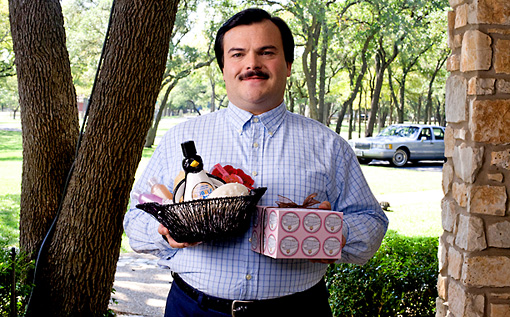
I'm looking at you, Mr. Black in Bernie.

I’m looking at you, Mr. Black in  this year’s outrageous Bernie.

I may not have written about my stepmother (though really my second mother because she’s been that special and such an important part of my life for so long) on paper but I have shared some of our stories to others a few times – and they’ve always made me smile.   Not only that, these stories have evolved my opinions and views of a particularly turbulent period in my life each time I’ve retold them.

I have also written a lot about AIDS on paper – as well as told numerous, or perhaps even immeasurable, anecdotal verbal stories – so many more of the latter, in fact, that I’ve risked alienating no small number of innocent bystanders over the years as I’ve gone on and on and on.   The plague year stories never change anything at all – no opinions or views that I know of.  The only thing they seem to change is my mood at the time of their telling. Depending on where I am in my life I can feel better or significantly worse each time I do tell one.

That used to frustrate me in the screenplay area until I realized that even the great masterwork on AIDS – Tony Kushner’s Angels in America, for example – didn’t change anything the way I really wanted to change it.  Which was, specifically – to make a full correction – to make it as if it was indeed a story and didn’t happen.  More precisely – to bring back those that I loved who were lost  and everyone else who didn’t deserve to die at such an unforgiving hand of fate and to throw it all into the dust bin of modern urban legend.

If only it were a dream...

If only it were a dream…

People will write to pay the rent, because of obligation and because they’re good at it.  But the majority of us – we write because we have to for our own very personalreasons.  I suspect part of this is to deal with the past and, in fact, correct it in some way – or at the very least understand it.  And perhaps affirm, deny or, in many cases even change the ending.    Woody Allen cops to this at the end of Annie Hall when he switches his bittersweet breakup with the woman he truly loved, for reconciliation – at least in the play written by his movie alter ego.   He tells us in not so many words that as a writer you want to change the past and have it make sense because in real life it often doesn’t.  In truth, nothing really does if you decide it doesn’t.  We impose the preferred order on things.  Which is, again, where writing, or storytelling, comes in.

All written stories have their beginnings, middles and endings.  And the best part is, we writers – every one of us in every medium, real or imagined – get to choose which goes where.  That, in itself, is worth remembering.

Second String

“Give me a second. “

When I hear this I’m immediately thinking..

Okay, you need more time.  Whatever…

Great, now I’m getting pissed.  And don’t let the fact that I’m in a hurry and still waiting trouble you because obviously what you’re doing is far more important than what I want or need at this moment.  Which has already passed because you’re so damned selfish and slow.

Of course, perceptions are often wrong.  And even more often than that people get angry about the things over which they are confused, or that they misunderstand based on faulty information. Or even more likely an item or incident they use as an anger substitute for that thing over which they are really angry about (life? the banks? world/your own poverty?  the Kardashian family fame and fortune?). Those things that are too scary to really unleash anger on so  you (we? they?) misplace it to other, lesser-perceived misstatements.

Which brings us back to waiting and my original statement.

“Give me a second.”

No, I (or the ubiquitous they) was NOT trying to poach more time.  (And if only you had asked either of us directly we would have told you). What I was really saying –if you would have engaged me in conversation and really listened to and thought about my response before jumping to your talking/thinking point – was this:

Instead of your first or #1 selection, I’ll take what is considered your second –or #2 – any time.

Yeah I mean you, Ms. Maroney.

See, sometimes the best choice for what ails us in the moment, or in our times, or even on a specific creative project, is the person who is the SECOND-in-command, our SECOND (or maybe even third) choice — the RUNNER UP (or even worse) to  present day fame, fortune and eternal frolic.  Sometimes it takes that very person – the under the radar supporting player or archetypal contemporary day “Bridesmaid” (think Kristen Wiig) – to bring us through the muddy waters and to entertain us and make us laugh or cry, and, most importantly, to put everything back into plain talking perspective and for once and for all and, hopefully, forever, make everything clear.  Forget the bells and the whistles and the fairy dust of the first stringers.  As a famous auto company once advertised about #2’s – often what their status guarantees is they “TRY HARDER.”

And trying harder is what makes you #1 (or used to, at least)…in the first place.  It’s the necessary step along with way before you (we? they?) get complacent in star status.

The most famous #2 of the past week is a  likely yet unlikely choice: a just-about 70-year-old man with piano key teeth, not very good hair plugs, and all the subtlety of Kevin James trying to emulate Adrian Brody’s Oscar-winning star turn in “The Pianist.”  This person, perhaps THE most famous #2 in the world, is a guy we Americans like to call – wait for it –

VICE-PRESIDENT JOE BIDEN.

Ole Blue Eyes

That’s right, the eye rolling, horse laughing, over gesticulating senior citizen on the national debate stage.  The guy some people thought was rude and other people thought was real.  The guy who, everyone agrees, was pretty much a poster child person for plain-talking populism of the quintessentially honest American kind that even the most uninformed among us could pretty much  – whether they agree with him or not – understand.

The perils of the #1 perch often don’t allow for that.  Or perhaps it’s what happens when one reaches #1 status that makes falling from the perch and, in turn, making one wrong move, seem even more perilous for the person that has indeed achieved it.  Or – to give a more musical example – maybe it’s the pressure of simply living up to the qualities that Debbie Harry longed to seduce in her famous #1 song.

Whatever IT is, Pres. Barack Obama, our #1, didn’t have IT when he debated several weeks prior, yet  he certainly did have it four years ago opposite his Republican opponent on the debate stage when he running for, but not yet, #1.  Mitt Romney hasn’t had it for the entire time he’s been #1 on the Republican presidential ticket but for some reason momentarily got it (in some people’s opinion, not necessarily mine), when he was #2 on the stage at the presidential debate with our current #1 American (Pres. Obama).

This is not to say #1’s are not truly the best overall and often don’t deserve to be top dog.  It only means that Mel Brooks’ adage of “it’s good to be king” is indeed all too true.  The cyclical version of fame, fortune and mere age ensures that there will always be a #2 worth watching – a person or moment that is second string now but will one day, through verve or sheer attrition and endurance (and sometimes through a faulty strategy of slightly guarded carefulness on the part of #1 that is thought necessary to maintain power) will temporarily and then perhaps even permanently cause the replacement of the top star.  That is the way of the world.  That is the historical and often necessary cycle of existence.

Buckle up…

So it stands to reason that during the reign of #1s, there are always times when the Big Kahuna will falter and one or more of us subjects would do best to listen, learn and be inspired by the musings of a #2 – or even #6, #7 or #8.  Second stringers don’t have as much to lose but often have a lot more to prove, which in turns gives them the motivation and energy to make the case or to pick up the baton (sports or creative) and win the race when the first stringers either graciously step outside or ask for a much needed helping hand they count on their #2s to provide.  What’s great about this is that it not only often works but more times than not, win or lose, makes the result more interesting and brings about the much needed evolvement and, eventual changes, of the future.

I see this every day with my students – who consistently surprise me with their work.  As a writing teacher, one learns to recognize obvious talent.  I mean, it doesn’t really take a genius to see that – only someone who is more than a casual observer.  But the moments teachers and audiences and, I’d venture to say, citizens of the state, live for are the surprising ones.  We get most excited by instances in which the second stringers, the ones not necessarily destined for greatness, rise up to surprise us in an area we thought they never could.  I see this every semester in creative work – people whose good ideas become realized into art that is more original than you ever thought it could be, not only surprisingly fresh but surprisingly great.  Watching an individual take a step out of the pack due solely to the application of their passion, desires and, above all, talent, is a moment that teachers, and audiences, and societies, do truly live for.

Mr. Biden’s robust debate performance, where he spewed the plain-talking, impolite frustration of most of the American public across the stage in Kentucky, (and for those not enthralled with our veep’s performance, perhaps the same could be said yikes! for Mr. Romney’s penultimate sugar high jabs in his first 2012 presidential matchup) is not limited to politics.  It often rears its head in all of the creative arts, in sports, in our friendships and even family lives.

Can film students, movie fans or anyone else in the public imagine the first string choice of Doris Day as the quintessential suburban seducer Mrs. Robinson in “The Graduate” instead of Anne Bancroft?  How about then “Magnum P.I.” TV megastar Tom Selleck as Indiana Jones instead of a now (but not then) film icon we call Harrison Ford?   The record shows that Mr. Ford and Ms. Bancroft were, to put it kindly, the #2 choices for their roles at the time but more than likely they were even further down on most people’s lists.

Really?

Chicago for years suffered with the ubiquitous title as America’s “second city” until some creative type in the Midwest wisely decided to own that derisive term (as all oppressed groups eventually do) and start a improvisational comedy troupe aptly titled “Second City.”  Ironically, this group became not only the best in the business but would then go on to be the primary supplier of performers and creative types behind perhaps the most enduring and iconic comedy troupes in the history of television – The Not Ready For Prime Time Players of “Saturday Night Live” – a show based out of what was and still is considered to be our #1 city – New York.

Live from.. Chicago?

It’s also easy to forget that Terrence McNally, the American playwright who has won four Tony Awards and countless nominations for work as diverse as “Love Valour Compassion,” “Kiss of the Spider Woman” “Ragtime” and “The Full Monty” was once best known in the New York theatre community as merely a “famous #2” by dating playwriting royalty Edward Albee.  Or that Katy Sagal, America’s infamous Peg Bundy on “Married With Children” and the star of the cable hit “Sons of Anarchy” was early only renowned as one of three literal #2s when she served as a member of Bette Midler’s trio of backup singers, The Harlettes.

In sports I’m old enough to remember when 15 year old Michael Phelps swam in his first Olympics and won 0.0 medals, gold or otherwise, yet sharp enough to recall that after subsequent record-breaking Olympic gold in 2008, it took this year’s drop to #2 status in the first 2012 race of his fourth Olympics game for him to once again emerge as the #1 swimmer of gold more times than any one else in the entire competition.

This could be a drinking game and we could go on and on.  But perhaps the best example is another political figure of the times who recently won the Gallup poll for the tenth year in a row as – wait for it again – the most admired woman in the world – Hillary Clinton.

She knows it.

Talk about a #2 and then some.  First Lady (but really a #2?) of Arkansas.  First Lady (and not even a #2) of the United States and an object of derision for famously proclaiming she wasn’t interested in staying “in the kitchen and baking cookies.” Then even more publicly proclaimed an inexperienced interloper for trying (and then failing) to create a universal health care plan for all Americans under the direction of her husband, the then president.  Undaunted at being #2, Mrs. Clinton did her job, learned, stood in wait and took her lumps from a “vast right wing conspiracy” she inelegantly said was lying (some might say salivating) in wait for her husband.

But then something funny, or perhaps eventual happened.   Her husband was no longer president and she decided to use her fame, smarts and nationwide experience to run for Senator in New York.  She not only won the #1 spot but became one of the most admired members of one of our most well-known “boys clubs.”  She then used her fame to try and become our Uber #1 in her own valiant run for president, only to be shunted down to #2 status by a guy with a weird name who had way less experience than she did – Barack Obama.   However, she barely had time to leave gracefully before our new #1 called her in to be a different kind of #1 (or is it #2, #3 #4 or even lower) – our Secretary of State and the defacto#1 face of foreign policy to all countries around the world.

In the end, it seems – everyone is #1 somewhere but usually #2 (or below) almost everywhere.  Human achievement does have its limits and the fact is very few of us make it into the hall of presidents or on an international awards stage.  But that doesn’t mean that, in more moments than most people realize, we all have the capability, if given the chance, to be as good or even better than any particular number on the right number of days if we keep at it and are given, or take, the chance.

That’s what Joe Biden accomplished last week.  And that’s why it’s important to keep pushing your rock uphill, downhill or sideways – no matter what your status or scoring is at any random moment in time.

And I said I didn’t like sports metaphors…