Pass/Fail

Dogs.Tug.Of.War

Life is a continuous process of give and take.  Take and give.  A process in which you make mistakes, lots of them, in addition to the many things that you get right.  In fact, one of the ways you can measure if you’re living a life really worth living – meaning doing it well  – is by the amount of mistakes you make.  Chances are if the total number that month or year is zero, you are doing the very thing you have been trying so hard not to do – failing.  Perhaps I’ve been teaching college students too long and that’s the reason I think in terms of pass/fail.  But I don’t think so.

Human beings are not computer programs whose excellence can be programmed.  We are a species who do the lion’s share of our learning the good old fashioned way – through practice and trial and error.   I don’t know about you but when I practice anything – my writing, my cooking, my teaching or my making non-neurotic choices even though the neurotic, crazy choice is far more appealing – I screw up.  I find the more I practice the less I screw up, which if anything is a reason for us all to incessantly practice at anything we care about.   We don’t usually because we are either tired or know that if things are going so well we don’t want to rock the boat since it’s only a matter of time before we – that’s right, you guessed it – screw up.

Sometimes things just don't come out exactly as you had hoped....

Sometimes things just don’t come out exactly as you had hoped….

A lot of times we plateau in what we do well and in an effort not to make a mistake we don’t force ourselves to do enough new stuff.   This, too, is a mistake because nothing stays the same ever – even if you stop and decide it’s going to.  At some point something will change in the equation so why not be the one to take the initiative and shake it up a bit to keep things interesting or perhaps even improve?  It’s because we have this idea that if we hold on to the same tried and true method of doing some task or interest or job the result will always be the same.  Hmmm, it might for a while – as long as we can do it – which won’t be forever.  But it will also ensure we get a bit lazy, or complacent or fail (there’s that word again) to open a door we might have enjoyed going down or benefited from immensely just because we didn’t want to…. Well, you know.

Though, I'm not sure I will ever crave a Vegan Burger

Though, I’m not sure I will ever crave a Vegan Burger

I find this complacency/fear in me sometimes when I teach the same classes, do my gym routine (when I go), or cook the same six meals for dinner several times a month (the rest of the time I eat out or order in).  For example, let’s take teaching – where I keep requiring students to watch the same five movies every semester to illustrate various screenwriting principles.  In the latter, it’s not that these examples don’t work – in fact they do work quite well.  Juno, Adaptation, Harold and Maude, Chinatown, North by Northwest – they’re all excellent films that young people can learn a lot from and, more importantly, I never get tired of teaching or talking about with them.   It’s that, well – I am already quite certain how well how well they work.  Perhaps there is something that could work even better (and make me better)?  Of course, there is.  There is always something that can work better.  But you have to search for it.  That’s why I also have students every other week go out to a newly released movie (at a movie theatre) that we can analyze – so as new screenwriters they can be exposed to all types of films – even if it’s in a genre they or I don’t like.

This week for instance, I insisted on Identity Thief – not because I was dying to see it but because I knew it had a quintessential Hollywood formula you could summarize in a one sheet (industry parlance for, uh, poster) and it is important to see at least one of those a semester if one plans to work in the real world movie business and know how either a. you make one of those or b. what you’re up against.
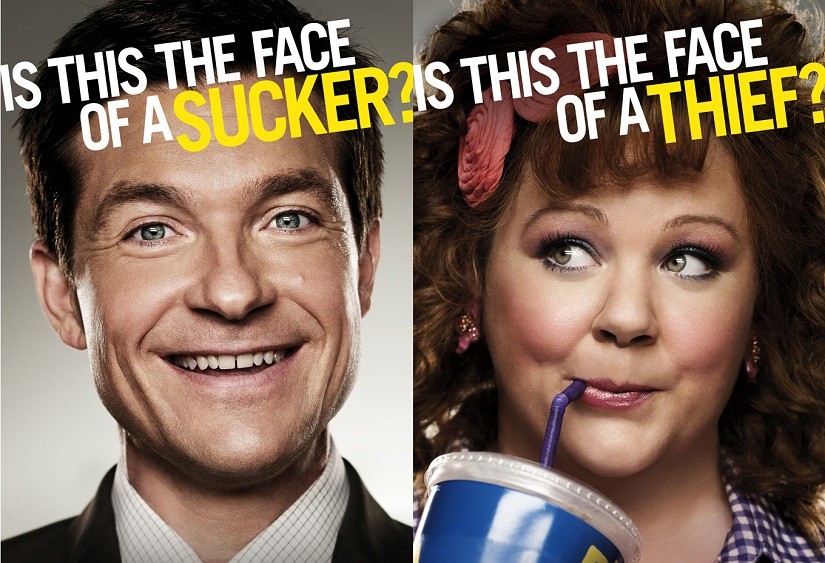
Definitely the sucker for paying full price...

Definitely the sucker for paying full price admission to this…

So what if it’s #1 at the box-office and as god-awful a movie as you can almost imagine  (well, certainly according to Salon).  And who cares if I will never get back those two hours and my artsy colleagues condemn me for it.  (Note: I actually enjoy the fact of the latter.  Remind me sometime to tell you the full story of how my very positive review of 9 to 5 in the eighties caused one of my fellow Variety film critics to fling his reporter’s notebooks halfway across the newsroom in unmitigated rage).  But at least in the case of Identity Thief it was an attempt on my part (if not the filmmakers’) to do something different.

Okay — I will admit that given the sheer nonsensically incoherent script choices made in Identity Thief I might have made the wrong choice here.  Okay, let me be more blunt – I might have (might have?!) screwed up.  This choice didn’t work at all as a film so perhaps it might have been better to have students watch a much more blatantly commercial film of that type that I knew did work brilliantly (e.g. Forty Year Old Virgin).  There’s only one problem — this is not the 2005 Virgin world of Hollywood.  It’s a different 2013 world a student needs to make their identity in.  So part of their education should be in knowing what to do and not to do.  To which this film illustrates the ultimate challenge.  Universally panned by the critics, probably the future winner of any number of Razzies and yet….it is the #1 film at the box-office this weekend with $36,500,000 taken in domestically in 3 days.  Screw up/Failure or Cleverness/Success?  Ponder that for a while and then consider your final answer to the question, rather than the film itself (which I don’t want anyone to run out and see), as your teachable moment.
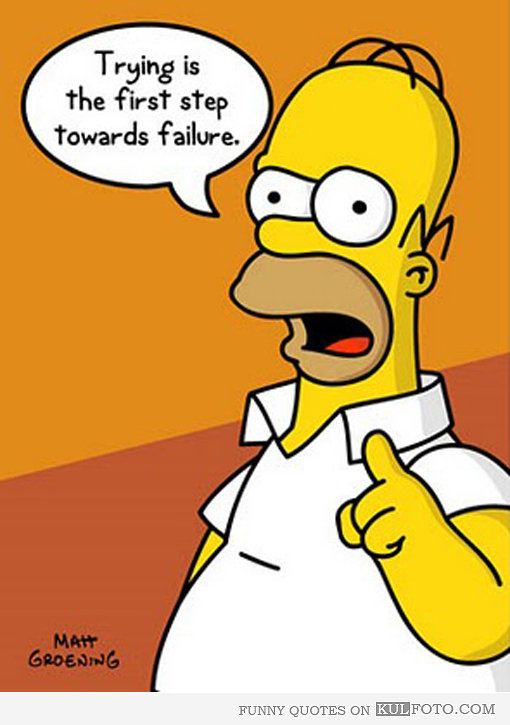
Or listen to the philosophy of Homer

Or listen to the philosophy of Homer

Mistakes came up a bunch of times at a recent WGA panel of Oscar and guild nominated screenwriters I took my students to attend.  It always does when writers talk among themselves – as well as other similar themes such as failing, honesty, creativity and discipline.  I suspect this is the case when you gather a group of any creative types – actors, directors, designers or visual artists.  Or maybe even plumbers or insurance salesman or accountants.  Who is to say that there are not these fears (or creativity) among them?  The medical plan that should never have been recommended; the copper pipe system that was not needed or too good to be true; the balance sheet that someone concocted to save their own asses instead of their clients.  Obviously – there is a theme here.

But I can’t speak to those nor would you probably want to read about them since we all know that for some reason, show business is EVERYONE’S second, if not first business.  What I can speak to is a few moments at the panel this week:

  1. Writer’s Guild president Chris Keyser noting that like many professions, writing is a solitary one but that “we write alone – together.”  That we are listening to nominated screenwriters on a panel who no doubt at one time listened to or read about Charlie Kaufman (Eternal Sunshine) and Callie Khouri (Thelma and Louise), who in turn also learned from Robert Towne (Chinatown) or Alvin Sargent (Ordinary People), who each probably heard or watched work by Paddy Chayefsky (Network) and Joseph Mankeiwicz (All About Eve), who took advice from  Carl Foreman (High Noon) and Daniel Taradash (From Here to Eternity).  Look up any of these esteemed writers and you’ll also find they all share something else — ALL have written at least one really bad movie, not to mention some of the other scripts you don’t know about.  In other words, all have screwed up – big time.
  2. Screenwriters Mark Boal (Zero Dark Thirty) and John Gatins (Flight) correcting moderator-screenwriter Dustin Lance Black (Milk) on his assumption that all writers search for absolute truth in their films.  Both agreed that absolute truth does not truly exist and even if it did, would be deadly dull if played out in real time.  Instead, what both require of themselves is honesty and authenticity amid many days, months and years of frustrating roadblocks and missteps along the way.
  3. Stephen Chbosky, novelist and screenwriter/director of Perks of Being A Wallflower, who freely admitted to a 200 page first draft screenplay, much of which had to be junked because of all of the unnecessary subplots he had included – a method of working he recommended to nobody else but one that he sheepishly admitted finally did work for him.
  4.  Roman Coppola, who co-wrote Moonrise Kingdom with director Wes Anderson, speaking to an audience question about the best piece of writing advice he had ever gotten. I f you closed your eyes and just listened, Mr. Coppola sounded exactly like the vocal incarnation of his father, master writer-director Francis Coppola, so it was particularly jarring to hear him pass on these words of wisdom from Coppola, Sr. (a symbolic writing father to many) which RC said were ones from centuries ago taken from novelist Alexander Dumas: “First act – clear.  Third Act – short.  Interest – everywhere.”

So inspired was I by these words that I went home and looked it up to find out more.  But instead what I found was that Roman, or perhaps his father, was mistaken and these words were apparently the advice of not Dumas but another esteemed, centuries old novelist – Honore de Balzac.

But who really cares (except maybe Balzac and he’s dead)?  Because despite the mistake of whomever – Francis or Roman or perhaps me in telling the story – the message was no less truthful or worthy.  This is important to remember not only in the subject of writing but also in an attempt to say or do anything meaningful.  Mistakes will be made but it’s what is really being said that counts – whether it’s from a director’s chair on a stage in Beverly Hills, in your house or apartment in a private conversation, or, most importantly, even only in your own mind – to yourself.

Dickens, The Super Bowl and Me

ARGHHH

ARGHHH

I will never play in the Super Bowl.  But that’s okay because I don’t want to.  First of all, there’s the matter of concussions.  If you’ve ever had one, which I have, you would never ever want to risk one again.  Unless you’re a professional football player.  Which I’m not – nor do I ever want to be.  As I’ve said.

As horrible as it was to have a concussion, and it was – partly because for months afterwards you feel like bright lights are the devil spawn and everyone is speaking to you from a faraway land in an only oddly familiar language (Note: Do not confuse either of these conditions with life in Hollywood) – it has also informed my life in many good ways.

I walk much more carefully down slippery floors, treasure almost every moment I can concentrate for more than 5-10 minute stretches at a time, and literally bask in the knowledge that not being good at sports like football no longer makes me a nerd but a wiseacre who knows how to play the long game of life.

I can be flip about all of this now because my “concussive” and “post-concussive” days happened approximately 20 years ago and feel like a chapter out of someone else’s past life.  However, this was not the case at the time.  Like a section of a good, classic novel by someone like Charles Dickens, the moments can be re-read or relived with a sense that this is the moment that will exactly define our main character (us?) forever.  That it is this dramatic occurrence, or this particular occupation, or this specific life circumstance that is who this person IS and primarily ALWAYS will be.

My life in clipart

My life in clipart

But in the case of the novel, that is only because Dickens was an exceptional writer who can make us believe it to be so — until he unveils yet another twist and turn in his story that will take his reader on yet another path.  In real life, we have the choice of a writer EVERY DAY to rewrite our chapters and redefine the focus of our existence.  That’s why the stories of lives are much messier than the stories of books, plays, screenplays or short stories.  We create our own dramatic structure (some would argue that many good writers also do this but that’s the subject of another discussion) and don’t have to amuse our audience – only ourselves.  We’re free to have our chapters go off on tangents, or have our main character make seemingly inexplicable and unsatisfying decisions, and to do both for as long as we choose despite the best advice or preference of others.  In fact, we can keep doing the ill-advised and never learn a lesson until the day we die AND we can do it all and still be an unsatisfying anti-hero because we have chosen to have our lives have no overall dramatic point WHATSOEVER (though it might serve as a lesson of what not to do for someone else, but there’s no way of controlling that).  In short, we can screw up, do the unexpected, chase dragons we never slay AND have a great or bad time doing all of it if we decide to do so.

Yet the ONE area where our lives are EXACTLY like a well-constructed story is this – every single action or decision or job or mini-life that we live will cause another future action that we take or a detour that we seemingly spontaneously choose to travel down.  Just as my concussion caused me to change the way I glide upon shiny surfaces, or to appreciate my intellectual life as a non-football player, your horrible job experience with the boss from hell in a given field can cause you to change career directions to pursue something else, enable you to bear down and speak your mind and create a change that will steer you to a more preferred position of power in this same field, or perhaps free you to focus more time outside your work life which will then cause you to meet the love of your life – or the lover who will forever change your life.

In writing classes this is a simple concept called “cause and effect.”  Meaning every decision a character makes – every single one – opens some small or big door for something else to happen – something inevitable that would not have happened if that small or big door had not been pried from its resting place earlier.  Syd Field, a much unfairly maligned screenwriting guru from the seventies who taught me quite a lot at one period of my life, rightly compared this to the scientific theory of Sir Isaac Newton’s laws of motion.  Neatly summarized in non-scientific language – for every reaction there is an equal and opposite reaction.

Always better with a Cookie

Always better with a Cookie

It has come to my attention as a teacher of college students and a professional writer in Hollywood, and as a mere human being, that many of us still don’t exist as if we believe this – for both good and bad.  But here’s the dirty truth:

THIS. IS. NOT. AN. OPTION.

Nor do we want it to be.  Cause and effect is a kind of magic – one that goes along with making choices and not knowing what the result will be.  Not every choice will have a big, opposite reaction or, if it does, it may not set something big in motion that is recognizable until many years or even decades later.  Or – it might.  But that seemingly bad choice now might turn out to be a good one, or a good lesson, in hindsight for you and who you are.  That is why I spend a lot of time telling my students, and myself, that truly there are no wrong choices – only choices.

I mean — I and others might not understand why you could ever think the first season of Smash is well-written but heck, maybe it’ll lead at least one of us to write a better musical for TV one day – or at least a cool piece of journalism of what the blankety-blank went wrong with a show chock full of so many accomplished professionals. 

Don't worry Deb, we smell it too!

Don’t worry Deb, we smell it too!

At the very least, perhaps it will inspire me to re-examine my love of Broadway – or even television – and become an opera or ballet aficionado.  After all, one man’s train wreck, is another one’s object d’art.  Or wrecking ball.

You might think what you are doing right now in your life is unsatisfying and ultimately insignificant, or so perfect  that you are positive you will be doing just this forever, but – quite simply –  that is mostly not the case.  Sen. John Kerry, who I voted for but am not a groupie of, acknowledged this some days ago when he spoke to the Senate and the world as a senator one last time just as he was formally confirmed to follow Hillary Clinton as our next US Secretary of State.

Choking up as recalled his long career as a Massachusetts senator and remembering the names of two even more famous politicians from his home state who came before him, he admitted:

“Standing here at this desk that once belonged to President (John F.) Kennedy and to Ted Kennedy, I can’t help but be reminded that even the nation’s greatest leaders — and all the rest of us — are merely temporary workers.”

To embellish on Kerry’s statement, and why not – add one more thing.  His presence in the Senate is no different than anyone’s presence in any particular job.  We’re all, all of us, doing temp work.  In fact, we are all also temporary.

Sure, but Kerry’s going on to be freakin’ Secretary of State from being a senator and I’m stuck in a dead end job getting coffee, or a dead end relationship not getting much of anything at all, you might argue.  Well, to that I say – how do you know how it’s going to turn out for him?  Or you?  This is just one moment among many for the man who lost the presidency to, uh…..George W. Bush just eight years ago.  To repeat, like many of the rest of us, he lost to George W. Bush!

Was it my wife?? Really?

Was it my wife?? Really?

Here are some other salient facts about a few random people you might have heard of to take into account.  Did you know at one point in time Andrea Bocelli – the Italian opera singer who was blinded at 12 years old after a football accident, AND has sold ore than 80 million albums worldwide, AND someone who you might find annoying or brilliant depending on your personal POV – was at one time thought of as a….court appointed lawyer??   Uh, yeah, that was what he did in his twenties.  You might also want to consider that at age 12, after his football accident, he was also merely a kid in Italy whose parents so wanted him to see once again that they allowed his doctors to desperately resort to treating him with…leeches?  I’m not kidding.  Were the leeches or the law merely side roads or did they in some way contribute to who this guy is today – well, only Dickens could probably be worthy of connecting the dots story-wise on that one – or would care to.

Want more?  Well, you know that Harrison Ford was once merely the hunky California carpenter next door who was married with a kid, and a part-time actor, until one day he happened to be working for a guy in the film business named George Lucas who decided to cast him in a few movies? (uh – Star Wars, for one).  Or that Marla Gibbs, the iconic sassy TV maid of the 1970s and 80s as seen on The Jeffersons was primarily known to friends, family and many other co-workers as a sassy airlines employee– a job she kept for the first three years of that hit series.

Yes, in this scenario you are Indiana Jones (you're welcome)

Yes, in this scenario you are Indiana Jones (you’re welcome)

Obviously, I could go on with a lot of examples.  Plus, we haven’t even gotten into what will happen or not happen in five, 10 or 20 years to your doctor, your waiter, the gardener down the street, your American Idol, the real life and fictional stories as told and lived by your favorite writer – me, Lindsay Lohan (let us pray) or — you.

It’s easier to use celebrities to illustrate this point because they seem bigger than life and it’s rules.  But they’re not.  Nor, are any of the rest of us.  Which, in the end, could be a very good thing.  No matter what you think of the decisions Martha Stewart has or has not yet to make.