Hollywood from the Couch

I spent part of this weekend binge-watching the first three episodes of the new, gay-themed Canadian sports romance series, Heated Rivalry, on HBO despite being told the death of the movies was upon us.

Once again.

In any other era this would be sacrilegious for a movie lover.

Let Me Explain GIFs | Tenor
Allow me to explain

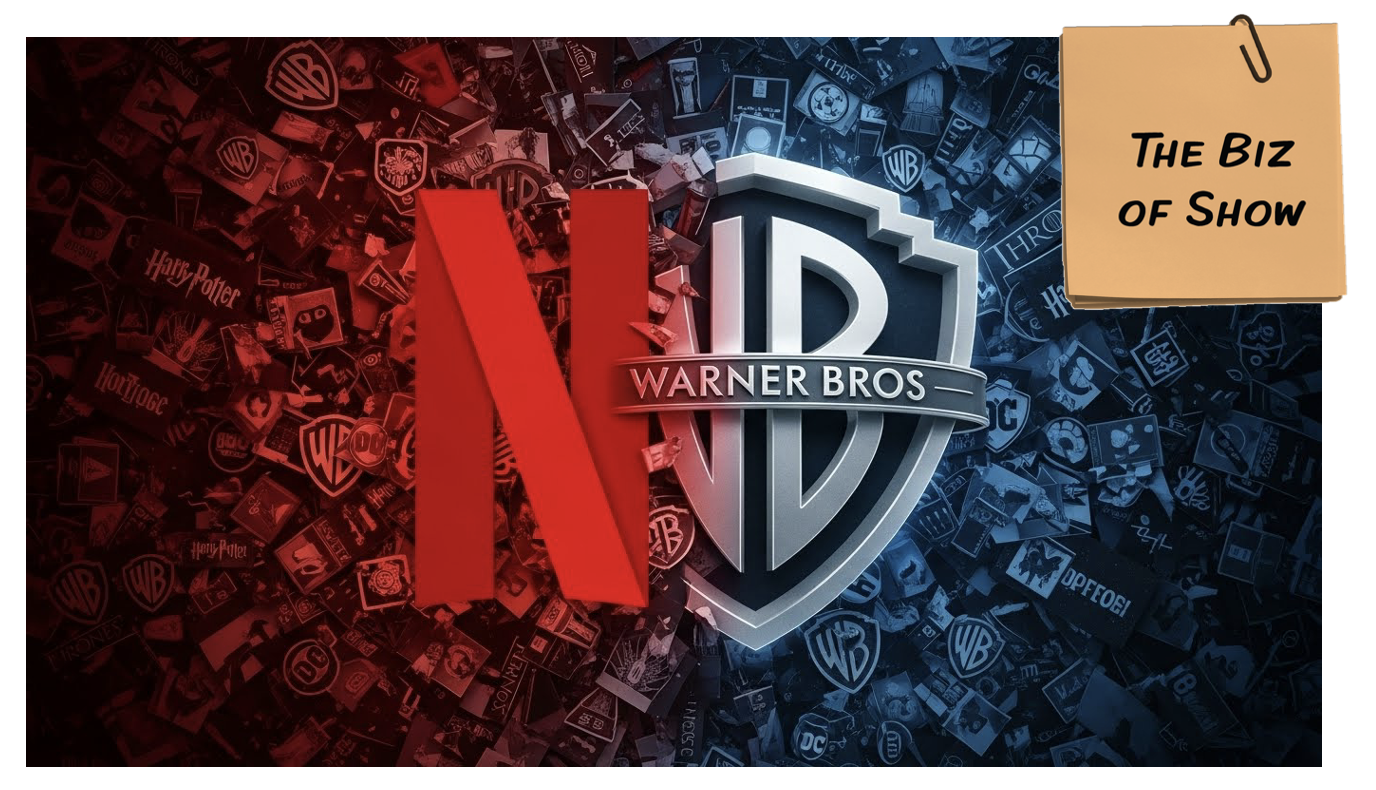
The funereal panic was related to the announcement that Netflix was buying Warner Bros. Discovery for the incomprehensible price (NOTE: To me, anyway.  I’m still smarting over $10 eggs) of $82.7 billion. A pending deal that, according to the N.Y. Times, could redefine Hollywood and the broader media landscape.

I have no doubt the above is true since Hollywood and media has been consistently redefining itself every couple of years since I first became professionally involved with it in the late 1970s.

Yes, I have all the career, financial and personal battle scars to prove it.  And one night, over cocktails, I’ll tell you all about if you so desire.  
all about eve gifs Page 2 | WiffleGif
Maybe some snowy night by the fire…

But more to the point, I have all the iterations of media and my own work to prove it.

Unopened boxes in my closet that contain VHS recordings of rare movies taped from network TV, cassette and eight tracks of movie soundtracks (Note: And more than a few vinyl records), a neatly tied bundle of laser discs (Note: A very short but very cool tech period, in my humble opinion), many drawers of CD movie themes/songs I bought or were sent to me from studios during awards seasons or for promotional purposes, and several walls full of DVDs my husband and I love having on hand even though three quarters of them are available on streaming services.

Add to that hundreds of original screenplays, pilots and treatments (Note: Several dozens of them my own) of very good work that was never made because they weren’t big enough, commercial enough, contemporary enough, relatable enough, young enough or just plain enough enough for the theatrical film market as it stood at the time.

Speaking for those projects that I DID NOT write, since no one can be objective about their own work, I promise you that determination is and was BULLSH-T since all of them could have been enough if given the chance.
Hi! I'm Anxiety. — World of Miley
Ya got that right

But, of course, it depends on what you mean by enough.  My definition is a film, or potential film or film element, that is entertaining or meaningful or satisfying to  group of people other than your friends and relatives. 

The theatrical deciders’ definition is a piece of material that will make them unlimited scads of money for the smallest amount of risk despite the tried and true adage, Nothing ventured, Nothing gained.

Scrooge Mcducking GIFs - Find & Share on GIPHY
Main priority

Meaning, screenwriter William Goldman’s summation of the movie business and all its marketplace gatekeepers in his seminal 1983 memoir Adventures in the Screen Trade still, and perennially, applies:

NOBODY KNOWS ANYTHING.

What especially no one knows anymore is what a movie is by 2025 and beyond standards and how it should or will be consumed. (Note:  Consumed?  What a horrible but applicable choice of words, as if we’re eating soylent green, though in a sense we are).

The chief complaint about Netflix and other streaming platforms is that their mere existence spells the death knell of the movie business, and the fact that it’s gobbling up one of what remains of a handful of big Hollywood studios ushers in the end of “movies.”

Well the view from my office would certainly change

After all, what incentive does Netflix have for people to watch a film outside of their homes, in a theatre (aka, the definition of a “real” movie)?

About as much as David Zaslav, a former cable/streaming exec who was put in charge of theatrical when he was made CEO of Warner Bros. Discovery in 2022 cares about it. 
Skeletor From Masters Of The Universe Trivia
His company portrait

Though probably more, since one of Zaslav’s first acts when put in charge was a cost-cutting measure that would’ve ended the one cable channel most beloved by movie lovers, TCM (Turner Classic Movies), as we know it, until filmmakers Paul Thomas Anderson and Martin Scorsese and others stepped in to exert a little… ahem… pressure.

Trending GIF oscars academy awards martin scorsese oscars 2020
Bless you, Marty

This while Netflix stepped up and made movies and deals with some of the top directors in the movie business, including Martin Scorsese (The Irishman), Guillermo del Toro (Frankenstein), Rian Johnson (Knives Out II and III) and Greta Gerwig (the upcoming Chronicles of Narnia) and her husband Noah Baumbach (the just-released George Clooney starrer, Jay Kelly). 

All of these films have had or will have theatrical runs of various lengths and all the work of these and most other filmmakers will likely continue to do so.

Are they or will they be as long as they used to be?  Well, um, no.

Debating GIFs | Tenor
I mean… I think I could be OK with that

But to all of the movie consumers out there – nerds, intellectuals, horror fanatics, foreign film fans, the super-hero obsessed or rom-com fanatics – how many times have you uttered these four words in the last number of years:

Is it streaming yet?

a man in a yellow jacket is waving his hand
Guilty!

It is worth noting the film most likely to win this year’s best picture Oscar and, for my money, the best film of 2025, Paul Thomas Anderson’s One Battle After Another, was a Warner Bros. release that played a mere eight weeks before being available to rent or buy on streamers. 

This is not very long at all by traditional standards. And will undoubtedly vary depending on how much demand there is to see a film and how much money can be made on them.

One Gif After Another : r/paulthomasanderson
… and there he goes

I used to marvel when my parents recounted to me there was a time that they huddled around the RADIO to listen to original serialized storytelling.  The same way I did to my husband a few years ago when I suddenly realized true crime podcasts were becoming the new commercial “thing,” making something very recognizably radio popular again.

Do I long for the old days of movies?

Not so much.
23 Classic Hollywood GIFs That Are Better Than A Time Machine
I’m with Margo

What I long for instead are the days of more good and great movies and less pure commercial garbage for the mythical lowest common denominator, non-thinking international, four quadrant audience.

And on that subject, I’d put more faith in Netflix than in the guy who treated Dr. Pimple Popper and 90 Day Fiancé with the same reverence as a Scorsese or Nolan film when he first listed them on HBO Max.
35 Funniest Someecards Ever | Bored Panda
Nuff said

Not that there is anything wrong with any film or TV show of any kind. Including the steamy Heated Rivalry, which I have every intention of watching in between this year’s Oscar movies – at the theatre and at home.

On my couch. 

Doom scrolling.

The Beach Boys – “In My Room”

Serling, Lear & Goldman


No, this is not a law firm.  As far as I know.

These are the names of three show business icons better known as Rod Serling, Norman Lear and William Goldman.

It’s not a good idea to trot out words like icon or legend too often.   You sound like a syndicated talk show host whose sole purpose in life is to overpraise someone more famous in the hopes that it’ll do you some good.

Think Mike Pence whenever he’s in the presence of the Electoral College POTUS.  (Note: And how could you not?)

Let’s hope that’s all he is #Mueller?

Still, there are some cases where the word icon feels exactly right, especially if we are to believe the dictionary definition:

Icon: A representative symbol of something.  Synonym,  idol, paragon, hero. 

Certainly Mr. Serling, Mr. Lear and Mr. Goldman are all of the above and more to most everyone in the writing trade, the entertainment industry and by extension, through the reach of their life’s work, the world.

Hyperbole?  I think not.

Thank you Stefon

In the last several days I was reminded of the gargantuan achievements of these three writers, all born within 10 years of each other, for completely different reasons.

William Goldman, who died this week at the age of 87, was for years the most respected and highest paid screenwriter in the business.  Consider the movies from over 40 years, beginning with Butch Cassidy and the Sundance Kid, then on to All The President’s Men, Marathon Man and The Stepford Wives and then back around to The Princess Bride, Chaplin and Misery and you might begin to get some idea.  If not, you can throw in tons of uncredited rewrites on things like A Few Good Men and Good Will Hunting and perhaps it will get clearer.

The Real Deal

It was William Goldman who introduced the infamous phrase follow the money into the lexicon of political writing via his Oscar-winning screenplay for All the President’s Men.  Peruse his other scripts and you will no doubt find many others.

Just ask Wallace Shawn  #asyouwish

Though none of them will even come close to his three-word perfect summation of the movie business:  Nobody knows anything.

For those not directly involved in the industry, here’s a full sentence of his  elaborating on that thought:  Not one person in the entire motion picture field knows for a certainty what’s going to work.

That and a lot more were written by Mr. Goldman in his 1983 seminal book on navigating Hollywood, Adventures in the Screen Trade.  But more than anything else, those three perfect words – NOBODY. KNOWS. ANYTHING. gave hope, courage and permission to a generation of people starting out in the business, myself included, to soldier on and persevere.

Cheers to you Mr. Goldman

His screenwriting work was brilliant, and he wrote a bunch of fine novels (on some holiday vacation read his first, Boys and Girls Together).  But his ability to so bluntly tell the truth about what he experienced and observed extended far beyond fiction or the movies.  He gave so many of us who had our noses pressed up against the glass the belief that the people we thought we had to impress didn’t have all the answers – we did.  All we had to do was to tell the truth through our work and we had as good of a shot at making it as he did.

Rod Serling and Norman Lear might not seem a natural combination at first mention but when you give it some thought it’s exactly right.  They were born within two years of each other in the 1920s and though Mr. Lear, now 96 and still active, has lived twice as long (Note: Mr. Serling died prematurely at the age of 50,) each writer changed the face of television by being fearless in their own very specific ways.

.. and both have a signature look

By his early thirties, Rod Serling was already an accomplished playwright and Emmy award-winning writer devoted to telling meaningful stories that touched on social issues.  Still, he was known in the biz as a bit of an upstart who had grown weary of battling corporate sponsors and executives too timid to support the kind of tales he wanted to tell.

That was when he got the idea to write in the more commercially appealing science fiction genre, grounding his characters in a way so relatable it would enable him the ability to tackle such timely themes as war, racism, class, politics and censorship.

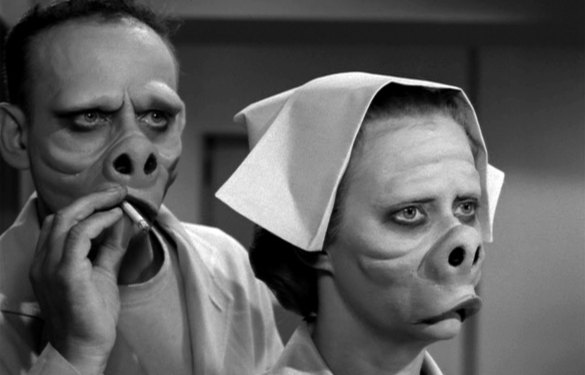
Like you’d ever forget these faces

One can hardly imagine when The Twilight Zone first aired in 1959 that even he could foresee the enduring legacy of that groundbreaking anthology series.  Not only does it still run all over the world more than half a century later, it has been reinvented as a feature film, in numerous television spin-offs and remakes, as well as homaged in the music world.

Most recently, Jordon Peele was announced as the host of a new CBS reboot of The Twilight Zone set to air in 2019.

But perhaps even more impressive is the fact that those three wordsTHE. TWILIGHT. ZONE. – are now embedded as a permanent part of language and pop culture as we know it (Note/Nee: Being an American these days is like living  in The Twilight Zone) that will forever be associated with its writer and onscreen narrator.

It was in that spirit this past week that Ithaca College presented Norman Lear with its annual Rod Serling Award for advancing social justice through popular media.   (Note: Serling taught at the college in the 1970s and his archives are housed there).  As a professor and Chair (Note: Ahem) at the school’s L.A. program, I got to be part of that evening and had a front row seat to Mr. Lear’s sharp as ever comic timing and humility as he got up to the podium at L.A.’s Paley Center to accept.

The man himself, pictured here with Ithaca College’s Park School Dean Diane Gayeski, and One Day at Time colleague Mike Royce

Anyone who has watched television comedy in the last fifty years has likely seen one of Mr. Lear’s shows and the majority of we baby boomers came of age on them.

To watch a first-run episode of All in the Family in the actual era it came of age was to see for the first time in half-hour prime time TV an unvarnished version of ourselves and our extended families in all of our inglorious prejudices, ignorances and, ultimately, humanity.  No one had ever used THOSE WORDS before on the Big Three networks despite the fact that they used them and we heard them every day of our lives.  Heck, no one had ever even heard a toilet flush on TV before the series did it in 1971!

Archie is not that impressed

Mr. Lear also gave us the first upwardly mobile Black family (The Jeffersons), the first TV comedy episode to ever deal with abortion (Maude) and the first divorced prime time mom of the era (One Day At A Time).  (Note: The latter also recently rebooted on Netflix). The fact is if we don’t see an immediate connection between the subjects tackled by the fictional law partners, Serling and Lear, it is merely due to our own shortcomings, not theirs

Among the unplanned comic gems during Mr. Lear’s acceptance speech at the Paley was the moment when his iPhone began to audibly ring.  He stopped mid-speech, instantly reached into his pocket and saw it was a family member, began a conversation with her, and, without missing a beat, put it on speakerphone so the rest of us NOT at the podium could hear.  Most actors, not to mention us non-96 year old pros and non-pros, couldn’t rehearse this and get it right (especially the speaker part) never much less be funny in our ad-libs to a faceless voice.

More skillful, however, was what came next. After he said of his TV work: I didn’t do it alone  he went on to reassure his many admirers that he really is only a person who gets up in the morning, eats, goes to the bathroom and then goes to sleep at night – just like they do.

Don’t mind me.. getting emotional over here

Then suddenly he, and then the room, fell dead silent as he contemplated this for a few VERY long moments.   As we all got concerned something was wrong, he finally looked down, then right back out at us, and said:

You know, everything in life led me to this moment.  Isn’t that something?

At which point he let some more time go by, evoking more silence once again, until he reiterated:  And to this one.

Then once more again, echoing:

And that one.  Everything you have done before has brought YOU right here…..Think about it.

One couldn’t help but wonder if what he was really telling us was that taking in the moment, really feeling it, and then sharing those feelings with others, was not only the key to his art but the secret to life.

Of course whether that’s true or not is in the eye of the beholder. Since, let’s face it, nobody knows anything.

“Those Were The Days” –  Theme from All in the Family