The Jury is Out

It’s been a whirlwind week in Hollywood.

The actors and writers are now both officially on strike, essentially shutting down film and TV production pretty much across the board.

Shut. It. Down.

At the same time, a TV show called Jury Duty, where writers and actors work together in a tightly planned but loosely scripted/partly improvised new type of workplace comedy/mockumentary/faux reality program, received four Emmy award nominations, including one for best comedy series.

Amazing what members of those two unions, along with help from many of the others, can do when they join forces.

A true ensemble (in front and behind the camera)

The conceit of Jury Duty is that one unsuspecting real-life person (Note: As opposed to the rest of us perceived fake ones who work in Hollywood) is filmed serving in a three-week trial that ONLY HE DOES NOT KNOW is fictional. 

But rather than be the butt of a cruel joke, he instead emerges as the HERO of the story, reminding us that not every random human in the world is the piece of sh-t we default think they might be these days.

Even in Hollywood.

It helps to have a hero as lovable as this guy

The success of Jury Duty depends on the close-knit collaboration between a group of dozens of actors playing jury, judge, lawyers, defendants and court employees, with the writers who created not only their characters but the countless scenarios, plot points and alternate scenarios and plot points designed to bend to the spontaneous will of the one real life character among them. 

In some cases writers double as actors, actors wind up writing (Note: Okay improv-ing via what WAS written) as they try to bring back the hero to the point of the scene, and non-acting writers huddle off-camera to create some new tweaks and challenges that will play out the quirky humanity of the characters and story actually being created to maximum effect.

LOL

It’s not that the producers, directors and crew of Jury Duty are not essential to pulling this gargantuan effort off.  But it’s that special sibling-like kinship between writers and actors that has existed since storytelling began, that conjures the magic everything else draws from.

Binge watching all eight half-hour episodes Friday night after a week of listening to the overpaid, stone-brained studio and corporate heads (whose businesses only exist because of all of this magic) bitch and moan about their 21st century shifting business models, provided some temporary relief.

Marsden earning his Emmy nom

(Note: This week it was the newly two-year contracted, at $50-$60 million plus salary, Disney chief Bob Iger, calling working actors’ requests for some guarantee that a machine couldn’t duplicate their digital likeness from one day of work, in perpetuity, and over as many projects as they like, UNREALISTIC.

Unrealistic?

Oh I know he did not just say that

The only thing unrealistic is that studios and streaming platforms across the board WON’T do this and more.  And maybe take their first-born.  And if you don’t believe me, check out my post from last month about Black Mirror’s sadly prescient and pandemic-written season six opener, Joan Is Awful.).

Nevertheless, all of that writer-actor simpatico on Jury Duty was also energizing to me as a member of both the WGA and IATSE, and as an admirer of the many talents of so many unknown, just plain working actors I’ve come across over the years.

Because it reminded me of what we can do together.  And how much power that partnership wields.

Imagine what we could all accomplish at a Margaritaville!

Jury Duty might not be your thing but it is yet another strange, new iteration of hybrid storytelling in a hybrid media world desperately in need of something new, and maybe even…..original?

It started as a workplace comedy by two veteran workplace comedy writers, evolved when some executive producers associated with iconoclastic actor Sacha Baron Cohen’s Borat suggested the faux reality element, and went on from there.

Borat wasn’t my thing but Jury Duty was.  Go figure.  I tried to and suddenly my mind went to Netflix’s Squid Game, also not my thing but certainly as original as either of the former two.

And so it goes.  And goes. 

Until it is gone.

All the feelings

Not everything can be Casablanca, One Flew Over the Cuckoo’s Nest, E.T., Raging Bull, Titanic, Parasite, or heaven forbid, Top Gun: Maverick and Mission Impossible – Dead Reckoning Part One. 

Nor should it be.

Still, if you don’t respond to mixed media metaphors think of it this way. 

The great Norman Lear created Archie Bunker, loosely based on his father, but the equally great character actor Carroll O’Connor brought him to life.

The same way Tony Soprano came from the complicated mind of Sopranos creator-writer David Chase, only to be made indelible by the until then unrecognized brilliance of another late, great character actor, James Gandolfini.

The man made picking up his newspaper iconic

It is these kinds of collaborations that moves entertainment forward and allows it to reach new heights.

Not only onscreen but off.

Amazing what writers and actors can do when they partner up, especially when their own very real lives are at stake.

The studio and corporate heads may not be listening now. 

But they will.

Or their entire new 21st century business models will fall apart.

Fran Drescher’s SAF AFTRA strike announcement

The Circle of Strike

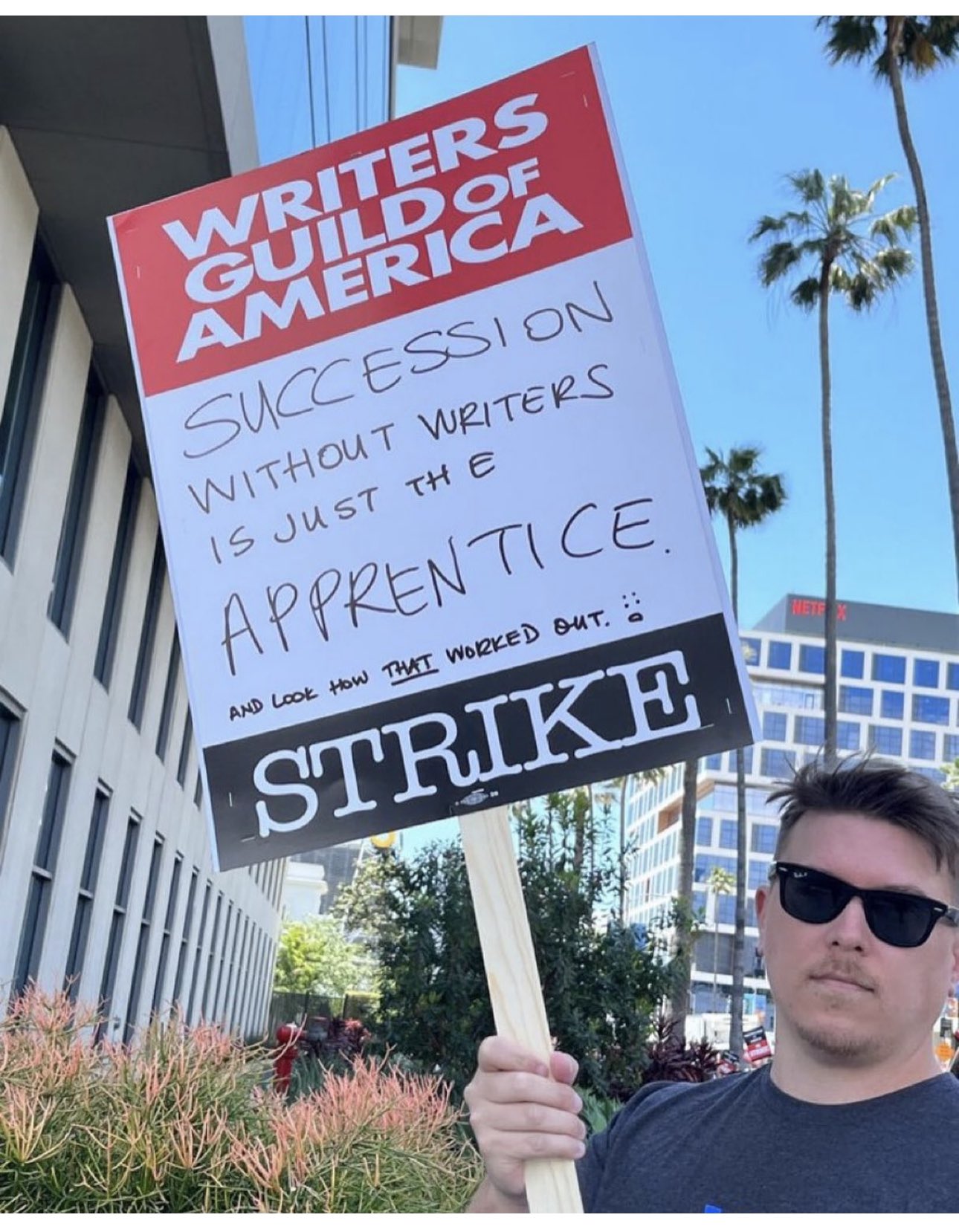
Nothing cheered me more than when a small group of my Thesis TV writing students, on their own, joined the Writers Guild of America picket lines one morning this week across the street from our classroom.

Marching shoulder to shoulder with the professional scribes they aspire to be, they understood they were fighting for the preservation of the writing profession in television and film, as we know it and as they hope it will still be by the time they get hired.

WGA is Gorges! #ICwriters

Of course, this didn’t happen in a vacuum. 

The night before, for their last class of the semester at the Ithaca College Los Angeles Program, I invited two working TV writer-producers, who also happen to be former students that sat exactly where they did 10 or so years ago, to hang out and give them advice, assurance and a reality check on what it takes to persevere and have a career.

Writers being who they are, regardless of age, the discussion was alternately funny, brutally honest and incredibly thorough.  It smartly told you everything you needed to know, and then some.

I mean, let’s face it, give people who are hired to speak to the page in words instead of out loud a stage and, well, it’s hard to shut us up.  Especially when we have a captive (Note: and younger) audience.

It’s the best!

Nevertheless, it felt like there was a real meeting of the minds with this group and their elders, both of whom are still significantly younger than The Chair. (Note:  don’t even ask).

Three generations of writers with many of the same questions and stories about process, money, anxiety and creativity.  We were all so different yet undeniably and incredibly similar.

The deep down belief in one’s talent bundled with the sneaky self-doubt.  The humor covering the sensitivity, or the angst masking the hysteria of the insult lines we’d never have the nerve to speak.  The eagerness to be heard and the desperate desire to tune out those who refuse to see us, or will never understand us, or simply piss us off.

Nothing has changed at all.

We’ve all been there

It reminded me of that moment in the eighties when I was lucky enough to meet the great screenwriter Julius Epstein, who along with his brother wrote a little classic film we call Casablanca. 

It was at a party held by a writing mentor friend of mine that Mr. Epstein, then well into his eighties, was deliciously delightful and brutally honest.

To paraphrase his thoughts about studio notes on his most famous film:

Do you think they had any idea what it was about or any suggestions that made any sense?  No!!  Just nod along and pretend that they do.  Then go off and do what you want.  Idiots!

Honestly, I don’t even think I’m embellishing.

Just keep spinning

Several years later, when I attended a big meeting at the WGA Theatre in Beverly Hills around the time the guild was about to strike over DVD residuals, among many other issues, former WGA president Frank Pierson, by then a veteran writer-director, had pretty much the same message.   However, he made it in a pointed, much more public statement to an entire auditorium of writers.

His rebuttal to those afraid of striking for what they deserved was something akin to:  How do you think the union came about?  This is what we HAVE to do.  If we didn’t do it we wouldn’t even have what we have now.  If it were up to them, we’d have nothing.

And know the only reason I am not giving Mr. Pierson’s dialogue its own paragraph is that I am 100% sure his words were more laceratingly surgical and eloquent than I could ever be.

Yet, message-wise, they’re the same.  And I passed it along to my students, all of whom were also astounded to learn that before the fifties not only were there no residuals or any share of any profits, but that you could be forced to share credit with a producer’s nephew who never wrote a word of your script if the studio so desired.

Truly the Wild West

Because of these men, and many thousands of other women and men like them, writers who are fortunate enough to land a job telling stories in film and TV make a really good living. 

They realized it was their stories that were reaching millions of people and raking in hundreds of millions in profit for their employers, and that it was more than fair that they be compensated in ways that were commensurate to their very essential contribution.

What Mr. Epstein and Mr. Pierson, in particular, were saying, in their own inimitable ways, is that you have to stand up for yourself, especially when it’s tough.

They were also telling us that rather than think of the people that do the same job as you do as your competition, see them as your teammates.

And for that matter, think of any member of an entertainment union as a comrade.

Solidarity Forever!

That’s what the message was from Lindsey Dougherty, the tattooed secretary-treasurer or Teamsters Local 399, a few weeks ago to several thousand writers assembled at the Shrine Auditorium in support of the 2023 strike.

If we all want to get what’s ours, we are going to have to fight for it tooth and nail. If you throw up a picket line, those f—n trucks will stop, I promise you.

It was not always the case that entertainment workers above and below the line, or any industry workers for that matter, were this united.  But recent advances in technology have shaken up the business (Note: and many other businesses) and significantly changed the means of access and distribution all across the board.

Not to mention the rise of a new brand of knee-jerk nationalistic fascism that has seemingly caused every human roach to crawl out from every venomous rock they were hiding under throughout the world.  They unite the rest of us, too. 

Um… yikes!

Yes, there are specific issues for currently striking writers.  Among them are:

– The producers/studios/streaming platforms refusal to negotiate on the future of AI , e.g. using AI as a way to eliminate, or at least curtail, the future employment of writers. 

– The unwillingness of streamers, in particular, to come up with a realistic formula for calculating residuals to writers, and other creatives like actors and directors, that properly assesses the explosion of streaming revenue compared to what it was just five years ago.

– The determination of producers and studio heads to cut writing staffs in half or more on all of their series by using new technology and new distribution patterns as a way of turning writing into a gig profession of day-player free-lancers or cut rate full-time employees.

– A flat out “no” from all of the aforementioned when asked to address decades-long ongoing issues like multiple free rewrites for feature writers, citing the excuse of team spirit, or allowing animation writers across the board entry into the writer’s guild to which they have unjustly been denied because of a century old, outdated, industry categorization spear-headed by none other than the late, and very long dead, Walt Disney.

No doubt haunting us from his mansion!

The root of most of these issues, e.g. the changing ways we watch TV and film, will cut across the board to every member of every union when their contracts inevitably expire (Note: The DGA and SAG next month).  Prolific actor Seth Rogen, known for also being a stoner but on this subject quite coherent, recently put it in starkly simple terms.

I’m personally distressed by not having any sense of how successful these shows and movies we make for streaming services are. The secretiveness only makes me think that they’re making way more money off of all of us than they want to share with anybody. These executives are making insane salaries that you would only make if you are running an incredibly profitable business.

If there is one thing that Gen Z understands and wants is for others to be authentic and real, especially with them.  You might think they’re glued to their phones but that’s a meme about who they are from another generation’s mind. 

Don’t underestimate Gen Z!

In fact, they are actually listening and watching US.  And they will strike accordingly when they don’t like what they see and hear.

That’s why my students voluntarily took to the streets when two writers took the time to speak with them in person and asked them to join in the fight to protect the future they hoped to have.

And why many more will follow in a worldwide, multi-generational battle against corporate greed, nee fascism, all across-the-board…and win.

The Lion King – “Circle of Life”