Decades ago, when I contemplated running away from what I perceived to be some awful reality, a dear friend turned to me and said:
Wherever you go, there you are.

Oy vey, as the women in my family used to say. So true and so to the point, especially if you’d been through a few years of therapy, which I had been at the time.
And never mind that it wasn’t my friend’s original thought but a quote often attributed to the great Chinese philosopher Confucius, which means the urge to throw all your cards up in the air and flee has been going on for centuries.
Still, it helps to be reminded that you can’t run away from yourself, your thoughts or REALITY.

Fine Chairy, you watch the news, fight on and muddy yourself in the pigpen of 2024-2028. We’ll meet up in four years and see who’s happier.
Well, of course you can block stuff out or live in a dream bubble of your own making, but that kind of defeats the purpose of real life, doesn’t it? As one of my favorite movie therapists, Dr. Berger as played by Judd Hirsch, says to the troubled teen he’s trying to help dig out of the danger of self-harm in Ordinary People: If you can’t feel pain kiddo, then you’re not gonna feel anything else either.

I’ve been wondering if that’s still true post-election as I try to wade through my raging, unforgiving anger, aspiring for a self-imposed four-year real world blackout that I know will never come. But deep down I know it is. Every great thing that’s happened to me occurred because of my willingness to learn from a past mistake I chose, something unsavory I observed, or deep arbitrary pain inflicted by circumstances no one saw coming.
This is why some of the most popular and/or painstakingly personal artistic offerings choose to traffic in exactly this territory. Creativity doesn’t happen because creators look for these dicey moments to dramatize but because these kind of moments force individuals to use their art to cope with all of the hopelessness and misfortunes they observe or experience in the world and serve it up in some sort of vague narrative logic in order to process, make sense and eventually truly understand the darkest of their times So they, as well as you and I, may better continue on in the world.

This sounds way too lofty and twee to be true. On the other hand, that doesn’t make it any less true.
Witness two big budget movies I saw this weekend.
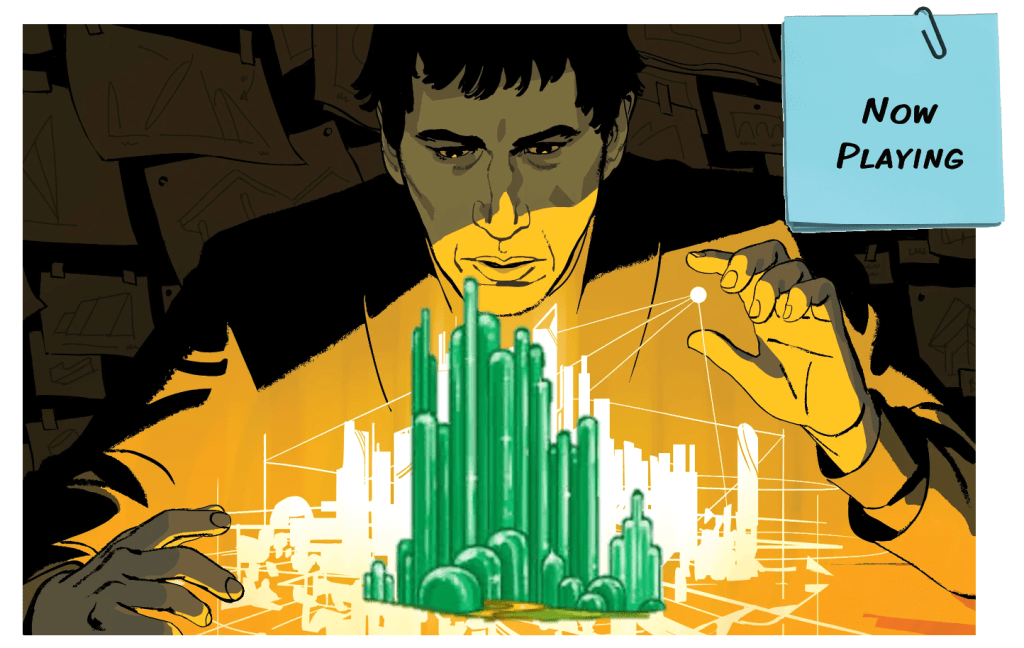
Wicked and Megalopolis.

Together they represent the most popular and the least popular out there at the moment. With seemingly nothing in common they are, in fact, quite similar in how they try to make sense of the charlatans of the world and their simplistically mean destructiveness and craven ambition and greed and lies to civilizations — and how precarious and unlikely it is in their stories that the truthtellers of the world will ever save society or, in the end, ever attain any form of personal happiness.
Which doesn’t mean its creators don’t try to give it to them.
Whether they succeed or not depends on your point of view and what you define as happiness. Just as who you resent, root for or turn your back on in each story depends on your personal definition of good and evil. (Note: No, there is no sound dictionary definition, as supported by the current state of our conflicting worlds).
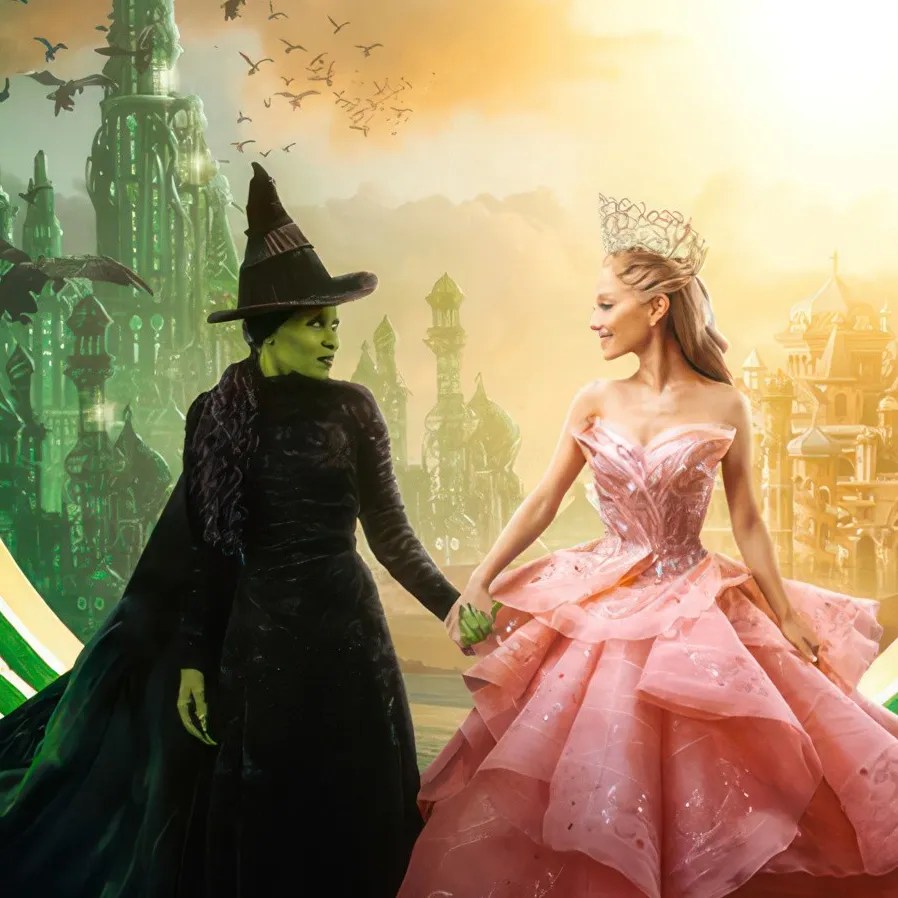
The stage musical Wicked (2003) was about many things, but chief among them for me was its existence as a thinly veiled parable for the eighties Reagan era of greed and avarice and “othering” of much-hated, maligned and morally objectionable minority groups, most especially gay people in the age of AIDS. Like the ailing animals onstage and their heroine Elphaba, we were scorned, hunted, disappearing and, in many cases dying, under a leader who knew all about those injustices but instead chose to blatantly ignore them and ride them to fame on the false myth of prosperity for anyone willing to work hard enough to make it so.
Americans have always loved a great myth, hence the American dream. But the one around Ronald Reagan, widely known to his fans and the world as The Great Communicator, was openly mocked and laid threadbare by songwriter Stephen Schwartz in the lyrics of one of the shows’ most beloved songs, Popular.
…When I see depressing creatures, With unprepossessing features
I remind them on their own behalf, To think of
Celebrated heads of state
Or specially great communicators!
Did they have brains or knowledge?
Don’t make me laugh!
They were popular! Please!
It’s all about popular
It’s not about aptitude, It’s the way you’re viewed…

Children’s author Gregory Maguire, an American living in London in the early nineties, wrote the novel Wicked (1995) as a way to delve into the origins of evil and in particular was influenced by a local murder case where both the victim and murderers were young kids He began to wonder what in their pasts could lead to such crimes and used his lifelong fascination with the film and books of The Wizard of Oz, along with his Catholic upbringing, to delve into what turned the Wicked Witch of the West, nee Elphaba, so awful. Not unsurprisingly given his religious background and the rise of Christian fundamentalism at the time, he made Elphaba’s cheating mother the wife of a minster in a passionless, oppressive marriage, who bore the child of her secret lover after drinking a green elixir, condemning her offspring to a life of literal, albeit magical difference. In other words, an undeniable “other.”
One could go back further to the 1939 film, based on the L. Frank Baum novels, but you get it. Each era emphasizes its villains and those cast in the shadows because of some action taken, often out of desperation, greed or even love, wrongheaded or well-intentioned though they might be.

In Wicked Part I (2024), now destined to be the highest grossing movie musical of all-time (Note: It’s hit almost $360 million worldwide box-office in just 10 days), Elphaba is played by a woman of color painted green, and her obvious smarts and extreme talents tower far above the male and female “mean girls” who relentlessly bully her at school. The smartest professors at school are animal eggheads with glasses whose intellect is rejected and marginalized. And the one minority in pseudo power, an Asian sorceress, is eventually exposed as a tool of the institutional status quo, a soulless toady willfully deceiving those she is meant to mentor in order to remain part of the elite ruling class under the great Wizard.
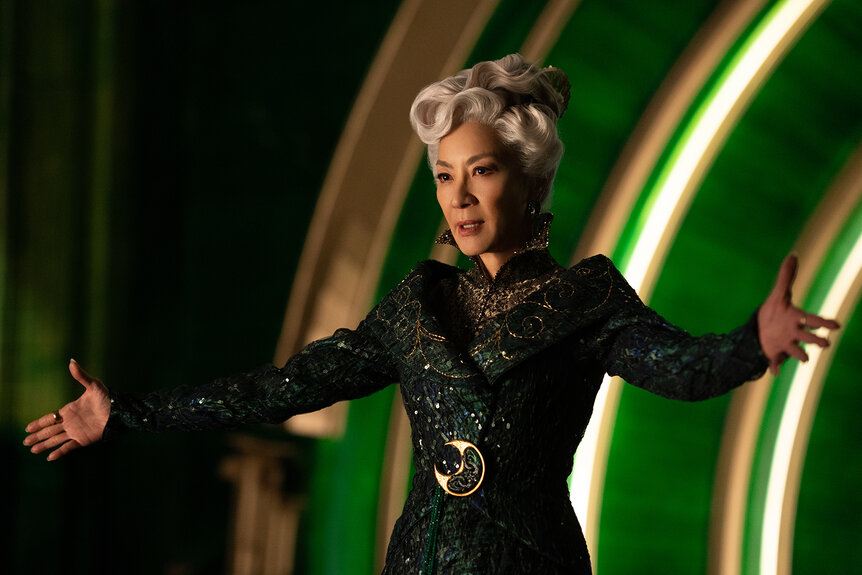
As for the Wizard himself, he doesn’t even bother to lie about his massive deceptions and the cruel intentions of his big scheme against those “othered” when Elphaba finds him out. He literally tells her: The best way to get people together is to find them a real good enemy.
If any of this sounds familiar to 2024 politics, it is VERY intentional. But only if one chooses to see it. Let’s not even get into setting aside the feel good fun and frivolity and fighting against it.
Which side of history we wind up on – the aspirational good or the ugliness of evil order in exchange for a few crumbs of pseudo security – is the primary question legendary writer-director Francis Coppola is choosing to leave us with in Megalopolis.

(Full disclosure: Coppola is one of my favorite filmmakers in the history of movies and the scale of his vision, overstuffed with ideas and always filmically compelling, is to me a worthy vehicle for him to go out on).
Yes, it’s a profound mess but in the best way possible because it takes for granted that movies are more than a stack of index cards shuffled together that use variations of a paint-by-the-numbers narrative paradigm to suture its audience into their seats by employing merely tried and true tools to elicit dramatic and comedic pleasures.

Coppola’s done that, reinvented that and stepped away from it, only to return and reinvent it again. I kept cheering to myself during all 139 minutes of him spending the capital he’s earned with us over the years in order to challenge us one last time about our futures by being both on-the-nose and hopefully obtuse.
The villains are diabolically 2024 and are meant to be so. Scions of a rich white family who are bloated, entitled and lazy – doing the minimal amount of work for the biggest reward. Trying to lead an ultra-right movement against the status quo, one of them screams to a cheering crowd of the economically oppressed: We Are Here, We are powerful and We are taking our country back!!!
If it weren’t so obvious, it wouldn’t be true.

The many more are distillations straight out of the fall of the Roman Empire. Literally. The costumes, the men’s haircuts, even the lead anti-hero, whose name is Caesar and is played Adam Driver, known for portraying any number of compelling/repelling movie leading men and villains with equal aplomb. Here he’s clearly a surrogate for Coppola himself, a visionary artist (Note: In this case an architect and discoverer of magical compounds) with manic tendencies, who is in one moment heralded as a genius and in the next met with bile-dripping disdain as a dishonest, poser has-been.
Caesar drinks, does drugs, hurts the people he loves and fantasizes about people and places that aren’t there but that he determines can remake our world and progress it for the betterment of everyone. Though, maybe they are there? Or, perhaps, it’s both, a worthy imagination that can ALSO further his own ambitions? Always the sentimentalist, Coppola leaves us not with the first or the third but with the possibility of the dream itself if we choose to act on it.

In his world, there is utopia if we are willing to come together and believe. Just because people look or think differently, doesn’t mean they can’t be the heroes in our one, common, human story.
Well, if anyone’s earned the right to cast himself as the godly movie oracle of humankind, of who and what we can be, it’s an 85-year-old American filmmaker who directed and co-wrote The Godfather and The Godfather Part II – two of the greatest films ever made. A guy who wants to leave us screaming into the void this message for future generations to come, recited by the children of what he imagines as a mythically better but still very attainable world he’s begging us to make good on.
I pledge allegiance to our human family, and to all the species that we protect. One Earth, indivisible, with long life, education and justice for all.
It may not play right now. But for right now, it’s certainly worth thinking about.
Cynthia Erivo – “Defying Gravity”






 notes from a chair