Mr. Scorsese

There are barely a handful of American directors who have been making movies for more than half a century and still working at the top of their craft and Martin Scorsese is one of them.
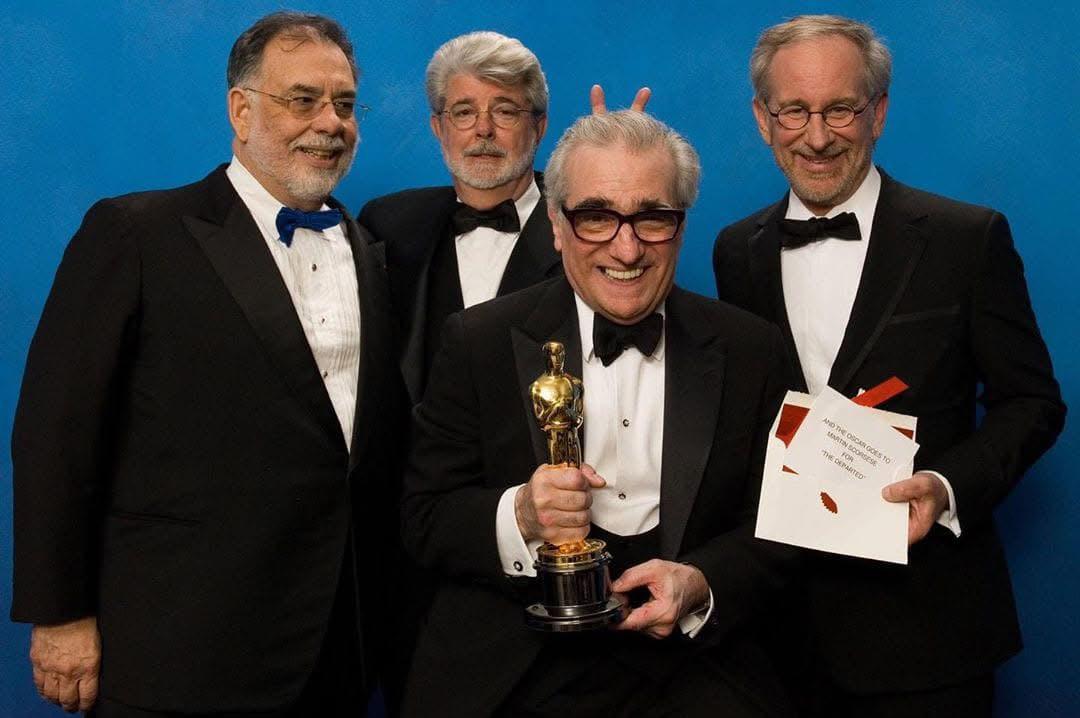
The rest are these guys

But that’s not the only reason to watch Mr. Scorsese, the excellent five-part documentary of his life and films, now streaming on Apple TV.

Rather it’s the candor in which the director, his family, and his long-time friends and collaborators so openly lift a veil of privacy to share his flaws, his genius, his often volatile nature and lifelong devotion to film, as well as his obsessive fervor and determination to make each of his movies to the absolute best of everyone’s abilities, especially his own.
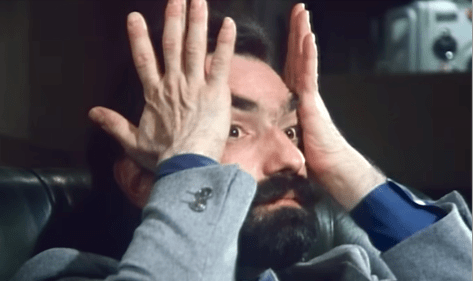
MR. SCORSESE (2025): New Trailer For Documentary About Film Director Martin  Scorsese… | The Movie My Life
The man behind the eyebrows

Never a part of Hollywood (Note: Whatever that is) and yet an undeniable part of Hollywood film history for present and future generations, Marty, as almost everyone calls him (Note: Except Daniel Day-Lewis, who for some reason only uses the more formal Martin) is that rare documentary subject that emerges not so much noble or admirable but merely very human and very, very, very hard-working. 

So much so that when you’re done with the five-hours it’s hard not to feel you should immediately get to work on your next six projects and begin considering the seven others that could be percolating on the back-burner. (Note: Whether you’re in show business or not).

Get to work Chairy!

Yet as directed by feature filmmaker, documentarian, novelist and former actress Rebecca Miller, Mr. Scorsese, more than anything else, is a true portrait of an artist.

You meet the short, asthmatic kid who grew up in Queens and Little Italy among professional gangsters and street bullies that became the inspiration for so much of the subject matter he covered in movies like Mean Streets, Taxi Driver, Raging Bull, Good Fellas and Casino.  But you also meet the devoted Italian Catholic kid who studied for the priesthood and made The Last Temptation of Christ, Kundun and Silence.  Not to mention, the lifelong movie fan who brought his encyclopedic knowledge of cinema to New York, New York, The Color of Money and The Aviator. Even the director-for-hire who was so able to bring himself to other people’s projects –  Alice Doesn’t Live Here Anymore, The King of Comedy and The Departed, to name a few – and transform them into award-winning cinema that captured the zeitgeist of their times.

Cheers to you, Marty

Still, this is not so much a lesson in film history than a fairly unvarnished exploration in what makes a person in the public eye we feel we somewhat “know,” tick.  There are many dozens of interviews, mostly new but others archival, including a significant amount with the director himself, detailing his drug use, periods of clinical depression, faltering marriages and unbridled fits of rage and frustration with not only his career, but his failure at life.

Among them are also a lot of incredibly funny stories about his “lacks,” often told in a self-deprecating manner by Mr. Scorsese himself.  Despite his gargantuan successes, the amount of times the director went from being at the top of the directing heap to virtually “dead” in the business (Note: His words, not mine) become head-spinning and almost comical.  While it doesn’t seem like someone at his “level” (Note: Again, whatever that means) would have to go butt heads with studio moguls or beg for money, Scorsese jokes that he’s been there a lot.  He even recounts one hilarious story where he threw the desk of someone he perceived to be a studio spy out a third floor window, admitting that right after he did it he was told it wasn’t even the right desk.

Oops?

I’ve seen every Scorsese film with the exception od Silence (2016) (Note: Some snowy night in front of the fire, as Joseph Mankiewicz wrote for Margo Channing to say in All About Eve) so by the end of Mr. Scorsese I wondered if there was anything significant I or the documentary hadn’t covered.. 

That is besides his 2024 Chanel commercial with Timothee Chalamet. Note: Ok, here it is:

Turns out there was one thing.

Ten years ago Marty directed an amusing 16 minute short film called The Audition, starring Robert De Niro and Leonardo DiCaprio playing fictional versions of themselves.  It was essentially made as a promotional tool for a new casino in Macau at a reported cost of $70 million, and has never been released theatrically, but, well, okay, you can watch it here:

The premise is that De Niro and DiCaprio arrive separately in Manila, run into each other, and find they’re both up for the same lead role in Scorsese’s next feature film. Written by his Boardwalk Empire collaborator Terrence Winter (Scorsese directed the pilot of the hit HBO series that Winter created, winning an Emmy in the process), it plays on a generational rivalry between the two stars and frequent Scorsese leading men as they try to one-up each other in front of the boss in order to land the role.

Scorsese being… well… Scorsese, even the short doesn’t take the easy way out.  Not only are both stars  full of themselves, but so is the fictional version of the director.  He’s clandestinely pitted them against one other, siding with each in different moments, until finally Brad Pitt shows up to make his cameo appearance by the end (Note: You know he’s coming at some point because he gets third billing). 

After that, well, you can probably figure it out what happens to the two Scorsese veterans.

Leonardo DiCaprio and Robert De Niro are starring in Martin Scorsese's next  movie
They beat each other up with their awards?

The quick, stylish directorial touches, clever asides (Note: I particularly loved the moment an annoyed De Niro begins imitating DiCaprio in disdain) and morally questionable behavior of the characters of the “director” “and his “actors,” are everything we come to expect from the Scorsese “brand.” (Note: Coined before that term was a de rigueur thing for anyone doing any job in the business).

But what’s most memorable about The Audition is just how keenly aware Mr. Scorsese is of the fact that to be in entertainment industry means that even when you reach the brand level of a Scorsese, you will spend the rest of your life, now and likely well into the hereafter, forever auditioning, often in uncomfortable, demeaning or even faux-demeaning situations.

The question is – will you let it get the best of you, or will you make the best of it?

Liza Minnelli – “New York, New York”

Not Joking

I’ve decided to wait a bit to see Joker.

Not that you asked and not that I’m afraid to venture out to a movie theatre showing Joker on its opening weekend.

Oh, yes.  Apparently, there is reason to be afraid.

My students actually brought this to my attention, noting more than several sets of their parents called them this week to warn them of the perils of venturing out.  These were mothers and fathers who were truly afraid their college juniors and seniors could possibly be shot at in a public venue that dared to show a movie that addressed the evolution of a cartoon villain into a gun toting vigilante who wanted revenge.

America, 2019 #sad

But it never even occurred to me to be scared and I have fears about pretty much everything.

Not being a parent and never one to miss the opening weekend of a movie I was desperate to see (Note:  Yes, I did see Judy on opening night.  Please.) I thought of venturing out to Joker.  But it wasn’t the prospect of the ridiculous crowds that go hand in hand with those huge box-office projections that made me stay home.

Reserved seating ensures you don’t have to wait in line for a ticket and I was willing to take my chances in the off chance of a flesh and blood gunman given I survived the eighties.  But, well, the rat f-ck in the parking lot, the talking in the theatre during the film, the inevitable crying kid who shouldn’t be there or texting teens with neon-screened phones who have to be there– I mean, really, I can wait.

I’m fine with this

And anyway, Martin Scorsese says any film that’s part of the Marvel Universe isn’t real cinema so I doubt that he feels any differently about DC/Batman origins.

Honestly, the closest I can think of them, as well made as they are, with actors doing the best they can under the circumstances, is theme parks. It isn’t the cinema of human beings trying to convey emotional, psychological experiences to another human being.” —  Martin Scorsese to Empire magazine this week.

Scorsese throws it down

If Scorsese is venting about high and low art we moviegoers are really in trouble.

Still, I get it, don’t you?  A steady diet of anything eventually makes it less special and inevitably, less than satisfying.  So how frustrating must it be for someone who is acknowledged as one of the best filmmakers of the century to watch the market for what he produces narrow further and further.

It’s the slow execution of everything he has given his life to.  The existential extinction of a widespread and very particular art form.

On the other hand, (and quite honestly) I can’t say I’m excited to see another Scorsese gangster movie, are you? Really excited?  I mean, are you really, really excited about the release of his latest three and a half hour long epic The Irishman early next month?  As excited as you were to see Goodfellas, Casino or even, say, The Departed?  Be honest.

I feel seen #truth

A superhero movie fan could argue a new gangster film from the director is the cinematic equivalent of a Scorsese theme park ride.   Others might, too.

This in no way lets the glut of Marvel/DC comic book movies off the hook.  Looking at what’s playing at what we used to refer to as real movie theatres at any given moment is a far, far cry from the last true golden age of cinema in the late sixties through the early to mid-seventies.

You know… before this #imissyoucarrie

The entertainment business has always revolved around making money, especially easy money.  So no one can blame movie studios, producers, directors, actors, et al for focusing on the broadest possible market with an emphasis on the key 18-24 year old demographic.

It’s said studios are most interested in a four-quadrant film, meaning the movie that will appeal to the widest swath of the population (Note:  What quadrant are you in?) but this is no longer the case.  It’s not even the case that whom they want to most appeal to are 18-24 year olds.

Most people when they go to a comic book movie #ifeelold

What is true is that superhero films accounted for more than 25% of total movie ticket sales last year, the equivalent of $11.38 billion.

Truth be told, this is a lot it is still far less than what we (okay I) might have imagined.  Until we realize, large as it is, it’s still a misleading statistic.  Those films might account for a quarter plus of releases but how wide of a release do the non-superhero movies get and how long do they really stick around?

In other words, 75% of the movies we have the option of going out to see might not have anything to do with Marvel or DC but if these films only play just one or two weeks in smaller, not easy to get to (or particularly desirable) theatres in not many cities, than what are the chances any of us will get to see them?  If a comic book hero is monopolizing 5 screens at an 8-screen multiplex do you want to brave the crowds on the weekend in order to see the latest indie offering starring Catherine Keener?  You might not even show up for a Jennifer Aniston rom-com or a Spike Lee joint.

Forget about the cost of a helmet or your bulletproof vest.

… and yet this is the film Catherine Keener did in 2018 #sigh

This is especially the case if you can wait a week or two and view them in the comfort of your large screened living room, which, in some cases, will offer images almost as large as the ones you might be treated to at one of the smaller multiplex screens that the non Marvel/DC movie you chose to attend would be relegated to.

It’s not an accident that Martin Scorsese’s The Irishman is backed by Netflix, which will make it available online three weeks after it debuts nationwide at what Steven Spielberg refers to as real movie theatres.

in unison: “you talking to me?”

Okay, I’m paraphrasing.

What he actually said is that Netflix films (and those from other streaming services) should not receive equal treatment at the Academy Awards and should be nominated for Emmys.  His belief is once you commit to the TV format you are a television movie and not a film.

But does his point of view extend to movies primarily backed or financed by Netflix and other similar platforms?  Or does Scorsese’s The Irishman get a pass because clearly HE makes cinema?

What IS 2019 cinema, anyway?   What is NOT 2019 cinema?

.. and what the hell is this??? #geminiman

As famed multiple Oscar winning screenwriter William Goldman once said of those of us in and around the film business, nobody knows anything.

And that, unlike most of what’s offered at your local multiplex, includes everyone.

The Late Ones – “The Joker” (cover of Steve Miller Band)