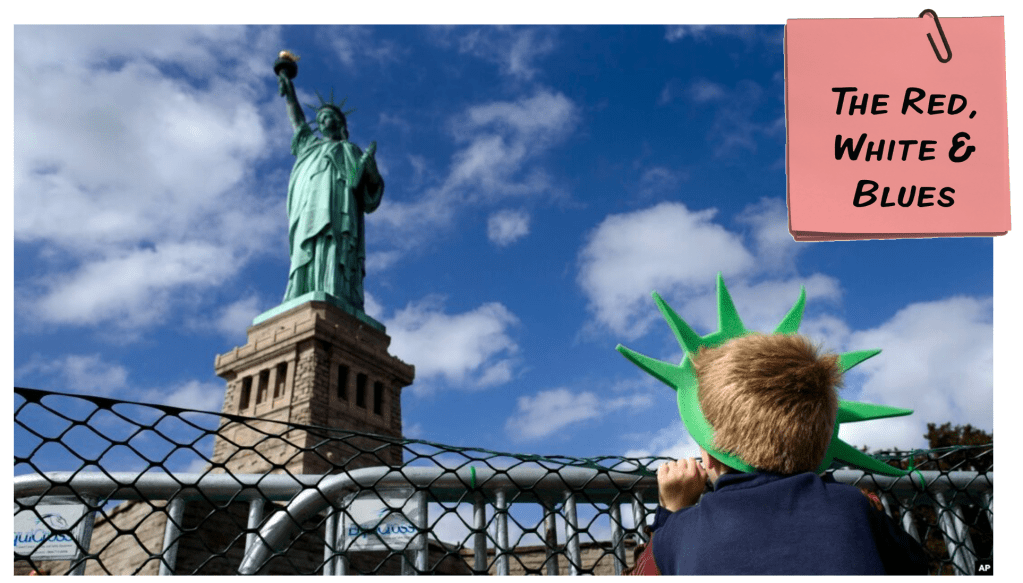
There is a 305 feet tall monument in New York Harbor that was built as a symbol to welcome all immigrants into the United States.
It is called the Statue of Liberty and was a gift from France to the U.S. in the late 1800s to honor American values and the end of slavery (Note: Ahem) after the Civil War.

The idea for this gift came from a conversation between Edouard Laboulaye, a politician, law professor and president of the French Anti-Slavery Society, and the sculptor Frederic Bartholdi.
I’ve thought a lot about the Statue in recent weeks as the United States continues to have a centuries old debate about immigration.
Among the questions raised in this debate are statements like:
–How many do we have to take?
– What about US, or the U.S.?
– We feel bad for “those people” but right now we don’t have enough American jobs for real Americans.
And my favorite:
– Why must we dilute American culture, religion and skin color with THEM, to the point where our very own AMERICAN culture, religion and skin color, gets watered down and rendered unrecognizable?

There is no point getting into the details of any one of those questions, and many more, over immigration to a country whose very existence was built on a nation full of immigrants from an oppressive society traveling to a new country where everyone from anywhere would theoretically be free to life, liberty and the pursuit of happiness.
That the U.S. has not always lived up to its mission statement is not in debate. But that this was always a fact of its intention is undeniable if you subscribe to historical facts, or any facts at all.
This week I watched the superb three-part PBS documentary The U.S. and The Holocaust by filmmakers Ken Burns, Lynn Novick and Sarah Botstein.

It’s a riveting six hours of overtly watchable, if maddening, history that sadly feels all too contemporary.
This is not only because it gives us a painstaking account of the rise and, not necessarily guaranteed at the time, fall of the Nazi Party.
Rather it is due to the fact that with the myriad of interviews with people who were there, combined with historical footage, governmental documents, and accounts from some of those serving the White House during those years, it explains the reluctance of the U.S. to open its doors fully to Jews desperate to escape (nee migrate) here, at the time.
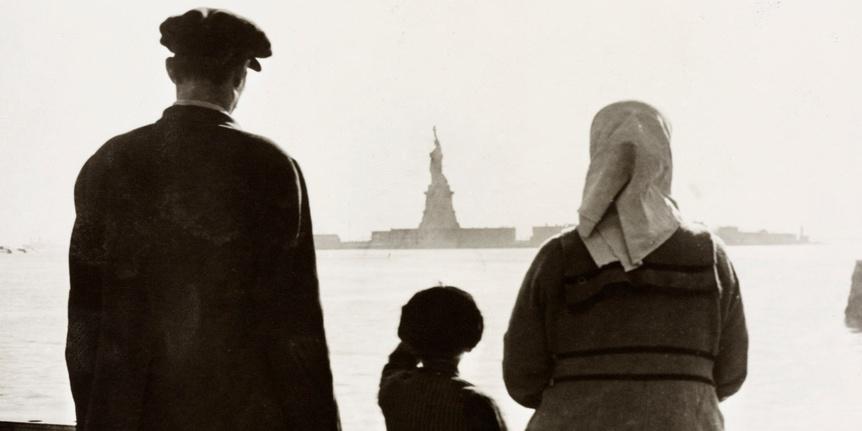
As the film puts it, this was principally due to:
a. A repressively strict immigration quota system and, more importantly,
b. A nationwide resistance to allowing our country to become overrun with others who would threaten the religious, economic and social balance in the U.S.
In simpler terms, this means Jews who would be needy, Jews who would take American jobs and, mostly, Jews that were branded as inferior and responsible for the economic troubles real Germans, nee Europeans, were forced to endure during the 1930s.
It wasn’t until several decades later when America had already won the war; six million Jews, not to mention many millions of others, had been killed; and the country had fully recovered from the Depression it was still reeling from in the 1930s, that US immigration quotas were lifted.

Yet all the while most of the top decision makers in the U.S. government knew of the grave danger and mass murders the Jews in Europe were enduring all through the 1930s.
Also, as the filmmakers inform us, public sentiment AGAINST welcoming any more European Jewish immigrants was well over 70% during most of that time.
This included a large and very rabid Nativist, Anti-Semitic movement dominating a significant section of public and private institutions in the U.S. being spearheaded by people like much adored, wholly American aviation hero Charles Lindbergh.

Well, what do you do when so many in a country don’t want to open its doors for outsiders from another country and culture to come inside?
How about when those citizens, already hurting from their own economic woes, claim there is no room for THEM?
These questions plague us to this day. To wit:
What can you say when people whose lives are in danger, people who have no physical resemblance to the majority of US, literally arrive here (Note: We are more connected these days and have better transportation) by the tens of thousands?
Do you tighten the borders, raise the quotas and build a theoretical and/or literal wall to keep them out? (Note: Also known as buying them bus or plane tickets to simply get them out of your sight and away from your town).

Or do you take history into account, visit New York Harbor (note: physically or virtually) and consider who you are as a nation and how you can learn from your past mistakes?
Here is some information about our very own Lady Liberty that might shed some light on things, as she is wont to do anyway.
Mr. Laboulaye, who as mentioned had the idea for Her in the first place, was a staunch abolitionist and supporter of the Union Army during the Civil War. In other words, he was rabidly against slavery, especially the kind that helped build the United States.

So when that particular form of servitude was officially outlawed here (Note: Ahem, again) he decided it could be significant to have a proper symbol of freedom greeting all newcomers on their arrival to these shores of freedom.
It would be the first visual they saw upon arrival, an encouraging beacon lighting the road to a new life in the offing.
That sculpture, Lady Liberty, actually depicts the Roman Liberty goddess, Libertas. She holds a torch high above her head in her right hand and in her left is a tablet on which the Roman numerals for American Independence Day, July 4, 1776, is inscribed.
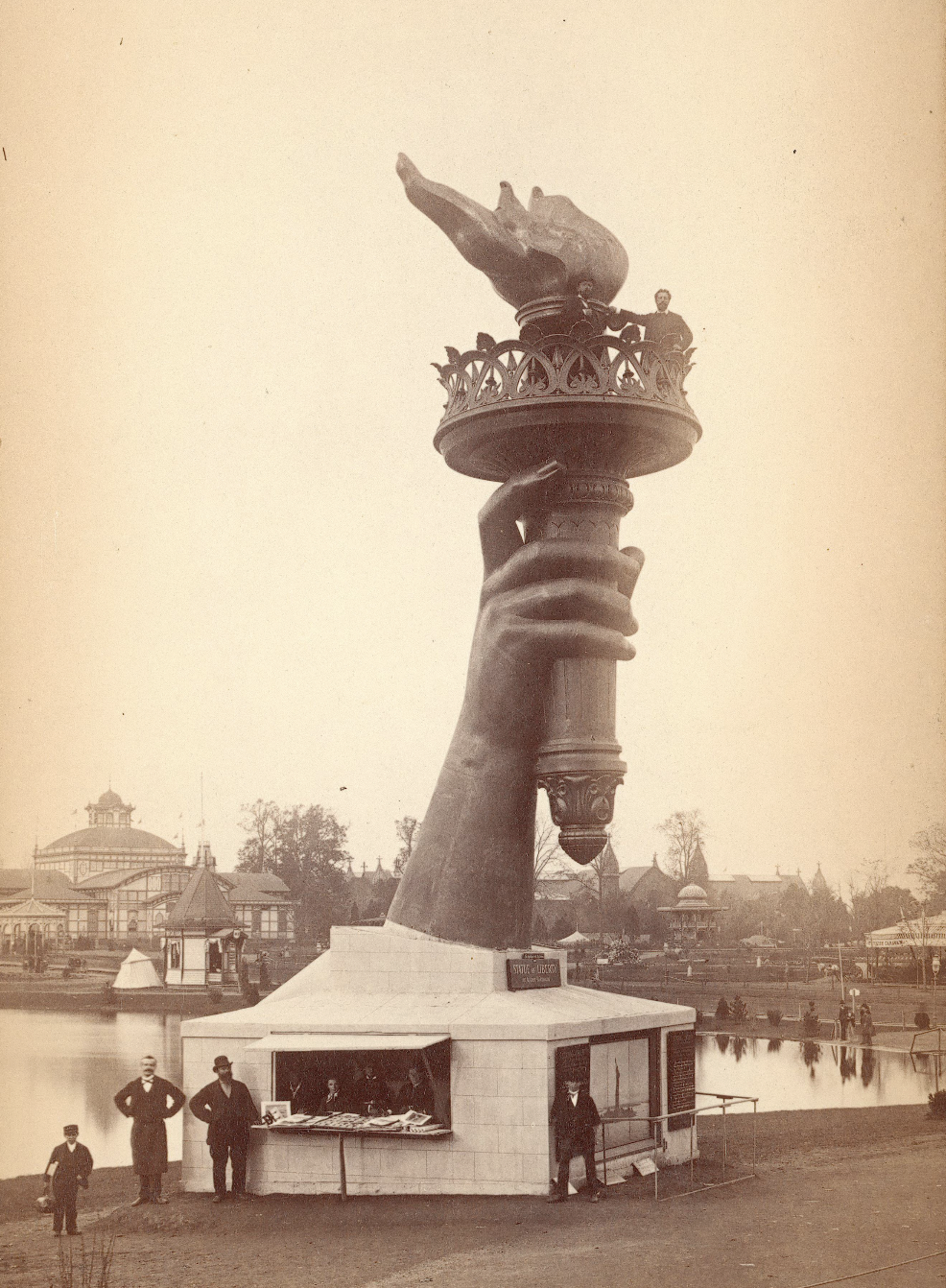
But the pedestal on which she stands, which would become part of the statue we know, took more than a decade plus to finance and build in the U.S. separately through donations spearheaded by a member of the media, a newspaper publisher (Note: Imagine that!) named Joseph Pulitzer.
It accounts for half the height of what is now one of the most iconic monuments in the world and bears a plaque of the poem The New Colossus, written by 19th century poet Emma Lazarus.
Not coincidentally, Ms. Lazarus was a Sephardic Jew from an immigrant family of Portuguese descent, as well as an activist on behalf of Jewish immigrants. (Note: Imagine that, again!).

And though her poem was not written specifically for the Statue her words have, over the years, become synonymous with its intent.
Among the most famous is this section:
Give me your tired, your poor,
Your huddled masses yearning to breathe free,
The wretched refuse of your teeming shore.
Send these, the homeless, tempest-tost to me,
I lift my lamp beside the golden door!
This is not to say that it takes someone Jewish inside the U.S. or a foreigner from outside the country (Note: In France, no less!) to show and tell us what democracy and American values are all about.
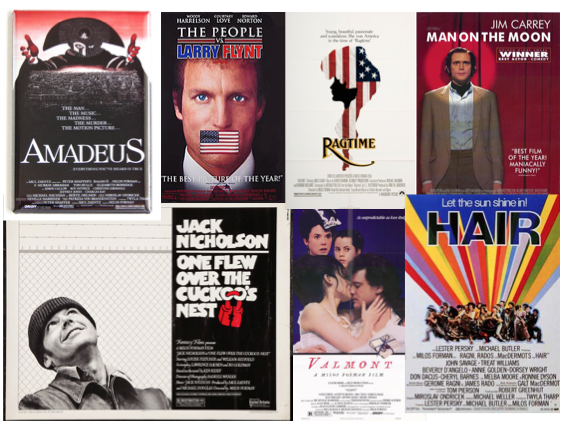
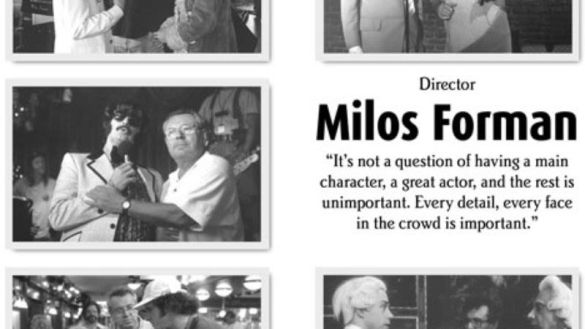
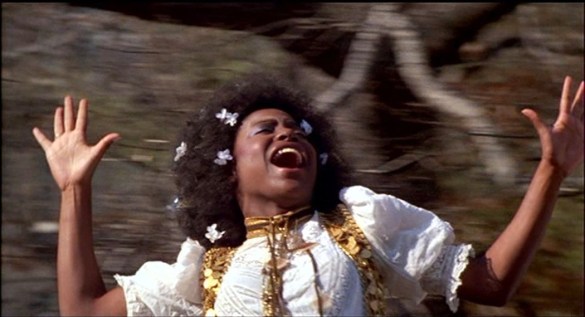
However, it has always been of interest to me that it took Czech born film director Milos Forman to make so many great films chronicling America, including the quintessential American counterculture musical, Hair; the fictional story of E.L. Doctorow’s America in Ragtime; an unlikely depiction and ultimate condemnation of American censorship in The People vs. Larry Flynt; and a celebration of oddball American creativity in the Andy Kaufman biopic, Man in the Moon.

It has also not escaped me that the very, very New York Jewish immigrant, Irving Berlin, wrote one of most popular anthems the U.S. conservative movement has ever wrapped its arms around, God Bless America.
All this is to say that every once in a while, and perhaps more often than that, it’s nice to be reminded who we really are, or strive to be, by some of the OTHERS who, rightly or wrongly, admired US.
And to welcome them into the fold and learn from them the lessons we were all supposed to have known in the first place.
Aretha Franklin – “God Bless America”




 notes from a chair