New Mad Beginnings


Screen shot 2014-04-14 at 10.39.59 AM

Beginnings are difficult for everyone – even Mad Men.  Not that the season 7 premiere Sunday night was bad.   But just like the announced passing of the CBS late-night torch to Stephen Colbert from David Letterman last week, it leaves a lot unresolved as to what the final verdict will be.

This is, of course, what great writing, great TV and a great life are all about. What’s the point if from the very start you know what the outcome will be?  You have to take risks, be a little messy and certainly subvert expectations a bit – especially if you want to land at the very top of your game by the time you get to the finish line.

This is echoed no better than in the words of Mad Men’s anti-heroine Peggy Olson – the slightly mousy 1960s gal from the boroughs who has now made it all the way to her supposed dream advertising job of creative director – when she flips out at all the easy-answer mediocrity surrounding her and screams at anyone in the office who will listen:

You’re all just a bunch of hacks!

Never mind that Ms. Olson, who is clearly correct in her assessment, ends the episode crying alone on her living room floor in sheer exasperation at what her life has become.  Please, who among us hasn’t done that at least more than once in their lives while striving for greatness? Well, if you’re not among them then you’re also not a part of the very large group of us who have also bellowed in frustration about the sheer creative laziness of co-workers and/or competition in your industry and the ways in which that type of behavior goes rewarded.
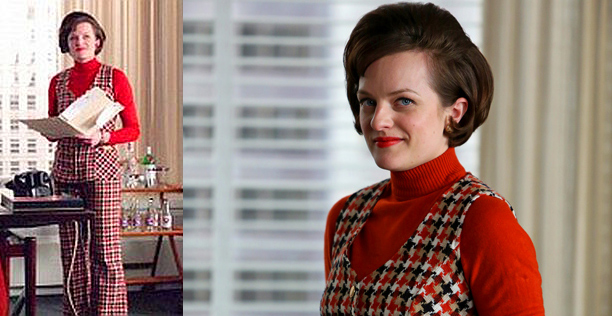
Plus girl can wear the crap out of a pantsuit

Plus girl can wear the crap out of a pantsuit

Count me among both the screamers and the criers AND as a Peggy Olson-esque persona who is damned proud of both.  Not that this is any guarantee of happiness.  Though certainly it does not mean you are sentenced to a lifetime of misery.  All it indicates is that you’re willing to take the chance at following your own path.

This ensures a constant lifetime barrage of new beginnings – of starting over and over again fairly consistently – never sure of what the final result will be but positive that at least you are doing the best that you can.  And that if your best doesn’t work you can always start over once more.  AND that, in the end, you are okay with that.

What’s fascinating is how the reaction to those who live this kind of life credo has not changed all that much through the ages.  For example, though Mr. Colbert taking over the late-night spot held so long by David Letterman evoked all kinds of positive responses last week, there was also an equal amount of hysterical trepidation.  Would Colbert on one of the major networks be de-fanged and become the dreaded kinder, gentler and horribly bland comedian?  Isn’t the late-night big network format in general too old for words, ensuring that anyone with an edge or formerly known for having an edge and now trying to become mainstream, would surely be doomed to failure?  And then there’s my favorite – why can’t we just have The Colbert Report and The Daily Show starring Jon Stewart forever?  Why does television always have to mess with a good thing in search of more audience, much more money and the most in ratings?

and why mess with an EGOT winner anyhow?

and why mess with an EGOT winner anyhow?

There’s only one simple answer to this and all of life’s questions – evolution.

You might think now that you want an eternity of The Colbert Report and The Daily Show but at some point they will seem as dated as the recording of last year’s Blurred Lines is now finally (and thankfully) beginning to feel.  And I know this for sure because I’ve lived through eras when Vanilla Ice, Kirk Cameron AND Arnold Schwarzenegger were all at the very top of their fields and seemed unlikely to ever disappear if the public had its way.

Mr. Colbert is smart enough to know all of the above as well as a lot of other stuff.  That’s why he is who he is and where he is.   He’s not afraid to evolve and his fans should allow him to lead the way.  Besides, how extreme do any of them think that change will ultimately be?  Has anyone watched Late Night with Seth Meyers?  I’m a big fan but much of the first half of his show, especially his monologue, is nothing more than an expanded version of the Weekend Update segments he rose to fame with on Saturday Night Live.  Jimmy Fallon on The Tonight Show is simply a slightly modified riff on Late Night with Jimmy Fallon with a few more mainstream jokes and celebrities and a slightly better set.  Though it is technically 60 years old, the current Tonight Show has evolved into something quite different from those led by the five and a half hosts that came before Fallon (Note: the half being Conan O’Brien).  Tune into Fallon any night of the week and you’ll hear not only a different theme song but see a series of fan-based, softball interviews that have nothing at all to do with what Steve Allen, Jack Paar, Johnny Carson or even Jay Leno did with their guests.

Though I doubt you'd see Johnny playing sticky ball with Harry Potter...

Though I doubt you’d see Johnny playing sticky ball with Harry Potter…

As for Colbert, he will be NOTHING like Letterman but probably more than a little like the fictional Colbert character he played for years on Comedy Central sans the self-reflexive conservative bigotry. That’ll be yet another in a string of new beginnings that, when you look closely at them, are really much needed readjustments and jump-starts moving us (and him) to the next level and the future.

Which brings us back to Mad Men.  It is now 1969 and there is nothing as prescient as looking at one of the most turbulent social upheavals in American history through the lens of hindsight.  Women like the aforementioned Ms. Olson didn’t seem to have a chance back then – except when they did.  But Ms. Olsen didn’t know that and it is this struggle that makes Mad Men so endlessly fascinating even when one fears it is drowning in a series of clichés.

No decade or the music or the clothes it spawns seem trite, corny or overdone at the time.  Which is why everyone should bridle at the all-knowing critiques of the first episode’s portrayal of late 1960s L.A. fashion, housing and slang.  Yes, women wore earrings THAT BIG and skirts THAT SHORT.  Yeah, men in their thirties, forties, fifties and sixties grew out their sideburns, donned love beads, smoked grass and said phrases like FAR OUT.  And if not every young person in their twenties hit their parents with lines like anger can’t make anything better, only love can those that didn’t certainly didn’t find anything out of the ordinary when that kind of thing came up in conversation.
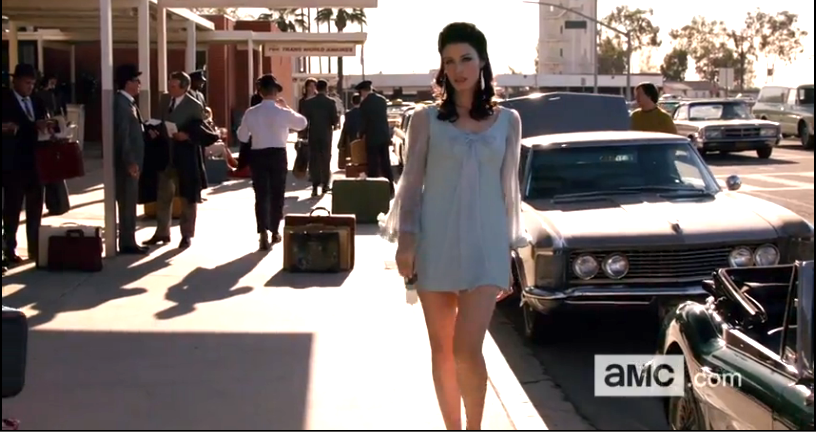
Perfectly acceptable clothes to wear while picking someone up at the airport.

Perfectly acceptable clothes to wear while picking someone up at the airport.

The year 1969 in America is probably one of the most difficult to film and not merely because of Richard Nixon, the Vietnam War, the moon walk (Note:  Neil Armstrong’s, not Michael Jackson’s) and the various other socio-political events of the day.  It is because that year was still full of unbridled idealism about the power of love and the non-violent changes it could evoke.  It was also due to the fact that the world was still filled with bright primary colors that were seen as hipper than hip rather than a silly throwback to the faux lollipop world of childhood.  And, as a west coaster of 30 years I am proud to say it is in part because California was undeniably THE go-to destination city for a front row seat to every last drop of all of it.

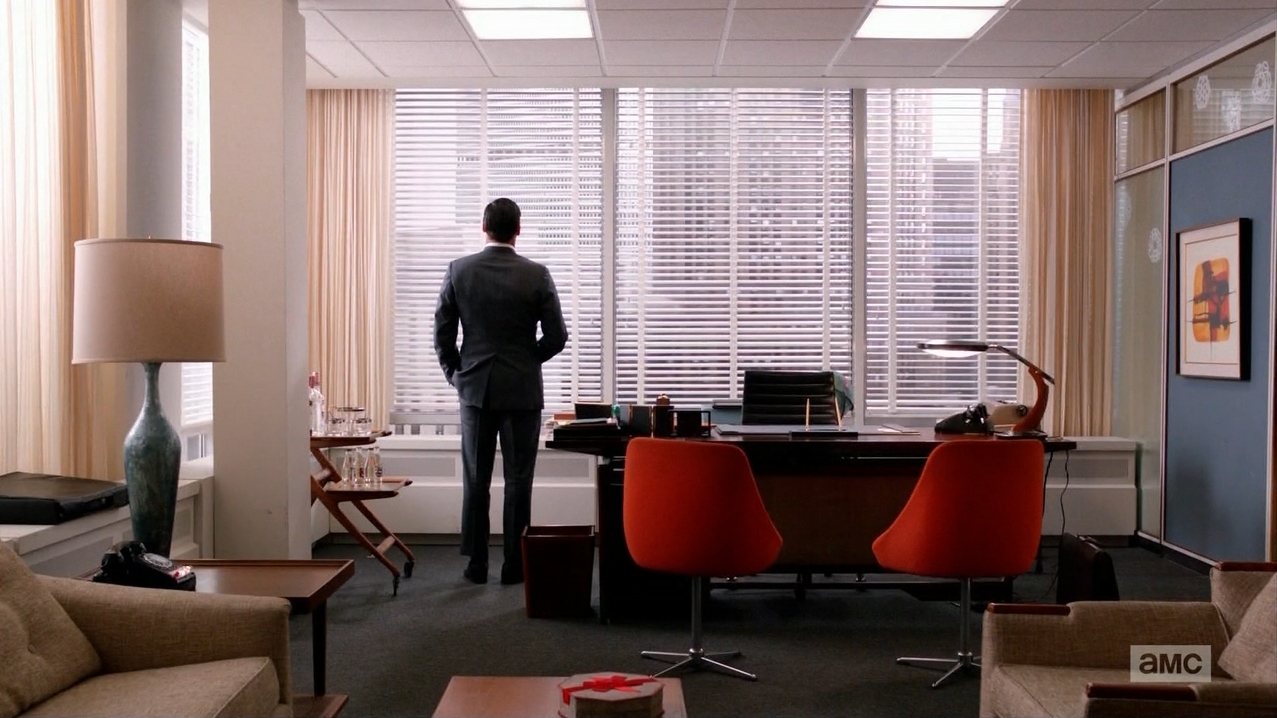
Watching an iconically handsome, square-jawed Madison Avenue idea man like Don Draper maneuver through an over-accessorized Canyon home in 1969 Los Angeles is a bit akin to seeing the oil-slicked fish of the Louisiana gulf coast struggling to survive the BP oil spill.  We know something has gone terribly wrong and even though what we’re seeing is true and probably important, in both cases it’s just not very pleasant to watch.   Even when Don goes back to his fabulous penthouse in New York City it doesn’t feel much better.  He’s lost his footing – as most people his age had in 1969 – and the cold cruel reality of change is beginning to literally enshroud him by the end of the premiere episode.  Much like the decade itself, there was little irony to be seen in that.

So where's this all going to lead?

So where’s this all going to lead?

Matthew Weiner, Mad Men creator and the writer of last night’s premiere, as crafted yet another new beginning for a TV series that continues to reinvent itself for every year of the changing decade it portrays while remaining essentially the same at its core.  He knows what he’s doing even when the rest of us have our doubts and that is how it should be.  Artists, like friends, family members and even some politicians, earn your trust over time by living their lives this way – either publicly, privately or both.  It doesn’t much matter whether they fail or succeed with each decision they make or in any given moment they decide to create or even live.  What matters is the overall effect on both the world and on you.  As a die-hard fan of Mad Men and the 1960s who knows all too well the value of new beginnings I’m willing to trust the process for now and go along on the ride.  If things go awry, I can always protest. Or maybe create another new beginning and do better on my own.

http://www.youtube.com/watch?v=P5Bc2xi-_rU


Who are you?

d69f5eeadc8bdb9828e1a46e32fa3b96

Within the last week my computer was stolen and within the last year my federal tax return refund was issued to someone else who illegally filed a claim in my name.  Now don’t panic.  I have another computer and about 65% of the stuff from the missing one is either backed up or in hard copy.  I also filed a new claim with the IRS stating that some jerk stole my social security number for tax purposes only – apparently a common occurrence these days – and have been assured by my accountant that within the next year or so I should get my full refund in the mail.

Of course, none of this takes away how absolutely creepy it feels to know that someone other than your dog has their paws on, inside and around private parts of you and your life.  It’s kind of like a blind date you didn’t ask for who stays over without permission and, aside from your wallet, steals some of your most personal items from your house, including, most importantly, your personal space.

Don't mind if I do!

Don’t mind if I do!

All of this got me thinking about the two-hour season premiere on Sunday night of the best written series on television – Mad Men – a show that at its core is about how the social and political revolution of the sixties forever changed (some say stole) the identities of American men and women but also allowed us to evolve into who we are today.  Not that I’m recommending it but theft and the turmoil it brings can be good too – waking us up to who and what we really are beyond who and what we possess.  (As if all that isn’t temporary anyway).

In approaching the herculean task of a season set in the often overwritten year of 1968, series creator Matt Weiner shows us a world of individuals who up until now were determined to be defined by what they have rather than who they are because the latter is just too scary and impossible to think about or really even know for sure.  This presents the ultimate problem for his characters because, truthfully, almost none of them have even so much as a passing clue as to their inner selves.  In fact, I’d venture to say that even if a magic Genie appeared to them offering to grant any three wishes of their greatest desire, they would be flummoxed to choose what the top three real wishes would be.  This perpetual conflict and uncertainty is why Mad Men continues to work year after year.  It is a show that series creator Weiner has acknowledged publicly has “no concept at all other than its characters.”

True words, man.

True words, man.

But in real life, as opposed to television drama (which in the case of MM, is much funnier, subtler, more dramatic and better executed), we all do have an identity, which is why no one can truly steal it if deep down you know who you are. That is the reason why I don’t get personally freaked out by the thefts mentioned earlier and why I don’t give a hoot about my Facebook privacy settings or how many items I buy online using a credit card that someone can possibly take and use as their own. Oh sure, these robber barons can make my life temporarily miserable and cause some financial strain or personal heartache, but can they truly take who I am and make it them???  I don’t think so.  Not unless they want to walk xxx number of years (not sayin’ the number, sorry kids) in my shoes and have each identical experiences of joy, heartache and everything in between that I have learned, or sometimes not learned, from.  (Note on the latter: I am nothing if not a work in progress.  Or, if you like metaphor, a chair still under construction but not completely built).

Still, it is also why the entirety of my, or most anyone else’s, true life would not make a good television series or movie.  We don’t live in constant conflict and wit that serve a three or five (or more) act structure and don’t have the best writers, directors and actors to perform it.  We only have ourselves.  Which brings us back to MM, American society and the year 1968.

OK JON! WE GET IT! YOU'RE HOT!

OK JON! WE GET IT! YOU’RE HOT!

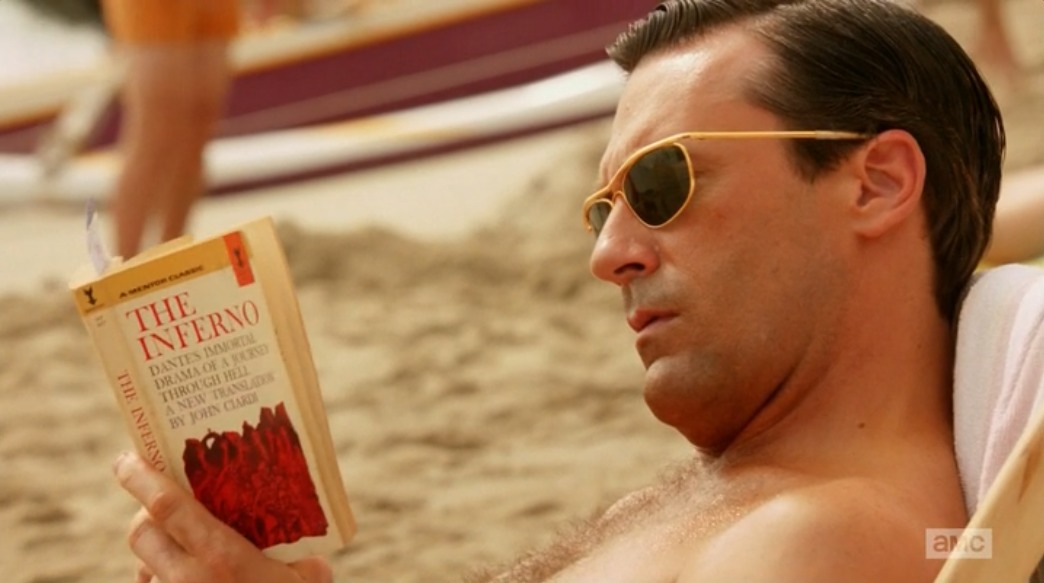
It is not surprising that in its next to last season Mad Men is finally tackling the issue of personal (and on a large scale, American?) identity because its iconic leading Man, Don Draper (Jon Hamm… did I mention Jon Hamm?), is someone whose own identity was literally stolen from a dead soldier and molded (by the real character, along with his writers and the actor playing him) into the alpha male of his time by stealing other traits from the best and brightest of what he saw around him in his travels from his rural American childhood, to the snazzy streets of Madison Avenue, to posh suburban New York, and then up to the polished penthouses of Manhattan.  Now in its final years, Mad Men has lost none of its own polish and luster because more and more the faux Madison-Avenue-American-dream-world from the late 50s it created is beginning to crumble before our eyes.  Rather like the way the economic bubble of the 2000s (aughts?) brought down the financial avarice of the 1980s’ “greed is good” culture and the failed American foreign power grabs of the 1980s, 90s and aughts has provoked a bit of an isolationist break from war on the part of the vast majority of the American public today.

As Mr. Weiner and company spend the next number of months against the backdrop of the assassinations of Martin Luther King and Bobby Kennedy, the campus shootings at Kent State, the riots at the Democratic convention in Chicago, the body bags of the Vietnam War, flower power, marijuana, bell bottoms, good and bad hairstyles (depending on your POV and the kind of hair you have) and rock ‘n roll, all topped off by the election of Richard M. Nixon to president (do I have to live through it a second time?!!), it is important to remember that every bit of these moments and many more are all part of what brought us all to where we are today.  It is why China, France, Germany or Japan will never actually be the United States, just as the United States can never aspire to be any one of those countries.  That’s not a quality judgment on us or them but merely a statement of fact.

You can steal an idea of something but, as Mad Men consistently shows us, ideas are intangible until they are embodied and fully fleshed and executed out by the actions of people and the reactions of others to what they do.  If you have any doubts that this show does it well – consider all of the many films and TV shows that attempt over and over to wallow in the backdrop of the late sixties for dramatic effect and how over and over again those television series and movies fail miserably, or at least in great part, in almost every way.   It is never about the backdrop or the surface or the literal of what we see.  It is always about what’s below the surface and how what is and isn’t there is played out by the people inhabiting that world.  To wit (very limited spoilers ahead):

Taking in the view (last Hamm  joke for this post I promise)

Taking in the view (last Hamm joke for this post I promise)

  • When Roger Sterling, the blue blood jokester partner at Don Draper’s ad agency, lies on his psychiatrist’s couch and ponders “What’s it all about, doc?” the effect is meant to be a comically indulgent comment on the sixties that will later surprise us with a lot more.
  •  When Don’s overfed, arch ex-wife Betty travels down to Greenwich Village to find a lost 15 year old girl and is told by a hippie gang leader that “You can’t grok (the word for understand in Robert Heinlen’s seminal 1961 novel Stranger in a Strange Land) that we (young people) are your garbage” it’s meant to sound misguided and dishonest until later on Betty shows us through her own actions it really isn’t.
  • When Don’s former protégé Peggy, now running her own creative department at a rival agency, tries to do what Don, her former boss, would do when she’s stumped on how to save an ad campaign of hers that unintentionally evokes an American military atrocity in Vietnam, it feels obviously poignant until Peggy’s wry self-satisfied smile later proves it to be anything but.
  •  And, while taking his official agency photo against the backdrop of Manhattan in his too immense office, Don himself can only stare blankly into the camera lens when a desperate photographer pleads with him to just “be yourself,” it feels too quaint for words until the last scene of the season premiere proves that for this ad man drawing a blank was the only truly honest response he has in him during the entire episode.

I tell my students all the time to not worry about anyone stealing their ideas. Original ideas can never really be stolen because it is always about how they’re executed – how they play out from scene to scene and in total. 

The only thing you have to fear... is wasting post-its

The only thing you have to fear… is wasting post-its

This is much the same as our lives and how we really live them rather than how it might seem to the world.   That is also the way it is with our favorite television series, particularly ones like Mad Men, which was never about the window dressing of the often portrayed 1960s but the ways in which the people who identified as Americans got through it… and came out the other side.