Is The Irishman why we go to the movies?

After spending three and a half hours seeing Martin Scorsese’s The Irishman, financed by Netflix, at a screening at the Writer’s Guild Theatre in Beverly Hills, there are lots of thoughts and feelings to be sorted out.

None of these have to do with the future of film exhibition or whether Netflix is justified in its release pattern for the new Scorsese film.  For those who don’t know, that would be only eight theatres in NY and LA this week, followed by additional movie screens in more cities seven days later and, finally, its streaming debut just ten days after that (Nov. 27) for anyone with a Netflix subscription or the ability to hop on to someone else’s account.

Netflix is so needy #validation

Scorsese, who turns 77 years old on Nov. 17, is one of THE best American filmmakers of the 20th and 21st centuries, or any century.  Yeah, he’s publicly expressed his disinterest in superhero films and sounded the alarm bells about a money guzzling, tent-pole-driven, market-researched-to-death movie industry obsessed with the Marvel/DC Universe at the expense of cinema dealing with humans and the complexity and nuance of their emotions.

But, for the record, he’s right about that.  Most of us would tire of potato chips and chocolate bars if we ate them 75% of the time.  Even if we didn’t, think of the affect it would have not only on our bodies but our souls, assuming it already hasn’t.

Avengers: Age of Gluttony

Point being, Scorsese not only has a good argument about what passes for present-day cinema but has earned the right to grouse.  For Taxi Driver, Mean Streets, Raging Bull, Good Fellas, New York, New York, The Aviator, Casino and The Departed alone, he can opine from now until the end of time about what displeases him and/or makes him happy about any one group of films or the movie industry in general.

also thank you for this gif

Which makes one wonder if the same goes for his audience.  If you’ve been a Scorsese admirer and mostly loyal fan all these years, do you have the right to be disappointed in the latest entry into the master’s oeuvre that everyone else seems to be calling brilliant?

Well, of course you have the right.  This is still a free(ish) country.  But is it called for, or even worth it to bring up?

Yeah, it is.

Oh there’s more…

Movies by their very nature are a communal experience.  Sure, many of us now too often watch in the confines of our own homes, and too often do it alone.  But the cinema Scorsese makes and presents is shared with others in a dark room where it’s then debated and dissected afterwards.  It’s part of the gift he’s given us for over half a century and to ignore real life discussion of a new Scorsese film would be like negating the very existence of the artist himself.

So here’s the thing…

Is that Ray Romano?

The Irishman is extremely well made, brilliantly acted and doubtless couldn’t be directed better by anyone else on the planet.  But it’s as cold as a tray of ice cubes on a bleak winter’s day and about as revelatory and/or insightful.

Ouch, Chairy!

After 209 minutes it’s difficult to not wonder aloud, Why did I just spend all of this time watching this?  What did this film tell me that I didn’t already know?  In what way was I touched, repelled or even slightly moved by the lives of these “wise guys” and the people around them?  (Note: Not to mention, I already knew the Mob murdered Jimmy Hoffa!!!).

This is especially true if you’ve ever seen a mob film by Scorsese.  Or watched one in that genre by his friend and contemporary, Francis Ford Coppola.  Or even binge watched the HBO series The Sopranos.

Don’t drag me into this! #cuttoblack

It’s unfair to say that with The Irishman Scorsese has made his version of a sequel to a sequel of his latest superhero film.  The Irishman has many flaws (Note: Despite what the critics are saying), but once it reaches the three-hour mark it forges some new ground.  In its last half hour, one begins to realize why the director spent all of these years trying to make this story and why it is likely the final chapter of every mob story he has ever told.

You can trust the Chair

But suffice it to say that dark and foreboding as it might be, that third act ending doesn’t so much surprise as simply…play out.  It takes you down a road you didn’t expect to see onscreen but pretty much could have imagined would have happened exactly that way off screen.

Would you have imagined it, if left to your own devices?  The answer is probably not if you weren’t a contemporary of Scorsese.  So in that sense, it does play in to the director’s own definition of cinema and, in its way, far surpasses anything you will see in the latest Marvel/DC superhero film.   Which is not to say it is Scorsese, or even cinema, at its best.

God, he’s so rich

There are many different reasons why we go to the movies.  Though let’s qualify that to reflect a 2019 reality.  There are many different reasons why we watch movies.

Escape comes to mind.  File this under the category of general entertainment.  We want to laugh and forget or, if we are addicted to catharsis, we want (and need) to cry and commiserate.

I already know I’ll be a disaster during this movie

Perhaps we want to feel superior to a person or class of people being portrayed onscreen.  Taken one step further, we might even joyfully hate watch something we know will be hopelessly dumb, awful or not to our taste just because we can, especially if we’re the type that has no empathy for its own highly overpaid craftspeople boring us.  (Note: Rest assured the latter also includes ALL of its above-the-line talent [nee actors, producers, writers AND directors] despite what they might say or admit to in interviews.  Though this should never, ever include Scorsese or anyone of his caliber).

But mostly, many of us go to and/or watch movies simply because we are true blue fans, Scorsese or otherwise.

… and for the popcorn #arteriesclogging #delicious

We hope for the best, realize we may be disappointed and yet still are pleased that we saw it.  Some but not all of us in that category can usually find something to like in almost anything, even if it’s the good intentions of those who might have let us down.   (Note: See a few paragraphs above). More importantly, there is always a chance we will see something we like, perhaps even love, and be transported.

And for that experience, we will be grateful, perhaps forever grateful.

With so many other ways to spend our time these days there is still nothing quite like sitting in the dark (or semi-dark, or even light) and watching someone else’s idea of life unfold.  For a short time we get to feel something we might have never felt before, or in that particular way

I have a lot of feelings, OK?!?!

There are Scorsese films where we have that for a few fleeting moments, for numerous moments or, sometimes, all the way through.

You (okay, I) want The Irishman to be the latter even though the best you can say about it is that it’s in the former.  But like all great cinema, the movie and its director contain some moments where you feel as if you are in the presence of screen super heroes.

And that says something.  Actually, it says a lot.

Muddy Waters – “Mannish Boy” (from soundtrack for The Irishman)
 

Revolting

Any era but this one seems to be the mantra of the day and who can blame any of us?   If the world isn’t falling apart, or at least regressing, well, it’s doing a pretty darn good imitation.

This is where nostalgia comes in because, well, when things seem this bad who can blame us for wanting to escape to the gauzy dreams of pre-selected luxurious times gone by?

This is where artists come in and in Hollywood there is no higher art than being a creator in film and/or TV.  Or is that TV and/or film.  It’s so confusing these days as to which medium gets first billing.

Don’t ask this guy what Netflix is… #spoileralert #heiswrong

But let’s table that discussion for now.

Much has been made about Quentin Tarantino’s latest, Once Upon A Time in… Hollywood in recent weeks.  Everyone seemed to love the recreation of the period but many balked at the context.

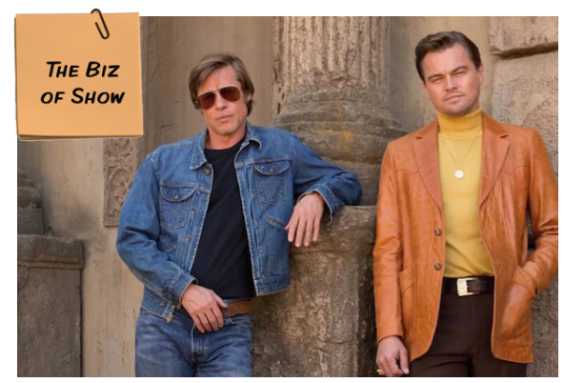
Are we really supposed to look back nostalgically at the 1969-era machismo of a nearly washed up leading man of TV and spaghetti westerns and his loyal, impossibly handsome stuntman?  Well, when the almost has-been is Leonardo DiCaprio and the sweet natured uber-hunk is a delectably shirtless 55-year-old Brad Pitt…come on, we all know the answer to that.

That’d be a YES MA’AM

And anyway, I dare you or anyone to look away when Brad peels his vintage tee off on that roof.  Because you won’t.  And you can’t.

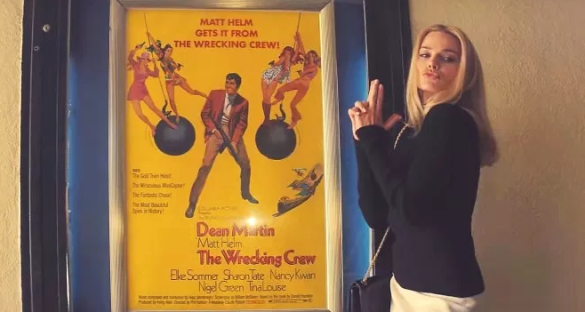
But why spend all this money revisiting the Manson family murders for the umpteenth time, bathing Margot Robbie in impossibly flattering sunshine and white go-go boots as Sharon Tate?   Is presenting her in this new Tarantino-esque light (Note: No spoilers here) really worth all the trouble?  And who the heck is Quentin to take it upon himself to do that, anyway?

The latter is the real issue for critics of the film and its nostalgia.

Mary McNamara, the LA Times’ Pulitzer Prize-winning culture critic, went so far as to call out Once Upon A Time… as nostalgia porn, likening it to the equivalent of a cinematic MAGA hat for its narrow, reductive and mythologized view of a world that didn’t exist.

Girl said whattttt?

That is unless you were a member of the white, male, Christian, heterosexual, able-bodied, culturally conforming, non-addicted, mentally well, moneyed elite.

Okay but….what film world really does exist???

Every artistic project is told through the lens of its maker, for better or worse.  The worse is that there are not enough non-white, non-male, non-Christian, non-heterosexual, non-able-bodied, non-culturally conforming, non-money, non-elite making the highest profile content in order to round out the picture.  (Note:  I purposely left out non-addicted and non-mentally well because it’s show biz and, well, who are we kidding?).

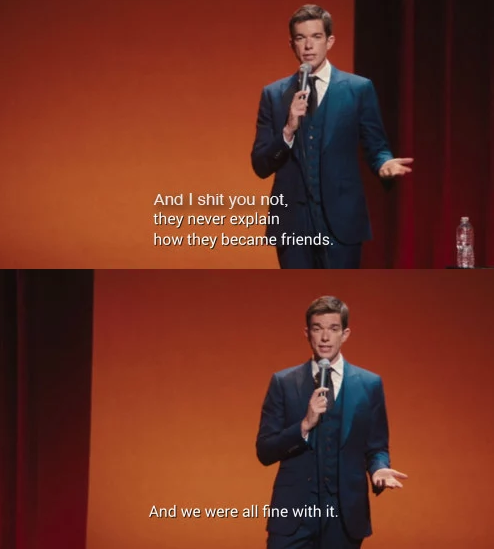
I was driving in the car with my husband the other day listening to an old John Mulaney comedy special (Note: Yes, we do that sometimes) where Mulaney did a hilarious bit about all of the illogical characters and plot holes in the classic Back to the Future. 

In it, the comedian muses at how any mainstream studio could green-light a film where a teen travels back in time and almost sleeps with his mother, one where his only real friend is a man in the neighborhood three times his age who he meets with secretly AND is a crazed, criminal loner of a “scientist.”  Not to mention a thousand other twists of logic and convenience that were as likely to happen as not anything ever.

I HAVE BEEN SAYING THIS FOR 3 DECADES!!!!

Now I can’t tell you how long I have been waiting – okay, THIRTY PLUS YEARS – for someone, anyone, to bring up these and many other moments of silly suburban wish-fulfillment contained in the script pages and prized cinematic moments of all three Back to the Future films.  Cause as a gay kid from the boroughs of NYC all they ever offered to me was a twisted Leave it to Beaver on steroids non-reality that I could never relate to or imagine ever truly existed.

Where is/was MY Back to the Future, I used to wonder?  Well, until someone creates a gay, Jewish superhero kid who is befriended by an eccentric Holocaust survivor down the street, I guess that it doesn’t exist.

I would see that movie #doitchairy

Sure, I’m being a bit flip but the truth is that is some small way, I am STILL waiting for it.

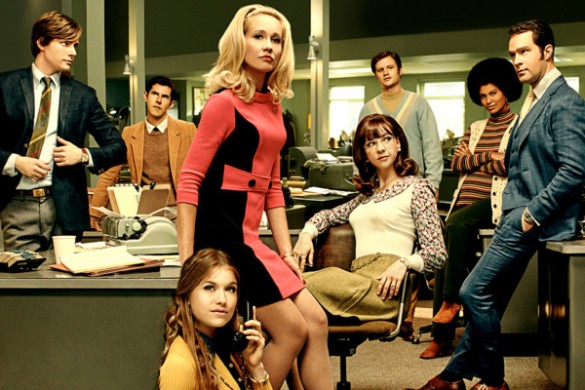
Thinking about all this and more led me to recently begin writing a period piece all of my own.  In doing so, I discussed the idea with a female friend and former student/now colleague who suggested I watch a one-season now defunct but very fine Amazon series that took place in a similar era entitled Good Girls Revolt.

Now how is that I, a journalism school grad who majored in magazine writing and came of age (and came out) in the seventies could have missed a show about a group of twenty-something gal magazine researchers who were aspiring to be writers in the 1969/early 1970s era?

feeling that Mad Men-esque energy #whereisjonhamm

If they couldn’t have been me they certainly could have been the older sisters I never had or the more experienced mentors I wish that I had met and related to at the time.  Because god knows I wasn’t getting very many breaks or invitations to hang out after hours from the straight guys in power.

Well, the fact is, gay or not I’m still a guy and the title, I don’t know, it seemed strange – like one of those borderline offensive Girls Gone Wild  vintage videos.  And with so much out there I guess it wasn’t a must see.  I mean, much as I don’t run for the macho stuff do I really go out of my way to look for shows with four female protagonists??

I guess not, since once I started my binge and got into the show I began to vaguely remember having heard more in its initial run about it, the book it was based on and the real female writers who wrote and created both based on fictional and real characters, some of whom even I knew about at the time.

Boo for me for not paying attention..  Like – BOOOOOOO, boo, boo.  What kind of typical faux macho…guy….was/am I?

I am ashamed.. so very ashamed

But more to the point, why was there only ONE season of this very fine and, for me, unusually period accurate depiction of a world that, after watching, I couldn’t imagine millions more wouldn’t be fascinated with?

After all, this was an early streaming series on Amazon, a service that wanted to take chances.  And it was female-centric (a key demographic), got good reviews, great audience reaction and respectable ratings in comparison to other Amazon renewals at the time.  Well, a lot of factors worked against Good Girls

#1 was that its premiere was two weeks before the 2016 presidential election, a time when a significant number of males in the country were rebelling against anything too female-centric, especially if it was on TV and let off even a whiff of women’s lib. (Note: #Hillary4Evah).

Me, thinking about November 2016

More importantly and #2 –

The head of Amazon at the time was Roy Price, a guy who didn’t get the show and at one second-season story pitch asked the show runners to use the actresses’ names when proposing future episodes because he hadn’t taken the time to learn the names of the characters they were playing.

Of course, little did he or any of the rest of us know that in less than a year he would be forced out of his job amid accusations that he harassed, this time sexually, Isa Dick Hackett,  not a character name but another real female show runner of another Amazon show, The Man In The High Castle.  Coincidentally, Ms. Dick Hackett is an out lesbian who also happens to be the daughter of Phillip K. Dick, the novelist who wrote the book on which the High Castle series is based on.   (Note: A play on words based on the surname of both the novelist and the show runner were among Mr. Price’s more noteworthy utterances reported during that time period).

This, in turn, was followed by the many revelations surrounding Harvey Weinstein from his accusers and the emergence of what we now sometimes all too glibly refer to as the #MeToo era.

There’s nothing glib about the story of the cancellation of a promising show like Good Girls Revolt, of course, most especially when it’s considered in light of all the attention a film like Once Upon A Time in…Hollywood is now receiving.

The only IT girl of the moment

Sure, I admittedly very much liked the Tarantino film but after watching the one season of Good Girls and learning of the circumstances of its cancellation, and my own initial indifference/ignorance towards it, it’s easy to see why so many are currently so publically over the whole Tarantino/DiCaprio/Pitt of it all. (Note: And not only women).

The fact is, until many more diverse voices get to create material with actors and directors from their communities who are every bit as bankable as a Tarantino, DiCaprio or Pitt, an inequity of point-of-view that is as world worn as the nostalgia those names so often propagate will dog their every achievement in the zeitgeist.

That’s not so much an objection to their POVS but to the fact that so many of us don’t get to see ourselves and our worlds reflected back at us at a time when being seen and heard is no longer a luxury of entertainment but a necessity for our very survival.

“Big Yellow Taxi” – Joni Mitchell