Fight Club

I stepped into a hornet’s nest of passion this weekend after re-posting a news article focused on a statement made by MSNBC commentator Joy Reid.

In it, she took Bernie Sanders to task for saying the Republican establishment will not stop him from getting the Democratic nomination for president, nor will the Democratic establishment. 

The tweet that started it all…

By equating the powerbrokers of both parties, Reid claimed Sanders was essentially staging a hostile takeover of the Democratic Party rather than bringing people of that party, and others, together to defeat Donald Trump.

She framed it all by pointing out that in making the above proclamation Sanders, a registered INDEPENDENT and technically NOT a Democrat, had boldly and unapologetically kicked 65 million Hillary Clinton voters, the majority of who WERE registered Democrats, to the curb.

And that he needed those voters to win.

I was in such agreement with those thoughts and so annoyed by Sanders’ cavalier messianic attitude, I instantly put it on Facebook with a single accompanying phrase: THIS.

Very quickly, and perhaps predictably given how many young people and former students are my Facebook friends, here’s what the reaction looked like:

My facebook feed for the last 24 hours

Now I had planned this week to write about how actress-writer Amanda Peet had literally stolen my identity with the title of her just announced Netflix TV series THE CHAIR, starring the sublime Sandra Oh as the head of a college English department.

I mean, all I could think of was:

HOW DARE SHE??????

But when you weigh my outrage against, well, my outrage, it’s clearly the subject of Bernie that wins — at least for right now.

More importantly, I’m thrilled that it did.

Me and conflict

That repost prompted close to 100 back and forth passionate, angry, frustrated funny and heartfelt comments on politics, social issues and the state of our mutual lives.

I don’t know that it singlehandedly changed anyone’s mind, for the moment, but I am positive it allowed many of us to better understand the place from which each of us were coming from and why we felt the way that we did.

I’m also inclined to think that the next time this subject comes up we might all be that much more informed about how people really feel on the issues and allow us to engage that much more effectively.

Me, achieving world peace

It might even enable us to resolve a few things and modify our approach, or opinions.

This is how change happens and this is how you open hearts and minds.  Not by rolling over but by engaging, arguing, listening and then engaging again.  And again.  And then some more.

A big part of my job as a college professor is to provoke, navigate and guide.   There is nothing wrong with criticism if it’s followed by discussion.  It’s essential in the classroom and in life if we’re to ever move forward anymore.
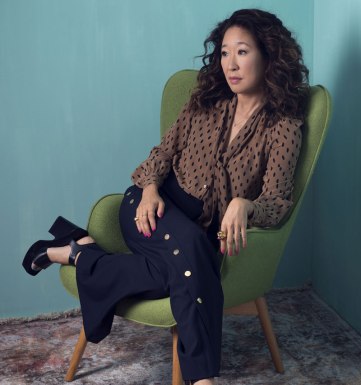
TAKE NOTE SANDRA! (nice chair though)

But too often these days we just can’t seem to do it well or avoid it all together.

Talking out loud about a controversial issue, statement or opinion devolves into I hate this, or him or herOr rage about the blah, blah, blah of the blah, blah, bah.  Even the mere sound or sight of the blah, blah, blah, in print, or worse, in person, is sickening.

This enables the I won’t comment at all for fear of being attacked or the strategy to seethe quietly (or not so quietly) and then strike in such a way that I can’t be harmed  and/or you won’t know who it is.

Or the alternate strategy of I will do nothing and just go on with my life, which isn’t horrible enough to move me away from my everyday routine in order to engage with this issue, or you.

If only

This doesn’t work for any of us on either side in the long run.

My college community is at the moment in the midst of discussions about race and racism as we become a more diverse and inclusive campus.

It is healthy to address those issues and more as long as it’s not done in an absolutist manner from either side.

This is difficult to achieve, as many in the fight will attest to, but clearly is possible.  We stumble, we upset each other but we persevere and eventually come to an understanding of each other’s points of view and then figure out how to best soldier on with the best outcomes for as many of us as possible.

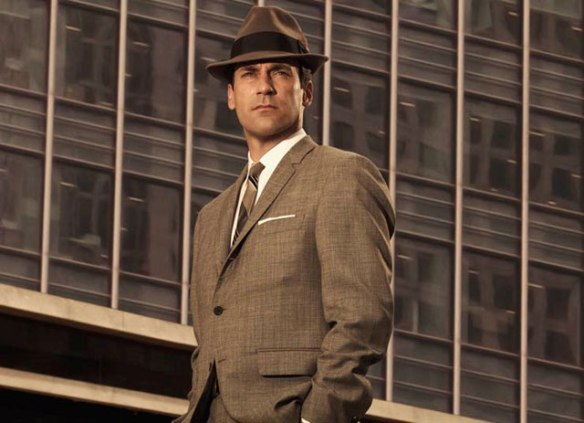
And if that doesn’t work, we can all agree that Jon Hamm’s still got it

It’s easy to see colleges, or social media platforms or real live engagement as a petri dish of microaggressions, oversensitivities, insensitivities, hostilities or simply biased and/or callous disregard, and worse. 

But that’s not the way I look at it.

We MUST get in the ring and spar, perhaps even fight, in order to get anywhere, especially these days.  We are required to LISTEN and then try to understand, regardless of whether we do a 180 and change our points of view.

To turn away and NOT do it, to hide from all this conflict, is a sure fire strategy for our mass mutual demise.

Christina Aguilera – “Fighter”
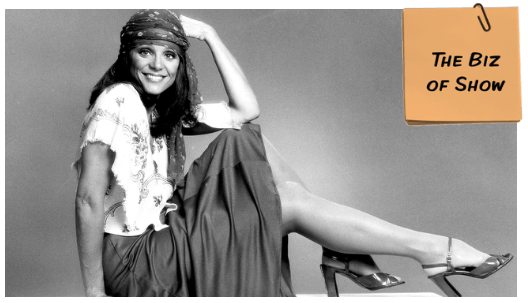
So Long, Dear Friend

The death of Valerie Harper this week got me to thinking about TV characters and the people who love them.

This is Us.

You see what I did there.  Even in writing about television a TV reference sneaks in.

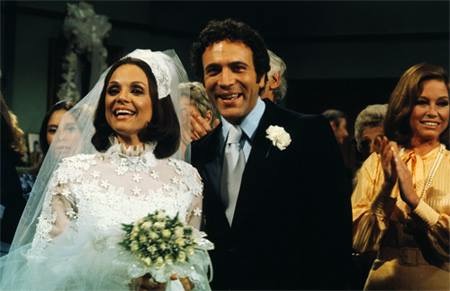
For those too young to remember, Valerie Harper played Rhoda Morgenstern, Mary Richards’s talky, funny, Jewish best friend forever neighbor on the famed Mary Tyler Moore Show in the 1970s.  She was so popular she was later spun off as the star of her own show, Rhoda, where she was given a fuller life, less catastrophic dates and, finally, a hunky man who became her husband in one of the highest rated episodes on TV at the time.

Picture Perfect

Of course, television being what it was/is, she eventually had to get divorced (Note: for no good reason, in my opinion) so the whole cycle of jovial unhappiness could begin again.

I grew up with Rhoda and she meant a lot to me, mostly because I knew her.  In the seventies there were 0.0 young Jewish New Yorkers on hit television shows and certainly none as instantly recognizable and human as Rhoda.  We all not only knew her, we were her on any given day.

And who wouldn’t want to be?

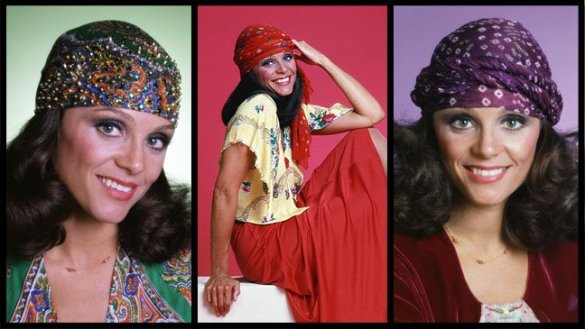
The head scarves alone!

Rhoda joked about her life being a mess but she wore vibrant colors, had perfect one-liners for every occasion and was smart.  Moreover, she was a survivor.  You always knew Rhoda would be okay and even if you couldn’t literally be her or have her physically in your life you wanted her to at least be in your living room or bedroom or wherever you watched television, with you, whenever possible.

Much of this was due to Valerie Harper’s ability to embody a well-written sitcom role, take her beyond the laughs and make her feel real.  It was just impossible to believe that in real-life she wasn’t Jewish, didn’t speak with a trace of a New York accent and had never appeared in a TV comedy before she became Rhoda.  But she wasn’t, she didn’t and she never had.

Yes way! #acting

Certainly, you don’t have to be a Jewish New Yorker to play one but back in the 1970s, and even now, many performers become so obsessed with playing us that they get the accent and the mannerisms exactly right to the point where they are not playing anything else.   They (nee we) become wawking, tawking hand-waving neurotics ready to mow down anything and anyone that gets in our way.

Okay, sure, we are all of that.  (Note: See Larry David on any given day, even though he long ago transplanted to L.A.).  But there are times when we also do color outside our given lines.  Rhoda always did that and without a very special episode where a beloved relative gets hit by a car and she has to deal with it seriously.  Or one where she’s chastised by everyone around her for making a bad joke about the accident. (Note: See Larry David again).

See? Relatable.

Of course, this phenomenon stretches across all ethnic, sexual and religious lines.  As a gay man I’ve cringed, ranted and left the room numerous times over the years as some straight actor badly pretended he was a certain type of homosexual male and then went on to win an award for said performance.

What? Who? #shade

Name your minority group and I bet you could, too.

Meaning, we all need our Rhodas.

Luckily times have changed and, with it, the level of writing, especially on what is now broadly considered to be contemporary television.   Given where cable and streaming series have taken us, it is not unusual in these times for many actors to transcend their actual selves and portray believable niche characters that bear little relation to whom they truly are in real life.

But they exist in a 2019 world where the roles are a lot deeper and niche is the new…Black? Asian? Jewish? Gay? Hispanic?

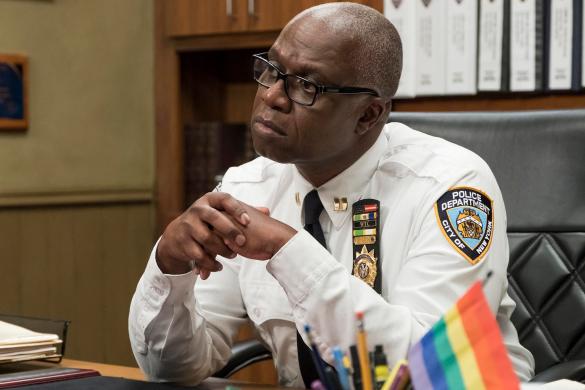
…or if you’re Andre Braugher: Black, Gay, and a Police Captain for the NYPD

It is also a world where, ironically, the brilliant work Valerie Harper did might today almost be required to be done by a New York, Jewish actress.  See if that gets you to thinking a whole host of non-PC as well as PC thoughts.

This is exactly the point where, for me, television comes in handy.  Every time things get too heavy or confusing in my life I know l can feel comfort in being able to wander onto the couch – or if it’s really bad, a bed – and spend minutes or hours with a whole host of non-existent people who, in those moments, are as real to me as anyone I’ve ever met.  By my count over the years:

Lucy Ricardo’s determination made show business not seem all that bad.

 Murphy Brown allowed me to hold out hope that in the end journalism would get the last  laugh, and word.

Let’s just not talk about the reboot, OK?

 Olivia Benson on the street reinforced to me that on balance there is someone to protect those of us who somehow managed to survive against all odds.

 Don Draper shamed me back to the gym for fear we (or the actor playing him) happen to meet on a busy NYC street (or preferably empty stuck elevator) during one of my yearly trips.

working on my time machine right now

Walter White scared me into always protecting myself by reminding me there can still be great danger around the corner because anyone could break bad.  

Liz Lemon made me feel sane and well adjusted, by comparison.

Jack Pearson helped me imagine a world where I really did want to spend time with every member of my extended family, and

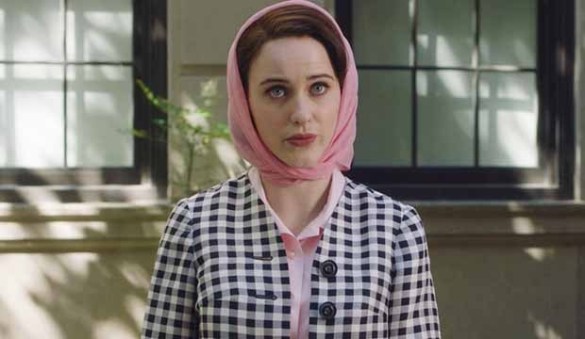
Midge Maisel made me laugh, cringe and sometimes cry at seeing all of my dead relatives and their friends on the small screen in ways that I could never have imagined in the days when I first met Rhoda.

What is it about funny ladies in good headwear?

RIP good friend.

I will still miss you even though I can see you tomorrow and every day of the week for the rest of my life.

Rhoda Opening / Closing Credits Season 1