
Rubbernecking

HiRes1-777x1024

Target Practice

We Americans love to gawk.  Okay, maybe it’s not a totally American thing since the term paparazzi became popular as a result of Fellini’s legendary La Dolce Vita (the perpetually annoying photographer in the film was named Paparazzo).  Still, in my limited travels around the world it feels as if me and my fellow countrymen (and women) are always among the first to arrive – either by ourselves or with some sort of filming device – to either a celebrity sighting or crime scene, especially when those two events happen simultaneously.

Granted, it is not necessarily a bad thing to be observant.  But – what exactly are we observing?

That all came to the forefront this week when Valerie Harper, the 74-year-old actress who was recently diagnosed with terminal brain cancer and is best known to us baby boomers as Rhoda from the Mary Tyler Moore Show, was announced as one of the contestants on this season’s edition of Dancing With The Stars.

Let’s be clear.  Anyone who has terminal brain cancer gets to do anything they want, including spending their final year(s?) of life rehearsing ballroom dancing four and a half hours a day in order to perform a 3 minute weekly dance routine before a live television audience of 17 million people.

Plus – full disclosure.  I LOVED Rhoda!  She was sassy, spoke with an accent from the NYC boroughs, endured an overbearing mother who made her life crazy AND had trouble keeping a guy.  With the exception of the head scarves and a few lady bits, I found watching her in my twenties was often the equivalent of looking into a one-way mirror.

I could have rocked that look

I could have rocked that look

So I’m not quite sure why her appearance on DWTS strikes me as a bit exploitive and over-the-line. Could it be my own fear of death?  Perhaps.  I mean, I know it is there and have witnessed it more times than I care to remember.  Still, I don’t like the idea of it staring me in the face weekly.  Though I did love Laura Linney on The Big C, a Showtime series about cancer where anyone, anytime could die each week because, well, it’s cable.

No – I don’t think it’s that.

Maybe it’s my general concern for Ms. Harper as a fan who has enjoyed her work for decades.  Aside from her time as Rhoda, she ‘s done lots of other interesting things over the years, including a recent brilliant onstage performance as the iconic actress Tallulah Bankhead in the stage play Looped.

Yes, she started as a dancer on Broadway, her cancer is near remission, and she announced that she wanted to attempt this enormous feat of athleticism to be a role model so others won’t fear life in their final days. Hmm, maybe I’m turning into Rhoda’s overprotective mother?  Or even worse, my OWN MOTHER???

Sorry – I REFUSE to admit that’s it.  Or to even think about it one second longer.

Here’s what I do think it’s about.  It’s the idea of being compelled to watch DWTS at all, which I now most definitely will do, at least on DVR – and probably a lot more than sometimes.  This makes me nothing less than a typical member of the flash mob out there that we call society.  All too human, all too base, all too bloodthirsty.  But to see what exactly?  Valerie Harper die live on television?  Or at least pass out from exhaustion, only to get up again and barely make it through the number amid gasps and awe?  Or to see her emerge victorious as many weeks as possible, proving you can cheat death when you have a terminal disease?

And all for this hideous, tacky thing?

And all for this hideous, tacky thing?

If we’re all hooked up to a lie detector, which would we all MOST want to watch?  Which would be the most…ENTERTAINING?  (Note:  You cannot choose none of the above.  And…you must tell the truth).

It did not escape me that a survey by Fandango this week of the most anticipated of all the fall movies – a time that is (or used to be) considered THE time to launch the classy or at least more serious Oscar contenders – the #1 choice was The Hunger Games: Catching Fire.  This is important to note because it is the sequel to a film that is literally about watching people die in a live (or in this case dead) televised competition.   Well, one supposes that could really be next.  Or perhaps it has already begun to arrive but we have not yet realized it.

En fuego

En fuego

I might be stretching the metaphor.  But barely. Humanity has a history of such things, from Gladiators fighting to the death in the Coliseum to boxing matches where every so often someone gets knocked out cold.   The difference is that hundreds of years ago the very function of gladiators was to do battle until someone literally collapses and dies.  These days we sort of just like putting people into impossible situations to see if or how long they can survive and how well they do it.  Yes, they can die or be irrevocably injured for our own enjoyment.  But it’s their choice.  Certainly, that’s a lot more civilized.  Isn’t it?

Civilized? Well, all except Wipeout.

Civilized? Well, all except Wipeout.

It’s interesting to read or watch the news each day and see what passes for current events.  Sure there are real wars but we usually black out the actual killings on television in favor of showing our politicians deciding whether or not to fund either more bloodbaths or more social programs.  Still, we get to see George Zimmerman, the man acquitted in the killing of Florida teenager Trayvon Martin, being arrested for the second time in several months for a speeding ticket or photos of Zimmerman’s wife filing for divorce because he spends so little time at home and has become too selfish.   You can’t blame him.  I suppose I’d be a little full of myself also if I got that much attention.  Speaking of attention, did you just hear that his defense attorney Mark O’Mara has been signed by CNN to be a legal analyst? That’s something else we can look forward to when we inevitably tire of this season’s DWTS.  God Bless America.

It’s not as if the US media and entertainment industries (yes, technically they are different) always know what we want, or are even thinking.  If this were so Neil Patrick Harris wouldn’t have happily announced several days ago that he would not be doing a musical opening number when he hosts the Emmys later this month.  Sure, the Oscars get Seth MacFarlane singing and dancing but television DOESN’T get Neil Patrick Harris singing and dancing.  Just what are they thinking there?  Obviously, not much.

You're breaking my heart, Doogie!

You’re breaking my heart, Doogie!

Then there is the massive advertising campaign for Ron Howard’s new film, Rush.  It’s gotten glowing advance reviews and very nice film festival reaction.  And Mr. Howard’s teaming on a somewhat commercially risky subject matter written by acclaimed British writer Peter Morgan (Frost/Nixon, The Queen) also deserves kudos.  But Rush is based on the 1970s true life story of two competing race drivers – a sport where fatal and near fatal fiery crashes and the charred beyond recognition human remains they left behind were a way of life.  You’d think they could give us a little more of the actual blood sport in the trailer, knowing as they do our taste for carnage.   Right now there are mostly the supremely enviable blonde tresses (not to mention other things) of the supremely enviable Chris Hemsworth as he charms the machinery off of every human and non-human being in his sight lines.  Well, I suppose audiences can forgive a little lack of carnage for that.   I know that I can.
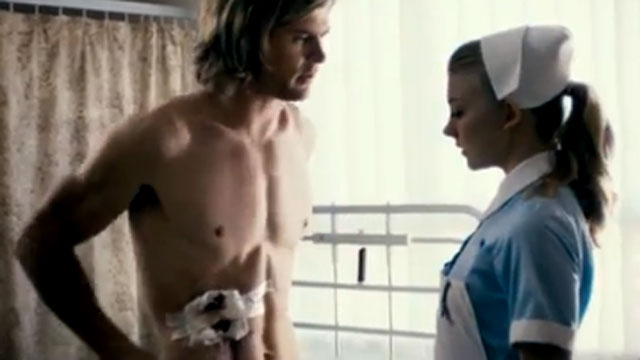
Oh.. is this movie about car racing?

Oh.. is this movie about car racing?

What is difficult to accept is that one easy way to get attention these days is to always do morea lot more – and preferably in as dangerous or titillating a way as possible.  Perhaps this was always the case.  In fact, when you chart the rise from Playboy, to Penthouse, to Deep Throat, to Hustler, to online porn, to Showtime’s annual and highly-rated multiple broadcasts of the AVN Awards (the Oscars of the Adult Entertainment Industry, which I stumbled across one day and reacted to like a bad car accident on the highway – I couldn’t look away) we can prove it not only was but that today it is even more so.

Of course, none of this means I will cancel my subscription to The New Yorker.  Or that any museums will be closed down.  But one can’t help but wonder if, as the years go on, those touchstones of culture won’t be viewed much like we now look at the language of Latin or the iambic pentameter of Shakespeare – intellectually impressive, perhaps even brilliant artifacts of another time and generation but nowhere near as exciting to us as the potential slaughters or killings occurring right before our eyes in any one of the Coliseum-like arenas of  entertainment that we’re choosing to put right in front of us.

Hmm, on second thought, maybe the times haven’t changed all that much at all.

Buy the Beach House

Watching the cultural phenomenon called “The Hunger Games” yesterday convinced me even more to take the advice a good friend of many years gave me this past weekend — “buy the beach house.”

Do not jump to the conclusion that this means I have the money to purchase that fantasy pied-a-terre on the shores of nearby Malibu or even one on the opposite coast of Rockaway, NY that I inhabited many decades ago as a boy when they were merely called bungalows.  I don’t.  Writers enjoy metaphors and some physical manifestation of intellectual advice rather than coming straight out and telling you what to do.  Part of it is our training and the other part is an innate cowardice that allows us to be far bossier through language on the page or images than we could ever be in real life.  Ernest Hemingway and Norman Mailer excepted, of course, though each were indeed wimpy in their own ways when you think about it.

As for my friend, her beach house advice was a way to communicate to me something strongly in language she knew I’d understand.  (We’ve known each other since high school, a time when we briefly dated – uh yeah, that’s how long ago it was), and have seen each other through many things.  And unlike most writers, she’s pretty direct.  See, she beat cancer in her twenties and – now decades later – it’s returned again.  Don’t stress – it’s not a Lifetime movie.  The prognosis is very promising but the second time dealing with the Big C is not only sobering but has a way of clearing away the stink and laser focusing on what is faster than you can say “Hunger Games” is the Emperor’s New Clothes.  Consequently, her “buy the beach house” orders to me still hang in the air because after 40 years, well, we don’t bullshit each other.

To the best of my knowledge, here’s what “buy the beach house” really means and,  yes I will also get to how and why understanding the place of “The Hunger Games” in the entertainment world today is essential to anyone who is interested in becoming a part of the entertainment industry today.

Movies, television, theatre, publishing, and advertising have for decades “new aged” the message “buy the beach house”  into our psyches.  “No day but today,” “Jump,” No guts, No glory,” “Don’t put off till tomorrow what you can do today,” “If not now, when,” “Have faith and shuffle the cards,” “I Am Spartacus” and so on and so forth are just a few examples.

Preach!

But in 2012 we need to go farther than what the construct of art will allow.  What does “buy the beach house” really mean?  It means, not only (Just) do it but do it in the real world.  It means it’s okay to dream and dream big, but in order to achieve those dreams it means you have to make sure fantasies don’t overtake your reality and in simply wishing something to be true you don’t convince yourself it is.  It means hard work, sweat, dedication and luck are all recipes for success but not necessarily antidotes to failure and all of them combined don’t necessarily guarantee you’ll avoid or achieve either one them as such.  It means, ultimately, that the road to happiness is buying whatever your version of the beach house is at the moment and, in doing so,  do the work and sign the contracts and do the work some more with your eyes wide open – understanding what you’re getting and staying determined to what you see as your eventual “dwelling” as you’re doing it in order to make it come true. It means that if you do all that and your beach house still falls apart, (which it is likely to because hey, we all know that global warming in 2012 has made living on the coast of any land mass perilous (ask Malibu’s Ali McGraw and some friends of mine in Mississippi), you will endure the disappointment and not allow your spirit to be broken, thereby enabling yourself to go on to your next dream – your next beach house.  Because god knows, there isn’t  only one.

Still has a great view!

Further translation?  You need to persevere and pursue your dream with all your might but you need to do it in a reality – not the distorted version of “Hunger Games” reality so popular with just about everyone but me right now (Okay, yes, more on that soon).

I saw a fine example of that perseverance at a panel I moderated some days ago with three directors, all former students of the college at which I teach.  All three of the panelists are working film and TV directors in their thirties and forties and all three had a clear path of working extremely long hours at not always desirable jobs while not abandoning their vision of their ultimate beach house.  Each also used whatever discouragement they had as fuel and each were able to speak up for themselves and their dreams, wants and desires when no one else could or wanted to (or even believed any of what they wanted might possibly become a reality).  Still, they stayed in touch with what they wanted and worked at it no matter what job they had or what state of mind they were in.

Eventually, two of them collaborated on a film that cost them $1100 (and was made on a camera they returned within the 30-day trial period) that went on to be very well-received and gross $5,000,000 worldwide.  Needless to say, this opened all kinds of career paths. Another panelist told tales of working many unrequired all-nighters at an assistant’s job that only allowed advancement when doubting superiors admired the work this person completed when no one else was around.  Oh, did I mention this person is now director-producer-editor of one of the most prestigious half hour comedies on television and that it was not until the last three years that this person even became a director?  And did I mention that the filmmaking team each started in lowly jobs, then became writers (not a lowly job despite what some people think), on air talent, producers and, finally, each directors of their own films?  Well, they did.

An even better view

These three people did not happen to land where they did by accident and they are not unique (although they are not average.)   But part of the reason they are among  the top of their class is that they imagined their own version of a beach house and kept trying to buy it – never giving up and never getting completely discouraged by the many turns of events that clearly indicated they had as much chance of achieving their dreams as purchasing actual west coast seaside property on a PA’s salary.  Their dreams became a reality because, in essence, they lived in reality but continued to dream.

Box Office Knockout

Which brings us to “The Hunger Games.”  If you like it – fine.  I didn’t.  Though I can certainly admire the work, the craftsmanship and the colossal effort that it takes to make a major studio “tent pole” movie in 2012.  And if you don’t think that takes a lot of effort and creativity and art, then you are over or underestimating what all three mean nowadays (or your POV), and you certainly don’t fully comprehend all of the potential minefields of a commercial system where most people want to use their talents but, at the same time, want to get all their hard work seen by more than a small audience of friends and admirers.   Certainly, NOT caring about this capitalistic stuff is an admirable trait if it’s really you but, then again, that has nothing to do with “The Hunger Games” or what it means for any artist of any kind who wants to work in the commercial system of movies and achieve their own version of a modest but sturdy beach house.

Without reviewing the plot, technical aspects, artistic execution or themes of “The Hunger Games” lets just say that it is basically a film version of a fictional futuristic reality show where each year a select group of young people 12-18 are forced to fight each other to the death.  It provides some slight and very superficial commentary, a few dramatic and emotional scenes that don’t get too messy, and lots of lots of eye candy, film trailer “moments,” and room for tons (or at least two or three) sequels, starting with its slightly open-ended ending.

I’ve noticed over the years that many of the people who love movies, both young and old, and are aspiring members of the next generation of moviemakers, are particularly drawn not to this kind of film but to the films of the sixties and seventies, which were a time of great sociological and societal shifts, not to mention soaring advancements in technical achievements and the way stories are told.  To simplify, there was a decided move away from the old-fashioned Hollywood type film to a more honest, independent type of films that told somewhat more realistic stories.

Here's to you, Mrs. Robinson.

And to be direct – this kind of movie is not “The Hunger Games.”  And it’s not — (fill in the blank with one of your fave contemporary films).  After two or three shifts since the 1960s and 70s, the kind of movies you love or your parents loved that you love probably accounts for, oh, 5-10% of all the commercial narrative films made nowadays (and I’m being kind).

As a member or aspiring member of the film biz in particular, it is very important to know and recognize that and plan accordingly, which is not to be confused with giving up your dream of a celluloid beach house on your own terms.

But while you’re working on your (seemingly elusive) dream you might also want to notice that the storytelling in cable television shows like “Mad Men,” “Homeland,” “The Big C,” “Dexter,” “Downton Abbey,” “Breaking Bad,” “Weeds” and many others are now carrying the gauntlet of the film sensibilities of yesteryear that you recall so fondly.  And that there is an online market that is breathing over the shoulder of movies theaters and portable and non-portable televisions everywhere as we adjust to watching entertainment on the “tablet” of our choice rather than in a specific market.

What I’m saying is that in 2012 you probably don’t want to purchase a beach house from the 1970s (if it’s still standing) because of the impossibility of maintenance in today’s environment   Even if that wasn’t the case and you insisted on being frozen in time, at the very least you’d have to admit you probably need to spend more than a little time, and actually more time than you had planned, to modernize the plumbing.

What I’m suggesting, then, is – take a look at the terrain around you – and in order to actualize your own personal beach house dreams, consider, if not significantly modernizing, doing some of the necessary maintenance work.