It’s back to school time and that means for students and college professors alike, especially those who aspire to write, and, like me, teach writing, there is that familiar feeling of excitement, infinite possibility and dread in the air.

I’ve been teaching writing a long time and have been a writer several decades longer, so I’m used to the dread when you know you’re going to be faced with a blank slate, screen or, as it used to be known in the biblically quaint time I grew up in, page.
As for new experiences of those faced with another year in school, that can be at least doubled.
But I also know that the “dread” about it all, as it is with most things, is simply fear of “it” or “you” being bad; fear of failing, being mediocre, or of disappointing, hurting or being hurt in some way. And that once you’re actually “in it” and “beginning it,” whether it’s a new chapter in life or that dreaded stone tablet page I learned on, there is also an exhilaration that just maybe anything, or everything, is possible.
It’s then that you become various shades of excited, a feeling that you hope will last forever, or at least for the multiple handful of months it takes to complete a project, or full semester or two.
Of course you know that won’t happen because:
a. Nothing lasts forever (Note: Did I just write that?) and…
b. It’s impossible to hold onto any one feeling that long
But it’s fun to hope, isn’t it? We humans always have that. Not to mention, the creative possibilities that spring from young minds are exciting, to not only peers but the elders that try, as best they can, to help them work their artistic impulses into their own unique cohesive takes on our current reality.

Sometimes their work is funny, other times it’s sad but over the years I’ve found it’s almost always somewhere in the middle, often tilting to one side or the other but overall a mix of both. (Note: And the blacker the comedy, the better, I’ve noticed of late).
True, my cross-section of students from an east coast liberal arts college spending a semester in L.A. is not a statistically infallible sample. But looking back in my mind and through my files (Note: Which are, yes, printed out pages in paper folders), I’ve found they’re a pretty good reflection of what younger people are generally thinking and feeling about the world, how they envision we might resolve our personal conflicts and what they see as the status quo (Note: In dramatic writing parlance it’s called “stasis”) at this particular point in time.
So, do you want to know what they’re thinking this semester?

Well, they’re writing stories about stopping evil from overtaking the world, surviving in a post-apocalyptic fantasy realm, investigating murder, recovering from abuse, avenging the death of their town and/or loved ones, solving the mystery deaths of a trio of young women, or triumphing in a life of crime after being unfairly fired from a low-paying job they were over-qualified for in the field of their choice.
There were only two “relationship-centered” but they are on people trying to overcome oppressive religious upbringings, pronounced class differences or tribal wars in the 22nd century.

Some of them propose dark – well, very dark – comedy tones but there was not one you could call particularly uplifting or primarily fun.
Were there always stories like this? Certainly. But not this many so consistently.
And, when you think about it – why would there be???

Writers reflect what’s going on in society and I can’t blame any young person who came of age in the last ten years for existing in pillaged fantasy worlds where mere existence is anything but guaranteed.
Nor can I fault them for making circumstances and problems of everyday life so perplexing that the only way to survive is for their characters to live in a world where some degree of magic is accessible. Not so much sleight of hand, though there is that, but in various degrees of actual magical power.
Certainly there is no logical way, or any way, to solve the issues and the environments the average person is up against these days.
I don’t in any way, shape or form see this as a by-product of them growing up in a Harry Potter-influenced world, if that’s what you’re thinking.
The only references to Potter that’s come up so far this semester, and also through the last, is their mass disappointment in its author J.K. Rowling for her hurtful, dismissive, dangerous and prejudiced (Note: Their words, not mine) public putdowns of and revulsion towards the trans community.
See, not a semester goes by these days where they don’t have trans and non-binary identifying students among their classroom peers and they abhor others sh-t talking them, or about them. The same way they don’t like the sh-t talk about their non-white and/or mixed race peers. Or women. Or gay people. Or… Or… Or…
(Note: Yes, they will sometimes write that a character is seated among a table full of old people and when I ask, how old ,I get answers like, I guess in their forties, or okay, fifties. But I, who by that definition is really really old, am working on that. While I still can).

Of course, like any younger generation – yours, mine and all those before us – they also abhor a lot of other tangible things about the world as it exists now, and as it’s being handed to them.
Just like so many more of us feel about our stasis. More than I’ve seen in many, many years.
But if you think you’re mad about where we’re at in the moment, they’re even madder. They just do a better job of masking it around you, and likely their peers, and themselves. It’s what accounts for what they are choosing to write in my class, and to repost on the occasional social media thread (Note: Though nowhere near as much as we do. I think they’d rather share music or laugh at TikTok content).
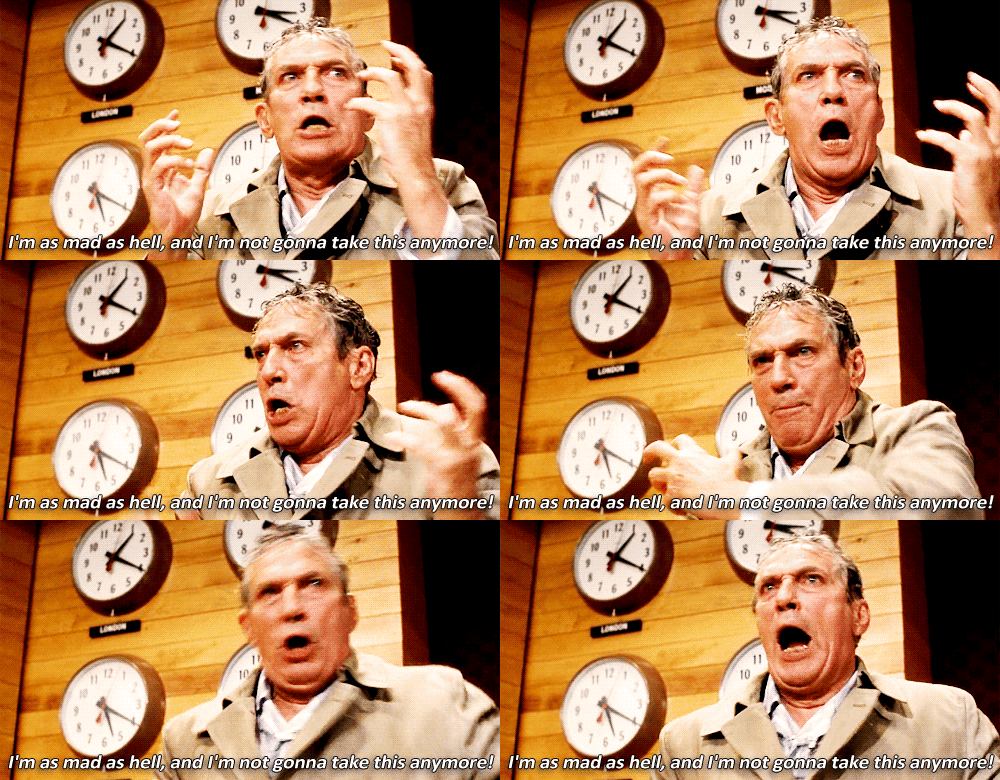
Still, the rage, sadness and anger at what’s going on right now, is still there.
At the violence. The deteriorating earth. The wave of totalitarian oppressiveness worldwide and the economics of everything. The sense that even the U.S. is no longer a safe haven from any of it, if it ever was.
They’re going to be around a lot longer than the rest of us and can’t quite see a way out of it without magic.

But one benefit the rest of us who have been around longer have is the knowledge that magic is a relative term that means a lot of things and comes in all kinds of forms.
Yeah, it can be literal. But it can also be earthbound and metaphorical. Practical solutions that seem otherworldly but are anything but, and are hard-won through years of talking and listening and compromise, coupled with research, discoveries, knowledge and, most importantly, persistence through it all.

I have four months to teach them the many forms magic can take, and inspire them to imagine it into their stories in whatever way they see fit. That is, along with all of the requisite other stuff.
#WishMeLuck.
And if you run into anyone their age, try to be encouraging.
The Lovin’ Spoonful – “Do You Believe in Magic”




 notes from a chair