For Your Consideration

Screen Shot 2015-07-19 at 10.22.46 AM

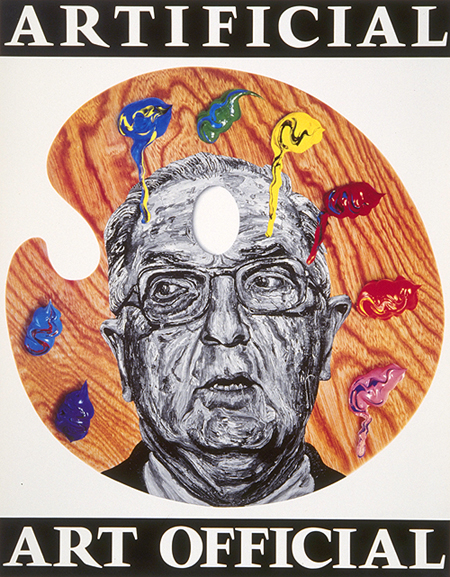
I used to have a poster in my bathroom that read ART OFFICIAL underneath a cartoon drawing of a deceased politician who, among other achievements over his 30 years in office, vigorously advocated for legislation in the U.S. Senate that would quarantine people with AIDS, reinstitute segregation in the South and defund all governmental support of the arts. His name was Jesse Helms and a looker, he wasn’t.  Still, every time I went to the bathroom and saw his face, snarling at me from over the bathtub, I felt as if I were taking a crap right in front of him and everything he stood for. This made me incessantly happy for quite a long period of time during a very difficult period of my life.  Okay, about 15 years.  Still, how many other $9.95 posters can you say that for?
Allow me to excuse myself

Allow me to excuse myself

Many people, including my now husband, criticized me for keeping Mr. Helms around for that long and begged me to take him down.  Nevertheless, I wouldn’t relent – even when Mr. Helms started to bend and fade after years of restroom abuse and we were towards the end of the Clinton administration where times had begun to change just a little bit.

Some months after Sen. Helms finally dropped dead at the age of 87 and my test of wills was won I decided it was time to move on.  Still, I sometimes miss that poster (Note:  The original piece was drawn by famed guerilla poster artist Robbie Conal) and everything it evoked – anger, color, sadness, triumph and, in the end, just plain justice.
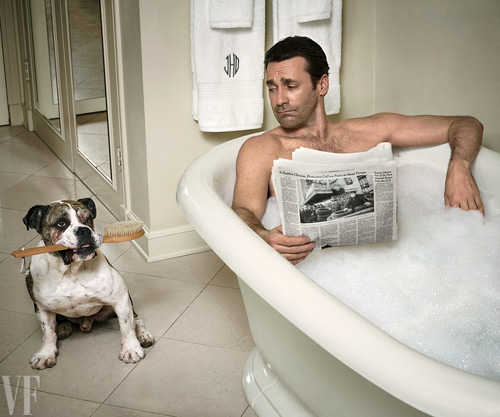
I have a better idea for some bathroom art.

Perhaps some better bathroom art

Point being, it’s hard to quantify what a poster or any piece of art means to an individual.  What speaks to us, why it resonates, just how good “good” really is or just how “awful” a truly awful creation can be is purely subjective.  Can you really, as the old saying goes, sew a silk purse from a sow’s ear?  Well, for my $9.95 you couldn’t get any more piggish than Jess Helms yet, crossed with the expert purse-spinning of someone like Mr. Conal, you could not have wound up with anything more silken.  My dear husband to this day still disagrees but, fortunately, arguments like those are not relationship breakers.

Which brings us to the announcement of this year’s Emmy Awards.

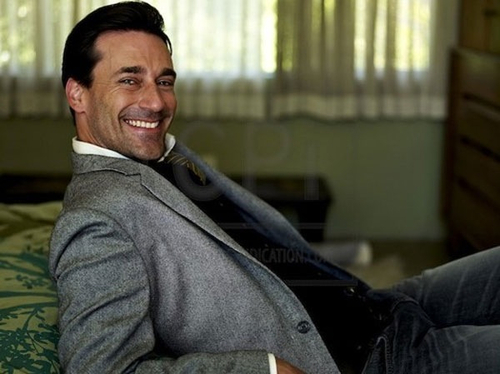
But before we begin, here’s a photo of Jon Hamm.

hai

hai

And another.

Me again?

Me again?

This man has NEVER won an Emmy Award and yet has been nominated all eight seasons he has brilliantly played Don Draper on the equally brilliant television series Mad Men, which finally ended its run this year.

Yes, Mr. Hamm is the physical anti-Helms and in that sense certainly bears no relation to any sow I have ever seen.  But that is no reason to penalize him for achieving the equivalent of the finest silk etching of one of the medium’s most iconic and certainly-to-be enduring characters.  So if you’re a voter – you. must. vote. for.  him.  And if you’re not, consider joining the Television Academy just so you can make sure that this time justice will be done.  Or simply go through your phone book and lobby someone you love, like or even feel indifferent towards to do the same.
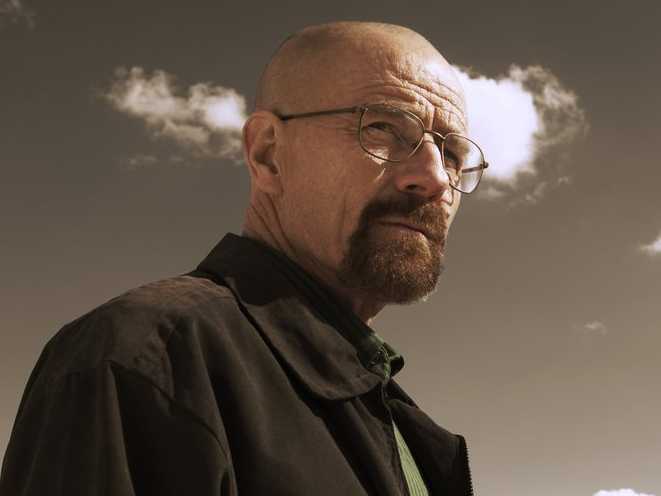
Even I will vote for Jon!

Even I will vote for Jon!

Now, where were we?

Ah yes – awards.  See how totally subjective these types of discussions can be?

For your conveniences, here is a link to this year’s nominees

There is no point going on about every one of several hundred categories and who was left out, included or otherwise justly ignored.  We all have our favorites.  And sows.  Yet here are some salient facts you might not have known:

Sizing up the competition

Sizing up the competition

1. Every nominee in every category must be officially “entered” into the race.  To do this it costs anywhere from $200-$800, which can be reimbursed if you are a member of the Television Academy – though that’s a yearly fee equivalent to the entry fee.  True, the studios or producers will often pay the money but not always.  Not to mention, any time anyone pays for anything that will give the general public pleasure, the cost will somehow funnel its way back to you – the audience – in some form.

Translation: This is not to say that there are not deserving people who win this or any other show business award.  But the next time you become outraged at the unfairness of it all, consider the paradigm on which this is all constructed. (Note: With the exception of any award for Jon Hamm).

2. The rules require most categories limit the amount of nominees from 2-6.  But you might notice that this year some have seven or eight nominees.  That’s because there is a 2% rule which means that if the last nominee who makes the cut is not getting 2% votes more than the next one in line, that BOTH have to be upped above-the-line.  Got that?  I thought so.

Whatever... she is marrying Joe Manganiello  #trophyhusband

Whatever… she is marrying Joe Manganiello #trophyhusband

Translation:  From the point of view of the television business – the more the merrier.  Meaning, if there is any way a network can somehow eke out another nomination it can advertise by getting one or two of its employees (who are often Academy members) to vote for one of their shows or performers or craftspeople they will do it with the hopes that they can land within 2% of the next marginal entry and somehow tip the scales in their favor.  Note:  This is not purely cynicism, though certainly something has to explain why Julia Louis-Dreyfus has been nominated 19 of the past 25 years for playing two very similar characters and Tatiana Maslany of Orphan Black finally received her first in three years for a BBC series (Orphan Black) during which she convincingly plays 5-7 very distinctly different people. (Note:  Oh, hiss and boo your own selves – Copyright, Bette Midler – and save your outrage for world peace).

3.  There is similarly no accounting for why perennial nominees are suddenly left off of the list.  For instance, this year Big Bang Theory’s Jim Parsons, a four-time winner and six-time nominee in the Best Lead Actor in a Comedy category, was completed overlooked.  Bill Maher, who has been nominated 18 times for hosting and writing his own show for 20 years (and has never ever won) was passed over entirely this time out.  (Note: He’s probably relieved).  Homeland was back among the best drama series in its fourth season after being dropped from the list last year following two consecutive nominations and one win in that category for its first two seasons.  Similarly, Mad Men has been nominated for best drama series for every year it has been on the air but NOT ONE OF ITS REGULAR ACTORS HAS EVER WON.  EVER.  #itsanhonorjust2benominated?
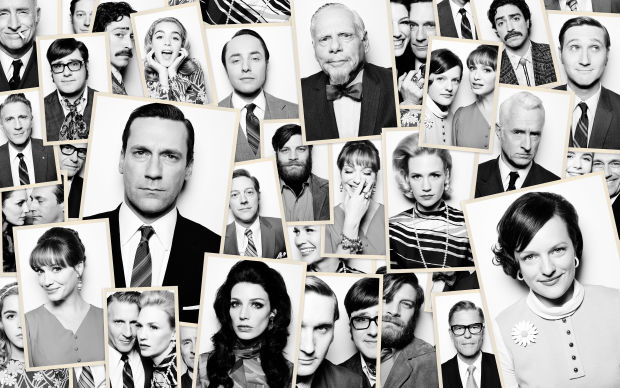
Will one of these admen (and women) bring home the gold?

Will one of these admen (and women) finally bring home the gold?

4.  A big deal is made each year over “new blood” being recognized during awards season.  This year, the people of the moment the zeitgeist seems happiest about are Amy Schumer for her much lauded sketch comedy show on Comedy Central, John Oliver for hosting a new HBO show that bears his name and Netflix’s Unbreakable Kimmy Schmidt, which scored a series and a handful of guest-starring nominees but none for uh, Kimmy Schmidt – aka Ellie Kemper?  There are no whys in this discussion.  Only why nots.
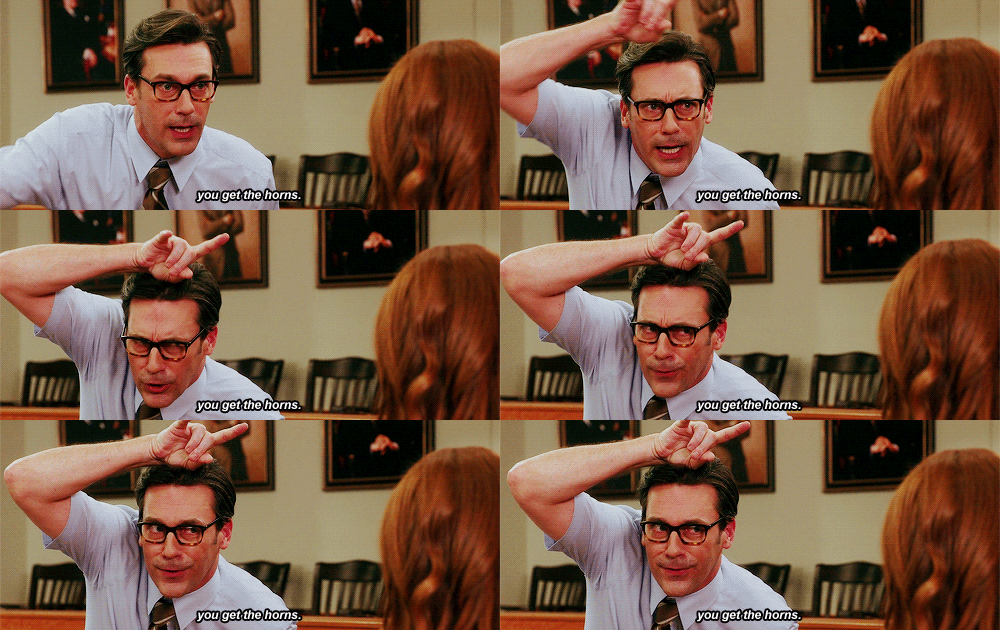
Hey... look who was on Kimmy Schmidt?

Hey… look who was on Kimmy Schmidt?

5.  It’s one thing to peruse a mainstream publication’s list of Emmy contenders for hits and misses but when you’re looking for something a bit more specific, or at least unusual, research shows (Note: Okay, fine, it’s just my opinion), people turn to blogs.  In this spirit, we’d like to point out that by far THE unique Emmy nominee of 2015 is the nod to Jane the Virgin’s Anthony Mendez as BEST NARRATOR.  The CW show has broken the barrier and become the first ever-scripted series to score a nomination in this category.  Since you’re wondering, this year he goes up against Neil deGrasse Tyson, who narrated National Geographic’s “Hubble’s Cosmic Journey,” Miranda Richardson, who did Nat Geo Wild’s “Operation Orangutan,” Peter Coyote, the voice of PBS’ “The Roosevelts: An Intimate History” and Henry Strozier, narrator of Animal Planet’s “Too Cute!” series.  Though the much-hoped nomination for Jane the Virgin star Gina Rodriguez in the lead actress category didn’t happen. #donteventry

6.  Finally, it could be argued that, historically, among the most competitive Emmy category has been lead actress in a comedy series.  Think about it – Lucille Ball, Carol Burnett, Jean Stapleton, all four Golden Girls in various years and, okay, yes, Julia Louis-Dreyfus.  (Note:  I never said she wasn’t good!).

However, there should really only be one winner this year and that’s Lisa Kudrow for comic/tragic/comic heroine Valerie Cherish on HBO’s The Comeback.

That girl!

That girl!

It doesn’t get any better than what she managed to pull off as actress, writer and producer.  Will she win against Amy Schumer, Amy Poehler. Lily Tomlin, Edie Falco and, um. J L-Dreyfuss??  If there is any justice, yes.  But as was the case with my under $10 piece of Jesse Helms artwork, sometimes it takes 30 years for justice to prevail.

Finally —

GIVE JON HAMM THE G-D DAMN EMMY!!!
The Real Thing

Screen Shot 2015-05-18 at 11.59.35 AM

Can people substantially change who they are? Or do they, as they get older, just become more of who they are?

Mad Men – one of the best-written series ever on television – grappled with the question of change and identity via the lens of the American psyche throughout its eight-year,seven-season, run. So it seemed only fitting – and simultaneously both obvious and brilliant – that this would be the primary question it answered in its finale episode.

A television program can only do so much but for my money and time there has not ever been a show to so accurately yet obtusely capture how Americans think, change or refuse to budge as this one. We have taken a lot of heat as a country for being a bit self-obsessed just as we have also always been lauded for our sometimes unsolicited generosity of spirit to others when their or our backs are to the wall. Perhaps America as a bastion of freedom that will always lend a helping hand and open door to those less fortunate has taken a beating in recent years. But the idea of the U.S. – and the desire for there to be a place where people can live free and be who they really are regardless of what they may or may not really be, observe or come from – is a concept that seems to only grow with power as time goes on and the world grows more (yet seemingly less) connected.

Don Draper's 1960 utopia

Don Draper’s 1960 utopia

The reason Mad Men was so often able to address these questions so brilliantly is that series creator Matthew Weiner chose exactly the right decade – the 1960’s – to tackle them. There has not been, nor probably will there ever be in the future, a ten-year period with so great a shift in cultural, political and social mores. It saw an unprecedented period of sweeping changes in how we thought, felt, and even dressed. Free love, the peace movement, a relaxing of social conventions that caused us to become (Note: Sometimes kicking and screaming) more inclusive and less discriminatory against the marginalized or less fortunate? Well, five plus decades later some of it would last – for a while – until segments of the majority in power (Note: Did I say the 1980s? Oh, now I did) decided to take a few more steps backwards from that advancing direction. But then again, all of this societal stuff tends to be cyclical anyway if you look at the rise and fall of any the world’s great super powers. At least we – well, many of the most fortunate of us, that is – still have a few more choices now than we did back then.

When one says Mad Men was about the sixties let’s be clear about something – it was really about the 1950s, 1960s, and 1970s. The decade we really think was the sixties didn’t actually begin until after John F. Kennedy was assassinated in 1963. Before that it was just the 1950s but with a more youthful glow. The 1960s then happened and took us through Vietnam, rock ’n roll, drugs and the search for love and that dirty term nowadays: self-actualization. But that ended after the 1968 assassinations of Dr. Martin Luther King Jr. and Robert F. Kennedy, television bringing the atrocities of the Vietnam War home, and the unmasking of all of the rest of the American dream for every bit of the invented sham it always was. That, in essence, was where our slow recovery – meaning the 1970s – began and continues to this very day.

Don's reading materials

Don’s reading materials

None of this is meant as an insult to the American dream or to negate the fact that many beneficial aspects to it still do exist. But make no mistake – it was and is invented and made up. The very nature of all dreams is that they are NOT REAL. Which, on the other hand, makes them no less true (or potentially true) in some form. I tell this to my students in every writing class I’ve ever taught when they voice concerns that their stories are too contrived. Well, of course they’re contrived! I answer. All of this stuff is made up, even if it’s based on real life. The task is to make it not seem like it is – to somehow have it evoke reality. That was hard fought advice I gave to myself after decades of self-flagellation whenever I myself grew overly frustrated that nothing I ever wrote seemed real ENOUGH.

There is no main character – nee protagonist, nee anti-hero or hero, depending on how you want to see him – to dramatically travel so effectively in, around and through these issues as a man whose job it is to manufacture American dreams, wants and desires – meaning an American advertising man.

From the pilot episode

From the pilot episode

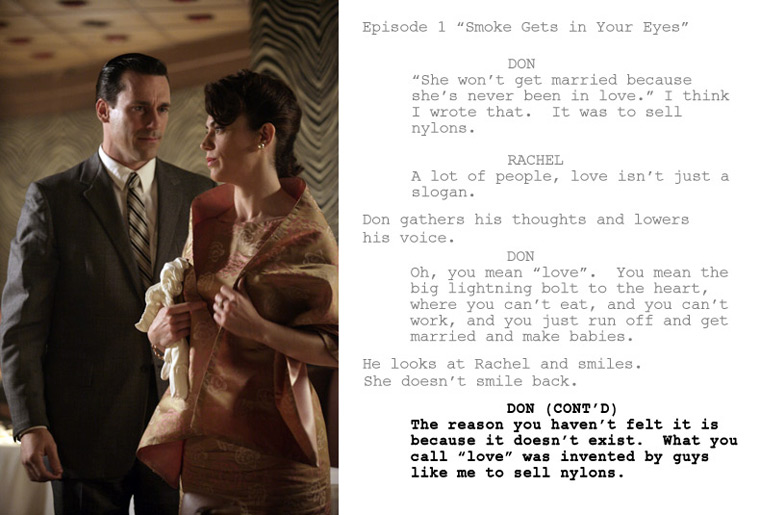
And what kind of ad guy – how about one whose entire personal identity is made up from the very beginning – both literally in Matt Weiner’s mind and figuratively in the character of Don Draper, a man who is really named something else he didn’t like or want to be and instead chose to assume the name and new life of a dead man. This is a guy who is so perfect looking, so talented, and so continuously successful in everything he does even when he is failing miserably – that he couldn’t be real. In fact, he couldn’t be anything more than the invention of some smart and savvy mind on Madison Avenue – which is what he is.

Don Draper’s journey from stud, to family man, to phony man, to rich man who remembers being a poor man, to rogue, alcoholic, reformed rogue with half a heart back to pseudo real, tortured American stripped bare at the end of the decade, seemed iconic and ironic enough. But it was only in the last episode this weekend, where the flawed yet somehow always enviable Don Draper took center stage alongside such other fictional American icons as Tony Soprano of The Sopranos, Walter White in Breaking Bad and even All in the Family’s Archie Bunker.

Television's (now) former leading men... casting long shadows

Television’s (now) former leading men… casting long shadows

It is giving nothing away (Note: Or perhaps it is so if you’re a stickler for these kind of things you might want to skip over the paragraph) to say that at his seemingly lowest point in the series Don decides not so much to change but to pull himself together the best he can and achieve what in his heart of hearts he’s always wanted – something uniquely his own and thus personally iconic.

But he does this not through the personal epiphany he has in the scene before when, in a burst of uncharacteristic, unguarded emotion, he is able to identify with and even hug a fellow lost male soul in a California encounter group when the man compares himself to an unchosen item in a refrigerator and laments that people “look right through you” and don’t see you. I mean in that moment you wonder if what Don feels is not so much kinship for a guy to whom he is essentially saying – that’s right, I feel the same way, they don’t see me either and I know how you feel – or whether as he’s hugging this poor shlub he is really saying – Listen bud, I AM the ideal, the guy you always think they see and who, in fact, they do see and always choose, and it’s no better on this side either. I don’t feel like anyone really knows me because I don’t know me, and let me tell you, just like you that feels like shit.

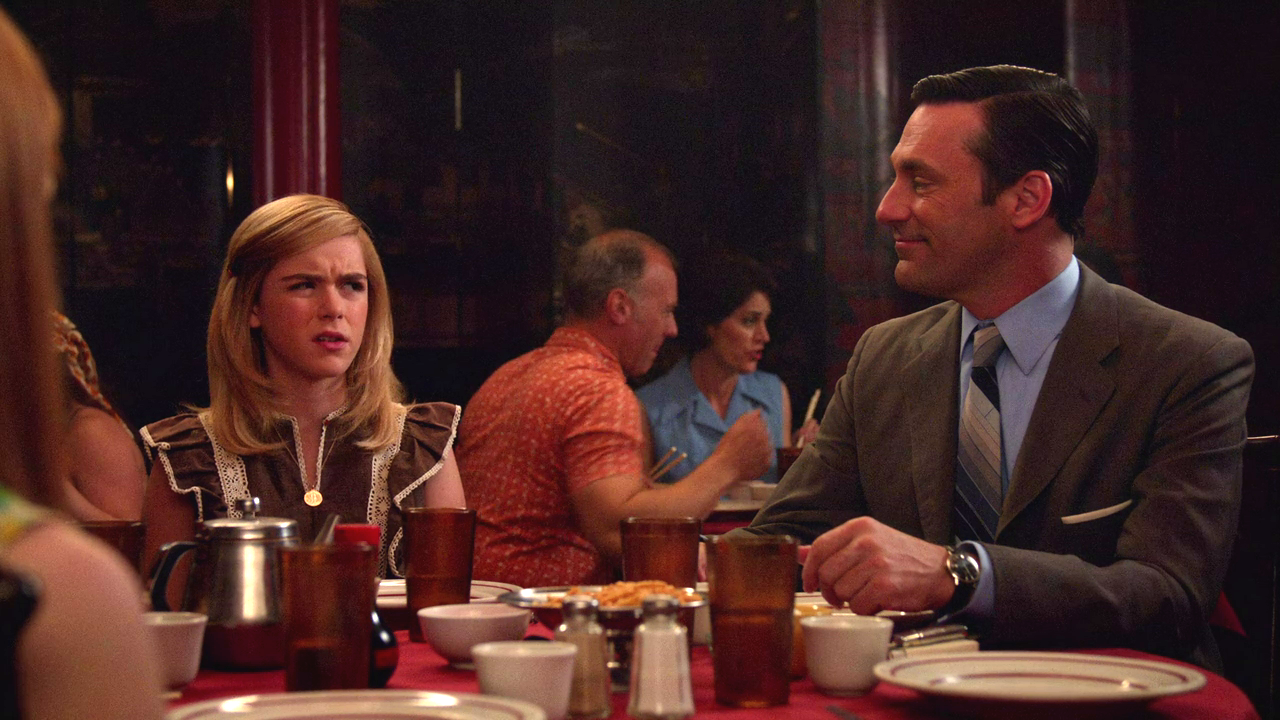
Sally gets it. Especially when she tells her father (in this season's "The Forecast"): "Anyone pays attention to you, and they always do, and you just ooze everywhere."

Sally gets it. Especially when she tells her father (in this season’s “The Forecast”): “Anyone pays attention to you, and they always do, and you just ooze everywhere.”

This would seem to be Don’s emotional catharsis and moment of self-actualization and perhaps it is in that moment. But like all heroes in very American art this hero has to take what he’s learned and apply it to real life. Or as they say via our take on modern dramatic film and TV writing, The Hero’s Journey — he needs to Return with the Elixir from whence he came and put his knowledge into practice in his own ordinary world.

Though we’ll never know for sure, it seems that Mr. Weiner’s (and Mad Men’s) answer to all this is NOT to have Don go home and become a better father, join the Peace Corp or set up a foundation for other lost souls less fortunate than he.

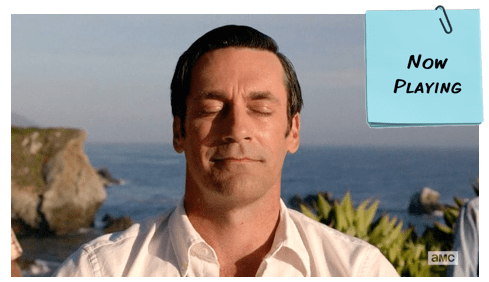
No – what happens is that during a subsequent day of mediation (complete with a joint OHM and all that entails) a literal bell goes off in Don’s head and he smiles – presumably with an idea.

Suffice it to say this is not a notion for how to achieve world peace or the beginnings of a cure for cancer. Though perhaps it is the ad man’s equivalent of that – a brilliant idea for a …Coke Commercial?

Say what you want about all of us as a culture, or as artists, but there is no idea too pure or life event too personal that we are above cannibalizing if we can turn it to our benefit into great art or at least a great business idea – though hopefully both.

Which I couldn’t help thinking about when Mr. Weiner revealed Mad Men’s final song and image – Don Draper’s last great idea. Cue one of the most famous television ads ever seen – a multi-cultural group of young people of different colors and nationalities atop a mountaintop having HIS Kumbaya moment but singing a song espousing the benefits and joys of us humans one day existing in perfect harmony as we each drink…our Coca-Colas.

You tell 'em, Rita!

You tell ’em, Rita!

Anyone who is of a certain age remembers I’d Like To Buy The World A Coke.  If not click here. First it was an ad jingle, then it was one of the first world videos, and then, and only then, was it re-recorded with new lyrics where it would become an…international hit record.

It was the beginning of another era – that of media cross-pollination, which would eventually give way to mass corporate ownership of the arts and vertical integration of all its divisions into a new world order.

Yes, we do have the Don Drapers of the world to thank for that.

But only THE Don Draper – and those who created him – to thank for seven seasons of appointment TV that, even in our current and vast media landscape, will sorely be missed.