
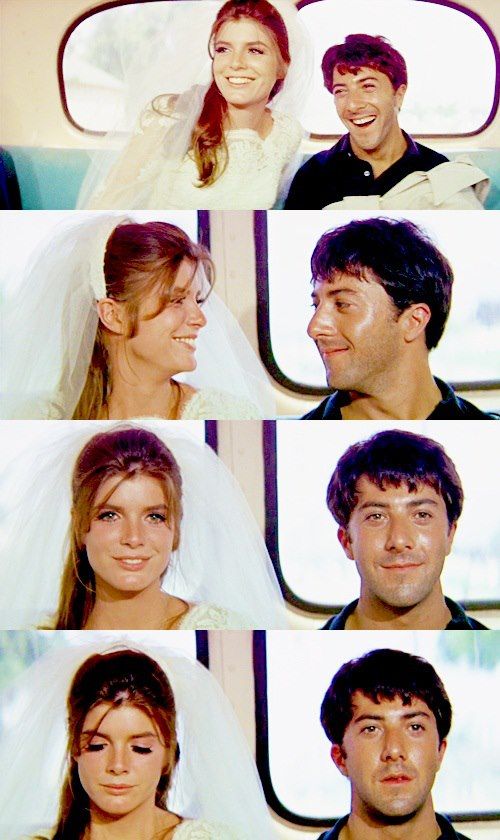
I was watching The Graduate for probably the 25th time last weekend.
It’s always been on my top 10 list of films. And not only because, like its protagonist, I was also a confused 20-year-old boy-man who graduated college early and had yet to have sex with anyone.

Did I just admit that publicly? Well, if that’s the worst thing you can say about me…
In any event – Mike Nichols’ direction; the performances by Dustin Hoffman and Anne Bancroft; the funny, squirmy, ring of truth screenplay by Buck Henry and Calder Willingham based on Charles Webb’s novel. And so much more. It ALL works.
Doesn’t it?

Well, it did for me. The first 24 times. Until last week when I was stopped dead in my tracks by one of its most potent sequences.
It’s about 15-20 minutes in when the sensuously seductive, middle-aged and married Mrs. Robinson coerces young Benjamin into driving her home and then condescendingly intimidates him into walking her inside her house and up the stairs to see her daughter’s portrait because she’s “afraid to be alone.”

Upstairs and in her daughter’s room, Benjamin’s now a nervous wreck, but, well, at least this is almost over. Until she begins to get undressed for bed, at which point he runs down the stairs to leave and she calls down to him, demanding he bring up her purse and put it back on the bed in her daughter’s room.
Which he does. Cause that’s what guys like us do.
At which point he turns and sees her quickly re-enter fully naked, lock the door to prevent him from leaving and stand boldly in front of him. She then declares – in a measured but very definitive voice – she is available to sleep with and that if he won’t do it now he should call her any time, day or night and they will make arrangements. It’s not a seduction so much as a challenge, bordering on a demand.

Never mind Mrs. Robinson is a long-time family friend and that her husband is his father’s long-time business partner. Or – creep alert – that she’s known since his toddler years. It doesn’t matter to her. One bit.
Except to him it does.
And Mrs. Robinson knows that. Because as she stares him down, still in front of that locked door, she demands he tell her he understands not only what she is saying but what she really means. And by her tone, it’s clear she won’t take no for answer.

Benjamin begins to stammer, sighs deeply and, in a desperate panic, finally says the words. At which point he pushes her naked torso out of the way, there’s a closeup of his fumbling hands unlocking that door, and he runs all the way down the stairs and out of the house in panic.
We don’t see Mrs. Robinson’s reaction to his exit but all through the scenes leading up to this climactic (Note: Though not quite. Not yet.) moment she smirks, lies, manipulates and even gently laughs at him. She’s confident this kid will soon be intrigued and very likely tempted. After all, she knows she’s eye candy to any man, especially a boy-man who is lucky enough to get a full-frontal, closeup view of her in the actual flesh. She’s doing HIM a favor. Trapped or not and whether he likes it or not.
But…how could he not like it???

This is how it read to me in 2024, a time when I am long past my twenties and far more experienced than I ever dreamed I’d be all those years ago.
The predatory behavior. Exposing yourself to an inexperienced minor (Note: It wasn’t until the early 1970s that the age of consent was changed from 21 to 18) in a room you lock from the inside. Not letting them leave until they either have sex with you or verbally, and convincingly, say they will consider it at some future date.
Some might consider it potentially traumatizing. If not downright abusive. Or even illegal.

Of course, in 1967 this was not only acceptable but a key factor in making the film one of the biggest box-office and critical hits of the decade. Benjamin was considered a lucky guy and Mrs. Robinson was thought of as a MILF (Note: A today term, but apt) doing him an, ahem, solid.
A neurotic mess when she locked that door, he would even continue to be a few sequences later when they check into a hotel room together. That is until he resists immediately f-king her once inside and she begins to laugh at him – and then accuses him of being gay.
That does it. He turns the lights out and it’s game on.

It took all that effort and all those “insults” for him to become a man. A guy who only months later would have the nerve to date her daughter and treat her shabbily, then decide he’s fallen in love with her even though she hates him, and then go all out and finally manage to convince her to marry him.
What could go ever wrong?

Thanks to Mrs. Robinson, Benjamin will NEVER need therapy. Not only that, he has finally found the stones to stand up for himself and get what and who he wants against all odds.
As all real men do.
A few questions to consider:
- What would we have said if Benjamin were Belinda and MR. Robinson locked HER in a room and exposed HIMSELF? Likely, that would not have been considered a good thing then or now. But if we kept the sexes of Benjamin and Mrs. Robinson intact? Do we think any differently about it, even today?
- How about if Benjamin didn’t respond to all that pressure and was impotent with Mrs. Robinson that first time in their hotel room because he was simply nervous? What’s the aftermath? Or his next move in the dating pool? And, well, how would that go?

- Or imagine a gay but closeted Benjamin in 1967. Would all this have changed him into believing he was straight? Or added yet another level of self-hatred to his pitiful secret desires? Perhaps it would immediately force him out of the closet simply to prove something. And what exactly would the result have been back then?
Revisiting a socially liberal, though seemingly apolitical classic like The Graduate and realizing it doesn’t fully hold up to contemporary morality, doesn’t mean we were all wrong about it. Nor does it detract from its craft, its humor, its insightfulness or its fine performances. It simply gives new perspectives on human behavior. And enlightens us on the nuances of consent and the dynamics of power.

TCM host and film scholar Jacqueline Stewart wrote about Gone With The Wind in the aftermath of George Floyd’s death and America’s new, imperfect reckoning with race. While others called for it to be pulled off the MAX platform, she instead wrote an introduction to contextualize it and led a filmed discussion for viewers who wanted to revisit it and see classic cinema for its flaws as well as its greatness.
She notes GWTW glorifies a system of brutality (e.g. slavery) and downplays the inhumane treatment of African people in a way that has shaped Americans’ understanding of race. But elaborates that given its enduring popularity the answer is not to ban it altogether but rather use its allure as a way to educate ourselves…The ability to complicate the pleasure we get from these works…puts us in a position of having more meaningful discussions about them.

On that note, there is a riveting documentary/play/movie that was just launched on MAX this weekend called, Slave Play. Not A Movie. A Play. Directed by Jeremy O. Harris, who wrote the provocative, and much acclaimed theatre piece, Slave Play, whose Broadway production received 12 Tony nominations several years ago, it’s a unique offering.
In under two hours, we get to see very dramatic, whole sections of various incarnations of the show from early workshopping to Broadway excerpts, as well as staged scenes Mr. Harris directed at the Yale Drama School.

More importantly, it contextualizes not only issues of race but queerness, love, marriage and yes, consent, in ways most of us have likely not ever considered or connected before.
If I told you that you would get to see period Civil War era scenes of a Southern white woman order her mulatto slave to have sex with her; a Black gay man humiliate his gay, white trash partner; or a Civil War overseer refuse to beat a Black female slave even though she urges him on, you might well say – um, that’s not for me.
But in actuality, that’s what Mr. Harris wants you to say. And think.

So he can then pull the rug out from under you mid-way through and let you know what this is all really about.
It’s insight that can happen when those of us who watch movies, television and theatre – the old, the recent and the new – get to see them through a contemporary gaze. When we don’t shut our minds off but instead open them up to all types of material and ways of thinking we failed to consider previously or perhaps never could have imagined.
Simon and Garfunkel – “Mrs. Robinson”




 notes from a chair