Has Meryl Streep ever turned in a bad performance? I don’t believe so. But has she given us examples of acting not up to her usual caliber? Certainly. (Watch 1982’s “Still of the Night” and report back). Tony Kushner’s genius “Angels in America” set the bar about as high as it could go for a playwright – and pretty much for any writer. Forget that he won the Pulitzer Prize. That particular piece of work, which he labored on for years of rewrites as he watched AIDS devastate life around him, will also live on for generations as the quintessential dramatic evocation of a plague whose ruthlessness and scope defied description. That is why sitting through his musical “Caroline or Change” some years later one couldn’t help but feel that, well…every brilliant writer deserves at the very least a “gimme.” (okay, that “one” was me – a severely disappointed fan in a severely UNconservative way at the time). The list goes on an on and most recently ends but certainly doesn’t stop with President Barack Obama.

Split screen is not our friend.
The buzz is abuzz with POTUS’ debate performance last week against his Republican challenger Mitt Romney. Among the colorful adjectives used: “devastating,” “bumbling,” “crushing,” “mediocre” and “defeated.” Even the venerable Dan Rather, who was brought down from his perch atop CBS for daring to suggest Pres. George W. Bush had avoided military service in Vietnam by joining the National Guard (even though Dubya was a member of the National Guard in the Vietnam era and did not serve in the military) proclaimed the next day on MSNBC: “Let’s say it for what it is, he got his clock cleaned…there’s no other way to put it.”
Trivia note: According to the NY Times, the phrase “clean your clock” was first used on the SPORTS pages (I should’ve known!) of the Trenton Evening Times, July 28, 1908 about a couple of local baseball teams – “It took the Thistles just one inning to clean the clocks of the Times boys.” This certainly doesn’t make the use of the term any more complimentary, but perhaps knowing its origin does take away some of the sting of this currently overused phrase.
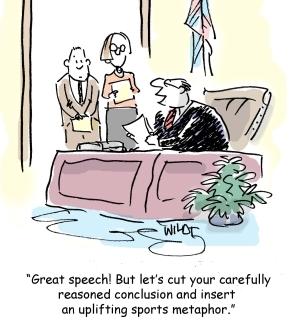
Whenever I hear guys on TV (and it’s almost always guys, let’s face it) use sports metaphors to describe or critique anything but a ball, a puck or pair of human legs reaching their preferred destination, it sets off a warning bell deep in my soul. But that bell doesn’t zzzing. Instead it tells me in a measured voice we are no longer describing a factual event but indulging in the “oh so witty” (not!) opinion of the person observing such an event. In which case, you might want to task another person with deciding if your timepiece was indeed really laundered or perhaps even to determine if its bath was as thorough as everyone on the sidelines of its supposed unauthorized spa treatment says it was.
Like many people, especially those in the arts, I’ve been described as overly dramatic, opinionated and argumentative by more than a few over the years (who… me?). I’m never insulted by these commonly accepted “off” terms because to me this also means that I’m passionate, committed and quite forceful, depending on the day, arena and reviewer. In fact, there are probably days where my audience (that’s you) see me as passionate where I feel I might be a tad overdramatic; and others where you’re nauseated by my insane opinions while I revel in the fact that I’m so committed to an issue and getting its truth out there that deep down in my soul I truly believe I am the long lost son of either Emma Goldman, Caesar Chavez or Gandhi. (okay, admittedly that feeling has only occurred once or twice).
Some days are better than others in the life of every human just as some performances are superior and some written works are more memorable (or, at least, relatable). Objectively speaking, there is no way to measure how good or bad anything is. That is why it all comes down to two things – consensus and feeling. And neither one can be counted on as being absolutely right or wrong.
The general consensus is that the President was having an “off” day (actually it was night) in his debate with Mr. Romney. And perhaps he was. Using our aforementioned standard of “consensus” we’d have to concede “off” would be the kind word. But remember, consensus is not necessarily always correct. I mean, the Grammy Awards voted Milli Vanilli their coveted Best New Artist award in 1990 and NBC renewed “Whitney” for ANOTHER season AND are giving her a reality show. So if you’re still so hot on the validity of consensus well… blame it on the rain.
What about feeling? Hmmm. Well, one can only imagine how Pres. Obama felt spending the night of his 20th wedding anniversary on stage in front of almost 70 million viewers debating the jollily avuncular Mr. Romney, who some say charmingly (though I say obnoxiously) joked about the prez being forced to spend his special evening onstage with a slick-haired 65 year-old man and a gaggle of television cameras. Annoyed? Preoccupied by a romantic encounter that already was, would happen in the future, or not occur at all because he had chosen to become President at one of the worst times in American history to begin with? All very possible. But despite the President dropping a few public hints, we will never quite know for sure. Though one radio host I listened to the next day speculated that Obama was playing “the long game” (ugh, another sports metaphor), deciding that his strategy was to let Mr. Romney hold the stage unchallenged as long as he liked so in subsequent debates Mr. Obama could then hold the former Massachusetts governor to all the blatant half-truths he had so genially helped himself to.
Further Note: Al Gore even suggested Obama’s “off” was due to the Colorado altitude and the fact that the president had arrived into town just two hours before show time. But we all know Mr. Gore and Presidential debates are not a winning combo so I wouldn’t take his analysis to heart

Rocky Mountain “High”
The only thing we can correctly surmise about an “off” day is that every single person in the world has one or more and that no other person in the world can know with full assurance why or if the day is truly off (and by how much) other than the person who is having it. If everyone batted 1000, there would be no reason for batting averages (jeez, now I’m even using sports?). If it truly is all good, then does that mean not even one day can ever be bad? Oh please! (Clearly, I am not Gandhi’s son). Finally, if one believes in the consensus (dubious in itself) that it takes approximately 10,000 hours (or 3 hours a day for 10 years) of practice to truly be a master in any one field, isn’t it a good bet that a significant number of those days yield many desirably “off” results in order to allow one to become more proficient in said field, which will subsequently serve as the fuel to vault into the so desired master category a decade later?
Speaking of which, I caught up with Paul Thomas Anderson’s “The Master” last week – a movie that is quite brilliant in parts and seems to indicate that 10 years of off days in a human life can be just as interesting as 10 years of on ones.
But I digress…
We are all so quick to discount our “off” days as something to be shunned, scorned or avoided that we hardly have time to consider just how valuable they can be. And we need to do this, if for no other reason than to provide a break from the monotony of our perfection.
I’m kidding, of course – but only in part. There is a dangerous rumor going around the zeitgeist that every performance needs to be played to the back row and that unless one hits a home run (yikes, I’m doing it AGAIN!) or pitches a perfect game, he (and perhaps one day she) is not worth that gazillion of dollars their multi-year contract ensures they will get paid.
As any expert in anything will tell you, there is a lot to be said for singles and doubles, for punts and for walks (oh, screw it – now I can’t stop!). Of course, no writer wants to have their play or movie or book bomb but, on the other, hand, it certainly does take away everyone’s expectations for your next work and emboldens you to perhaps take a bigger chance in the follow-up since clearly no one will ever like anything you produce ever again.
We have no way of knowing how on or off anyone, including ourselves, will be on a given day other than to know that either verdict is certainly possible. More likely, however, is that we’ll fall somewhere in between. On — but in the judgment of others not as on as we could be or have been in the past. Or definitely off — whether we (they?) love what we’re producing or are feeling lousy or annoyed enough to have not even gotten out of our bedrooms (for good AND bad reasons) at the time the day began.
Ultimately, it doesn’t really matter what the verdict is. What matters is that we show up. This is what people like Meryl Streep, Tony Kushner and Barack Obama consistently do – knowing full well that some days will be judged much better than the ones before or after it – by themselves and, mostly assuredly, by others.
Or – (ATTENTION: ONE FINAL SPORTS METAPHOR!) — as the great hockey player Wayne Gretsky once so eloquently put it:
“You miss 100% of the shots you never take.”