“They can smell desperation a mile away,” was the harsh assessment from a very successful and wealthy (not the same thing) friend of mine years ago when I was going through a particularly dry employment stage.
“Screw you,” I thought, “I’m not desperate! And even if I am, the projects I’m pitching are great and I am charming, funny and exude confidence no matter how I’m feeling. So I know for a FACT you’re wrong and that it doesn’t have anything to do with that!”
“or ….does it?”
After all these years I hate to admit — Yeah, it does.
It’s easy to preach this sort of advice from high atop your pile of money or at your “A” table or house in the snazziest neighborhood in town. Certainly easier than doing it from a broken down kitchen table in a crumbling studio apartment where you can hear your neighbors’ every footstep at all hours of the day or night.
Well, not necessarily.
The reality is – it’s all about ownership. Of yourself, of the idea and…of the outcome – meaning you’re not even thinking about whether it’s good or bad, that’s how much you believe in what you’re doing or saying. The latter is the toughest, especially when you’re desperate. How do you pretend you don’t care when your very life and livelihood depends on it? Because your life and livelihood never DEPENDS on it. Repeat: It NEVER does.

Workin’ it.
Former President Bill Clinton gave the master class in ownership this past week when he addressed the Democratic National Convention in a highly detailed 48-minute speech on economic and governmental policy that had most of the nation, and worldwide audience, at the edge of their seats. How do you do that in an age where even the ratings of “30 Rock” and “The Office” have slipped while “Keeping Up With The Kardashians” is enjoying a never-ending ratings surge?
Consider the following wrong answers:
- Bill Clinton has a near genius I.Q. (approximately 137) so he can pretty much do anything.
- Bill Clinton is rich and not motivated by money so he doesn’t care about success or failure anymore.
- Bill Clinton is selling someone else (Pres. Obama) and everyone knows it’s easier to do that than to sell yourself.
- Bill Clinton was speaking to a crowd of people already on his side. He was preaching to the choir! There’s NO degree of difficulty there!!!
Really. Isn’t this the guy who was impeached from the presidency in national disgrace, reviled by half of the country and most of its women AND nearly died from heart disease just a few short years ago? How do you make a public comeback from that no matter how smart you are and how much money you have in our cynically cynical A.D.D. age of fact-checked, slogan-bloated, generically engineered reality?
Here’s a thought – by knowing what you’re saying and standing by who and what you are and what you believe no matter the outcome.
Let’s break those wrong answers down.

Piece of cake.
1. Genius and talent. As a person who has traveled through the businesses of entertainment, politics and academia through most of my life I’ve met some incredibly brilliant and talented people. I mean, so smart that it might make you never want to utter a sentence again and so talented that you have the urge to never, ever even attempt to try to do anything original in your field because this person has already gotten there and done it way better than you could have ever hoped.
But what I also know is one of the finest female singers I ever heard, who was in my high school class, I’ve never heard from again in my adult life. And that Van George Serrault, the brilliant artist, never sold a painting in his life. Also, that Sarah Palin was the nominee for vice-president of the United States (I’m partisan, get over it) and —— – —– (too soon to be that partisan) was actually president. Plus, there was also that teacher you got stuck with in college (or even high school) who convinced you that even you knew more about a given subject than they did. (Do I need to even mention his or her name?)
As my Dad so wisely told me, “there will always be people more and less smart (and talented) than you.” The key is what you do with what you have and how hard you are willing to work. What is it they say in the World of Dated Though They Shouldn’t Be Homilies – talent is 1% inspiration and 99% perspiration?
Meaning Bill Clinton didn’t just get up on a podium and espouse a bunch of partisan talking points. He had lots of statistics, research and thought to back it up. But he also didn’t list a boatload of genius statistics and expect you to understand it. He took the time to analyze and synthesize all of the information in order to make his points. In fact, he did such a good job that even factcheck.org and countless other organizations found his speech to have a total of ZERO stats that didn’t check out. Talk about arithmetic.
Former Clinton spokesperson Terry McAuliffe confirmed that on a vacation with Mr. Clinton more than a month ago the former president spent innumerable hours each day personally working on this speech, despite being rich enough to have a few other geniuses do the digging and at least one to write it. And the freedom to not even give it in the first place. Not surprisingly, he chose none of the above.

I’m rich, bitch!
2. Being rich means not caring about the outcome. Seriously? Well, I’ve met several billionaires in my life – that’s with a “B” – and the opposite is true. A billionaire’s credo: every deal is personal and winning is the only acceptable outcome even if it takes years of double and triple dealing to make it so. For most active, wealthy people, rather than retirees or dilettantes (because who wants to talk about them anyway), there is always something being worked on – a project or an argument or a personal desire to bring into fruition. That’s often what made the person wealthy in the first place. The determination and desire to win, communicate and/or prove the other guy wrong or yourself right. It’s always personal and there is ALWAYS something at stake. All the money in the world won’t change deep down inside the fact that – YOU LOST – even when you try your best to convince the world that you don’t care.
Note: Now let’s not mistake losing for financial failure. For example, I’ve met many famous (and less than famous) artists, myself included, who do a project that might not make a lot of money or receive mixed to bad reviews, who truly believe and feel that in the end they’ve won. In the final analysis, the victory can be getting it done in exactly the way you want. This is universally true for a section of both the wealthy AND the poor. For the top 1% the loss is usually much more public. But for the other 99% it can be equally humiliating, or perhaps even invigorating, depending on one’s point of view.
As for Bill Clinton, he’s made many mega-millions through memoirs and high-priced speaking engagements in the years since his presidency AND has even given away billions to solve worldwide problems through his Clinton Global Initiative.
But it’s also taken him more than a decade of hard work and dedication and image rehabilitation to emerge as the most popular living American political figure of 2012, according to recent polls. All the money in the world can’t buy that. Ask Meg Whitman, former EBAY CEO who is wealthier than Bubba but whose money couldn’t even lift her to the governorship of California that she so desperately wanted. Or Ross Perot, whose presidential run against Elvis Clinton cost him more money than Bill Clinton is now probably worth in total.
Shilling for a living, baby.
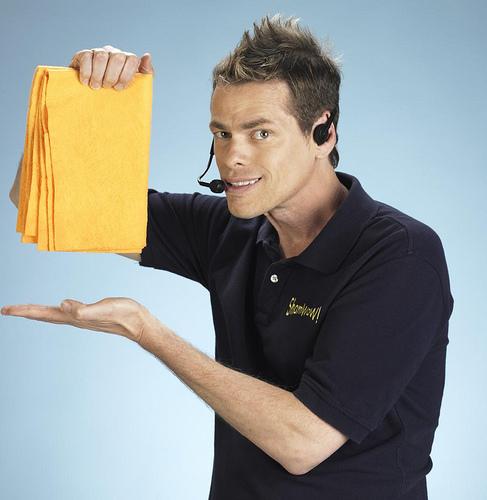
3. Selling someone else is easier than selling yourself. Most writers, directors, actors or any other creative people in film who want to work will at some point find themselves on projects that, to put it kindly, was not their idea, choice or in any way their personal favorite. In other words, it’s not uncommon in the world to be a “gun for hire” – employed to do the best job using your particular brand of expertise. Often times you get paid, sometimes you’re doing it for merely the credit, and still other times you’re doing it as “a favor.” (Yes, people still do those).
I can recall a particular low point myself going to work on a grade “C” Jean-Claude Van Damme movie. Some designer friends of mine like to recant stories of lugging bags of cut rate underwear from a shopping mall in the middle of nowhere on a 100+ degree film shoot or stacking miniscule pill bottles in a fake pharmacy that will probably never be seen onscreen for a drug store commercial. The take away here is not how dedicated we all were but that even if you’re working on the crappiest thing in the world at some point it dawns on you that your name will be on it and that, “screw this, I’m gonna make my part of this piece of crap slightly less crappy” even if it kills me AND them (hopefully, the latter).
This is not quite the case with Bill Clinton in his DNC speech since his wife is the President’s Secretary of State and by all accounts relations between the two Presidents have grown much more cordial in recent months. So that means there is some personal investment. Still, here are several reasons why this speech had to be extremely important to a man who is no longer president:
- His wife is Secretary of State AND might herself want to run for president in 2016.
- His entire life has been about building himself and the Democratic Party up – meaning he truly believes the first two are what is best for himself and the country.
- All presidents are concerned about their legacy and are somewhat egomaniacal (who else would want that job?) despite what they might say to the contrary.
You might think this is “just a job” and “easy money” when you start. But if you’re any kind of real, high-achieving professional, by the time you finish you’ll swear you were extremely overworked and way, way, way underpaid.
Preach Whoopi!
4. It’s easy to preach to the already converted. In the early 1970s, my mother told me she was going to vote for Richard Nixon because he promised to end the Vietnam War and she didn’t want me to be drafted. Well, you can imagine how this went down with me. I couldn’t vote but was a Chicago 7 revolutionary at heart. How could my Mom, the person who loved me more than anyone in the world and would swear on a stack of bibles I was innocent even if she witnessed me gun down a busload of senior citizens, betray me like this??? It literally still makes no sense to me. Because despite my ample persuasive abilities – and as my friends, family and students will tell you, they are formidable – no amount of nagging, cajoling, intellectualizing, tantrums, facts, figures or even tears would change her mind.

Good god, Mother!
Lessons learned at an early age: no matter how friendly your audience is to you, it will take a lot of work to convince them of something they might not want to be convinced of. You have to be crafty, mature and in most cases, over the age of 17. (Especially when dealing with my mother).
Bill Clinton’s speech at the DNC certainly roused the attendees in the hall. But he was shooting for a lot more than that. He was shooting for undecided voters watching or reading about he said. He was aiming towards dispassionate Democrats who didn’t particularly think working on this campaign was important. He was addressing the rest of the world about what he, the President who presided over the greatest economic upturn in the last half century, thought would be the best strategy to solve the world’s problems.
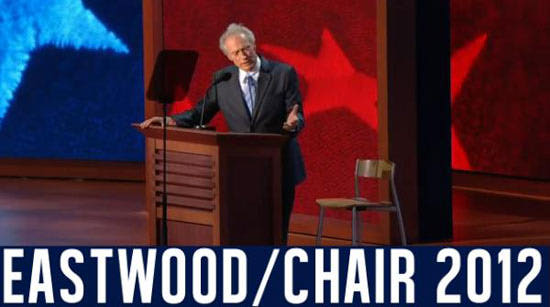
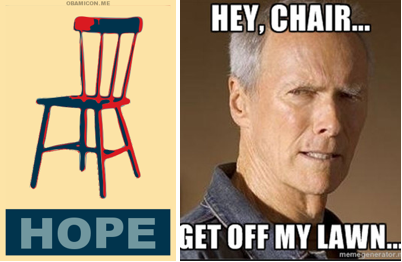
Part of owning the room on any given day is taking nothing for granted and leaving a little bit but not everything to chance. Compare the text of Bill Clinton’s written speech and the actual version of the talk, complete with 20 minutes of ad-libbing, as Sec. of State Hillary Clinton joked a few days ago that she planned to do. Then consider Clint Eastwood’s almost totally ad-libbed address at the Republican Convention talking to an invisible Pres. Obama seated in an empty chair. Several days ago Mr. Eastwood admitted to his local newspaper in Carmel that the idea for his speech came to him moments before he went onstage and that rather than massively prepare he had little idea what he’d do prior his entrance onstage.
Certainly both Mr. Eastwood AND MR. Clinton are hard-working icons who, on any given day, could take on each other. And if on a film set and not on a political stage, Mr. E would, in particular, have the advantage.
But on that given moment, on those two arguably equal nights, who truly OWNED the room as they spoke? Think about it. Then, think about it some more. Then, take some action of your own.