Surviving the Plague… with Matthew McConaughey

Dallas-Buyers-Club-Poster-Header

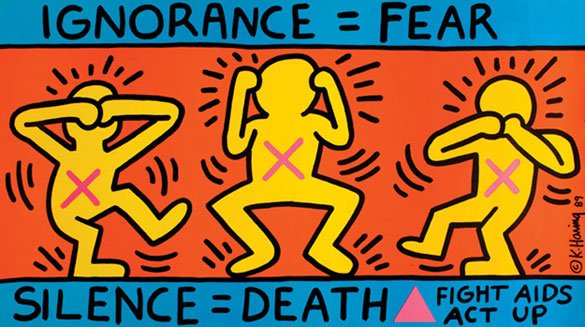
I went with my longtime partner to see Dallas Buyers Club this weekend at the local movie theatre. This was not an easy feat.   The mere image of a very gaunt Matthew McConaughey on the movie poster stabbed me in the gut with a generalized feeling of terror and nausea that brought me back to what I imagine will be the most horrible times of life I will ever barely live through.  That would be AIDS in the 1980s

Posting a blog thirty years later on a date that also happens to be World AIDS Day is an odd proposition.   Seared in my mind forever are the faces of living and dying people I knew well, knew slightly, or only knew of as I passed by them at a party or a business meeting – people who wasted away dead or killed themselves before the inevitable ravaged outcome of AIDS happened to them.   That I survived at all is a matter of luck, timing and, well…luck.  Not to degenerate into pop culture references, but to the gay community in particular this was a kind of real-life Hunger Games where many, many more than one person per district had to fight something quite insidious, evil and amorphous in order to survive.  The primary culprit was a lethal and mysterious virus.  The secondary enemies were ignorance, prejudice, our own government and, in some cases, our own friends, neighbors and loved ones.

more than just a ribbon

more than just a ribbon

But simply remembering one’s own story discounts the power and effect of something so massive.  The story of AIDS, like the story of any worldwide plague, cannot be summed up through the experience of a single individual or even group.  I might get cards and letters for this but it would be akin to saying that The Diary of Anne Frank told the story of the Holocaust better than Elie Wiesel’s Night or William Styron’s Sophie’s Choice.  Or that somehow Gone With The Wind covered the Civil War era in a more realistic way than 12 Years a Slave or Glory  or even vice-versa.  The larger and more tragic the event, the more stories there are to tell.  It all depends on where you were and who you were at the time– your perspective and your point of view.

There is a short remembrance in this week’s New Yorker by a reporter named Michael Specter.  He writes about a  photo that was given to him by a friend of two dying men in the Castro district in 1980s San Francisco – one confined to a wheelchair and another, tall and gaunt, bending down to help him – so he can be reminded of the actual story of those days as he wrote about the plague and gay history in the future.  He references this photo as he tells us of the current skyrocketing rates of new HIV infection in the gay community due to resumed risky sexual practices on the part of young people who were not around to see the ravages that came from the disease at a time when there were no or few effective drugs to ensure long term survival.  He also touches on the fact that by the end of this year AIDS will have killed FORTY MILLION people in total, many of them heterosexual and living in Africa.
powerful reminder

powerful reminder

Once again, who died and why and who lived and how is only part of a much larger story.  This is a medical story, a sociological story, a political story and a human story of the world community and, in no less of a meaningful way, individual lives.  That I know a few wonderful guys who continue to survive the plague 2-3 DECADES later is another story in the mix of all the others previously alluded to.   Where we get into trouble is trying to compare, quantify and draw definitive conclusions as to what is most meaningful or even noteworthy.  How do you qualify survival?  Or quantify death?  There is no way to do it and to truthfully bear witness to the actuality of the worst of what occurred.  There is, only — what occurred.

Which brings us back to Dallas Buyers Club.  This is the story of an admittedly racist, homophobic, white trash talkin’ Texas bull rider and electrician named Ron Woodruff who was diagnosed with AIDS in 1984 and given one month to live.  Mr. Woodruff was a real person and, by all accounts, not a particularly pleasant one.  But like many unpleasant individuals, he is not without his charms.  The latter qualities are brought out with the sort of bold verve and definitive eye twinkle that plays perfectly into the talents of an actor like Mr. McConaughey.  He does a lot more than lose 50 pounds from his normally tan, muscular frame and paste on a bushy moustache to bring us back to the skin and bones Russian roulette days of the 1980s.  He actually manages to bring to life the kind of guy that would repulse you if it weren’t for the fact that he was sick and dying.  In all honesty, he might repulse you still.
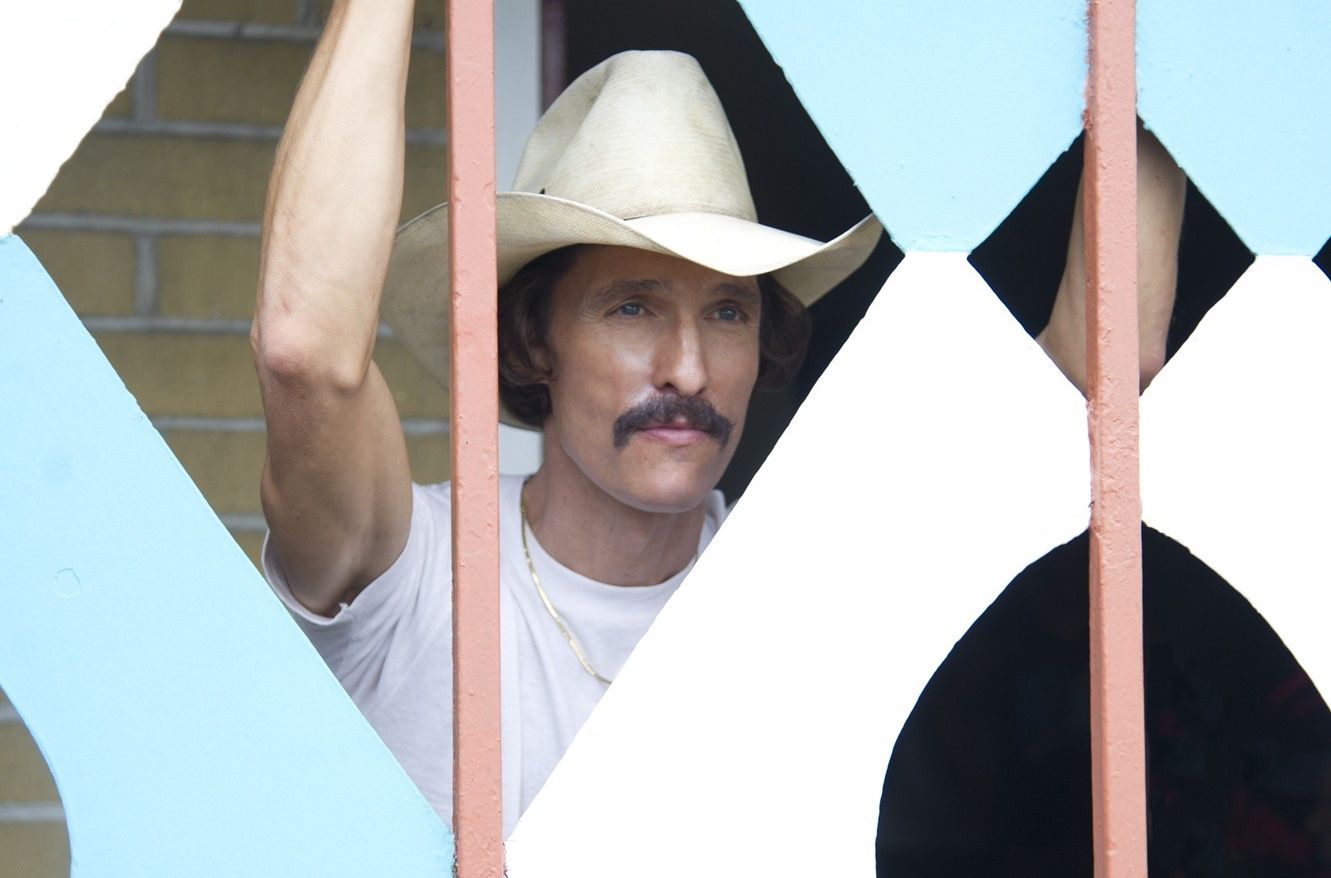
Despicable Ron?

Despicable Ron?

At one point early on in Mr. Woodruff’s company I, a gay man, turned to my partner of 26 years and sarcastically whispered:  Why can’t they just make a film about all of this for us?  Not surprising on my part.  For all the tragic dramatic stories about AIDS that could be tackled by major or mini-major studios in the last 30 years, the only one that comes to mind that had a gay protagonist was 1989’s Longtime Companion.  Tom Hanks won an Oscar for Philadelphia but the protagonist in that movie was Denzel Washington, the straight African American lawyer who defended the dying gay man in a lawsuit.  And The Band Played On was an HBO movie that chose, among all of its many characters, to star Matthew Modine as a straight white doctor fighting the good fight against the disease in San Francisco while numerous gay men stressed and played all around him.  Several years ago I Love You, Phillip Morris treated AIDS as the punch line to a sociopathic joke of a con artist we presume to be a bisexual man in the body of Jim Carrey but are never quite sure of on any level.

Among many others...

Among many others…

Owning a story, even one that you have lived through, is a very slippery slope that I began to slowly tumble down into as Dallas Buyers Club continued.  The character of Mr. Woodruff, who I do recall hearing about in real life, was bold enough to go against the accepted medical science at the time and travel down to Mexico where he found alternative drug treatments dispensed by a disbarred American doctor that, unbeknownst to him, would prolong his life for many years.  He then chose to circumvent the laws at the time, illegally transport the drugs back to Texas, and open up his own “club” to dispense these medications to members who would pay a $400 per head, per month membership fee.  Never mind that he was making out like a bandit – he was also temporarily enabling many other people to save their own lives for significant amounts of time using a model that he mentions in the film was really created by homos in New York, San Francisco and other big cities across the country.

Hmmm – in a normal movie this kind of talk would not redeem Mr. Woodruff’s character in my eyes.  But those were not normal times.  Somehow, as the movie progressed this asshole became a bit of a hero if only because he managed to take away the profound suffering of what stood in for the many young men that I knew personally at the time who would, in the end, have no such relief at all.   Well, extreme circumstances do call for extreme reactions – both in life, movie fantasy and upon reflection.  Never mind that Mr. Woodruff briefly made a personal fortune and the massive nationwide fight gay men were waging on every front, including the ones Mr. Woodruff trod in, were mostly ignored here. Despite my great reticence, as I watched the film, I found myself rooting for this egocentric ignoramus – a guy who wound up being far smarter and eventually, but not totally, a lot more enlightened than I had previously seen as being possible.

(Side note:  The movie also co-stars Jared Leto as one of the few straight actors I’ve ever seen pull off a believable drag queen on film.  Forget William Hurt’s best actor Oscar in 1985 for Kiss of the Spider Woman.  As most gay guys will tell you, that was mostly about a straight guy showing us drag and flamboyance in a film made in the early days of AIDS rather than a straight male actor being a real character in a movie that takes place during the early days of AIDS).

Make room on your awards shelf, Jared.

Make room on your awards shelf, Jared.

I’m assuming that like all real-life movie heroes and anti-heroes in recent years – from Johnny Cash to Richard Nixon – Mr. Woodruff’s true edges have been softened and hardened to meet the filmmakers’ dramatic needs.  This is how it is and will always be in the creative arts.  Even documentaries are not totally real depictions of what actually happens.  They can’t help but be influenced, if only slightly, by the filmmaker’s own interpretation of the events.  Ask D.A. Pennebaker. Or even that master of restraint – Michael Moore. (Note: I love MM and the latter is, um, a joke). (Note #2 – And yes, since memory is at the very least selective, even How to Survive a Plague probably missed a few things).

As for Dallas Buyers Club it might be at turns clunky, thinly developed, or lacking in an overall broad historical perspective. Most movies are, or do, in parts.  But what it does extremely well is evoke an important era and tell yet another story about a human plague that seems to have no end for those of us lucky enough to have survived it.  It will also do this for others new to the fight who will now, and in the foreseeable future, find themselves navigating the waters if the gasps I overheard from several young people around me in the movie theatre are any indication.  And, additionally and in particular, it might slightly sway one or two or more of those others who don’t really care about this fight at all.

If Mr. McConaughey’s portrait of the sometimes off-putting Ron Woodruff enlightens even one small-minded jerk about all of this it will have been more than worth the effort.  And even if it doesn’t, it has every right to stand along all of the stories of that time.  No one owns The Plague Years – even those of us who were fortunate enough to live through them and bear witness to our own individual stories of hell from that time.

Ying/Yang: Katniss and Llewyn

Two hep "Cats"

Two hep “Cats”

In the last week I went to the U.S. premiere of Hunger Games: Catching Fire and its very lavish after party, as well as to a screening of the new Coen Brothers movie Inside Llewyn Davis at the Academy of Motion Picture Arts and Sciences, which was followed by a panel where Ethan and Joel Coen, the soon to not-be-unknown actor in the title role, Oscar Isaac, his co-star and already known fellow actor John Goodman, as well as several others with the film, spoke.

So, how was all of this?  Well, um, equally dull and exciting; smart and dumb; provocative, entertaining and just plain cheesy.  In other words, they were pretty much representative of where the movies are today in that they are the extremes on either end of Hollywood’s taste level or lack thereof depending on what side of the taste barometer you choose to reside in (Major Note: These extremes should not be considered good and bad but, more accurately – blatantly commercial vs. purposefully obtuse and odd).

You know.. kind of like what happened here.

You know.. kind of like what happened here.

Before we get into any kind of judgments, or even observation, it is important to be clear at the outset on one general point:

Neither of these experiences makes me a VIP or represent in any way an achievement on my part.If you live and work in Los Angeles and in the entertainment industry in any form –or even know or are peripherally fascinated by those who do – you too will quickly gain access to these kinds of exclusive affairs.  In fact, even if you’re simply in town and make it your mission to be on the lookout for these events, chances are you will eventually rub shoulders with someone or something that can get you in.  On the latter point it is always important to remember that films are part of a multi-billion dollar industry called SHOW business.  This means that unless its puppet masters have enthusiastic people to whom they can show their wares to and spread the (good?) word, their piece of merchandise – or asset, as movies are now referred to by its many MBA schooled agents, producers and studio executives – will die an obscure and, more often than not, premature (at least in their own minds) death.

In a contemporary world where illusions are fast becoming reality – in part thanks to the myriad amount of misinformation in what is supposed to be the age of information, this is essential to remember.  Movies and anything having to do with them are in no way reality.  They are merely meant to be distractions from or reflections of reality.  Therefore, to measure one’s value on how included, or important or isolated one is to or from key cultural events like movie premieres or screenings would be akin to spending your time infuriated that you didn’t get invited to the seemingly fantastic dream your friend, co-worker or enemy told you they had last night.

Just kidding!

Just kidding!

Dreams are personal illusions that are only as real as their dreamers choose to make them to themselves and to you.  The same can be said for movies, movie premieres and screenings AND the people who attend and run them. Plus, just as there will always be another dream – and perhaps better dream of your own personal invention – there will forever and ever be another film (and, one hopes, better film) or film premiere, talkback, screening or some such occasion to which you too will be either invited or personally motivated enough to get into.  (Note: Or even crash… which, if you succeed, certainly counts in the scheme of things since it can make for an even better retelling of a dream you specifically retailored to yourself).

As for the films:

The Hunger Games: Catching Fire

HungerGames_Catching-Fire-catching-fire-movie-33836550-1280-673

Vogue.

Jennifer Lawrence has now become America’s fun sister, cool girlfriend, ideal daughter and best friend forever.  It also helps that she is immensely talented.  If you have your doubts, have someone record YOU, in close-ups, holding an oversized bow and arrow while you’re looking into a blank space and see how many real and true emotional expressions you can come up with.  It will be shocking if there is even one we can all believe.  Yet I’m still counting the emotions JLaw had me believing as she steadied her quiver and stared down me and everyone else among the many millions who watched her pull these and many other moves around the world onscreen this weekend.

If you want to make a somewhat silly tent pole studio movie that’s dramatic it helps if you can find someone with movie star qualities who can really act to hang it on.  Warner Bros. found this when they recruited Robert Downey, Jr. for Iron Man and Disney realized it, despite their initial reservations at his effete outrageousness, when they cast Johnny Depp in Pirates of the Caribbean. Jennifer Lawrence holds this Hunger Games (and probably the upcoming third and fourth installments in the next two years), with these very same attributes, and does it equally well as the guys, if not better.

Oh, she knows it!

Oh, she knows it!

 Certainly, it helps that she is surrounded with a slew of Academy Award winners and nominees in supporting roles – including Phillip Seymour Hoffman, Woody Harrelson, Donald Sutherland, Stanley Tucci, Jeffrey Wright, Amanda Plummer and any number of other award contenders and just plain really good actors I’m leaving out.  But were it not for JLaw’s ability to hold the screen as the unlikely teen heroine Katniss Everdeen – a kind of tough talking, wild child pioneer girl thrust to reluctant prominence in a dystopic future only because she wants to save her beloved little sister – there would be nothing much of anything to watch here.

One of my students asked me if this film was better than the first HG.  I replied yes, but that I was the wrong person to ask since:

a. I am far, far beyond the target audience these films are intended for and

b. I didn’t read the books and was sort of lost during the first one.

ancient artifacts

ancient artifacts

When I watched the first HG I had no knowledge of anything about this world and couldn’t get past the fact that the wealthy elite running this society chose to dress in powdered wigs and clothes right out of the French Revolution at the time of colonial America.  I mean, if you had all of that money centuries from now wouldn’t you choose fine fabrics and comfort rather than the stiff, heavy armor of the 17th or 18th centuries?  Plus, being the liberal romantic I am I just couldn’t buy that everyone with money in this privileged society had devalued life to the point where they were rooting for large groups of young people to literally kill each other off live on television for entertainment.  Of course, I still can’t believe anyone in America takes Sarah Palin seriously, believes that Ronald Reagan was a great president when he helped usher in the age of AIDS and corporate deregulation, or that Rand Paul doesn’t wear a rug.  So perhaps I’m not the best critic in these types of scenarios.

Yes, HG2 has some clever moments, one in particular involving a Lenny Kravitz designed dress (that’s all you’re getting from me); another where JLaw demonstrates to the powers-that-be just how dangerous she can be with some rope and white plastic in the space of 30 seconds; and a third where Ms. Plummer gives us a few new and original sacred crazy moments she’s become known for throughout her career.

But ultimately, this is called H GAMES for a reason – to present yet another permutation of yet another game.  Oh no – here we go again.  Yup, that’s right.  Deadly stuff comin’ at ya from all directions, no time to rest and little food or drink to be had.  How much of this can we watch?  Well, how many fights did Rocky live to fight, or help fight?  That should give you a pretty good idea.  There are no adjectives – good or bad – to quantify the experience.  Only money.  And…sequels.  Two more at the very least. (Note:  Yes, I know they say there will be ONLY two but c’mon, get real).

As for the premiere itself:

Bad News:

  1. At least 90 minutes to get there and park (one’s own version of HG without death or lethal weapons, assuming you don’t use your car as the latter).
  2. You must surrender your cell phone on arrival because you must go through a metal detector to gain admission.
  3. Once inside and waiting for the film to begin, you have to listen to live commentaries on large projected screens being beamed online by Yahoo that are hosted by three good-looking young Yahoos holding microphones, asking inane questions and referring to JLaw as Katniss Everdeen when we all know she is, as I’ve said, America’s new sister/daughter/bff.

Good News:

Werk girl

Werk girl

  1. The stars are all there (no – I didn’t get to walk the red carpet with them) and ushered out onstage in front of you right before the film. (Note: JLaw wore a cool outfit that looked like a belted Danskin underneath of see-through light blue ball gown. Woody Harrelson, however, wore baggy 80s jeans, a rumpled old T-Shit under an overly long mismatched sport jacket, and a baseball cap).
  2. The food was plentiful and FANTASTIC afterwards.
  3. You walk into the after-party past two lines of men on either side of you who are systematically banging their own timpani drums to exactly the same beats you hear in the movie. It makes you feel like a HG contestant but with no (well, little) risk of getting killed.

Inside Llewyn Davis

Llewyn and a bearded Timberlake

Llewyn and a bearded Timberlake

Let’s get this out of the way first – it’s pronounced Lew-in Davis.  This drove me crazeeeee before seeing the film.  Why couldn’t I pronounce it?  Why did I care that I couldn’t pronounce it?  Why did the Coen Bros. choose to title their film with a word many people couldn’t pronounce and how were they smart and savvy enough to convince the studios and their marketing departments to allow them to do so?

The answer to the latter and many other questions concerning this movie and its makers is, in part, why they are THE Coen brothers and why their films are so strange, iconoclastic and uniquely their own.

Llewyn Davis is a guy we all know and have probably met.  He’s the one who’s brilliant at what he does but is his own worst enemy.  In creative terms, he is the singer/musician who is so hopelessly talented that he moves us less than a minute into his song and infuriates us in pretty much every other moment before or after he’s done singing.  He’s the kind of person who seems to get off on complications, who goes out of his way to sabotage himself and pretty much anyone or anything else he cares about, either accidentally or by design, and yet is also the one who stays in our minds long after he’s gone. He’s the type of guys women dream about being with or are with and the friend other men secretly wish they could be, at least for a day or week or two, for the sheer, unadulterated id of it all, whether they admit it or not.

This type of character is not limited to show business but is perhaps easiest to appreciate and exemplify in the creative arts.  That is because odd behavior is accepted in our world (odd being not so much deemed odd but original) and thus it makes Lew-in weirdly likable and appealing in this film even when he’s doing unappealing and downright strange things.

Well, what is normal anyway?  Especially in the 1961 Greenwich village folk music scene – the pre-Bob Dylan era where NY still had a bit of a small, hometown feel and the idea of being a revolutionary through your music seemed daring and risk taking.  In today’s world, one would actually have to BE a revolutionary – someone who blows things up or participates in real wars – in order to earn that real type of street cred.  Hmmm, perhaps that was the real, underlying appeal of the time period to the Coens, though it’s doubtful you could ever get them to admit to this or much of anything if you asked them.

This would be years before Betty's trip to the Village

This would be years before Betty’s trip to the Village

One has to admire filmmakers like the C Brothers who have managed to make so many unusual movies in the business parameters of today’s industry.  They’ve had Oscar favorites like No Country For Old Men, True Grit and Fargo, cult hits like The Big Lebowski and Barton Fink– all of which I very much enjoyed and/or appreciated to varying degrees.  They have also done movies so oblique or off-putting that they just drown in their own self-awareness – The Ladykillers, Burn After Reading, A Serious Man and Intolerable Cruelty come to mind for me.   They’re infuriating and invigorating all at the same time.  That they exist and that they manage to exist…and yet…that they continue to exist at all – is confounding.

Frick and Frack?

Frick and Frack?

It is then not surprising that watching the Coens answer interview questions about one of their movies for half an hour is no more enlightening about their creative process than the most obscure part of a scene in their strangest, most to difficult to grasp pieces of work (Note: You choose your most favorite, or unfavorite CB moment).

Q: Why did they write about the folk scene in 1961 pre-Bob Dylan’s arrival some years later?

Um, well.  We don’t do icons.  (Long silence).

Um, well, okay.

Q:  Their style of directing, or writing – the way they approach material?

Uh, lots of awkward silences and roundabout answers that I can’t recall because I’m not quite sure they were answers at all.  Perhaps they are Llewyn themselves or individually?  Well, not really because their kind of commercial and critical success would make Llewyn an icon and as they have clearly said – they don’t do icons.

Well, aren't you a special little snowflake?

Well, aren’t you a special little snowflake?

Perhaps it was the interviewer.  The questions to these guys were not the most incisive nor even prepared.  I mean, if you’re going to interview individuals who make this kind of material, wouldn’t you have 5, 10 or even 15 back-up questions just in case they tried to vague the daylights out of you?  This person did not.

On the other hand, there is a game to be played here and most directors, writers and actors in the industry these days play it.  It’s called showing up to screening events – talk backs as they’re called – and with good humor, cheer and some thought, letting people know how a bit more of how you were able to put onscreen what they’ve just seen.  It makes people feel appreciated and a bit more a part of your process and shows how you got there.   And in places like the Motion Picture Academy it gets them to perhaps nominate you for an Oscar – or even vote for you to win.  You make a deal to show up for the studio at the same time they make the deal that allows you to make and/or distribute their movie.

Well, at the very least the Coens did show up and perhaps that’s enough.  Or maybe it’s not.  I mean, what do awards mean anyway?  Okay, let’s not go there.

Well, they certainly don't hurt.

Well, they certainly don’t hurt.

What’s more important is perhaps learning about the process of filmmaking from people who are among the best at it.  Hmm, not sure that happened.  Though at some point they did admit that neither one of them were the best at talking about how they do what they do.  Which might have been the most revealing and honest moment of the interview.  Certainly, it was among the most memorable.

In this context – and granted I’m making this all up as I go – perhaps one could think of Llewyn Davis (the character) as a version of the Coens were they not as savvy in getting their work out to the powers that be and as fortunate to have ridden the wave of quirky and then broader commercial success.  One needs to possess talent, timing and some sense of respect and savvy to those in the business of show, especially when you’re starting out, in order to succeed.  Llewyn Davis possessed only one of these.  The Coens, in their own individual way, possess ALL of these.

About the film:

Good News:

  1. Oscar Isaac, who has up to this point only done supporting roles in movies, does a real star turn here.  He’s an excellent singer and riveting screen presence who is in practically every moment of the film.   It’s worth seeing for him alone.
  2. The look for the film – seemingly black and white but not, and the evocation of the time period – is sadly beautiful and thoroughly realistic in its stylized manner.  Get a bunch of contemporary films about the sixties and watch them and note the differences.  LD doesn’t pretend to be the sixties, it simply IS the sixties
  3. The film has an excellent sound track with original music composed and vintage music chosen by T-Bone Burnett.
  4. The running time is 105 minutes.  Few films should be over two hours.  Unless I choose to make one sometime in the future.

Bad News:

  1. There are few feel good moments (though perhaps this is good news) and you won’t leave singing a happy tune.
  2. Few big relationships or moments are played out to emotion satisfaction or, really, to completion.
  3. Cat lovers might get a bit nervous throughout, though in the crawl there is a statement by the Humane Association that no animals were harmed in the making of this film.
NEXT STOP:  Saving Mr. Banks and American Hustle… Stay tuned.