Gay is the Old Black

Emmy bait.

Emmy bait.

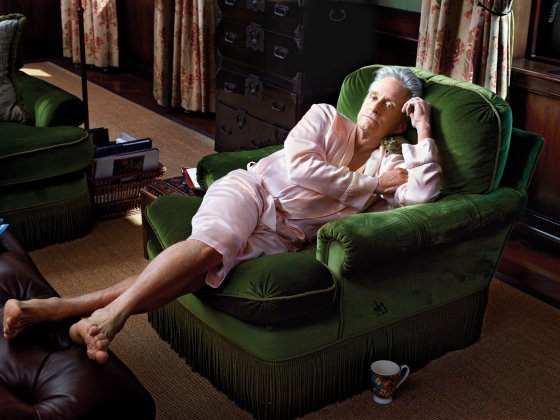
One wonders if Michael Douglas would play the part of the homophobic father of Jonathan Allen, the 20 year-old from Tennessee who, after being thrown out of the house by his parents two years ago for being gay, wowed the judges on America’s Got Talent this past week.  Or, better yet, if Steven Soderbergh would even choose to direct a movie about it.  Or if Jerry Weintraub would ever decide to produce it.  The way all three did with the continuously lauded and now award-winning HBO film about Liberace’s later years and prurient love life, Behind the Candelabra.

My guess:  probably not.  Most movie stars of Mr. Douglas’ generation dislike playing roles they deem too unsympathetic.  And don’t use the example of Gordon Gekko in Wall Street.  That film was made in and about the 1980s – a time when the general population actually agreed that “greed was good” and that ole Gordy was not so much a villain but a slightly tainted ideal many aspired to.

Of course, the majority of critics, audiences, and the cast and crew have not deemed the cable TV portrait of uber-gay Liberace unsympathetic either.  That would require that the real-life tale of the entertainer and his former lover Scott Thorson had been truly told.   The one about a 16-year old boy who was lured into the Las Vegas home of a fifty something mega-millionaire star with promises of wealth and family.  The one where the star repeatedly had sex with the boy for several years before he turned 18 (as well as any number of years after) with full knowledge said star was breaking the law. The same one where, when the older man got bored with the boy and the boy started taking too many drugs, as many young boys do, found a replacement and tossed him onto the street as he had so many others before him that were of age, with a little bit of money and a couple of fur coats – all the while publicly denying to his dying day that they ever had that kind of relationship or that said entertainer was even gay.
Eyeroll

Eyeroll

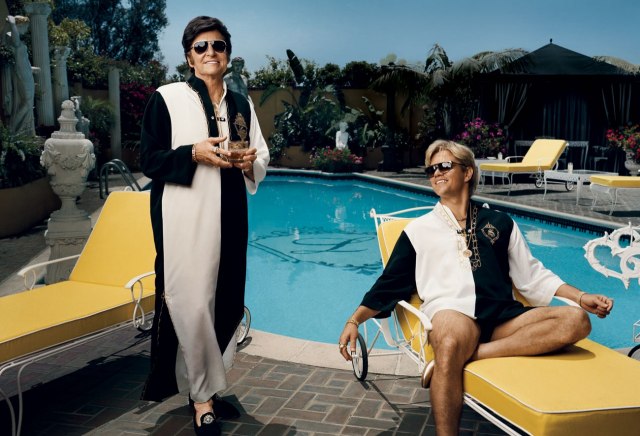
I’ve resisted writing anything but a few paragraphs about Behind the Candelabra up to this point because it seemed like the kind of film that would get some recognition for the circus stunt of Michael Douglas in sequins and a blonde-tressed Matt Damon screwing him from behind, and then disappear.

Such is not the case.  The cable film just won best drama and best actor from the Broadcast Critics Association.  It played to large and enthusiastic crowds at the Cannes Film Festival.  And mostly straight audiences (and some gay) seem to have embraced it as bold and groundbreaking.  Even those few writers who have dared to write critical pieces about the movie are often skewered, lacerated and told to get over themselves in the comments sections (even in respected places like Salon).   Also, Behind the Candelabra is likely to get nominated and win a slew of Emmy Awards, and go down in the books as “the courageous film all of the studios passed on with that director and that cast (can you believe it!) because they were too afraid of the gay subject matter.”  The latter is the meme that Mr. Soderbergh and Mr. Weintraub have been tirelessly and successfully peddling during the last six months.

Which is why, at this point, I’m weighing in.

Frankly – this film disgusts me.  Not as much as the lies about the war in Iraq, gay bullying or the right wing trying to take away a woman’s rights to choose.  That’s a different level of disgust – maybe more like infuriation.   But disgust – yeah, that about covers this.

I’ve thought a lot about other words to use to describe my feelings – queasy, nauseated, annoyed or even…jealous?  But finally, after much consternation, I decided that the perfect world is, indeed….

dis·gust  A feeling of revulsion or profound disapproval aroused by something unpleasant or offensive.

It is worth noting it’s not the people attached to this film that signal disgust to me – I respect them all (professionally that is, I don’t know them personally).  It’s the film itself and everything it tells us about where the industry is today vis-à-vis movies about gay people – or about most minorities – that makes me want to run to the toilet and be sick.

Someone tell that to the Emmys!

Someone tell that to the Emmys!

This is also not to say that the life of Liberace might not make an interesting movie.  That story – the one about how a young Midwestern piano prodigy invented (and for years carried off) the flamboyantly effeminate (some would say homosexual) persona of a character named Liberace and became the world’s greatest entertainer while still managing to convince his mostly gay intolerant world of fans he was anything but homosexual, would indeed be fascinating and almost certainly would not have caused me to write any of this.  And, even if it wasn’t particularly good, I doubt it would actually have made me feel disgusted.

Of course,  we will never know for sure since that tale was far from the one HBO and this prestigious group of A-list film professionals chose to tell in 2013 – a time when gay marriage is not only favored by the majority of people in the US (and an overwhelming majority under 25) but where its difficult to read any daily print or online news source where a major story about something homosexual is not featured on the front page.  I mean, even me – a middle aged guy who was “born that way”- sometimes gets gay fatigue.
geyyyyy

Still, true change in the movies, and the world, is not solely about the amount of ink you get or the measure of RAM you occupy on someone’s computer or website.  True change not only moves at a glacial pace but is often a one step forward, two steps back deal.  And this is where Behind the Candelabra comes in.  And me.  And my disgust.  The kind that I’m feeling right now as I compose this.

Writers are told all the time that their movies need a reason to be made. So are producers, directors, actors and studio executives.  But since writers are, by definition, the inventors of the first tangible version of a project, perhaps it is best to start with us.  As a writer one asks oneself:  What is the reason for this story?  Why make it?  What compels it to be told?  What would interest an audience?  Why will anyone care?  Why do I care?
I feel you Neil.

I feel you Neil.

I teach my writing students to ask these questions early on because I don’t want them to waste their time working on anything they are not fully invested in.  Even if it is the silliest, most exploitative story in the world, the author must find a way to imbue some kind of personal feelings of – well, something – into it.  Because if it doesn’t mean much to us, how can we expect it to mean anything to you?

I’ve watched Behind the Candelabra twice and have been looking for meaning, or even relevance, to today’s audiences.   Here’s what I’ve come up with:

  • The story of a May-December relationship told from a gay perspective could be fair diversion, one supposes.  But that would seem only fair (and not exploitative) if we had a bunch of films about other, less prurient (and more successful) same sex relationships to compare it to – which we don’t.
  • The emotional journey of a relationship can sometimes be enough to override a lack of story.  In essence, the ride you get having a front row seat to the ups and downs of human interaction between two people over a period of time can substitute for a paucity of plot points.  There are some emotions here – for instance, shock and sadness that an older person could actually convince a younger person to have extensive plastic surgery to remake their face to that of their “mentor.”  But certainly not ever sadness or shock that this relationship will end badly – or interest in how it does – which knocks out most of the tension throughout the film and causes the last hour (and more) to be deadly dull.
    A sharp contrast to this knee-knudge heard 'round the world.

    A sharp contrast to this knee-nudge heard ’round the world.

  • Maybe it’s the spectacle??  Ahh, now we’re getting somewhere.  The sequins, the clothes, the excess of a hidden lifestyle and time period in show business that no longer exists is lots of fun.  And those gays – who better than them to do this up in style!  (Though note: there is not a single gay person in the principal above-the-line talent or crew).
  • Another attraction could be the over-the-top characters themselves, who are at the very least entertaining in a very broad, stereotypical manner compared to what else was going on in the world at that time.  The homosexuals have always done this well since time began and it makes audiences quite comfortable to view them this way, thank you very much.   And certainly, why make any movie that is not at least fun!!??
  • Juicy parts for actors who can be cast against type.  The old Hollywood joke: Every time a straight man puts on a dress they give him an Oscar?  Well, not anymore.  (Note: Even James Franco’s Marilyn Monroe drag as Oscar host fell flat a few years ago).  So, you have to find new ways for them to do it.  How about a happy recipient of anal sex who dies tragically that can’t be X-rated?  It’s Oscar/Emmy bait for Michael Douglas.  (He even gets to have AIDS, but we can downplay that ‘cause the real life Liberace did!). Plus, what about an enjoyment of Speedos, suntans and Las Vegas?  It’s the flip side of Ocean’s 11 for Matt Damon and he’ll jump at that!   What actor wouldn’t want to play younger than they are, get fat and then skinny and then fat and skinny again as they age, become addicted to drugs and then recover?  No one, that’s who.
Yeah, I'm exhausted too.

Yeah, I’m exhausted too.

But please, please, please, please – do not tell me this movie is groundbreaking or even something different.  And if you’re a high-powered A-lister, don’t keep spreading your tales of woe about how the heads of movie studios are ruining the business by not taking chances on this kind of film.   They might be ruining the business by not taking chances but NOT taking a chance on this film was exactly the right choice.  It has no relevance to 2013.  It had relevance in 1983, and in 1993 – at the height of the AIDS epidemic – when it might have meant something other than an easy way to make some money, get some attention and garner a few awards for “courage.”

The people who made it should know better.  And might benefit from watching Jonathan Allen tell another all too familiar, yet far more commercially relevant and compelling story for today.  This story was  indeed shown last week not on the big screen or on cable television but on, of all things,  network reality TV  – America’s Got Talent, to be exact.

It is indeed the golden age of television.  In some circles, at least.

The Great Chair-dini

tumblr_lxduwqBVEr1qd8bubo1_500

In 1964, the U.S. Supreme Court famously overturned a lower court decision in Ohio that deemed the 1958 Louis Malle film Les Amants (The Lovers) pornographic and therefore unfit to be shown in a Cleveland movie house. The theatre manager at the time had been fined $2500 (which I’m hoping was returned because with minimal investment it would probably mean at least $250,000 to his heirs today) for enabling the very lucky patrons of the Heights Arts Theatre to see this movie which, incidentally, starred Jeanne Moreau and had already received a special jury prize from the Venice Film Festival, among other accolades.

Then: pornography, Now: Tame enough for ABC Family

Then: pornography, Now: Tame enough for ABC Family

However, what makes that tidbit of entertainment history noteworthy isn’t the fact that one group of American judges half a century ago found a French film to be too dirty for public consumption while another group thought it to be – well –entertaining – but the words used by U.S. Supreme Court Justice Potter Stewart to explain why Les Amants wasn’t hard-core pornography.

I shall not today attempt further to define the kinds of material I understand to be embraced within that shorthand description,” wrote Justice Stewart. “…But I know it when I see it, and the motion picture involved in this case is not that.

We’ve come a long, or perhaps even short way in 50 years, but the fact remains: Creative work has always been impossible to rate and categorize on any objective scale because by its very nature it is subjective and therefore defies grade-ability   I find this particularly infuriating as a teacher in the arts since I am often required to measure the success of a particular piece of work – a fact that is really an opinion, which means that it is essentially unknowable as a fact.

Plus — what is success anyway?  Selling it for a lot of money?  Great reviews from the outside world?  Jealousy from your peers masquerading as audible gasps of awe?  Or perhaps just simply an “A” from me?

Though, this is how an "A" feels.

Definitely how an “A” feels

It depends on how hard-core your tastes, you, and your rating system is.

But after decades as a critic, writer and teacher -and once I get past the required basic skills of whatever art I’m rating, judging and debating – all of the very best work I experience share one thing — magic.

Ahhh, moan and groan all you want and call me Ishmael.  You all know what I mean.  Maybe you call it something else but it’s that feeling you get when…(ahhhh, where are you Stefon?)…. Okay, I know it when I see it.

For those who don’t – definition, please:

Magic – 1. The use of means (as charms or spells) believed to have supernatural power over natural forces.

a.  the ART of producing illusions as entertainment by the use of sleight of hand, deceptive devices, etc.

When people criticize some piece of entertainment that they see or read as being phony I always laugh to myself (and sometimes even out loud or to their faces) because:

Of course, it’s phony!  That’s what makes it art – and entertainment.  It’s made up!  The trick is – to make it not SEEM phony.

I think worrying about being phony is out the window...

I think “phony” is out the window…

The entertainment industry has often been accused of being chock full of charlatans.  This is another amusing observation since who else would specialize in the art of phoniness that doesn’t seem false and the practice of making things up that more often than not appear to be real, if not con men or women?   I do wish I had known this in my twenties and thirties since it would have made my early years in the business a helluva lot easier.  But nevertheless I finally do get it now and I am passing it on to those of you who don’t know or haven’t admitted it yet and want to save decades of therapy bills.

Or, to put it another way:

You need to be a master magician in order to be a great artist or great entertainer.  A purveyor of the phony executed in the sincerest way possible.

tumblr_mlii0ha5bn1r0y8j6o1_500

You will finish your script.. You will finish your script

How do you recognize magic and the master magicians responsible for it?  The answer is easy – you know it when you. …(yes, I’m going there again)………….see it.

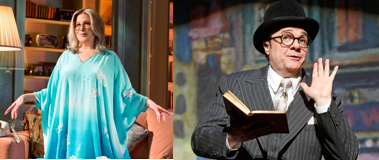
Some phoniness is skill and some of it is simply inherent talent so it’s easy to get confused.  For example, I just returned from New York where I saw Nathan Lane and Bette Midler each prove how a handful of artists are simply born that way and why it’s foolish for the rest of us to try and catch up or even figure them out.

It’s not that there is not a great deal of skill in Mr. Lane’s evocation of a closeted gay actor in 1930’s NY vaudeville in The Nance or Ms. Midler’s portrayal of Hollywood superagent Sue Mengers in the one-woman show I’ll Eat You Last.  Certainly, each understands the craft of stage acting and the ins and outs of what you have to do as a performer to interpret a text and create/evoke a character.  But you simply can’t teach, learn or acquire what either of them does live eight shows a week, month after month. That kind of talent – the ability to turn from comedy to drama and back again on a dime while eliciting audience tears, guffaws and something even more of a rarity these days – intense silence – simply by playing pretend right before our eyes is simply – a gift.  I’m the biggest showbiz groupie there is and have been watching each of them do this onstage in countless shows over the last 30 years and I can tell you only this – try as you might you will NEVER figure either of them out.  Nor, do you want to.

A whole lotta talent for one picture

A whole lotta talent for one picture

For the rest of us mere mortals, there is still hope because even the duo of Midler & Lane have stumbled in mediums other than the live stage (Isn’t She Great, anyone?

So, simplistic though it may be, think of this as a starter kit that will set you on the road to being your own creative magician.   Because anyone who has been in the game and achieved some measure of success in more than just a few minutes can tell you that absent any kind of real talent at all, there are still several basics tricks of the trade that can move you up a notch or two on the playing board.  (And believe me, it is a game).

1. Deliver or exceed on the premise:  

Now You See Me is a film now out in theatres that is all about magic – literally.  The premise:  A group of magicians perform a major series of heists masquerading as magic tricks against corporate America while eluding elite law enforcement officials.  The requirement:  Really, really cool slreight of hand/mind you can’t figure out, snappy dialogue, adrenalin-filled twists and turns, and one or two major plot surprises.  So who cares that the third act is not as great as the first one and a half or that 75% of the major critics in the country panned it? Certainly not me and the rest of the audience, that’s who.  $50 million plus in 12 days and 75% positive crowd reviews on Rotten Tomatoes tells us the filmmakers knew exactly the kind of movie they were making and gave it to us — in spades.  And to push the metaphor even more uncomfortably, that’s not a card trick, just good playing

2. Don’t bore me:

Don't bore Nina!

Don’t bore Nina!

Nikki Finke was just another smart, prickly journalist covering the entertainment industry who more than seven years ago decided to start her own website, www.deadline.com by combining great reporting skills with an over-the-top, take no prisoners style that suffocated traditional journalism (and occasionally its standards of objectivity).  But she was never, ever, ever – not even once – boring.  Today, Ms. Finke has pretty much single-handedly redefined daily coverage of show business, made millions selling her site to a larger conglomerate (Penske Media) and in the process might have poison penned herself out of the pinnacle position at the top of the very mountain she built. 

From vulture.com. All hail Queen Nikki??

From vulture.com. All hail Queen Nikki??

Still, as Ms. Finke herself very well might respond – So what?!!!  Or – If you weren’t such a lousy reporter you’d know the real story.  Or – I don’t have the time to waste on the many moments of stupidity you managed to create in your just one paragraph of text.

Though she sometimes crosses the line into petty personal vendetta, Nikki’s reportage almost consistently scoops her competitors and is seldom wrong.  There’s an innate creativity to what she does that, as a former entertainment reporter, I can testify is extremely difficult to achieve in the field.  She’s mean, she’s an original and she doesn’t make you yawn – which seems to be the right combination for success these days whether you want to admit it or not.   Her philosophy is probably best summed up by the instructions she gives readers who choose to post in her ever-popular comments section:

…Don’t go off topic, don’t impersonate anyone, don’t get your facts wrong, and don’t bore me.

3.  Be original:

Icon

Icon

It’s hard to imagine that Susan Sontag, social critic, thinker and novelist who has often been hailed as one of the great intellectuals this country has ever produced, grew up in the 1940s in the San Fernando Valley section of Los Angeles (Sherman Oaks, to be exact) writing, while still in her teens, lines like these:

Childhood: a terrible waste of time.

All of us would be misguided to try and be Sontag.  But what she herself recognized early on was that she needed to pursue what she wanted to the nth degree and ignore those who wished she would stay quiet, or at least enjoy life a little bit more.  For her this meant devouring piles and piles of classical literature at any early age – from Balzac to Dostoyevsky to Pushkin; having affairs with both women and men in the sexually repressive 1950s and beyond; and recognizing all along that she, as well as everyone else, is nothing more than a creation of their own desires and actions.

As the famous writing teacher Brenda Ueland once wrote, Everyone is original and has something to say.  But few of us stay in touch with the idea that it is feverishly acting out our very originality that will bring us happiness and allow us to succeed (though perhaps not in the way we were taught – which is another type of original thinking in itself).

Check out the new theatre piece in NY I regrettably didn’t get to catch based on Ms. Sontag’s journals, called Sontag Reborn. Or, better yet, read some of Sontag’s essays or books and tell me you still think magic is limited to pulling rabbits out of hats or sawing your girlfriend or boyfriend in half.  Besides, the latter’s been done to death anyway, both literally and figuratively.

4. Be Bold:

Sometimes an infographic says it all.

Sometimes an infographic says it all.

I write those two words at least once a month here.  That’s because I remind myself of this almost daily.  It’s great to be original, interesting and to deliver on a promising premise.  But unless you have the courage to put yourself fully out there as you create, sell and then recreate and sell some more, you probably won’t get where you want to be.

There’s a revival of a musical in NY at the moment called Pippin.  In it, the great comic actress Andrea Martin, who got her start on the classic Canadian TV series SCTV (for younger people – she was the Kristin Wiig of her time), has one extended show-stopping number called No Time At All where she gives her grandson uplifting advice about life and on the vagaries of growing old.  Now, knowing the song and hearing that Ms. Martin was going to be playing the grandmother I thought – Okay, so Andrea Martin makes me laugh, even if she is a little young for the part, but she’ll still be fun.  Then I went on to The Google and discovered Ms. Martin is actually 66 years old, the exact age the part was written for.  And she’s doing this role on Broadway, swinging from a trapeze (Spoiler Alert:  Live.  Really.)

Her best role (in my opinion)

Her best role (in my opinion)

I think of my Mom, who sadly died at that age, and then I think of what the age of 66 evokes and sounds like to most of us and I wonder (sometimes even out loud when no one is in the room)  – am I really being bold?  And why aren’t I?

And then I consider – just how much bolder can I get?  What’s in my way?  What’s stopping me?

And then, when I get the nerve – I look in the mirror (Cause I’m vain). With the lights on (Usually to find my glasses).  In the morning (Well, my version of it, which is often not before 8) Right when I wake up.  (Okay, sometimes 9).

It’s not always a pretty sight but this image does start my day out with one very bold action (You’re just gonna have to trust me on this one).

…With that out of the way, the other 23 and a half hours usually gets relatively easier.