An Off Day

Has Meryl Streep ever turned in a bad performance?  I don’t believe so.  But has she given us examples of acting not up to her usual caliber?  Certainly.   (Watch 1982’s “Still of the Night” and report back). Tony Kushner’s genius “Angels in America” set the bar about as high as it could go for a playwright – and pretty much for any writer.  Forget that he won the Pulitzer Prize.  That particular piece of work, which he labored on for years of rewrites as he watched AIDS devastate life around him, will also live on for generations as the quintessential dramatic evocation of a plague whose ruthlessness and scope defied description.  That is why sitting through his musical “Caroline or Change” some years later one couldn’t help but feel  that, well…every brilliant writer deserves at the very least a “gimme.” (okay, that “one” was me – a severely disappointed fan in a severely UNconservative way at the time).  The list goes on an on and most recently ends but certainly doesn’t stop with President Barack Obama.

Split screen is not our friend.

The buzz is abuzz with POTUS’ debate performance last week against his Republican challenger Mitt Romney.  Among the colorful adjectives used: “devastating,” “bumbling,” “crushing,” “mediocre” and  “defeated.”  Even the venerable Dan Rather, who was brought down from his perch atop CBS for daring to suggest Pres. George W. Bush had avoided military service in Vietnam by joining the National Guard (even though Dubya was a member of the National Guard in the Vietnam era and did not serve in the military) proclaimed the next day on MSNBC: “Let’s say it for what it is, he got his clock cleaned…there’s no other way to put it.”

Trivia note:  According to the NY Times, the phrase “clean your clock” was first used on the SPORTS pages (I should’ve known!) of the Trenton Evening Times, July 28, 1908 about a couple of local baseball teams – “It took the Thistles just one inning to clean the clocks of the Times boys.”  This certainly doesn’t make the use of the term any more complimentary, but perhaps knowing its origin does take away some of the sting of this currently overused phrase.

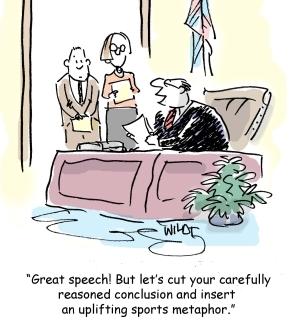
Whenever I hear guys on TV (and it’s almost always guys, let’s face it) use sports metaphors to describe or critique anything but a ball, a puck or pair of human legs reaching their preferred destination, it sets off a warning bell deep in my soul.  But that bell doesn’t zzzing. Instead it tells me in a measured voice we are no longer describing a factual event but indulging in the “oh so witty” (not!) opinion of the person observing such an event.  In which case, you might want to task another person with deciding if your timepiece was indeed really laundered or perhaps even to determine if its bath was as thorough as everyone on the sidelines of its supposed unauthorized spa treatment says it was.
Like many people, especially those in the arts, I’ve been described as overly dramatic, opinionated and argumentative by more than a few over the years (who… me?).  I’m never insulted by these commonly accepted “off” terms because to me this also means that I’m passionate, committed and quite forceful, depending on the day, arena and reviewer.  In fact, there are probably days where my audience (that’s you) see me as passionate where I feel I might be a tad overdramatic; and others where you’re nauseated by my insane opinions while I revel in the fact that I’m so committed to an issue and getting its truth out there that deep down in my soul I truly believe I am the long lost son of either Emma Goldman, Caesar Chavez or Gandhi. (okay, admittedly that feeling has only occurred once or twice).

Some days are better than others in the life of every human just as some performances are superior and some written works are more memorable (or, at least, relatable). Objectively speaking, there is no way to measure how good or bad anything is.  That is why it all comes down to two things – consensus and feeling.  And neither one can be counted on as being absolutely right or wrong.

The general consensus is that the President was having an “off” day (actually it was night) in his debate with Mr. Romney.  And perhaps he was.  Using our aforementioned standard of “consensus” we’d have to concede “off” would be the kind word.  But remember, consensus is not necessarily always correct.  I mean, the Grammy Awards voted Milli Vanilli their coveted Best New Artist award in 1990 and NBC renewed “Whitney” for ANOTHER season AND are giving her a reality show.  So if you’re still so hot on the validity of consensus well…  blame it on the rain.

What about feeling?  Hmmm.  Well, one can only imagine how Pres. Obama felt spending the night of his 20th wedding anniversary on stage in front of almost 70 million viewers debating the jollily avuncular Mr. Romney, who some say charmingly (though I say obnoxiously) joked about the prez being forced to spend his special evening onstage with a slick-haired 65 year-old man and a gaggle of television cameras.  Annoyed?  Preoccupied by a romantic encounter that already was, would happen in the future, or not occur at all because he had chosen to become President at one of the worst times in American history to begin with?  All very possible.  But despite the President dropping a few public hints, we will never quite know for sure.   Though one radio host I listened to the next day speculated that Obama was playing “the long game” (ugh, another sports metaphor), deciding that his strategy was to let Mr. Romney hold the stage unchallenged as long as he liked so in subsequent debates Mr. Obama could then hold the former Massachusetts governor to all the blatant half-truths he had so genially helped himself to.

Further Note:  Al Gore even suggested Obama’s “off” was due to the Colorado altitude and the fact that the president had arrived into town just two hours before show time.  But we all know Mr. Gore and Presidential debates are not a winning combo so I wouldn’t take his analysis to heart

Rocky Mountain “High”

The only thing we can correctly surmise about an “off” day is that every single person in the world has one or more and that no other person in the world can know with full assurance why or if the day is truly off (and by how much) other than the person who is having it.  If everyone batted 1000, there would be no reason for batting averages (jeez, now I’m even using sports?).  If it truly is all good, then does that mean not even one day can ever be bad Oh please! (Clearly, I am not Gandhi’s son).  Finally, if one believes in the consensus (dubious in itself) that it takes approximately 10,000 hours (or 3 hours a day for 10 years) of practice to truly be a master in any one field, isn’t it a good bet that a significant number of those days yield many desirably “off” results in order to allow one to become more proficient in said field, which will subsequently serve as the fuel to vault into the so desired master category a decade later?  

Speaking of which, I caught up with Paul Thomas Anderson’s “The Master” last week – a movie that is quite brilliant in parts and seems to indicate that 10 years of off days in a human life can be just as interesting as 10 years of on ones.

But I digress…

We are all so quick to discount our “off” days as something to be shunned, scorned or avoided that we hardly have time to consider just how valuable they can be.  And we need to do this, if for no other reason than to provide a break from the monotony of our perfection.

I’m kidding, of course – but only in part.  There is a dangerous rumor going around the zeitgeist that every performance needs to be played to the back row and that unless one hits a home run (yikes, I’m doing it AGAIN!) or pitches a perfect game, he (and perhaps one day she) is not worth that gazillion of dollars their multi-year contract ensures they will get paid.

As any expert in anything will tell you, there is a lot to be said for singles and doubles, for punts and for walks (oh, screw it – now I can’t stop!).  Of course, no writer wants to have their play or movie or book bomb but, on the other, hand, it certainly does take away everyone’s expectations for your next work and emboldens you to perhaps take a bigger chance in the follow-up since clearly no one will ever like anything you produce ever again.

We have no way of knowing how on or off anyone, including ourselves, will be on a given day other than to know that either verdict is certainly possible.  More likely, however, is that we’ll fall somewhere in between.  On — but in the judgment of others not as on as we could be or have been in the past.  Or definitely off — whether we (they?) love what we’re producing or are feeling lousy or annoyed enough to have not even gotten out of our bedrooms (for good AND bad reasons) at the time the day began.

Ultimately, it doesn’t really matter what the verdict is.  What matters is that we show up.  This is what people like Meryl Streep, Tony Kushner and Barack Obama consistently do – knowing full well that some days will be judged much better than the ones before or after it – by themselves and, mostly assuredly, by others.

Or – (ATTENTION: ONE FINAL SPORTS METAPHOR!) — as the great hockey player Wayne Gretsky once so eloquently put it:

“You miss 100% of the shots you never take.”

Chair on Chair

Clint Eastwood is an icon.  And if you don’t think so, here is the dictionary.com definition:

Icon:  A person or thing regarded as a representative symbol of something: “icon of manhood.”

No, I did not add the manhood part or appropriate it from some other place to make my point more effectively.  That is the literal, on-the-record given example.

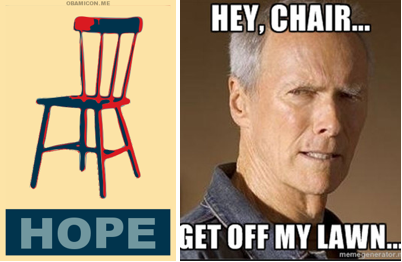
It is dangerous for any one thing or person to be regarded as a gold standard representative symbol of something as Mr. Eastwood proved this past week when he dragged an unwitting Chair onstage in Tampa on the climactic night of the 2012 Republican National Convention.  One reason is that once you’re the international standard for something we all value from your perceived public image, it is inevitable you will one day disappoint.  And that is because the nature of existence is nothing stays the same and that everything in the world is uniquely its own in ways an outsider can never fully know.  An image (or icon) is a mirage – and the very nature of mirage is, it isn’t real.  What it is changes or rearranges, in accordance with the eye or taste of the beholder.  This holds true both for the shelf life of people like Clint Eastwood and for objects such as chairs, who have even less to say about their iconic status than humans do. (Note: “The Eastwood Chair” is now trending internationally and is probably now the most famous chair icon we all know).

Because everything in the world is uniquely its own, this makes it particularly tough for icons – inanimate or living – to be all things to all people.  Why?  Well, for example:

No one human has the same fingerprint.  And as any dog (or any other pet) lover can tell you, no two animals of the same species are exactly the same either.   One can even take this further for, let’s say, ants, who are seldom pets.  I mean, we might not be able to tell the difference between the ants crawling around our backyards or inside our cabinets, but I’d bet that any other ant could. As could another animal/insect of another species.  So how can any one of that or any species ever properly represent all the others not only to their own species but to the rest of the world?

I would argue this is even the same for mass-produced items.  They each have their own microscopic, milli-minutiae quirks that we humans can’t see but that make them who they are.  No item can be exactly what it was when you acquired it or first admired it – or live up to the perception you had of it.   Which is partly because your perception clearly isn’t seeing everything, certainly not as much as what is seen by another like-minded item of its own kind.  Plus, like humans, items also change – if even slightly – as they age.  There is always slight color derivation, a tiny smudge or crack in the armor on the outside.  Or perhaps on the inside, out of view.  I’m reminded of an old Bette Midler monologue that talks about what’s hidden beneath the surface of each and every one of us, no matter how alike we might seem on sight.  One day while walking through the streets of Manhattan, the entertainer ran into a sad, mentally ill lady in a huge Daisy dress who was almost bald and had, substituting for hair, a fried egg on her forehead.  Terrified in those days of her own tenuous emotional balance on reality, Midler mused that she didn’t want to wake up one day and wind up with a fried egg on her own head.  But then, later in her routine, which went from hilarity to poignancy in the space of just a few minutes, she somberly concluded:

“The truth about fried eggs is…everybody gets one.  Some people wear them on the outside.  And some people – they wear them on the inside.”

I prefer mine over easy


Meaning nothing can or should really be set up as an icon for anything. It’s a recipe for disappointment and failure on both our parts because you’re never seeing the real, true picture.  Just as the 82 year-old Mr. Eastwood might now disappoint as the universal hyper symbol of Manhood due to his mocking routine of Pres. Obama, who he imagined was sitting onstage with him yelling unlikely nasty retorts from an empty chair – that particular brand of Chair, which hadn’t chosen the spotlight as Mr. Eastwood clearly did and continues to do, has now become the iconic Zelig of inanimate objects and is engendering all sorts of blowback.  Plucked out of obscurity by one icon, said Chair – which doesn’t have a name but has become an unwitting symbol as “The Eastwood Chair” – has various Twitter handles, Facebook pages, portraits, personalities and doctored images it never sought out to begin with.

Scouring the web, it is clear this once unknown single piece of furniture enrages, disappoints, is put on a pedestal, is lampooned and is publicly scorned, deified and idolized.  It is now every bit, and perhaps more, iconic than Mr. Eastwood.  This in itself proves the shallowness of iconic status.  Though sometimes it’s about achievement, it can also come when one is in the wrong place at the right time or even the right place at the wrong time.  Even a casual X Factor like birth can have something to do with it.   I mean, ask Prince Harry.

Leave me outta this!

 As an ordinary Chair myself, actually the Pendleton Chair of the Ithaca College L.A. program, it should be understandable that I’m a little sensitive to what would happen if an ordinary Chair suddenly found itself trending worldwide. Though none of the fellow Chairs that I know are iconic symbols, my position does share a dictionary.com definition with what is now the most Famous Chair in the World whose listing fittingly comes first in our dual definitions on dictionary.com.

Chair:  1. A separate seat for one person, typically with a back and four legs.

2. to act as chairperson of or preside over an organization, meeting or public event.

Much like Ms. Midler felt pain for the Lady with the Fried Egg on her head, this week my heart has consistently gone out to what is now the world’s most iconic Chair.  So like any good tribesman, I thought I’d reach out and try to be supportive.  Imagine my surprise when The Eastwood Chair (TEC), quite average and quite happy before it began its meteoric rise to fame just days ago, asked if I’d do its one exclusive interview.

But first, an exclusive with The Chair

Me???  Wasn’t a slightly, well, bigger forum, what was needed?  “No,” replied, TEC, the one thing it didn’t want was to fan the fire.  All it sought was just its real POV out there on the record.  Because the one thing it’s sure of after the last few days is that whatever it says, even if it’s to just me, will gain worldwide traction – at least for a few weeks or so.  The following are TEC’s own words and our conversation verbatim.

Me:  Well, this has been quite a week for you, huh?

TEC:  You could say that.  I can’t really say anything.

Me:  That’s kind of a theme in your life, isn’t it?

TEC: (laughs) I guess so.  I hadn’t meant to put it that way but, there you are…

Me:  Does it bother you that other people are now defining you, who you are, on such a, well, global scale?

TEC:  (seemingly tilts back, then forward again) I was really angry at first.  I mean, I was positioned backstage, providing a service.  I like to think of myself that way – service oriented.  I’m functional.  I don’t crave the spotlight on my own.  Someone might sit on me but that doesn’t mean they are me. To suddenly become the thing that everyone’s making fun of…

Me:  It must be difficult.

TEC:  Well, as they say, I was just “born this way” and living my life.  I didn’t intend for the world to react so extremely to me one way or the other, or use me as an example to make fun of, or idolize or to hate on just because someone else is using me like that and causing them to think that way.

Me:  But isn’t that part of the nature of any chair?  For instance, if someone had you in their house and was really angry, they could throw you across the room and break you if they wanted.

TEC:  (withered look) Wow.  I hadn’t ever thought about…(silence) Yes, I suppose they could.  And that would be awful.  I guess I’ve been lucky so far.  But nobody should be defined as something they aren’t simply because of mistaken identity or because a human needs to work out their “stuff “ in a mean way through you.

Me: Okay, well, not to be mean myself but…isn’t that, according to what you just said, your function?

TEC: I said I’m fuctionAL.  I don’t have one specific function. But in people’s minds now I’m this – “thing.” And it can be real negative in people’s minds.  I just want everyone to know that image, those traits they’re putting on me – the arrogance, the cursing, the awkwardness – they’re fiction.  They’re stereotypes.  They have nothing to do with who I really am deep down.   Depending on who is doing the looking and the sitting, I am lots of things deep down.  I am more than the butt of a joke…

Me:  Butt.  Chair.  That’s funny.

TEC:  I’m not laughing.  Sorry, but…

Me: You said it again.  But.

TEC: These jokes are being used to hurt someone.

Me:  Hurt whom?

TEC: I better shut up.  I don’t want to get too political.

Me:  Oh, come on, your secret’s safe.  Hardly anyone reads the blog compared to, let’s say, your Twitter page.

TEC (chuckles):  You mean Twitter pages, don’t you?  I mean, which one?

Me:  (chuckles back) Well, there’s The Eastwood Chair, The Empty Chair, This Seat is Taken, Obama’s Chair, Invisible Obama….

TEC: Stop, please….

Me:  Well, they all don’t have your exact image.  I take it you’ve seen them?

TEC:  I try to stay away.  Also, I’m sort of limited in what I can see unless someone is sitting on me.

Me: Ah, right.

TEC: But I wouldn’t be honest if I didn’t admit to sneaking a few looks.

Me: Care to elaborate?

TEC:  No.

TEC’s least favorite. “That tramp,” it says.

Me:  Fair enough.

TEC:  I mean, aside from that, I’m not sure it’s exactly safe.  I’m only one chair.

Me:  But an important one.  You could be the Rosa Parks of Chairs, if you chose to be.

TEC: That’s a little grand, don’t you think?

Me:  Maybe so.  I’m not saying you have to be or it’s what you should do or a requirement or…

TEC:  I get it.  It’s okay.  Really.

Me:  You want to talk about Mr. Eastwood?

TEC: Not really.  But I suppose I should.

Me: Are you angry with him?

TEC: Yes.

Me:  I thought you’d hesitate.

TEC:  Why?  I’m in an undisclosed location.  He’ll never find me.

Me:  I found you.

TEC:  Actually, I found you, remember?

Me:  Right.

TEC:  And when we’re done, trust me, you won’t be able to find me again.  No personal offense intended.

Me: None taken.

TEC:  But you will hear about me.  And from me.  A movement is growing.  And it’s about more than chairs, one chair or even all chairs.  See, there’s a network out there protecting the real me because the struggle is really about everything…

Me:  You sure are sounding like Rosa Parks to me.  Or at least one of her disciples.

Silence.  The light hits the top of TEC and it appears several inches taller.

Me:  Care to elaborate just a bit more?

TEC: Okay, so it’s about thinking before you use something innocent solely for your own benefit against its will or feeling.  Or dislike or hate something only because of what you think it is.  Or categorize dishonestly one way before you know it – or even if you do know it.  Cause deep down you know you’re being dishonest.

Me:  Is that what you think Clint Eastwood did? 

TEC:  Eastwood’s 82 years old and a huge movie star.  He’s used to doing anything he wants and he comes from another generation.  It’s more about everyone else and what they say and how they react to what they can plainly see right before their eyes.  And – the truth.  (A beat.)  Though let’s say next time I’m around the rich and famous, I’ll be more prepared and blend in.

Me:  Really.  How can you…

TEC:  We have ways.  I can’t reveal everything.  As they say, ultimately, “A chair is still a chair…

Me:  Even when there’s no one sitting there…”

TEC:  Very good.

Me:  It’s a Hal David lyric from a Burt Bacharach song ,“A House Is Not A Home.”  Mr. David just died this week, so…

TEC: Oh, wow. Sorry.  That’s sad.  I didn’t know.  I really liked his music.

Me:  Well, he was 91 so he did have a great life.

EW: And understood the true meaning of a chair.  Unlike some people.

Me:  Maybe one day they will.

TEC: I hope so.

Me: It’s all in the song, if you think about it.

TEC:  I just wish everyone had slightly better taste in the music they choose to listen to.  You know what I mean?