Trumping Mr. Corman

The lie starts when you actually show up an hour early for a 7:40 am flight only to be kept waiting on the ground 90 minutes due to the airline’s clerical error.  It continues when you turn on the news and a senior member of Congress is telling you Planned Parenthood spends 90% of its time on abortion when every report and factoid tells us that is only 3% of its services.  It continues when you look at someone’s Facebook post and a top website admits it publishes writers all the time who it knows in advance are factually inaccurate.  It nearly ends when you watch “American Idol” or “Dancing With The Stars” and, clearly, the worst singer or dancer wasn’t voted off and someone more talented got the axe for favoritism.  But the lie truly ends when right before you go to bed the top organization in charge of rewarding positive portrayals of your minority group  gives an honor to a movie you find impossibly, horribly and forever indefensibly offensive to you (can’t say the name of the movie) [“I Love You, Phillip Morris”] or the group [GLAAD]).

In any event –-  Those were some of the lies I endured this past week.  Probably they are something else other than lies (right now I can’t think of what) but that seems the most apt description to me right now – a deception, a manipulation that isn’t true or as it should be.   But isn’t one person’s lie another person’s – truth?  Indifference?  Zen-like acceptance of the world?  Or just plain outrage – the kind of acceptance, indifference or outrage that fuels fringe-like groups coming to power in society or mediocre television, radio, film, theatre and the endless of revivals and remakes of such.  Perhaps I’m exaggerating.  But I don’t think so.  And remain ever hopeful that..

Donald Trump is another story.  He’s so slickly…Donald…that I and no one else knows — and no talking head that I’ve seen can tell us for sure —  if he’s a Grade A, #1 liar, a misunderstood truth-teller or something in between.  What everyone does seem to agree on is he’s our modern-day P.T. Barnum – meaning he’s one of our master showman.  Someone who knows how to generate white hot light, outrage, polarization and yes, even good will around himself or a particular person(s) or story.    (I’m not repeating his “lie” because you already know it).

Trump actually trumps truth AND lies because, in some strange way, he’s entertaining.  Most reality TV is entertaining, especially after a long day at the workhouse.  Or even worse —  a long day looking for work at a workhouse.   Any workhouse.

Forget the truth.  Just give us something to talk about (thank you, Bonnie Raitt, but it still shouldn’t have been the title of that Julia Roberts movie, sorry.).  Stephen Colbert some time ago coined the phrase “truthiness.”  Which means kinda, sorta, in a way – true.  But at the very least pleasantly (or unpleasantly) anecdotal.  Jon Stewart and Colbert make fun of this kind of thing and if someone gave me my own show or paid me more than I made for this blog ($000,000.00), I would too.  Gladly.

Entertainment can get away with being untrue because it’s a palatable lie and, at least on the surface, doesn’t really hurt anyone.  It actually often revels in the art of the lie or fudge or partial truth for the sake of drama or comedy.  The trick?  Well, a lawyer friend of mine once explained it to me – lying that is.  He was admittedly a master liar.  Actually, he reveled in that ability.  His advice:  “You have to put a grain of truth in the lie or no one will believe you.”  By the way, there wasn’t a smile when he said this.  He was dead serious and believed he was giving me rock solid guidance on how to advance in my career.

I might have followed it had I not I not been the worst liar in the world and a person who feels guilty if I get extra change in the market and don’t immediately give it back.   I’m not necessarily proud of these limitations but facts are facts. And at least I can sleep at night.  So does my friend.  And quite well.  At two different houses three times the size of mine, may I add.

Where were we?

Oh yes –- entertainment.

My first big exposure to that lie was when I started the weekly national box-office column at Daily Variety.  This was in the early 80s – years before the Internet, computers (I had a manual typewriter!!!) or cell phones.  Or before the movie grosses were a box-office derby reported on by all the morning shows, major media outlets and even the New York Times.

What I had to do was call each of the major and indie film distributors with movies debuting that weekend (no, it wasn’t a rotary dial) to find out “estimates” of what their film(s) made in ticket sales that weekend.  These numbers were reasonably accurate because studios crosschecked each other via their relationships with multiplex theatre chains and, frankly, their competitors.

Where I’d run into trouble was with independent distributors who often needed to report higher grosses for their films to get future funding and to show off what successes they were in order to compete for talent and other resources with the major studios.  That’s where Roger Corman comes in.

For those who don’t know (or recall), Roger Corman  was?  is known in some circle as King of the Bs (as in “B” movies) and producer of such low budget films as “Little Shop of Horrors,” “Death Race 2000” and  “Piranha.”  He is also the man who gave some of our best known filmmakers (Martin Scorcese, Francis Coppola, James Cameron) their first shots at directing features.

One week New World had released a film whose name I can’t now recall and the rep at the studio gave me a box-office gross report that was outrageously inflated.  Not the usual 10% margin or error but, like, 30-50%.  I knew this was so because a) every other distributor had the true figure, b) it made no sense that this low budget film could have a per screen average so high, and c) New World’s past reputation for gross reportage was, well (fill in the blank).  When I politely (yes, I was polite in those days) questioned the accuracy of the figure several times to several people I was told Roger Corman himself would call me.   Which he did.   The conversation went something like this:

Corman:  Nice to talk to you!

Me:  Same here!

Corman:  So –  the grosses on (name of film) are ($ dollar figure)  at (number in the hundreds) theatres.  Do you have any questions?

Me:  Yes. I’m told that the figures you gave me…(blah, blah, blah)

Corman:  These are the numbers I’m giving you.

Me:  Right.  Right, But….

Corman:  Are you saying I’m lying?

Me:  No, I didn’t say that.  But I have…

Corman:  These are the figures I’m giving you.

Me:  (Polite explanation of figures’ inaccuracy and corroboration from others). (More apologies) …So you see why it might seem a little…

…. A long silence.

Corman:  Then print what you want!

Click.

Me:  Hello?

Dial tone.

Me:  Hello?

Dial tone.

Corman knew exactly how to bridge the roads between entertainment and lies.   Quite efficiently.  When one watches Donald Trump and many of the others, one longs for such simplicity.
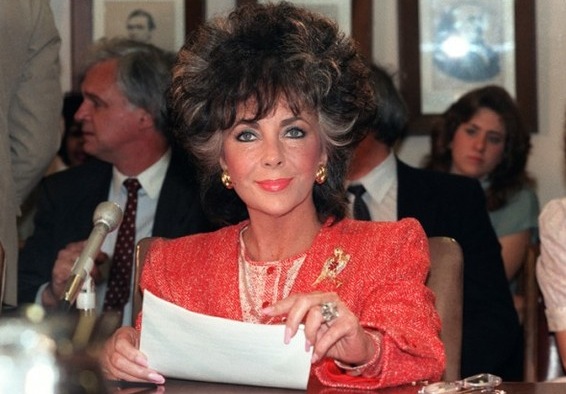
Elizabeth Taylor, “Battle: L.A.” and our Topsy Turvy World

The death of Elizabeth Taylor this week marks the passing of an era in the world for many reasons.  One of the many for me is that my mother looked like her.  Not exactly.   But enough that I can recall every few months of my childhood, and then periodically over the years, being somewhere with my mother to hear those words:  “Anyone ever tell you you look a lot like…” “You know, you’re a dead ringer for…”  My mother used to smile demurely at such adulation, and then, as time went on, was simply amused by it, only wishing she’d had some of Elizabeth’s money, a few pieces of her jewelry, and probably just one or two of her lovers, if I might be so bold.  But such is life that my Mom didn’t live like a movie star queen, just simply thought of herself as one.   A classy pedigree can do that to a person.  But that’s off topic and you don’t need a glimpse into my therapy.

Ms. Taylor represented the best of an era – obscene looks, talent, money, passionate love affairs, marriages, children, public scandals and bouts with death, only to rise out of it like a phoenix and go through the drill of each all over again.  It’s the stuff of great drama – the kind that are seldom made anymore on film, television or the stage.  And in addition to her life, Elizabeth Taylor lived and played in all three venues.

For those under 30, think Angelina Jolie and multiply it seven fold for each of her husbands or eight fold for each of her marriages (she married Richard Burton twice).  Like Ms. Taylor, at the age of 36, Ms. Jolie has to her credit lots of kids, money, lovers, movies, and a sole best supporting actress Oscar and is about to remake “Cleopatra.”  By that time in her life, Ms. Taylor had all of the above plus she had already completed “Cleopatra” got paid the most money of any actress in the history of the business for it and helped sink Twentieth-Century Fox AND earned TWO best actress Oscars.    (Is this comparison a faulty one? Probably not).

Ms. Taylor and Ms. Jolie would probably rightly tell us that the Oscars are clearly the least important achievement on the list, though if the economy keeps tanking they might be worth much more than their present value in gold.   And a case could be argued that it would be the best thing in the business right now if one of the remaining studio conglomerates does sink for overspending on a big, bloated overproduced movie – no kibosh on the new “Cleopatra” intended for producers Frank Marshall and Kathleen Kennedy, because I might want to get one more big original screenplay of my own produced one day and certainly don’t want to burn any bridges the way things are.  But if one examines the two Oscars won by Ms. Taylor for best actress and the sole statuette won for Ms. Jolie for best supporting actress, and the films each have made to date as among the biggest dramatic movie actress in the business, it gives a little peak into what’s going in movies today and a look at why Elizabeth Taylor’s death is totally and truly, once and for all, really clearly the passing of an era.  Especially in the entertainment business.

Taylor won her second best actress Oscar for “Who’s Afraid of Virginia Woolf?,” made at age 35 and was roundly criticized as too young for it. (An enduring, culturally iconic film, it won a lot of Oscars and is the first film by now legendary film director Mike Nichols). Jolie, 35 this year until June, made/released  “Salt” and Johnny Depp’s  “The Tourist.”  Jolie is the most bankable (female) star and thus gets offered EVERY VIABLE PROJECT IN THE WORLD. Trust me, even probably before Meryl Streep if she’s age appropriate.  (Or even if she’s not.  Could she have played Julia Child?  Well, the studio might have liked it).  So did Ms. Taylor.  That’s how she got to do “Virginia Wolff” when most people thought she was hopelessly too young and miscast in her thirties and a “movie star”.  So it’s not a question of turning down.  As someone wisely once told me when I didn’t like the seemingly bad choices a star actress was making, “what are the films being made that you think she should be doing that are being made.”  Years later questioning my career, he once again told me – “what are the open assignments you really want to be doing from what’s out there???”

Here’s a list of some of Ms. Taylor’s great films from ages 18-35 – “A Place In the Sun,” “Giant,” “Raintree Country,” “Cat on A Hot Tin Roof,” “Suddenly Last Summer,” “The Sand Piper” and “Taming of the Shrew.”  For blockbusters, let’s add  “Cleopatra” and for star vehicles she elevated let’s include “Butterfield 8,” which did win her the first Oscar.  (Though so did her near death experience that year and an emergency tracheotomy). During that time she also managed to have five marriages, several children and almost die, while losing a husband, stealing the husband of her friend, bankrupting a studio and becoming Hollywood’s highest paid actress.  Aside from her Oscar winning supporting role in “Girl Interrupted,” Ms. Jolie also did most of the above, though with less marriages and not being a friend of her present “husband”’s former wife.  Yet Ms. Jolie’s films include:  “The Bone Collector, “Lara Croft: Tomb Raider,” Beyond Borders” “Mr. and Mrs. Smith,” “Original Sin,” “”Salt, “Wanted” and “The Tourist.”  For blockbusters, throw in, well, “Alexander?” For star power elevation of material throw in  “”The Changeling” and  “A Mighty Heart.”

What are the studio films being made today where Ms. Jolie acts in that would raise her film oeuvre to the level of Ms Taylor’s?  Any in development?  How about what’s being made out of books or Broadway plays?

I’m waiting.

Still waiting.

Silence.

Okay, think some more.  Anyone?  Anyone?  Bueller??

Okay, then let’s watch a scene from “Virginia Woolf?”

Which brings me to Sony’s new blockbuster,  “Escape from L.A.” “Battle: L.A.” Do we have to?  Oh yeah.

For $100 million and who knows how many tens of millions of advertising, it’s not that the film reaches the depths of badness of, let’s say, “Battlefield Earth.”  It’s not that entertaining.  It’s just dreadfully mediocre and well below average.  Boring bus and truck John Wayne/Green Beret stuff by way of nauseating hand held camera, generic alien villains, earnest subplot characters whose arcs are thoroughly confusing, and spoon fed information from talking heads on TV screens that violate every rule of screenwriting by mostly telling us verbally what’s going on rather than by allowing plot to unfold amid the action.  But it’s escapist, you’re making too much of it, you say?  Perhaps.

Do you want me to start comparing its star Aaron Eckhart, who tries valiantly to survive and sometimes manages to elevate the material – with the movie star he looks most like – Robert Redford (check it out, they have the SAME thick blonde HAIR I can only dream of possessing and cleft in the chin, sculptured face).  I won’t go through their films but go to IMDB and check their ages and the comparable credits thus far.  Poor Mr. Eckhart doesn’t have much of a shot at Redford stardom.  Not because he’s not a movie star and not because he’s not good enough.  But because they are simply not making them like they used to anymore on the silver screen.  Plain and simple.

What’s going on now is the classic “B” movie – the programmer of years gone by – the low budget war movie with the hackneyed plot – or the cheesy science fiction tale with the “B” stars – has become the “A” movie price wise and attention wise for all the major movie studios.  And the “A” movies, which you’d include most of the Oscar winners, are now the “B” films – lower budget, acquired by other companies, featuring big stars and memorable (sometimes) plots, adapted from classy material.

Is it topsy turvy?  Or is this simply the end of Planet of the Apes (spoiler alert), where Charlton Heston realizes that the planet he has crashed landed on where apes can talk is not some bizarre far off doppelganger for Earth but actually Earth itself, transformed by decades of time and lack of attention to its species.  That could be a melodramatic description but so was Planet of the Apes, written by the great master storyteller Rod Serling, who luckily didn’t live to see the remake of his tale being turned into yet another pulp studio blockbuster some four decades later.

At a director friend’s birthday/dinner party this weekend, I was chatting with two screenwriters more well-known and more produced than I – talking about the change in eras and sensibilities in the industry.  It was agreed one becomes irrelevant if one complains too much about the way things are because, well, they are what they are.  And that this generation deserves to have their kind of music and movies, just like we did.  Ella Fitzgerald and Frank Sinatra, wonderful so they are, felt like a million years ago to us, when our parents talked about and played them.  That must be how the movies of the 60s and 70s seem, and rightly, to young people and the industry today.  But will Angelina Jolie movies or Elizabeth Taylor’s movies stand the test of time?  They both share a lot of qualities, top of the list being their stunning beauty and abilities as an actress.  But Ms. Jolie has been born into a different dimension of space and time.  Where you need aliens, guns, 3-D or an end of the world problem to get anyone’s (studio’s?) attention.  So she does the best she can.

We, meaning anyone in the industry, especially those of whom are young and thus have a longer shelf life than the rest of us at this moment in time, might want to help her.  At the age of 60, Elizabeth Taylor was able to use her stardom to help turn the tide on a worldwide pandemic. She showed us that anything was possible and reinvented herself as a great humanitarian.  For those who love movies and make them, her passing might be the time to take note of what’s out there and, like she advised, try to do just a little bit better. even though the deck seems stacked against us.  It’s not as important as fighting AIDS or world hunger (Ms. Jolie’s charity), but aren’t the movies at least worth trying to save?

In closing, two Elizabeth Taylor quotes come to mind.

“So much to do, so little done, such things to be.”  And, finally –- my fave — “Big girls need big diamonds.”