How do you achieve excellence? There are certain markers like this week’s Olympics and the Oscars two weeks from now. Within them are societal and cultural markers like medals, trophies, fame and money. But without any one of these, does it mean that you are not excellent at the things you do? Hmm, perhaps we should consult our trusty dictionary.
Excellence
- The quality of being outstanding or extremely good; an outstanding feature or quality.
Notice that nowhere in this definition does it state THE best. This is because the dictionary knows better than we that no one and nothing in the world can be judged THE best due to the fact that THE best changes on any given day. The most you can hope for is excellence. And that comes with its own set of rewards.

… or maybe you do think you are the best.
You can beat yourself up, tell yourself you have to get better and concoct an intricate system of deprivations for yourself when you don’t reach your perception of excellence. I used to do this with my writing and it seemed to help for a while in allowing me to achieve more. But it also took a heavy psychological toll that at some point began to cost me my excellence. Kicking and screaming I backed off and realized – after any number of years of psychotherapy and crippling exhaustion from whipping myself into submission – that I had to accept I was no longer doing my best, or more importantly at my best, when using this particular strategy. So after much practice at actually getting myself to believe that a new way was possible I got myself back on the excellent track by simply working hard and – odd concept though it may seem –once again ENJOYING the work at hand that I have chosen.
Marriage seems to me another sort of cultural benchmark these days –- one of love — especially for gays and lesbians. Yet for some of us it can also be seen as more of a necessary legal arrangement rather than an arrangement to aspire to in the sweepstakes of the heart. In either case, the institution itself has little to do with the excellence of a relationship and more to do with mainstreaming yourself into the world so as to be treated like everyone else who wants to publicly declare and legalize their love relationship. But what if you don’t want to be like everyone else? What if you do not want to conform? Does that mean you are any less excellent at love, or even relationships? All societal markers to the contrary, the answer is: certainly not. (Note: I confess to having spent more than my fair share of time battling this one and have decided that love is always excellent, no matter how simple or complicated we make it).
The bottom line is — you don’t have to be part of a race you don’t want to win. Does that make you any less excellent in your chosen category of endeavor? Certainly not, again. There are lots of people who choose not to compete in many areas of life and are not interested in competition in general. Some of this thinking harkens back to the old Eastern spiritual philosophy to not shine the light on yourself but on others. But this does not mean these people are any less excellent at what they do. It only means that you simply may not know about them because they are not in the commercial or competitive rings.

You go and get your award, Malibu!
The broader question – and perhaps the only one to ask is: how much do you want to push yourself to achieve personal excellence? Do you aspire to be extremely good at what you do? (e.g. do you have to be THE best snowboarder in the world?) Or Is simply doing your thing your most excellent way to live and what excelling means to you? Or – and here’s a thought – can’t you be and do both????
Watching the winning trifecta of young male U.S. Olympic slope style skiers pose in what will surely become their iconic silvery polar jackets from Nike (Note: Printed on the jacket’s inside linings are the words: This is your moment) – their gold, silver and bronze medals around their necks fresh from the winners podium – one couldn’t help but smile. C’mon, these guys are DUDES– it’s all good rad crispy that they won. But what made it better was that if you met them on the street and knew nothing of their backgrounds you’d be hard pressed to know that they were anything but happy-go-lucky bros who were only special because of how good a mood they seemed to be in in contrast to everyone else. Oh, with the exception of silver medalist Gus Kenworthy – a lifelong dog lover who made it his mission in Sochi to save a wandering brood of pups he saw on the street and either take them home to the US or find them proper homes in Russia. In either case, that makes him exceptionally exceptional and his deeds outside of the Olympics the most, MOST excellent.
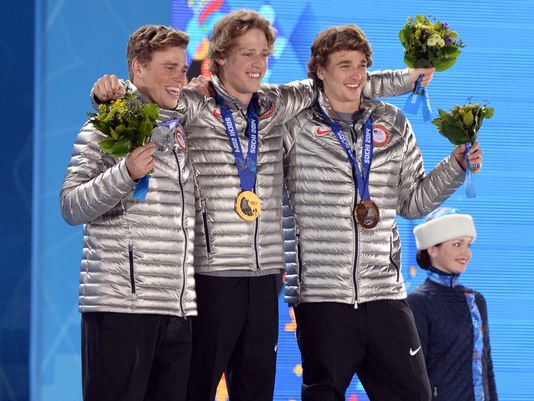
Stand-ins for One Direction?
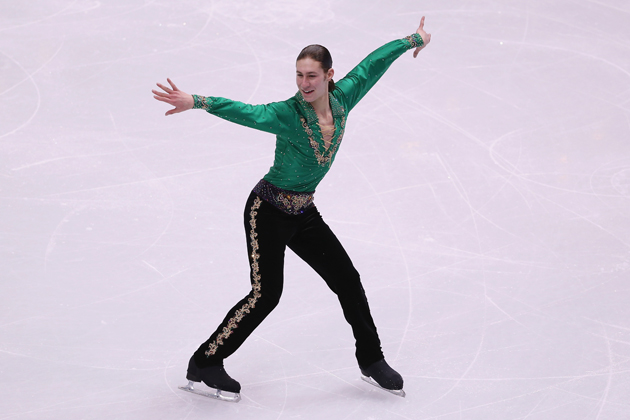
What I’ve also observed this Olympics is how excellently talented people act when they don’t “win.” In particular, I was impressed with 19-year-old ice skater Jason Brown (our main image for today), who ultimately came in ninth place in his event but gave interviews with the excitement of someone who came in first. This was in sharp contrast to many other wonderful athletes who to varying degrees felt shamefully disappointed that they didn’t medal or did not win the gold. Of course, this was not entirely their fault. I watched in a sort of strange angry horror at how two time gold medal Olympian snowboarder Shaun White, who finished fourth this year in his event, was branded in the media as the big “loser” all week and cross-examined about how disappointed he must be to be deemed only the fourth best in the world in his sport on that given day.

Maybe it was the hair?
For years people in Hollywood have joked that it’s an honor just to be nominated for an Academy Award with the unsaid truism being you’re ultimately a loser if you don’t win. What this is saying more than anything else is that it doesn’t count at all unless you win. Wait, so then… being an Oscar nominee means you’re…a loser? That’s what one actor I once worked with told me it felt like after losing in the big category. This person recounted leaving the whole thing totally depressed as someone who had disappointed everyone. In fact, to this day that actor looks back at the experience with extreme sadness. This would seem either hard to imagine or simply neurotic behavior to me if it weren’t for the fact that more than one Oscar loser I have met over the years has told me exactly the same thing. That’s how far this way of thinking has all gotten.
Of course, any kind of ongoing excellence comes with some sacrifice. But that should not be in how you’re looked at or categorized by others (or even yourself) –and more in accepting the idea that you can’t be excellent at everything in every moment. No one can do it all and be everywhere at once so no one – not even you (or me) can excel at everything IN the world.

Uh… ya think?
For all the hours you spend practicing your snowboarding there will simply be less hours you can devote to – dating? making love? movies? visiting museums? watching TV? family time? friends? writing? Something has to give. Oh, you can try to incorporate some of those into your routines and multi-task. (Note: Just the images this brings to mind makes it all worth trying). But multi-tasking takes away from the singular focus you need to excel, at least that’s what the research says. You see where I’m going here. You have to make some choices and narrow it down. You can’t do it all even if you decide to think you can.
A lot of writers face this problem when they structure a script and try to tell the story of every character. Here too you must make choices. This is especially challenging for my neophyte writing students who, in their enthusiasm, won’t sell any of their people short. I see this as generosity, admire the kindness of their intentions and hate to be the Scrooge McDuck who has to tell them that part of being excellent at their craft means making the hard decisions and sometimes being the “bad guy.” That guy (or gal) who sacrifices something – or someone – for the greater good of what they are all doing.

Oh you mean I can’t have this many characters?
Perhaps a nicer way to put this is – compromise. Not comprising your values but modifying rigid ways of thinking. Rigidity should not be confused with discipline, which is always necessary to be excellent. Rigidity is about not listening, about a harshness of spirit with yourself and what you are trying to achieve that does not allow you to see the forest from the trees. If you are going to be your best – i.e. some version of excellent – the first step is to admit you do not know it all and to learn from the best. You can be stubborn here– making the choices you see fit and sticking to your guns when you feel deep down in your core of cores you are correct. But you also cannot set yourself up as a deity that is all knowing and needs to be worshipped (Note: even if the rest of the world is treating you that way) and be your most excellent self.
What is fascinating about Hillary Clinton, among so many things, is not only her overwhelming work ethic – some her a workaholic – but the fact that she always seems willing to compromise (or even accept defeat), listen, sit back, be a team player, and then regroup. This just might win her the U.S. presidency. A person who lost the election of her life then joins the man who beat her up on the political battlefield and helps him have a better presidency by traveling the world as his Secretary of State? Whatever bitterness there might have been did not last and by most accounts Mrs. Clinton and Pres. Obama became quite friendly, if not friends and treasured professional colleagues. Imagine if she had just thought she knew better, licked her wounds and went away, dragging her faux fur behind her? Who knows where either one of them would be? But this is a pattern of excellent behavior on her part that has allowed her to go from being a potential First Lady in the nineties who once snapped I’m not some Tammy Wynette, standing by my man baking cookies, to being a successful First Lady who nevertheless failed miserably at her task of passing health care in the 90s…. and then still go on to be someone branded as sad and foolish for staying with a husband who kind of had sex with a 22 year old intern in his Oval Office, and then still on to being an inexperienced U.S. senator who eventually became a top colleague who won the respect of senators on both ends of the aisle for her intellect and effectiveness… only to emerge again as a leading yet failed presidential candidate who then became U.S. secretary of state and worldwide opinion maker, and now seems likely, at 66 years old, to run again for the White House and thus make history by becoming the first female president of the United States.

Did ya get all that?
Yes, Hillary Clinton is connected, political and extremely intelligent – but there are a lot of political, connected and extremely intelligent people in the world. She is excellent because she listens, learns, practices, fails, starts over, makes mistakes, practices some more, withstands the missteps, makes more mistakes and then gets up and does it all over again. She also tries new things and isn’t intimated by new opportunities. Well, maybe she is intimidated– probably she is in her private moments – but who among us isn’t? And how many of us go ahead and continue on to do the hard or even hardest thing anyway?
Don’t mistake this for a Hillary Clinton puff paragraph (or two or three). In truth, it was the famous playwright Samuel Beckett who once wrote “Try again. Fail Again. Fail Better.” This was in an obscure series of short novels published in his later years under the umbrella title Westward Ho and the words were written in an entirely different, much more obtuse context.
Still, it is the nature of writing that sometimes a mere tossed off phrase that you meant one way becomes a mantra in another. Or in this case, a recipe for success for everyone from a Silicon Valley billionaire to a graduate school student to a middle-aged blogger like myself. That doesn’t make Beckett a failure any more than winning the Pulitzer Prize makes him a success. What was most excellent about him, and so many others, was the combination of both his talent AND his work and the dedication and determination he brought to both.
Decades ago I worked on the crew of Bill and Ted’s Bogus Journey, the sequel to Bill and Ted’s Excellent Adventure. Truth be told, it wasn’t a great movie nor was it one of my penultimate professional experiences over the years. I remember thinking at the time that these movies were so dumb that I could not believe they got made at all AND earned boat loads of money, nor that I was being so well paid to do a job on something so insignificant. Yet here I am, 30 years later, voluntarily using the phrase most excellent – a phrase that was first brought into the international lexicon by the writers of those films – to make an intellectual, or at least common sense point about excellence.
Go figure, dude.