Notes from Methuselah

A student wrote about an older couple who were returning to their summer home and carrying luggage where one has a heart attack. We were hashing it out in class and I said, “How old.”

“Oh, they’re really old.”

“Ok, but do you mean like, Gloria Stuart in Titanic old?” (Note: The woman who was in her nineties when she was nominated for best supporting actress).

“No, but old…..I’d say, well, I guess they’re in their fifties.”

“THAT OLD!?” I say.

“Yeah.”

“You’re sure?”

“Uh, huh. People have heart attacks in their fifties.”

Long pause.

Crickets. Crickets. #awkward

“I might as well just kill myself now then,” I reply.

Pause. Then some nervous laughs.

“Oh. Well, it just seems like they’re a lot older than the other characters.”

“That’s fair,” I say. “But this couple. Are you sure they could even lift their luggage enough to move it across the room? I mean, they’re that mobile for that age?”

More nervous laughter. Then the rest of the class catches on and starts to laugh.

“And you imply with their body language that they still have sex. Are you sure that’s safe at their age?   Could they even make it into the bedroom, much less do anything?”
Don’t be fresh!

“You’re not going to let this go,” the student countered, finally amused.

“No, I don’t think so. I’m having too much fun,” I say. “And who knows how much time I have left? I better take advantage of it while I still can.”

And….scene.
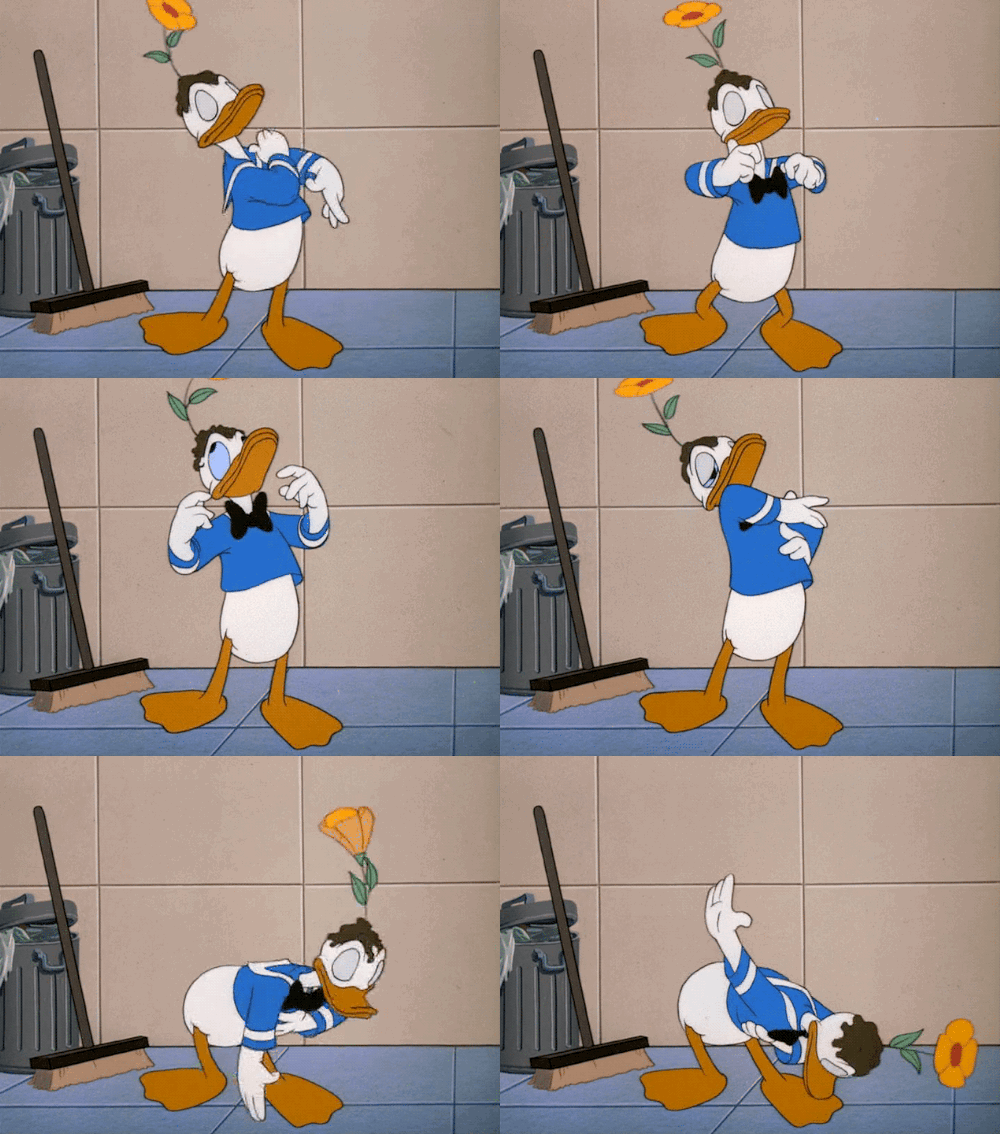
Thank you. Thank you very much. #noshame

This is a fairly typical scene these days for me and many of my contemporaries. And for my older friends – not to mention my 88 year-old Dad who assures me it will only get worse. Then again, exactly what IS the alternative?

That’s rhetorical. We all know what the alternative is. So it doesn’t bear repeating.

Too much to ask?

Full confession – there was no reason a student in their early twenties should think that a couple in their fifties is anything BUT an older couple. And after my mini-vaudeville routine I admitted as much.   But what I was trying to convey was behavior and sense of clarity. Just labeling someone an older couple isn’t very specific. Unless, well…it is. But I refuse to go there quite yet. Especially at my age.

The movie Get Out positions baby boomers Catherine Keener and Bradley Whitford as exactly this type of older couple – as well as the symbols of phony, middle aged liberalism. Though even middle aged is relative. As Meryl Streep, playing a fictional Carrie Fisher, stingingly retorts to Shirley MacLaine, playing a fictional version of her then sixtyish mother Debbie Reynolds, after Mom tries to claim middle age for herself in Postcards from the Edge – Really. How many one hundred and twenty year old women do You know?

I thought it was hilarious in the nineties.   But now it’s deeply funny. Tinged with a touch of self-righteous irony on the ungrateful daughter’s part.
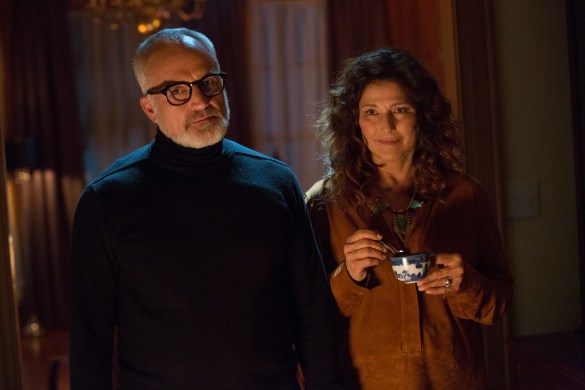
Regular On Golden Pond over here #helpme #getoutforreal

I think this was part of the issue for me not being a cheerleader for Get Out. The kind of middle-aged white liberal I am bore no relation to the phony Kumbaya relics I was seeing lambasted on the big screen. Not that I minded the roasting. What I didn’t get was the generalities about a group of people and the seemingly unmotivated behavior based on a stereotype.

Oh. Right. That was the point. Turnabout is fair play. Still, don’t you have to BELIEVE IT in the context of the world you as a filmmaker have created? And if you aren’t specific enough to make us believe it, aren’t you no better than the long generation of movies in the past that have so consistently done it to other minority groups?

Hmm. I’m not sure whether two wrongs don’t make a right or many wrongs make a right for a few new and improved wrongs to at least even out the playing field a little. I’m going to have to think about that one.

This might take a while #brb

The trouble is you get to the point, or the age, when you don’t want to have to think too hard about that one. When I heard 76-year-old Al Pacino was going on the stage locally to play one of my favorite playwrights, Tennessee Williams, during his last creative days in a workshop production of a new play, And God Looked Away, I quickly went online and bought my husband and I two tickets at $189 a piece on a Saturday night.

My first thought: I have to see Al Pacino live onstage before he dies and I don’t care if he’s the opposite of gay and southern. It’s called acting, right?
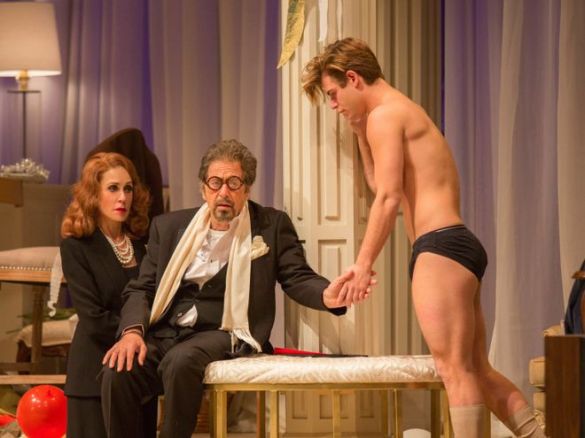
oh, hello.

Well, I thought so. Even though he’s older and far shorter, Pacino managed to thoroughly inhabit a fading, drug-addled Williams. It felt like the essence of a real character.   In much the same way very hunky and very hearththrob-by Hugh Jackman miraculously evoked the very gay and very lithe singer-songwriter Peter Allen on Broadway in The Boy From Oz. Mr. Allen, like Mr. Williams, was one of my faves and is almost as far away from the Wolverine as, well…I am. Though not quite.

Yet mostly what our L.A. Times critic couldn’t resist sneering about in Mr. Pacino’s case was that:

“The privilege of seeing Pacino portray the aging American playwright in a Demerol haze while pawing shirtless male hustlers as reviewers crucify him for his latest flop doesn’t come cheap.”

SHADE

Hell, that sounds good to me, gay liberal that I am. In fact, I’d pay even more to see that performance again if they fix the play a bit more. At least they were on to recognizable human behavior rather than an overworked or too witty social commentary that bears little resemblance to my reality. Or, well, a reality.

Which I suppose is relative, depending on who you are and what interests you. The hope is that what we’re actually living is reality, and what’s created in our individual fictional worlds based on that reality, is actually worthy of our attentions at all.

Though one supposes it beats the alternative.
Open Books

Does anybody really want to be private anymore?  Twitter, Instagram, Snapchat, Facebook and their many future and inevitable iterations would say otherwise.

The idea that each of us can express opinions on a mass scale and actually be heard – well, read and seen, which are close but not exactly the same thing – feels revolutionary.  Rather than shouting in the wind, or to your family and friends, one can literally shout at the world these days and it is entirely possible that a person or mass of people that one’s never met will see, hear, perhaps even listen… but most importantly RESPOND.   Of course, not always kindly.  File that under be careful what you wish for.

Oh days of yesteryear

Still, one could argue the situation these days is a lot more preferable than it used to be.  There was a time not so long ago that one could die in frustration with one’s inner thoughts or angry outer thoughts that the world too often turned away from.  Certainly not everything one has to say or voice is important to the world but what is certain is that it is very much important to that person.

We all, each of us, have at least one thing in common and that is the desire to be heard, and in turn, hopefully, understood.  By someone.  Or many.  Why?  Well, it varies.  Sometimes it’s on an interpersonal issue with someone we know.  In other more existential moments it is on larger topics and what we believe about ourselves.  about the world, and about humanity.  And in loftier but no less meaningful moments it is about a pressing desire to proclaim what is RIGHT AND WRONG in  ALL of the aforementioned orbits.

It really is hard being the smartest person in the room

When we can’t stop shouting about an instance, an argument or an issue, it’s more than pressing.  It’s crushingly personal.  And we can’t shut up about it no matter how much we try or don’t attempt to.  This, in particular, is where a 2017 life comes in handy.  Even if one doesn’t receive a direct response (DM) there is a feeling that somehow, somewhere, someone listened.  And might act on what was said.  By US.

Oh, and by the way and on a very much-related topic – this – more than anything else – is the dirty little secret about being a WRITER.  (Note:  Though certainly, not the only one).

Was someone spying on me? #meeveryday

On a recent and quite brilliant stand alone episode of Girls, Lena Dunham’s emerging writer Hannah Horvath is summoned to the breathtakingly gorgeous and sprawling apartment of a famous writer played by The Americans’ Matthew Rhys.  It seems Hannah has written a think piece for a feminist blog about this man, one of her all-time literary heroes, and his misadventures with a series of four different college age women he mentored and taught with whom he had unwanted or perhaps manipulated wanted, sexual relations.

Hannah tells him she wrote the piece as a means of support to thousands of young women who are forever scarred by a situation of abuse at the hands of someone more powerful.  But the writer makes a powerful case that although her words are brilliantly executed by someone with rare talents, they only tell a partial story of what she merely chose to see based on second and third hand accounts that she read.  For to be a true writer, he tells her, is to not only respect all sides but to dig deeper into one’s subject and understand reality, motivation, connection and situational circumstance in order to truly determine what constitutes the truth.

At which point, Hannah and the author have their own new interaction that EXACTLY mirrors one of the aforementioned circumstances, leaving it to the audience to determine who was right or wrong.  Or if, indeed, such a thing even exists at all.

Oh how I’ll miss you, Girl #hannah4ever

There are all types of writing and each has their individual demands.  But what they all have in common are two very specific things:

1. The truth

and…

2. What the writer believes the truth to be.

Of course, there are few absolutes in the world outside of math and science and lately even those have been brought into question.  Which really only leaves us with #2 and brings us full circle.

As both a writing teacher and someone who annually reads numerous works of writing from all over the country for various grants and scholarships, it becomes joyously and sometimes painfully obvious to me that when reading a writer one learns as much about that person as one does about the issue or subject being presented.  Often more.

You can’t help but begin to wonder – why of all the subjects in the world did this person choose to concoct a story about homeless LGBT youth?  What happened in their background that provoked this individual to pen a story about a 1930s honkytonk in the southwest with such fervor?  Who would choose to devote years to telling the tale of gnome who appears to a young lad in the middle of a cornfield at turn of the 20th century Midwest?

Or a tiny sprite of a girl who loves eggos

I choose these because in the last year all three have been among the most outstanding student and professional pieces I’ve read from young, unknown authors.  And in the cases of at least two of the three (Note: I do not know the author of the third) I know the writers revealed quite a bit more about themselves than they ever intended.  And to their great credit.

I’ve quoted it before but it bears repeating that no less than six famous writers are credited with having once famously stated (and I’m paraphrasing because five of them most certainly did):  Being a writer is easy.  Just open a vein.

And add to that in less witty parlance:  There is no other way to get to the truth.

Perhaps (?) (!) that was what Margaret Atwood was doing in the early eighties when she wrote the now famous A Handmaid’s Tale – a work of fiction in a dystopian world that not only went on to become a best seller which has since never been out of print but has spawned both a feature film and an upcoming Hulu television series where Ms. Atwood herself makes a cameo guest star appearance.

And…… PEGGY!

In her story, a Christian fundamentalist movement takes over the United States -which reeks of pollution and sexually transmitted diseases – and installs a totalitarian regime that subjugates women and forces a particular class of them to serve as the term vessels of unwanted pregnancies to a more powerful group of men forcing their wills on them for what they believe to be the ostensible survival of society.

Well, of course this is a work of fiction!

Fact almost seems more surreal than fiction these days

So much so that Ms. Atwood herself penned a piece several days ago for the NY Times explaining where she was and what she was thinking when she first wrote her perennial bestseller.

As well as what she could offer as to it’s meaning in what has been promised to be a new and improved United States that will once again be great again.

It’s a curious position to be in – addressing the real possibilities of a fictional story written in the past of an unimaginable dictatorial future some believe we are headed towards in the present.  But like any great writer she demurred on how prescient she was, attempting to be vaguely encouraging without providing answers.  In the age of what we’re constantly being told is instant communication, it’s up to all of us to draw those conclusions in the present.  Loudly.  For our futures.  Revealing not only where we stand but real parts of ourselves.  Before that is no longer a possibility.