A Twee Too Much

Screen Shot 2015-06-14 at 12.47.50 PM

There are a few things I need to get off my chest.

  1. I won’t be seeing the Jurassic Park reboot.   I found the first one interminably dull after a short while and this was at a packed screening in cushy seats where other people were loving it.
  1. My flat screen TVs, all of which are smart (certainly much smarter than me) have become the enemy. If I so much as graze one of their buttons in the wrong way I am left with nothing. No sound, no picture, snow or a frozen image. This can then only be remedied by calling one of five sources for help (all of whom I’ve bothered more times than I can remember) – a call which is even more embarrassing than admitting this problem publicly to all of you.
  1. I’m tired of people who can’t carry a tune or barely can sing but seem to do so quite well because of modern technology, passing themselves off as musicians and singers – and convincing the record industry and downloading public this is so.   You can’t croon or play if you are unable to achieve the effect without the help of heavy machinery.giphy
  1. Losing ones hair and figure is not fun nor is working out more than you ever did in your lifetime just to maintain status quo, health or to just look presentable enough to avoid scaring small children. On the other hand, cutting into your face or having fairly recent medical school graduates inject you with poisonous waste products from exotic animals so your skin can seem as taut as the sheets on a new recruit’s army cot seems even worse. And certainly more expensive.
  1. Ronald Reagan was a TERRIBLE president and don’t let anyone reinventing history in the forthcoming election year try to tell you any different.
because a picture of Reagan would make me barf, enjoy this litter of puppies

because a picture of Reagan would make me barf, enjoy this litter of puppies

This all started with a screening I attended of Me and Earl and the Dying Girl this weekend. No one likes a good cancer movie more than me, and certainly there isn’t a guy on the planet who gravitates more to an indie tearjerker – especially one that sold for near record millions at Sundance like such predecessors as Little Miss Sunshine – one of my all-time film festival (or any other kind of festival) favorites.

Now I hope all the filmmakers who made Earl go on to have long and happy careers (Note: They all inevitably will), not to mention most of the actors, who mostly did stellar work (Note #2: You can decide the muggers for yourself when/if you see it) and seem to have been enjoying themselves during filming. But if I have to watch one more hip, young, piece of cinema demographic filled with endless snide, deprecating dialogue bouncing off of colorful, macramé-like images shot through endless gradations of a fisheye/crooked/or skewed lens, I WILL just spend the rest of my life inside, watching my smart TVs, where I vow I WILL call one or more of you to figure out the problems with each and every one of them.

And just know by that time there will be many, many more.

It’s writer-director Wes Anderson time – meaning that’s what 100 minutes of Earl longs to give you via an unfresh and un-new visual and storytelling style– which in turn is unsurprising since WA’s frequent producer, Indian Paintbrush, distributes this one. Yup, it’s Quirky McQuirk-Quirk, Jr. with just a dash of sincere 60s/70s film homage and postmodern emotionless emotion thrown in.

And now I'm exhausted

And now I’m exhausted…

Question: If Odd is the New Norm then what is the New Odd? Would that be Mundane? It brings to mind the master originator of contemporary postmodern, David Lynch, and when he made The Straight Story in 1999, a pretty conventional tale of an older man crossing several states to visit his dying brother. The director publicly admitted that he had gone just as far as he could go with strange in his past so he decided the truly revolutionary strategy for him was to go plain. So just who will step up and assume the mantle of the then mid-career David Lynch? Anyone? Bueller?

Or perhaps let’s put it another way:

PLEASE, PLEASE, PLEASE — will someone make an impression out there doing PLAIN – which these days merely means unadorned and with a lack of tricks???

And not from this guy.. please

And not from this guy.. please

I knew the moment I saw Wes Anderson’s Rushmore 17 years ago and was left dazed and confused – something I have never been when watching a Richard Linklater film, by the way – that I was in trouble. But never did I dream that Mr. Anderson would be responsible for a commercial cottage industry of distanced, strange and bizarre just for strange’s sake.

This, of course, is how I also felt as a very, very young man when everyone was making such a fuss about National Lampoon’s Animal House, Raiders of the Lost Ark and Ghostbusters. I mean, they were fine, all fine – but the notion that they’d spawn endless sequels, reboots and their own cottage industries? Well, no wonder the president of Columbia Pictures didn’t hire me for that film development job in the 1980s – especially when I answered my personal favorite studio film of the previous year was Ordinary People. What an idiot I was. Though Ordinarily People could clearly be rebooted today – albeit with hand drawn animated inserts for the teary parts and with Mark Ruffalo and Parker Posey playing the parents of – the young new Miles Teller?
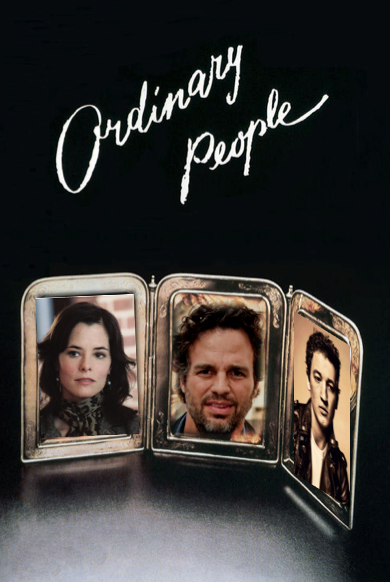
Coming soon to a theater near you

Coming soon to a theater near you

By the way, I think Miles Teller is among the best of the best in Whiplash and The Spectacular Now. He might yet one day win an Oscar even though his older generational acting doppelganger, Michael Keaton, never has (Note: He should have this past year). I also believe Miley Cyrus is very talented, imaginative and not a flash-in-the-pan, Amy Winehouse was not for a moment ever overrated and that the pastiche conceits of American Horror Story works every bit as well in its way as do the broad and stylized comic turns of both Broad City and Girls do in theirs. (Note: Coincidentally, Me, Earl and the Dying Girl was written by American Horror Story alumn Alfonso Gomez-Rejon).

But sometimes it is the job of each of us, especially those who have no other platform to do so other than in an obscure personal blog, to rail against the popular – to call out what we perceive to be The Emperor’s New Clothes.

pitch-perfect-enough-gif

The gay community, not to mention any number of other un-American US citizens tried unsuccessfully to do this all through the Reagan years of the eighties – when during that president’s stewardship AIDS became a pandemic and tax cuts for the rich and corporate deregulation helped spawn the economic meltdown of the late 2000 naughts we are all still recovering from.

Yes, I am on a soapbox but how else do our collective voices forestall Jurassic Park 33 – which you all may think you want now but, trust me, your grandkids will be cursing you for. Those same kids will also likely be listening to the new 2100-age, as-of-yet unborn Sinatra singing live in each of their rooms through some kind of still undiscovered clone entertainment mechanism.   And by the way, these kids will have all also adopted their own brands of voluntary male pattern baldness for their inevitably overweight selves because certainly by that time they won’t want to look like their grandparents – since at that point they will all be sporting perfect bodies without exercise and be tossing around their long luxurious manes of intact original hair thanks to some new, priceless and certainly voluntary (Note: Though we all know socially it won’t be, not really) medical option.

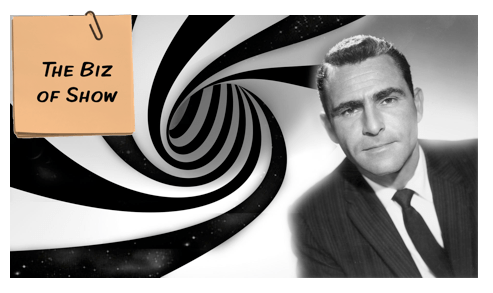
Welcome to the Twilight Zone

Welcome to the Twilight Zone

I’m not sure I’ll be around then – yet given the aforementioned advances there is a possibility I could at least still be carted about like an old embryo in a trendy Mason jar. However, I am 100% positive I still won’t get Rushmore, Me and Earl and the Dying Girl or Ronald Reagan.

Generation gap, my eye – the latter of which might actually be all that is left of me. If so, it will still be just as discerning as it ever was despite what the majority is saying.

This, as Martha Stewart says – and you know that SHE will definitely still be around then – is a good thing.
Ahead of Your Time

Screen Shot 2014-07-06 at 1.11.21 PM

It’s a sort of a tradition at our house on holiday weekends to at some point excitedly tune the television in to a Twilight Zone marathon.  (Note:  That would be the original black and white series first broadcast from 1959-1964, in case you were wondering, rather than any subsequent remakes or sequels).

What is unusual is not so much that we here are consistently entranced by the inventive storytelling and enduring themes of a classic television show – almost anything artistic that lasts has those qualities and more.  Rather, what stands out is that on any other particular day of the year we would only have to walk several feet over to our shelves of DVDs to watch any one of those episodes on our big screen TV, desktop or laptop computers at any time of the day or night.

These days we all have to be reminded of what’s really good from time to time, don’t we?  Yes, we’re living in a new golden age of television but sifting through it all has become a challenge that most of us simply don’t have the time for.  I don’t know about you, but too often I am willing to settle.  I think – all I want is to be entertained a little, or laugh a little or even be prodded to think a little bit more on a subject I hadn’t considered by what I’m watching.  And have it last in my mind a little bit longer than the time it takes to suck down a single Mentos.

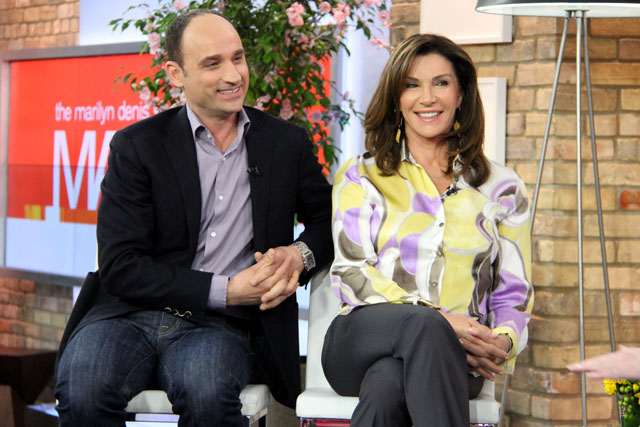
... or really if it involves any home design with these two.

… or really if it involves any home design with these two.

We read and hear constantly about how a continuing explosion of networks and a myriad of new streaming opportunities make this the optimum moment to be what the entertainment biz calls a content creator.  And how privileged this new generation of Millennials (along with everyone else who is older, not dead and still working) are to be among those whose stuff is getting read, seen or generally played with via those or any other venues.  But…well….. here is what the top 1%/chattering class of those bull crappers are really saying:

You young people who are writers, directors, actors and even producers?!  Yeah you! Do you know how LUCKY you are?  There are so many places where all that stuff you make can now be seen.  So don’t complain to us about how difficult it is to get views or how much you’re not getting paid.  This is the LAND of opportunitythe wild west of new media landscapes.  Don’t you all realize how GOSH DARN fortunate YOU ALL ARE to even be a part of this????

original

(Note: I might add that the same goes for middle-aged and older creative people.  It’s just that the top 1%/chattering class chooses not to include the rest of us among the content creators because, with some exceptions, they are not quite as interested in the types of content that we are creating).

So – here is both the really ugly and really reassuring truth about all of this:

It is no easier or difficult to be a writer, director, actor, producer or any other type of artist than it ever was.  The same blank canvas still exists and it still takes the same single-minded leap of faith, ingenuity and ever so slight craziness to believe that anything you have to say will prove interesting to anyone else or even be listened to.  That is both the challenge and, when it really works and lasts, the ultimate reward.

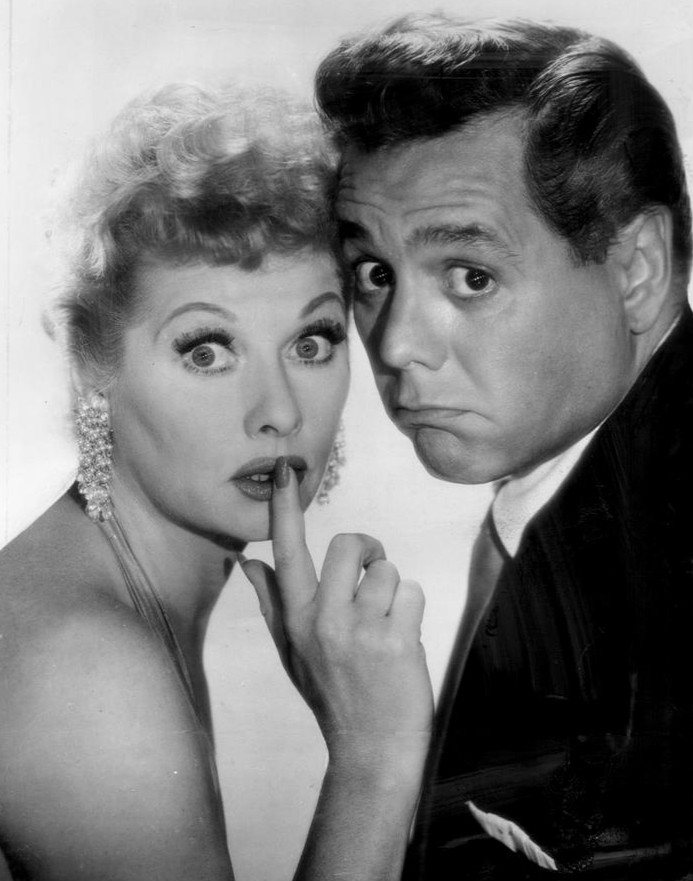
Twilight Zones don’t happen without a gigantic leap on everyone’s part  – the hardest and longest being from its creators. Nor does something light and classic on the other side of the spectrum like…well…I Love Lucy.  A 1950s television show about a Manhattan housewife married to a foreign musician we can’t understand, played by a “B” movie star and her real-life, non-actor foreign musician husband who we also can’t understand?  Are you kidding?  Well, this better be the funniest thing we’ve seen in years.

Still America's sweethearts

Still America’s sweethearts

Ah, yes – and lucky for them and for us it was.  In the same way that the unique idea of dealing with the timeless dramatic themes of conformity, prejudice, sexism and totalitarianism in a futuristic and alternate universe has also kept The Twilight Zone alive all this time.

One could go on and on with examples from the artistic discipline of one’s choice.  I simply chose The Twilight Zone and inserted I Love Lucy in the back-up position because they were most easily at hand and on the tube this holiday weekend.  And we’ve already established how much I – and we – enjoy easy.

It is not the wrong time for those of us in the Business of Show, or in any other business, to remind ourselves that the viability of one’s new idea can’t be measured so much against what’s out there but by what’s in there – meaning in your heart and soul and mind. Oh, pooh pooh that idea all you want – or as Bette Midler said several decades ago on her fine comedy album, Mud Will Be Flung Tonight – “hiss and boo your own selves” – it’s true.  Too many of us are not willing to go there nowadays, myself included.  There’s an emotional risk to failure and that is rejection, embarrassment, shame and depression.  There is also a financial risk and that’s loss of home, status or just plain poverty.  And certainly it’s no more fun that it ever was to be poor these days.  Probably less.

Still, the ugliest and tritest truism about art, and its even higher counterpart, innovation, is that nothing great is ever accomplished by dwelling on the what will happen instead of concentrating on the what could be.  That means taking a risk and going with what really moves you or gnaws at you.  No, this does not mean living in an artistic cocoon without taking in reality or the rest of the world.  That’s the kind of thing the top 1%/chattering class and all the other naysayers in your life and brain say to get you off track.

Not your ideal working environment

Not your ideal working environment

Take The Twilight Zone, for example.  At the time of its conception Rod Serling was a long form dramatic writer for live television who had served in the military and was married and had children.  It was the 1950s and he had a family to support and he didn’t have a chance to live in an artistic garrote and WRITE merely for himself.  So what did he do?  He embraced the most popular art form of the day but wrote about subjects he cared most about in just about the most commercial structure imaginable.  What were those subjects?  Oh, simple ideas fit for mainstream consumption in the escapist times of the fifties and early sixties.  (Note: Insert sarcasm here). Ideas that were ANTI-GOVERNMENT, ANTI-WAR, explored SEXISM TOWARDS WOMEN and addressed that popular old subject we’re still all always so willing and anxious to talk about – DEATH.

As I viewed Twilight Zone this weekend I was once again amazed to rediscover the timeless themes Mr. Serling managed to feature that few of us have the nerve to tackle today.  For example, Time Alone At Last in season one dealt with a bookish bank teller who loved to read classic literature but was perpetually ostracized for being strange and behind the times in then contemporary 1950s America.  Season 2’s The Obsolete Man went a step further and centered on the execution of one of the last thinking intellectuals living in a now totalitarian state where only people who are of direct use to the whims of its corporate-run government entity have the value to live.  Coincidentally, the leads in both episodes were played by veteran character actor Burgess Meredith, who gained greater fame the following decades as the original Penguin in the Batman television series and as the grizzled old trainer of Rocky in the first of all 22 of those films.  Hey, as Peter Fonda once told me his father Henry once told him: You go where the work is.

Meredith in Time Enough At  Last

Meredith in Time Enough At Last

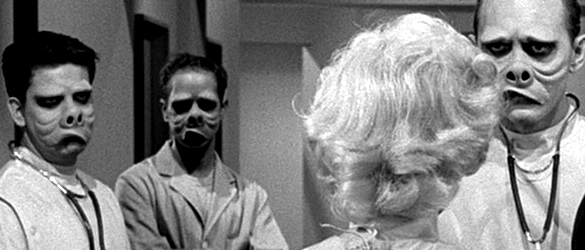
Mr. Serling was also probably one of the first male dramatic writers on television to so prominently focus on feminist themes and address the devaluing of women in American society.  Season 2’s Eye of Beholder, first broadcast in 1960, is one of his most classic.  A woman with a bandaged face has endured her 11th and final (per legal limits) plastic surgery to make her face not necessarily beautiful but simply what is considered for the times to be normal – or at least not as ugly as the horrible features she was genetically cursed with.  But when her surgeon finally unmasks her he and everyone else cries out in horror that there has been no change at all while simultaneously we in the audience see for the first time that the woman is not only blonde and beautiful but everyone else in the room – and in society for that matter – are all hideously and literally pig-faced.  Look around at all of the surgically mangled faces of 2014 humans worldwide – especially those of women, who still face more stringent societal standards of beauty than men – and one can’t help but long for a fictional Twilight Zone limit of a mere eleven surgeries when the subject of voluntary facial augmentation comes up.

Are you sure we're not on Santa Monica Blvd?

Are you sure we’re not on Santa Monica Blvd?

Interestingly enough, as the 1960s continued and the feminist movement began to take root, along with The Twilight Zone, the series chose not to play it safe but to go even deeper.  One Serling-produced episode in Season 5, Number 12 Looks Just Like You, focused on a young, futuristic woman with a pleasant face who is refusing to go along with the government mandated surgical transformation all young women and men of 17 must endure. Forsaking their own genetics, each must decide which of several scores of prototypically beautiful yet perfectly vapid faces, bodies and minds they will choose to transform into.

Being like everybody, isn’t it the same as being nobody?, questions the young woman. To which her perfectly transformed doctor can only reply, Hey, what you need is a nice instant cup of Smile.

A nice instant cup of Smile, if such a thing existed, might be what any number of commercial production companies and their vast audiences would prefer nowadays. But that does not mean that it has be what we content creators make for the selling.  In fact, it is really up to the creator – the first line of defense for the integrity of the artistic endeavor, to fess up and take responsibility for the creation much in the way Mr. Serling did in his storytelling for not only that episode but the entire series.

Preach, Rod.

Preach, Rod.

On that note, this might be a good time to mention that the genesis of The Twilight Zone actually came from the extreme censorship Mr. Serling had to endure at the hands of the networks and sponsors who chose to cut and then severely edit much of the work he had done before it.  The final blow came on a drama he wrote that was broadcast in 1956 called Noon on Doomsday. Inspired by the real-life case of Emmett Till – a young Black man of 14 whose eyes were gouged out as he was brutally beaten and then shot to death for merely speaking to a White woman in Mississippi one year prior – Mr. Serling persevered as first the setting of his story was taken out of the South – and then his young Black male lead was changed to a Jewish pawnbroker – until the final, watered down product focused merely on the actions of a generic foreigner in an unknown town.

But had Mr. Serling thrown up his hands in disgust and walked away right then and there, or just simply thrown up, we would never have The Twilight Zone.  It was only when he decided to beat the marketplace at its own game and partnered with another producer who liked his idea of using a science fiction setting to tackle all of the timely yet difficult subjects he aspired to write about (in other words – owning the idea of that foreigner in that unknown town but making him anything but generic) that any television network or sponsor would come onboard.  Which is not to say they did so without continued rancor or distress at just how timely and topical Mr. Serling would choose to be.

We should all be wary of countering the lesson of The Twilight Zone with comments like – oh, but times have changed, it’s not so easy to do that stuff these days, or even thoughts like, well, for every Serling there are hundreds of those who don’t make it and, quite clearly aren’t geniuses, but could do decent work, what about them?  To say this is to miss the point entirely.  No great or even good idea happens on the first try and most geniuses are merely just hard-working people relentlessly going about their jobs with dogged determination in a self-created world where giving up is not an option.  People like Serling have no idea if and when they will ever be successful – or if their new idea will ever be accepted.  They just keep going.  And that is the recurring theme of creation whether it’s digitized, computerized or merely presented  – for your approval –  in black & white.