
As I explained to a friend, I can’t NOT watch/read the news because as a former full-on neurotic it’s scarier for me to NOT be in touch with what’s really going on than to imagine what is truly going on. As bad as the world might seem to be at the moment – and what it seems to me is pretty bad – I know from experience I’d conjure up a hell of a lot worse left to my own devices.
Still, this was a week.

So after hearing about:
- The 30-year-old gay male makeup artist from Venezuela who was grabbed by ICE because of a few meaningless tattoos and deported to an El Salvador prison where no one has heard from him in more than a week.
- The mid-forties U.S. military veteran with terminal cancer whose experimental treatments keeping him alive were cancelled by Elon Musk’s DOGE bros because they were too….something.
- And the nice old ladies in red states across the country singing protest songs, or screaming, at town halls over the closing of local Social Security offices and the very real prospect that their earned benefits will soon disappear…
I turned to the movies and television.

This is not unusual and reminded me of the time I binge-watched the first four and a half seasons of Breaking Bad in nine days. Ostensibly it’s because my sister told me I would never be able to catch up before the last six episodes aired but also and equally important was the fact that I knew I had to endure my first colonoscopy the following month and wanted something, anything, to do to keep my mind occupied.
Following this reasoning, I took myself to see the new Bong Joon Ho movie, Mickey 17. Yes, I had assigned it to my students over spring break but, really, what better way to get reality out of your mind than to watch a film where Robert Pattinson gets to play 17 (Note: Actually there’s 18) versions of the same character? Even the trailer made me laugh, and that’s an achievement in itself these days.

Armed with no more information than that, wasn’t I surprised to see Mickey 17 was all about the dystopian future of the have and have nots, populated by one particular cult type leader who for no discernible reason at all seems able cast a spell over the masses and get them to follow him. He does this with promises of exceptionalism he never plans keeping to people whose welfare he cares nothing about unless said people can help him expand his own wealth or psychological value in a place, nee planet, where you can become an expendable for experimentation.
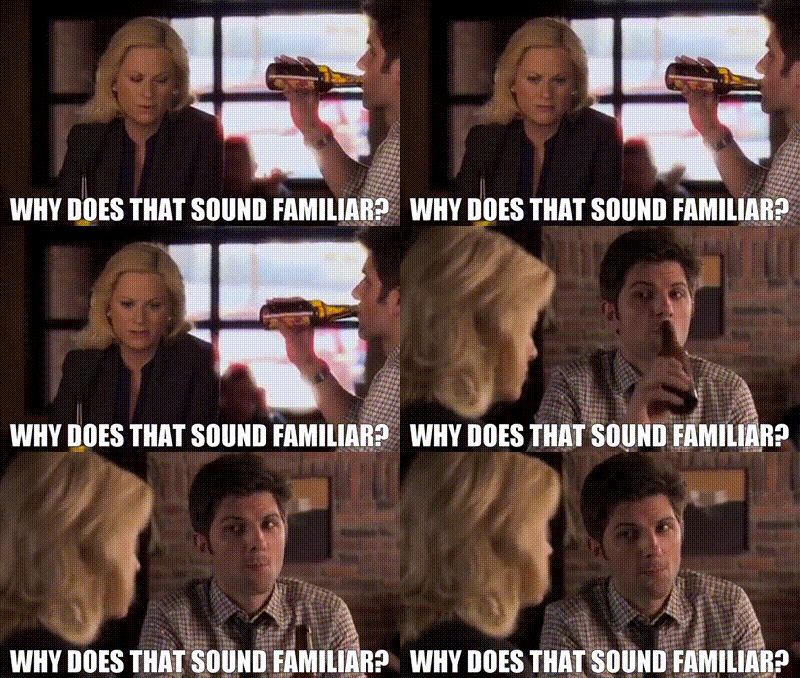
Meaning you get copies made of you multiple, and many, times. Meaning you DIE, but not really because somehow they make copies of you from your dead body/carcass, though don’t ask me how. Of course not everyone does this, most of the people just enable it through their everyday tasks. But this is done on a planet/alternative universe that it takes 4 years to get to in a scientific endeavor headed by a failed politician played by Mark Ruffalo, by way of Donald Trump.
How do I know it’s Trump? Well, he sounds like him, moves like him and, perhaps most importantly, is married to an ice princess wife who doesn’t really know much of anything except satisfying her own pleasures and propping up her delusional husband in order to do so.

Pattinson is indeed hilarious in the title role(s) (Note: Comedy? Who knew?) and the movie is chock full of ideas. But it’s a narrative mess that has more tangents than a Trump speech. Nothing is quite cohesive but it’s never uninteresting and always feels original. Unlike a Trump speech.
Anyway, I was trying to get away from all that and, just when I thought I was out, they pull me back in. #Godfatherisms.
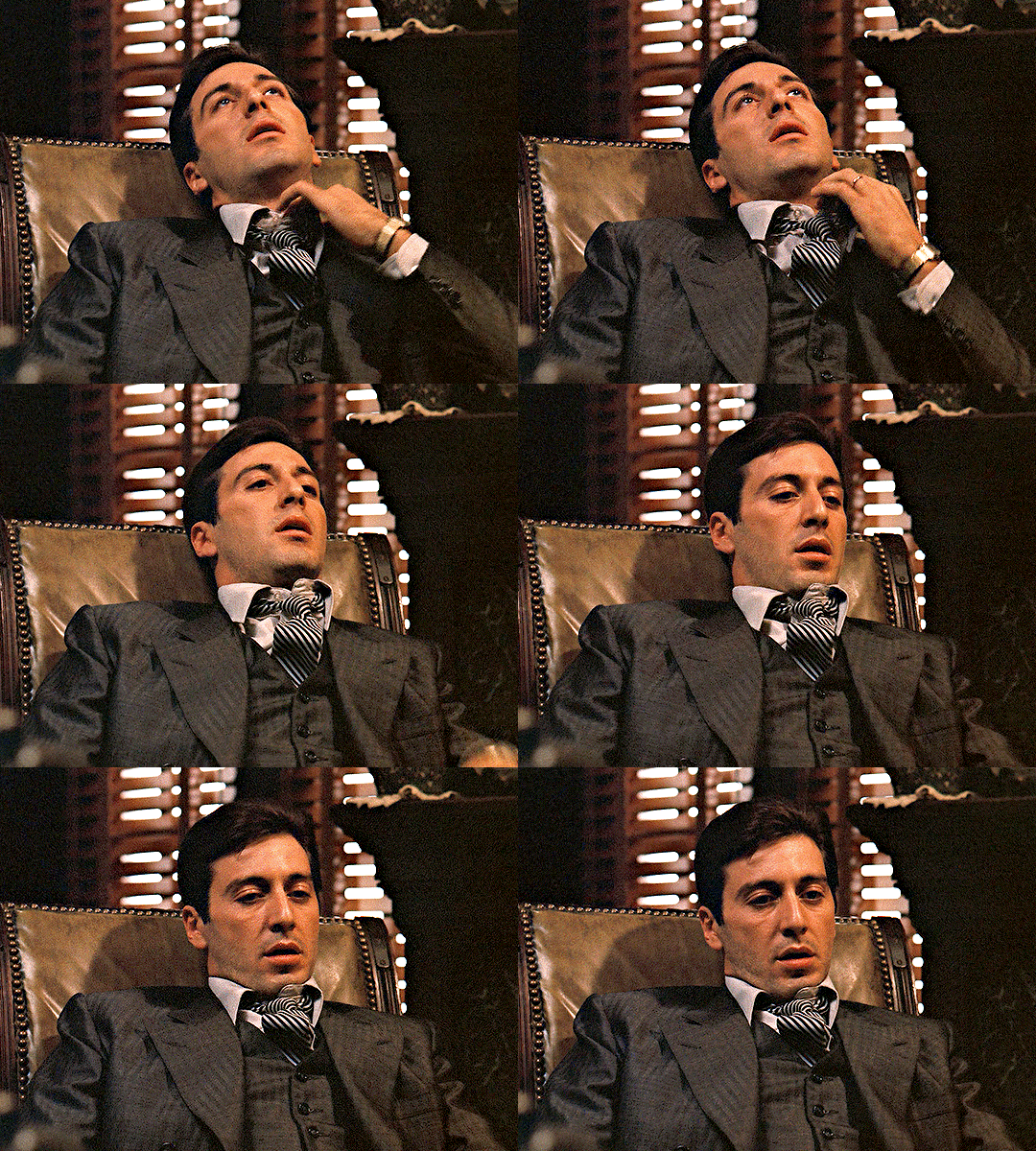
This made me think, or shall I say turn to, television for some order, since TV has so many platforms we all in Hollywood love talking about, that give us so much more to choose from these days.
But instead of watching a rerun of The Nanny, which for me never fails to delight, or The Twilight Zone, which can be scary but at least has clear characters and surprise twist endings I can get behind, I decide to stay with different and original because that’s generally my taste in what passes for good writing.

As one studio development executive who liked my writing told me in the nineties, this kind of multi-layered intelligent stuff just might be my downfall in the 21st century. And while I can’t say she was correct overall, in this case I do have to give her points.
Because The White Lotus, season 3, episode 5 offered both the KISS and the MONOLOGUE. The latter was brilliantly delivered by Sam Rockwell, playing a guy’s guy with access to guns and drugs, who seriously sits down with his middle-aged white guy friend and delivers one of the better written speeches on TV in quite a while. In it, he basically confesses that besides being promiscuous with hundreds of women in Thailand he has also been enjoying anal sex with an equal number of men, and more than one at a time, and that eventually he added different women to stare at him while he was receiving, which then led him to further question his sexual identity, and wonder whether he really wanted to be a….Well, let’s just say he goes into sexual territory that has been scrubbed from every Trump-led government website because, according to current U.S. law, it doesn’t exist.

As if that wasn’t enough to bring me back to our present unreality, there was no outraged reaction to it the next day. Instead it was seen as wild and interesting, which I applaud but at the same time don’t understand because aren’t these the kind of thoughts that MAGA voters find reprehensible? I guess not. But you know what was found to be intolerable – the KISS between two ultra drugged and ultra drunk brothers (Patrick Schwarzenegger and Sam Nivola) who were mercilessly egged on to kiss each other by two women they were trying to bed all night in a brain-breaking montage towards the end of the episode. The kiss lasted mere seconds but the next day social media was virtually exploding in horror with phrases like, ICK, ICK ICK!; I won’t watch any White Lotus after THAT; or WHY????
No, I am not advocating for homosexual incest between siblings (Note: Though if they are both past the age of consent if really isn’t my business), but…
YOU CONFUSE ME AMERICA. Though perhaps that is the point? Or is it? Now, well, I’m really confused.
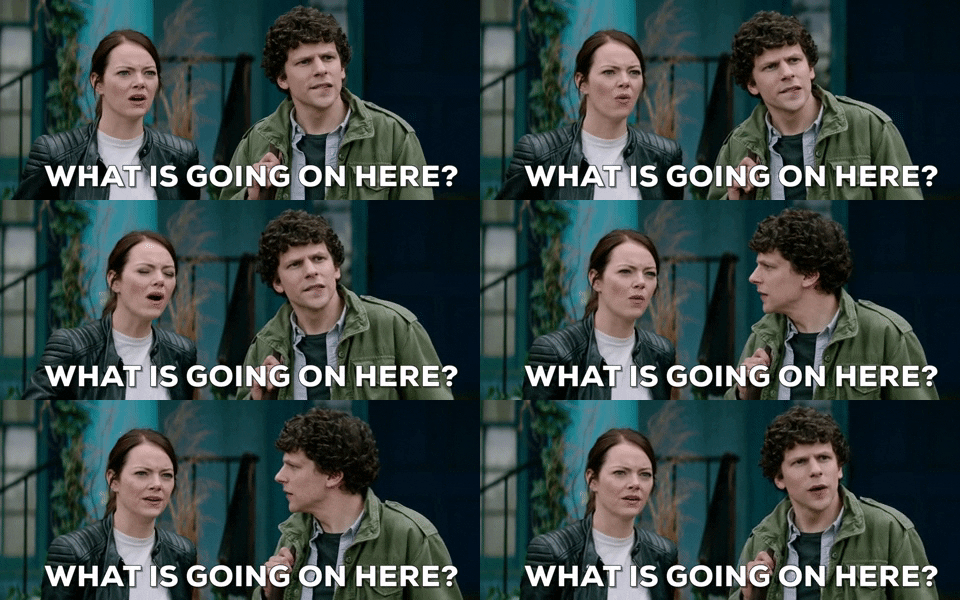
Which leads perfectly into the finale of Apple’s Severance, a streaming series that I like but often leaves me confused. I spoke about it with my tv writing students this week and a few confessed they were obviously not “smart enough to understand it.” I quickly corrected them, saying that they were since I, myself, am a “smart enough” viewer and I don’t fully understand either.
Here you have a show with a clever concept – a futuristic, dystopian world where there is technology that enables you to split half your day with a doppelganger of yourself, via brain chip implant, that won’t feel the pain or anxiety you are enduring and will also somehow tame your own misery and anxiety in the real world. Yet in this doppelganger world, run by the nebulous and suspiciously evil company Lumon, you are a business dressed worker, a cog in a creepily obtuse corporation, clustering onscreen numbers into onscreen boxes inside an onscreen computer system for reasons you don’t fully understand.
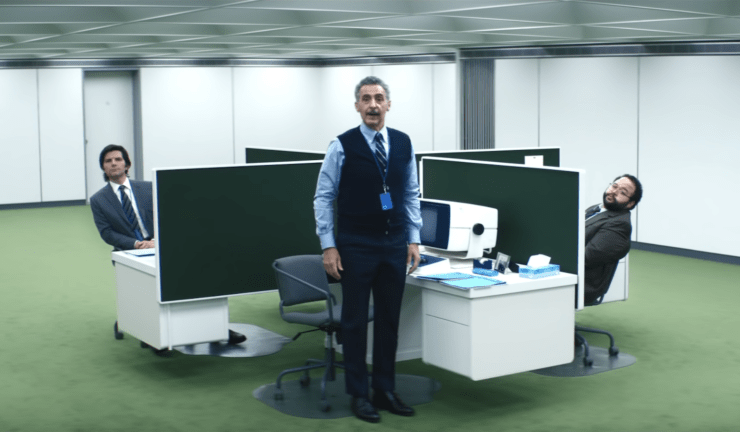
Nevertheless, a job’s a job and what you find is that at least it’s a task to keep your wandering mind occupied from the true reality of pain. Though, truly, you don’t really know what life is like for your “outie” (Note: The you that lives in the outside world) because you’re an “innie” (Note: The half of that person who just lives to sort and type).
The series is a slow roll out and through the first season asks the question of what happens when the “innie” of you actually starts to care about the people you work with, forms relationships and even falls in love. What agency do they have in their life outside of what they are programmed by their world to do? This, of course, is a question many of us are asking ourselves these days – though in a different way than people did in the 1960s and 1970s (Note: A fact I can testify to since I was there).

Anyway, Severance always intrigues, even if you have little sense of what this fictional company with these innies is up to. Clearly, it’s evil but what is their end game? The 1% that run Lumon seem to be making lots of money but the sheer disregard for human life, the glee over the punishments they mete out to those in their way, and the total lack of empathy they have for any person or thing or institution that dare questions their actions keeps reminding me of one nagging question for the writers and, ahem, Lumon. Among others.
Why? Why do this? What do you hope to gain? Are you not human? Wait, we know you’re human. But what kind of human are all of you? There are gaggles of people at Lumon who feel this way and play along with the game. So much so that it becomes a little hard to believe since even in the season two finale – where we get nebulous clues about the backstory of a few – that major dramatic question of why is never answered.

And that is when I once again think about the gay makeup artist, the veteran whose cancer treatments were no longer accessible to him due to the abolishment of that NIH program, and the terrified senior citizens who are showing up to town hall meetings screaming about the gutting of social security workers, offices and what seems an inevitable interruption, or dissolution, of the guaranteed pension they spent their life paying into.
Which prompts the answer to all of it.
It’s because…THEY CAN.

They may want to do it for various personal reasons. They’re angry, resentful, prejudiced against one group or another or perhaps were never hugged by their fathers or mothers.
But as Severance has rightly decided in this year’s finale, that’s not the point.
When those with power decide they want to do something, it’s not about figuring out their motivation and then trying to reason with them. Because you’re being treated like an “innie.” And if recent disapproval ratings for this administration are to be believed, that represents the clear majority of people in the country.
That’s why at the end of the day it’s only about one thing – YOUR RIGHTS.
Demanding those in power give them to you – or give them back to you – and when their actions say NO standing up to thwart them with EVERYTHING you have.
While you still can.
Before they put your number in a box and delete you, too.






 notes from a chair