A (School) Year of Magical Thinking

It’s back to school time and that means for students and college professors alike, especially those who aspire to write, and, like me, teach writing, there is that familiar feeling of excitement, infinite possibility and dread in the air. 

Yay?

I’ve been teaching writing a long time and have been a writer several decades longer, so I’m used to the dread when you know you’re going to be faced with a blank slate, screen or, as it used to be known in the biblically quaint time I grew up in, page.

As for new experiences of those faced with another year in school, that can be at least doubled.
Same, same.

But I also know that the “dread” about it all, as it is with most things, is simply fear of “it” or “you” being bad; fear of failing, being mediocre, or of disappointing, hurting or being hurt in some way.  And that once you’re actually “in it” and “beginning it,” whether it’s a new chapter in life or that dreaded stone tablet page I learned on, there is also an exhilaration that just maybe anything, or everything, is possible.

It’s then that you become various shades of excited, a feeling that you hope will last forever, or at least for the multiple handful of months it takes to complete a project, or full semester or two.
Is this joy?

Of course you know that won’t happen because:

a. Nothing lasts forever (Note: Did I just write that?) and…

b. It’s impossible to hold onto any one feeling that long

But it’s fun to hope, isn’t it?  We humans always have that. Not to mention, the creative possibilities that spring from young minds are exciting, to not only peers but the elders that try, as best they can, to help them work their artistic impulses into their own unique cohesive takes on our current reality.

Me with my college students

Sometimes their work is funny, other times it’s sad but over the years I’ve found it’s almost always somewhere in the middle, often tilting to one side or the other but overall a mix of both. (Note: And the blacker the comedy, the better, I’ve noticed of late).

True, my cross-section of students from an east coast liberal arts college spending a semester in L.A. is not a statistically infallible sample.  But looking back in my mind and through my files (Note: Which are, yes, printed out pages in paper folders), I’ve found they’re a pretty good reflection of what younger people are generally thinking and feeling about the world, how they envision we might resolve our personal conflicts and what they see as the status quo (Note: In dramatic writing parlance it’s called “stasis”) at this particular point in time.

So, do you want to know what they’re thinking this semester?

Let’s begin

Well, they’re writing stories about stopping evil from overtaking the world, surviving in a post-apocalyptic fantasy realm, investigating murder, recovering from abuse, avenging the death of their town and/or loved ones, solving the mystery deaths of a trio of young women, or triumphing in a life of crime after being unfairly fired from a low-paying job they were over-qualified for in the field of their choice.

There were only two “relationship-centered” but they are on people trying to overcome oppressive religious upbringings, pronounced class differences or tribal wars in the 22nd century.

My head is spinning

Some of them propose dark – well, very dark – comedy tones but there was not one you could call particularly uplifting or primarily fun.

Were there always stories like this?  Certainly.  But not this many so consistently.

And, when you think about it – why would there be??? 

Maybe that’s it?

Writers reflect what’s going on in society and I can’t blame any young person who came of age in the last ten years for existing in pillaged fantasy worlds where mere existence is anything but guaranteed.

Nor can I fault them for making circumstances and problems of everyday life so perplexing that the only way to survive is for their characters to live in a world where some degree of magic is accessible.  Not so much sleight of hand, though there is that, but in various degrees of actual magical power.

Certainly there is no logical way, or any way, to solve the issues and the environments the average person is up against these days.

I don’t in any way, shape or form see this as a by-product of them growing up in a Harry Potter-influenced world, if that’s what you’re thinking.
Well I mean…. Ok fine

The only references to Potter that’s come up so far this semester, and also through the last, is their mass disappointment in its author J.K. Rowling for her hurtful, dismissive, dangerous and prejudiced (Note: Their words, not mine) public putdowns of and revulsion towards the trans community. 

See, not a semester goes by these days where they don’t have trans and non-binary identifying students among their classroom peers and they abhor others sh-t talking them, or about them.  The same way they don’t like the sh-t talk about their non-white and/or mixed race peers.  Or women.  Or gay people.  Or… Or… Or…

(Note: Yes, they will sometimes write that a character is seated among a table full of old people and when I ask, how old ,I get answers like, I guess in their forties, or okay, fifties.  But I, who by that definition is really really old, am working on that.  While I still can).

Since I didn’t feel old

Of course, like any younger generation – yours, mine and all those before us – they also abhor a lot of other tangible things about the world as it exists now, and as it’s being handed to them. 

Just like so many more of us feel about our stasis.  More than I’ve seen in many, many years.

But if you think you’re mad about where we’re at in the moment, they’re even madder.  They just do a better job of masking it around you, and likely their peers, and themselves.  It’s what accounts for what they are choosing to write in my class, and to repost on the occasional social media thread (Note: Though nowhere near as much as we do.  I think they’d rather share music or laugh at TikTok content).
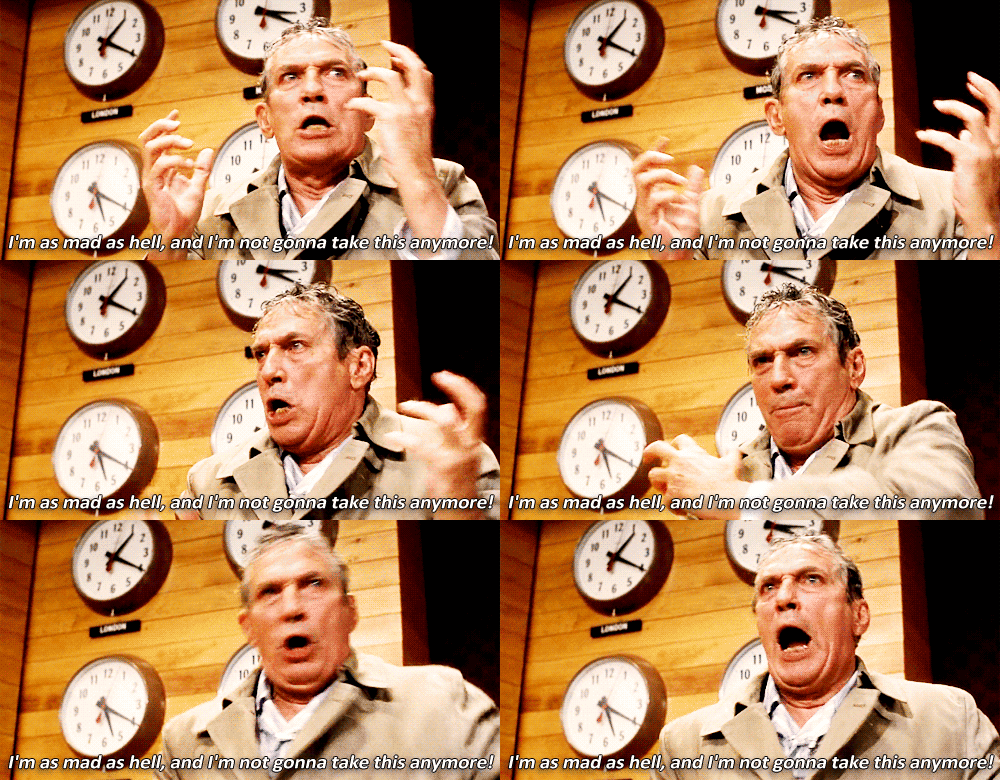
Maybe that’s why I still talk about this movie!

Still, the rage, sadness and anger at what’s going on right now, is still there.

At the violence. The deteriorating earth.  The wave of totalitarian oppressiveness worldwide and the economics of everything. The sense that even the U.S. is no longer a safe haven from any of it, if it ever was.

They’re going to be around a lot longer than the rest of us and can’t quite see a way out of it without magic.

… and I don’t blame them!

But one benefit the rest of us who have been around longer have is the knowledge that magic is a relative term that means a lot of things and comes in all kinds of forms.  

Yeah, it can be literal.  But it can also be earthbound and metaphorical.  Practical solutions that seem otherworldly but are anything but, and are hard-won through years of talking and listening and compromise, coupled with  research, discoveries, knowledge and, most importantly, persistence through it all.

You can do it!

I have four months to teach them the many forms magic can take, and inspire them to imagine it into their stories in whatever way they see fit.  That is, along with all of the requisite other stuff.

#WishMeLuck. 

And if you run into anyone their age, try to be encouraging.

The Lovin’ Spoonful – “Do You Believe in Magic”

The Gospel According to Chairy

If you do a good enough job inventing yourself you will find your way into a world you want to live in. – The Chair

It occurred to me when swamped in a myriad of student scripts that it is the perception of many more than one person under the age of 25 that we are living in post apocalyptic times. Don’t keep telling them, this is not normal. They get it. Believe me.

They know

I’m not sure what to do with this since I don’t necessarily disagree. So I went to see a new documentary film called The Gospel According to Andre, which traces the life of former Vogue creative director and well-known fashion icon Andre Leon Talley.

Mr. Talley is a huge 6’6” gay African American man of a certain age who grew up in a time of segregation in Durham, North Carolina, has a masters degree from Brown University in French literature and for a number of years in the 1970s was the Paris bureau chief of Women’s Wear Daily. Not to mention he is friends with every major designer on the planet. He has also for decades had a reputation for being a character.

OK.. maybe an understatement

This is often the kind word used for flamboyant, larger-than-life gay men of any age. The unkind words – well, we all know what they are, so there is no reason to repeat them.

What does bear repeating is this: Gay men like Mr. Talley are not merely characters. They are studied human beings who, when faced with marginalization and oppression consciously choose and hone a character to be and use it in order to be the person they want to become.

They, or shall I say we – after all, I refer to myself here in the third person and as an inanimate object – may initially be seen as a bit of a joke to some but what’s presented is dead serious.

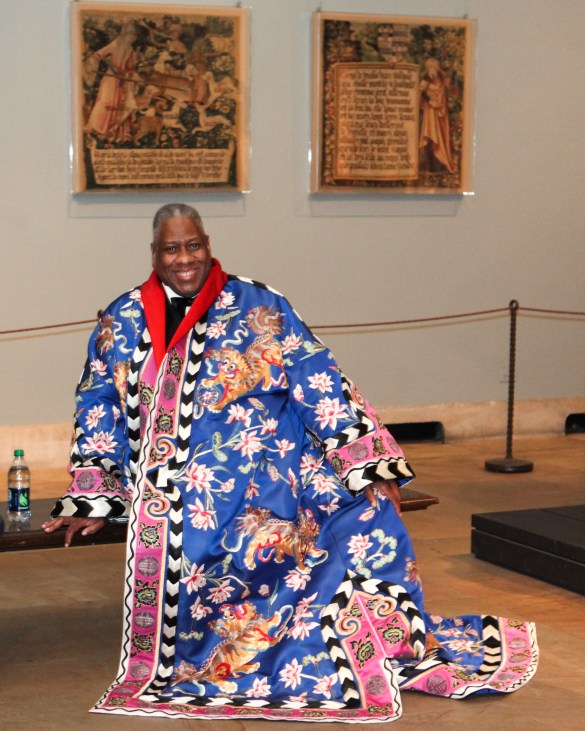
Like one’s choice of clothing (Note: Mr. Talley’s being luxuriously bold printed flowing caftans that I could never pull off as anything other than draperies, and even that’s doubtful), it becomes, in Mr. Talley’s words, one’s armor. It is what makes you feel empowered enough to navigate – the more unkind words are claw or climb – to the places you long to but fear you never will.

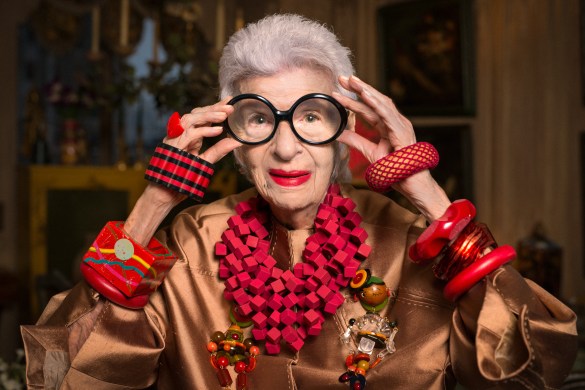
Hello have you met Iris #werk

Yes, we all make these choices daily. Whether we choose to acknowledge, admit or even know it or not is an entirely different story.

I have spent decades observing, meeting and writing about successful people in pop culture as a writer, journalist, social climber, friend and wanna be acquaintance, and one of the few traits every one of them had in common was a fierce understanding of their talent(s) and an evolving plan in how they were going to present themselves (and it) to the world.

They often don’t do it alone. Many times they begin, or even continue to thrive, by imitating other people they admire. Still, what they eventually evolve to becomes uniquely them – even if it’s more often than not an amalgam of quite of bit of what came before them, and then some.

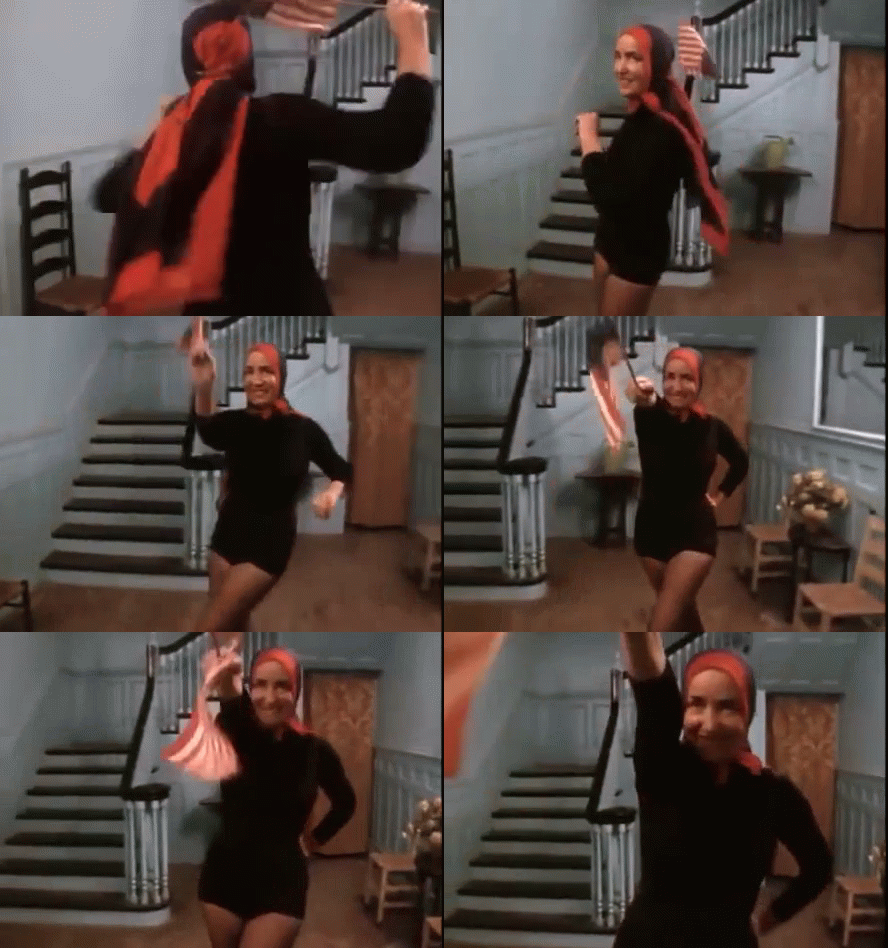
We see you Little Edie

In Mr. Talley’s case it was a little bit iconic Vogue editor Diana Vreeland (his first mentor in fashion), his grandmother and other churchwomen he grew up with in the Jim Crow South, and a bunch of fellow fashion-obsessed contemporaries he met at Brown and RISD, among many others. This was then mixed with major dollops of himself to become the person you see in the film with the grand lifestyle and laundry list of achievements.

For the rest of us – well, what we’ve done has gotten us the experiences and lives we’ve all had up to this point. They might not all be the subject of a feature film (Note: Though each probably could be) but are a result of every choice we have made – both consciously and unconsciously.

And as any decent writer can tell you it’s always better to at least actively contribute to your own narrative, even if you can’t totally control it.

Yes, this makes all the difference. Rather than acted upon, you are acting out – or being out, proudly – using your smarts to get you to where you want to go in a world that to you might often seem post apocalyptic. It offers that many opportunities.

A dose of confidence helps too

But this is the way that it was – and probably always was – for many of us, and so many others who won’t or up until recently still refused to acknowledge it. Not to mention, it is the way it seems to be for too many now.

It is most certainly what many of my current students are feeling and writing about judging from the pile of scripts I’ve just gotten through. Of eight screenplays in one class, six were set in post apocalyptic worlds. That’s 75%. The seventh was about an inanimate object in a pushed fictional reality – so draw your own conclusions there – and the eighth was set in a foreign country its young protagonist had never been to nor successfully navigates until we get the feeling that, at the very end, perhaps she just…may?

I’m intrigued…

Though the veneer changes it would seem the circumstances of the world are likely just as crazy as they’ve ever been.   So as a default human warrior you want to choose an arsenal to make you strong, to make you feel comfortable enough in your own skin to do your best AND to keep you safe in the inevitable tough times.

Choosing a persona is one way to do this and, no, it’s not about being phony even though technically the word is derived from the Latin term for a theatrical mask.   That is according to my husband, who is always annoyingly right about things I am so sure of.

So…since he is so…grrr…correct about so many things and the secret to a happy marriage is admitting when you are wrong even when you still want to insist you are smarter despite all evidence to the contrary – why don’t we just compromise (yuck) and use the more modern word everybody and their mother has adopted for this instead– branding.

I like the sound of that!

Yes (ugh) choosing a version of who you are to get you through – with all of the accouterments that entails – both visually and intellectually – is nothing more than an old strategy for what it turns out is the not so new technique of…blech….modern day branding.  

And be assured you couldn’t possible hate that word any more than I already do.  In case you didn’t know.

But like broccoli and brussell sprouts with nothing more than lots of olive oil, salt and pepper and perhaps a hint of good balsamic, we can ALL grow to love it. (Note: Maybe). Because it WILL make it easier for the world to see YOU – or at least a side of you – that will best showcase an already impressive and/or outstanding aspect of yourself and get you where you want to go. (Note: Trust me, I learned this the hard way).

That is, if like Mr. Talley, you’re bold enough to show a true part of who you really are deep down inside.

Janelle Monae – Q.U.E.E.N