Adam Sandler, My Bar Mitzvah, and Jewish Visibility on Screen

You might think the new Adam Sandler movie that dropped this weekend on Netflix, You Are So Not Invited to My Bat Mitzvah, is a slight comedy about a Jewish ritual that he produced to give his two teenage daughters co-starring roles in.

Well, yes, but also no.

Yes, I am writing about a Sandler Netflix movie

If you eliminate the Holocaust, Neil Simon and the neurotic angst of the typical adult Jewish male as subject matter or author, the list of mainstream American feature films filled with Jews at the center grows pretty small.

Oh, sure there are some, but well, not all that many. 
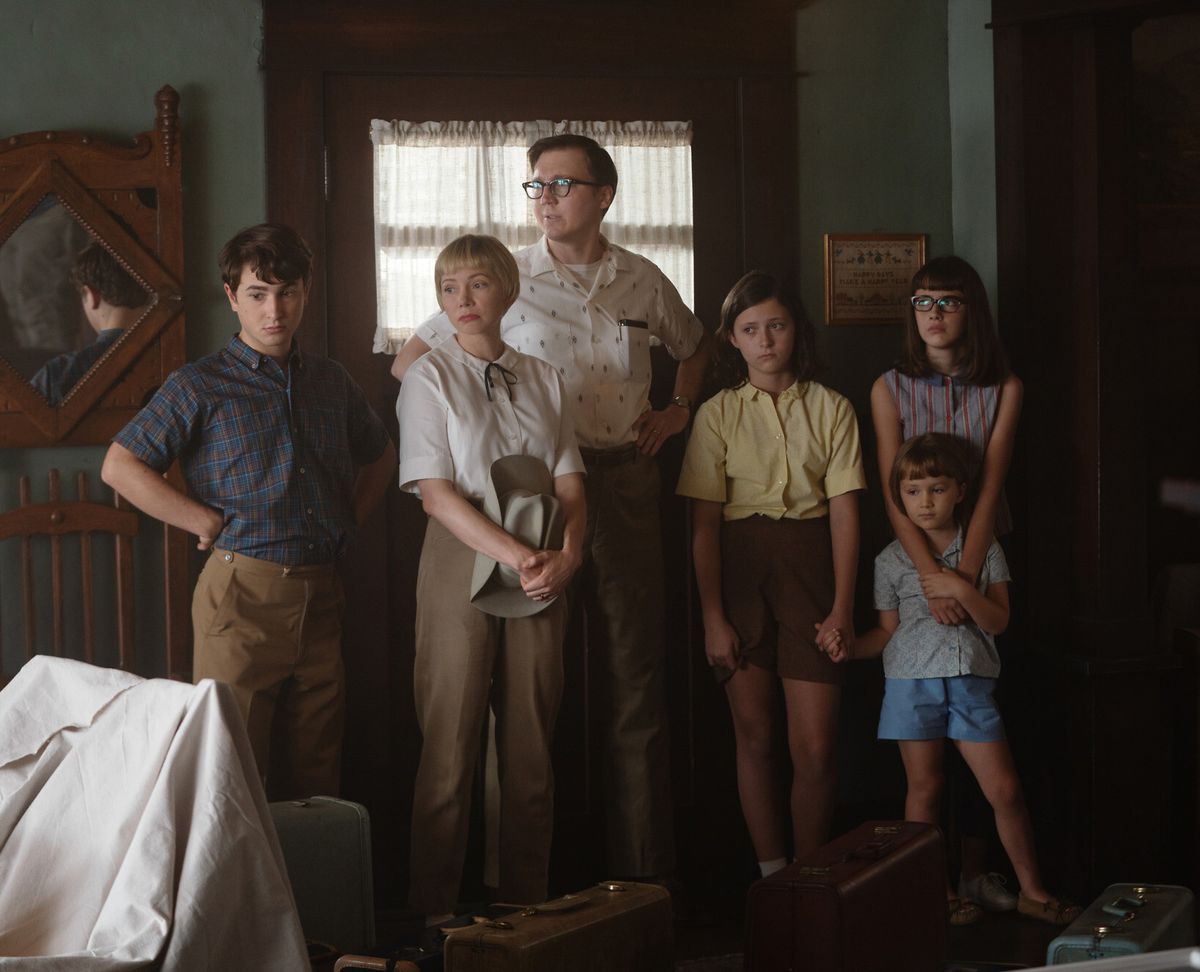
Ah yes, those Fabelmans are a recent entry

So it was with great intrigue that I spent my Saturday night with the Sandler family. (Note: Sunny Sandler is the star, Sadie Sandler co-stars, Adam Sandler plays a key supporting role, and even his real-life wife, Jackie Sandler, appears in a small part).

And, may I say, they did not disappoint. 

wait.. really???

To have fictional Jewish siblings, family and friends casually fill a space that is mostly reserved for white bread John Hughes-esque characters living cleverly in a typical American suburban landscape felt new and, actually, sort of groundbreaking for a wide-release American feature.

Especially since the so particularly Jewish story beats they were engaging in were more than ably filling in the space of the most thematically typical studio coming of age scenario imaginable.

And, trust me, I know where of I speak.
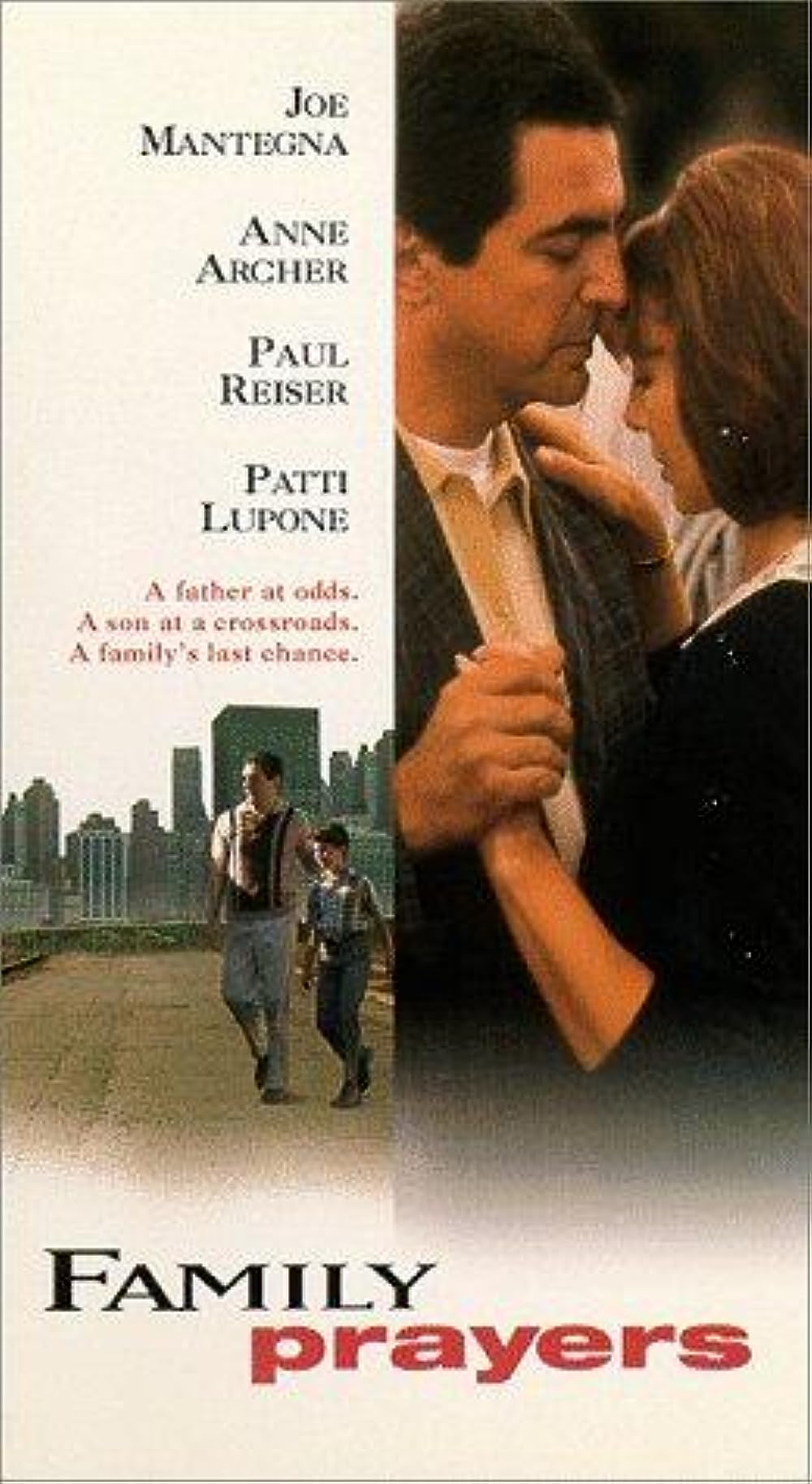
Exhibit A

It was 30 years ago this year that a movie I wrote loosely based on my family and the events that led to my bar mitzvah, Family Prayers, was released.

And though it was more of a drama with only some comedic elements, at the time the script was considered too specific, too niche and toookay, let’s face it, Jewish, to have even a snowball’s chance in hell of breaking into the mainstream.

And that was if the film was made perfectly (Note: As if THAT exists), which ultimately it wasn’t.

Not that I was thinking about any of that back then.

That’s fair

It just seemed like a good way to tell the story about the disintegration of my parents’ marriage, my Dad’s gambling addiction and a kids’ (Note: Um, my) confusion about, well, what it means to be an adult. 

So I only wrote it as a writing sample that could show off my talents and maybe get me work of some kind, any kind, since I knew:

a. Action movies and Saturday matinee sci-fi/comic book stories were what was commercial

b. I was squeamish with blood and the only comics I read were Archie, Betty and Veronica, and…  

c. A Jewish kid or family going through anything particularly Jewish, except maybe Nazis, was simply not considered a thing.

Did I hold out small secret hope it would get made?  Sure, in the same way I briefly fantasized about being straight some years before.

It wasn’t working

But we all are who we are, right? 

So it was with great defiance that I decided to write about one of the worst, yet dramatically fertile moments of my then relatively short Semitic life.

That, in itself, was ironic.  Truth be told, NO ONE in my family EVER even went to temple.  Still, we were culturally Jewish.  What this meant for me, and many other Jews who came of age when I did, was:

a. We celebrated a handful of key Jewish holidays over family dinners, sans prayers.

b. We ate a lot of lox, bagels, deli food and brisket (Note: And Chinese food on Sunday nights.  Don’t ask me why this is even Jewish but on the east coast it sort of was/is), and:

c. We kvelled (aka basked in pride) when Barbra Streisand became a movie star and Steve and Eydie (Note: Steve Lawrence and Eydie Gorme) appeared on TV.
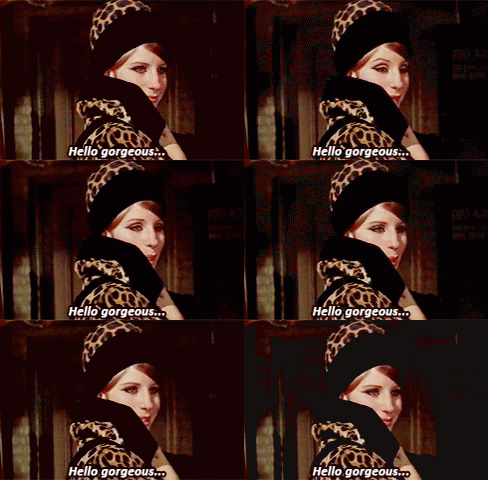
Hi ya Babs

Oy vey.

I guess that’s one of the things I appreciated about You Are So Not Invited To My Bat Mitzvah. Based on a 2001 novel by Fiona Rosenbloom, it’s essentially a story about teen culture, Jewish culture and a Jewish girl who is rolling her eyes at everyone and everything except for her own needs. 

It’s funny and silly and mean and sad and infuriating and, ultimately sort of meaningful.  It takes apart Jewish friendships and family life in sweetly relatable ways that weren’t available back when I came of age.  And even if they were, the specific worlds they were offering were certainly not deemed broadly relatable.

This is a Sandler movie — can you believe?

When I wrote my screenplay in the eighties I chose an event from my life I figured would work as a structuring device to explore my world. 

But what I discovered in the writing was that my bar mitzvah, and what it turned out to be – a VERY pared down SMALL reception due to a lot of family drama – really did symbolize my coming of age.

What I get from the Sandler movie is a bit of the polar opposite.  A coming of age story that is very much about a bat mitzvah girl and the Jewish kids, and even non-Jewish kids, who surround her.

The ritual, even as it is sometimes played for comic effect, is as important a part of her life as her parents, siblings and friends she fails but ultimately learns to appreciate.
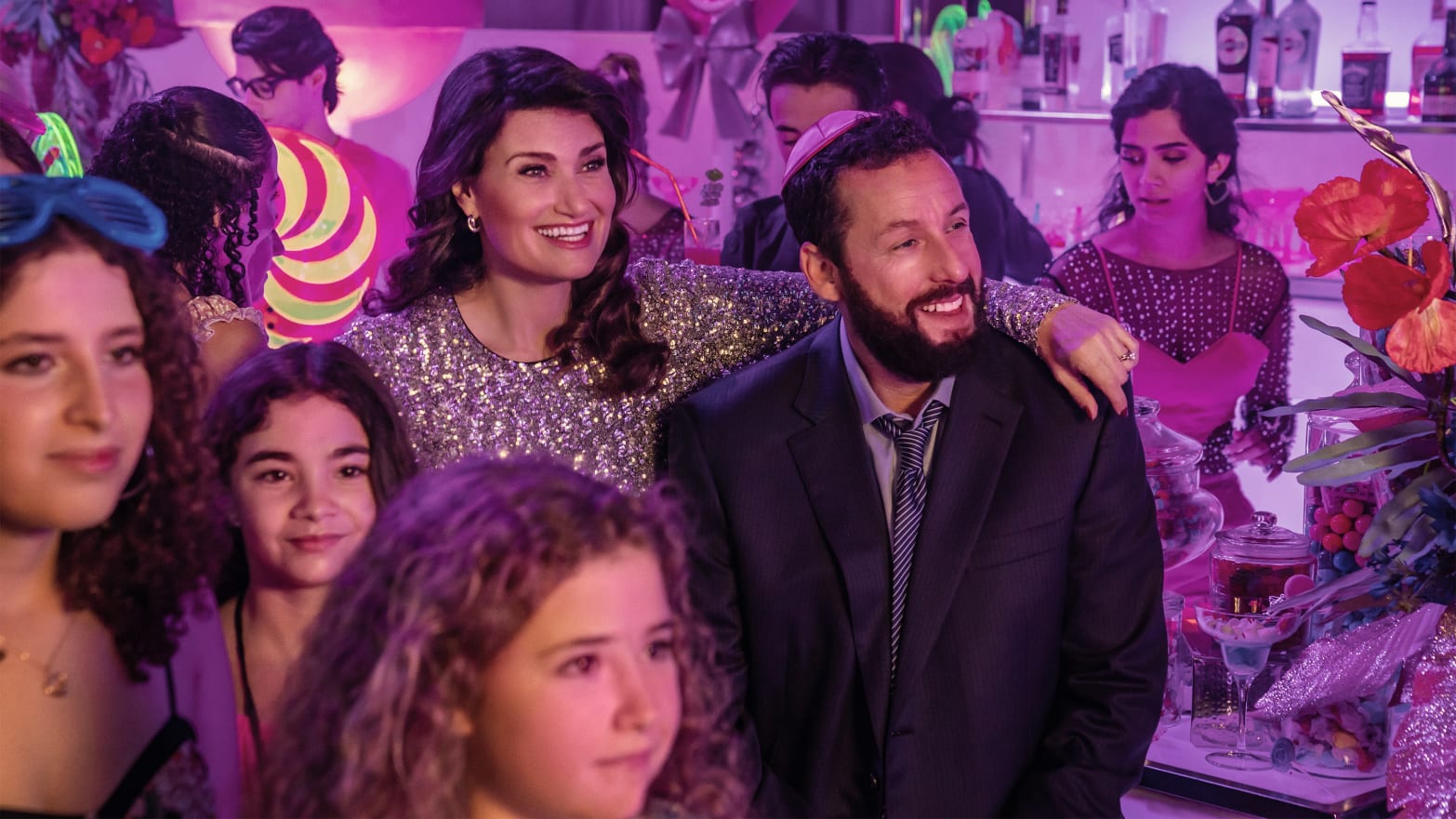
Idina Menzel is her mom, so I mean, how bad could it be?

She’s a Jewish girl/woman the movie offers for audiences to embrace, rather than a kid who just happens to be Jewish that a film is asking audiences to listen to. 

And to me, that feels like progress.

Even if bat and bar mitzvahs have never been your things at all.  Or never will be.

Adam Sandler – “Bar Mitzvah Boy”

The Jury is Out

It’s been a whirlwind week in Hollywood.

The actors and writers are now both officially on strike, essentially shutting down film and TV production pretty much across the board.

Shut. It. Down.

At the same time, a TV show called Jury Duty, where writers and actors work together in a tightly planned but loosely scripted/partly improvised new type of workplace comedy/mockumentary/faux reality program, received four Emmy award nominations, including one for best comedy series.

Amazing what members of those two unions, along with help from many of the others, can do when they join forces.

A true ensemble (in front and behind the camera)

The conceit of Jury Duty is that one unsuspecting real-life person (Note: As opposed to the rest of us perceived fake ones who work in Hollywood) is filmed serving in a three-week trial that ONLY HE DOES NOT KNOW is fictional. 

But rather than be the butt of a cruel joke, he instead emerges as the HERO of the story, reminding us that not every random human in the world is the piece of sh-t we default think they might be these days.

Even in Hollywood.

It helps to have a hero as lovable as this guy

The success of Jury Duty depends on the close-knit collaboration between a group of dozens of actors playing jury, judge, lawyers, defendants and court employees, with the writers who created not only their characters but the countless scenarios, plot points and alternate scenarios and plot points designed to bend to the spontaneous will of the one real life character among them. 

In some cases writers double as actors, actors wind up writing (Note: Okay improv-ing via what WAS written) as they try to bring back the hero to the point of the scene, and non-acting writers huddle off-camera to create some new tweaks and challenges that will play out the quirky humanity of the characters and story actually being created to maximum effect.

LOL

It’s not that the producers, directors and crew of Jury Duty are not essential to pulling this gargantuan effort off.  But it’s that special sibling-like kinship between writers and actors that has existed since storytelling began, that conjures the magic everything else draws from.

Binge watching all eight half-hour episodes Friday night after a week of listening to the overpaid, stone-brained studio and corporate heads (whose businesses only exist because of all of this magic) bitch and moan about their 21st century shifting business models, provided some temporary relief.

Marsden earning his Emmy nom

(Note: This week it was the newly two-year contracted, at $50-$60 million plus salary, Disney chief Bob Iger, calling working actors’ requests for some guarantee that a machine couldn’t duplicate their digital likeness from one day of work, in perpetuity, and over as many projects as they like, UNREALISTIC.

Unrealistic?

Oh I know he did not just say that

The only thing unrealistic is that studios and streaming platforms across the board WON’T do this and more.  And maybe take their first-born.  And if you don’t believe me, check out my post from last month about Black Mirror’s sadly prescient and pandemic-written season six opener, Joan Is Awful.).

Nevertheless, all of that writer-actor simpatico on Jury Duty was also energizing to me as a member of both the WGA and IATSE, and as an admirer of the many talents of so many unknown, just plain working actors I’ve come across over the years.

Because it reminded me of what we can do together.  And how much power that partnership wields.

Imagine what we could all accomplish at a Margaritaville!

Jury Duty might not be your thing but it is yet another strange, new iteration of hybrid storytelling in a hybrid media world desperately in need of something new, and maybe even…..original?

It started as a workplace comedy by two veteran workplace comedy writers, evolved when some executive producers associated with iconoclastic actor Sacha Baron Cohen’s Borat suggested the faux reality element, and went on from there.

Borat wasn’t my thing but Jury Duty was.  Go figure.  I tried to and suddenly my mind went to Netflix’s Squid Game, also not my thing but certainly as original as either of the former two.

And so it goes.  And goes. 

Until it is gone.

All the feelings

Not everything can be Casablanca, One Flew Over the Cuckoo’s Nest, E.T., Raging Bull, Titanic, Parasite, or heaven forbid, Top Gun: Maverick and Mission Impossible – Dead Reckoning Part One. 

Nor should it be.

Still, if you don’t respond to mixed media metaphors think of it this way. 

The great Norman Lear created Archie Bunker, loosely based on his father, but the equally great character actor Carroll O’Connor brought him to life.

The same way Tony Soprano came from the complicated mind of Sopranos creator-writer David Chase, only to be made indelible by the until then unrecognized brilliance of another late, great character actor, James Gandolfini.

The man made picking up his newspaper iconic

It is these kinds of collaborations that moves entertainment forward and allows it to reach new heights.

Not only onscreen but off.

Amazing what writers and actors can do when they partner up, especially when their own very real lives are at stake.

The studio and corporate heads may not be listening now. 

But they will.

Or their entire new 21st century business models will fall apart.

Fran Drescher’s SAF AFTRA strike announcement