Patty

A close colleague and dear friend passed away very suddenly the other day after a very short illness.   Her name was Patty Zimmermann and she was a real presence and a force of nature.

She was a combination and contradiction of so many things. 

Film scholar, intellectual, brilliant, challenging, hard working, determined and indefatigable.

A tough cookie yet a sensitive soul who could break out into tears if she trusted you.  A pusher who never stopped pushing but, more importantly, never stopped pushing you or encouraging you with some project or notion or thought you might not have thought much of.

Oh, and a loving mom and wife and friend. 

Very much so.

And no, of course, she wasn’t perfect. 

At all.

But which of us are?

If you can think of anyone to put on that list, you’re lying.

Patty and I were about the same age and I’ve lived long enough to experience enough loss to know the drill. 

In roughly this order there is shock, devastation, sadness, loneliness, love, healing, recovery and, finally, renewal. 

But, well, you are never the same after you lose someone.

A piece of them is imprinted on you that shapes who you are and how you proceed with your life.

Maybe this sounds insightful but, truly, it doesn’t really scratch the surface of much of anything. 

Especially since I keep coming back to one basic thought –

How can someone be told they’re sick one day and then, less than three weeks later, be dead?

How could I be talking or texting with them one day and then the next day, or a few days later, they’re gone?

Well, because they can – in three years, three weeks, three days or three seconds.

And none of us wants to think too much about that because, if we did, well, not much of anything would get accomplished.

So since Patty would have none of that, here’s what I want to share:

It’s not about her many essays, books, accolades, challenges, friends, families, anecdotes and philosophies.

I’ve been reading about them all over social media and if you google her name you can find out about them too.

It’s about her and me and human connection.

About seven years ago I was facing a very serious medical challenge that I don’t talk much about.  I’m okay now, as far as we know.  But it was difficult and tricky for me for a lot of reasons.  And even though I never stated them, somehow she knew.

When you’re facing something big, if you’re lucky, you get a lot of support.  But what you also get are a lot of surprises.  People run away because they can’t deal with mess. 

Actually, what they can’t deal with is their own mortality, but that’s another subject. 

Just know, for all the people who are there, expectedly or unexpectedly, there are a whole lot of others who keep their distance because they can’t deal with being close.

This was not Patty.

We lived on different coasts and didn’t see each other all that often.  We were in touch, but not constantly.  She and my husband were closer friends and colleagues but he didn’t tell her everything.

And yet, she knew what I needed that I didn’t have.

Those handwritten notes on durable cream-colored note cards. 

Words of encouragement and cheerleading and support and compliments and strength from an across-the-country one person cheering squad.

Not constantly but consistently.  For years.  Often turning up out of the blue just when I needed them.

This is not to say that I didn’t have incredible love and devotion from people right here in my daily life.  And in other places.

But what writer doesn’t like to get handwritten missives, written with a good pen, in thoughtful, pithy, positive, passionate phrasing?  Who doesn’t want that validation?  Who doesn’t want to steal some strength?

I still have them.  And there were many. 

I once told her how much I appreciated them but I’m not sure how much she understood.  I’d read them over if I suddenly got down.  I’d keep them in my top drawer by my bed, alongside bills that had to be paid or lists of stuff I had to accomplish. 

Just in case I needed a lift.

I didn’t even have to read them.  In fact, I didn’t re-read them all that much.

It was more the feeling and the sight of them.  The fact that they were there and that I could look at them or not look at them anytime I wanted to.  I could use them to remember or to steady myself.  Or ignore them and bury them under a mountain of paper I didn’t want to have to deal with if I was choosing to forget.

What I never did was file them away.

This might not seem like a lot but it meant a lot for reasons I can only now begin to understand. 

Patty was a big supporter of this blog, reposting it frequently and talking it up to a voluminous list of her colleagues and friends. 

She recommended me for writing assignments, helped me navigate the waters of academia when I segued into a new career and accepted me into her extended family soon after my husband and I met.

I have a lot to be appreciative for but it’s the notes that mean the most and taught me the most. 

As I’ve told my students for years, you never know what effect your writing will have on someone else. 

And yet somehow, the power of the notes, her notes, continue to endure and surprise me.

Rest in Power, dear comrade.  I miss you already.  So much.

John Lennon – “Power to the People”

Serling, Lear & Goldman


No, this is not a law firm.  As far as I know.

These are the names of three show business icons better known as Rod Serling, Norman Lear and William Goldman.

It’s not a good idea to trot out words like icon or legend too often.   You sound like a syndicated talk show host whose sole purpose in life is to overpraise someone more famous in the hopes that it’ll do you some good.

Think Mike Pence whenever he’s in the presence of the Electoral College POTUS.  (Note: And how could you not?)

Let’s hope that’s all he is #Mueller?

Still, there are some cases where the word icon feels exactly right, especially if we are to believe the dictionary definition:

Icon: A representative symbol of something.  Synonym,  idol, paragon, hero. 

Certainly Mr. Serling, Mr. Lear and Mr. Goldman are all of the above and more to most everyone in the writing trade, the entertainment industry and by extension, through the reach of their life’s work, the world.

Hyperbole?  I think not.

Thank you Stefon

In the last several days I was reminded of the gargantuan achievements of these three writers, all born within 10 years of each other, for completely different reasons.

William Goldman, who died this week at the age of 87, was for years the most respected and highest paid screenwriter in the business.  Consider the movies from over 40 years, beginning with Butch Cassidy and the Sundance Kid, then on to All The President’s Men, Marathon Man and The Stepford Wives and then back around to The Princess Bride, Chaplin and Misery and you might begin to get some idea.  If not, you can throw in tons of uncredited rewrites on things like A Few Good Men and Good Will Hunting and perhaps it will get clearer.

The Real Deal

It was William Goldman who introduced the infamous phrase follow the money into the lexicon of political writing via his Oscar-winning screenplay for All the President’s Men.  Peruse his other scripts and you will no doubt find many others.

Just ask Wallace Shawn  #asyouwish

Though none of them will even come close to his three-word perfect summation of the movie business:  Nobody knows anything.

For those not directly involved in the industry, here’s a full sentence of his  elaborating on that thought:  Not one person in the entire motion picture field knows for a certainty what’s going to work.

That and a lot more were written by Mr. Goldman in his 1983 seminal book on navigating Hollywood, Adventures in the Screen Trade.  But more than anything else, those three perfect words – NOBODY. KNOWS. ANYTHING. gave hope, courage and permission to a generation of people starting out in the business, myself included, to soldier on and persevere.

Cheers to you Mr. Goldman

His screenwriting work was brilliant, and he wrote a bunch of fine novels (on some holiday vacation read his first, Boys and Girls Together).  But his ability to so bluntly tell the truth about what he experienced and observed extended far beyond fiction or the movies.  He gave so many of us who had our noses pressed up against the glass the belief that the people we thought we had to impress didn’t have all the answers – we did.  All we had to do was to tell the truth through our work and we had as good of a shot at making it as he did.

Rod Serling and Norman Lear might not seem a natural combination at first mention but when you give it some thought it’s exactly right.  They were born within two years of each other in the 1920s and though Mr. Lear, now 96 and still active, has lived twice as long (Note: Mr. Serling died prematurely at the age of 50,) each writer changed the face of television by being fearless in their own very specific ways.

.. and both have a signature look

By his early thirties, Rod Serling was already an accomplished playwright and Emmy award-winning writer devoted to telling meaningful stories that touched on social issues.  Still, he was known in the biz as a bit of an upstart who had grown weary of battling corporate sponsors and executives too timid to support the kind of tales he wanted to tell.

That was when he got the idea to write in the more commercially appealing science fiction genre, grounding his characters in a way so relatable it would enable him the ability to tackle such timely themes as war, racism, class, politics and censorship.

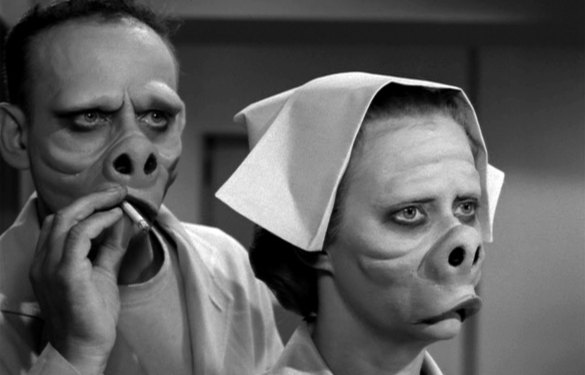
Like you’d ever forget these faces

One can hardly imagine when The Twilight Zone first aired in 1959 that even he could foresee the enduring legacy of that groundbreaking anthology series.  Not only does it still run all over the world more than half a century later, it has been reinvented as a feature film, in numerous television spin-offs and remakes, as well as homaged in the music world.

Most recently, Jordon Peele was announced as the host of a new CBS reboot of The Twilight Zone set to air in 2019.

But perhaps even more impressive is the fact that those three wordsTHE. TWILIGHT. ZONE. – are now embedded as a permanent part of language and pop culture as we know it (Note/Nee: Being an American these days is like living  in The Twilight Zone) that will forever be associated with its writer and onscreen narrator.

It was in that spirit this past week that Ithaca College presented Norman Lear with its annual Rod Serling Award for advancing social justice through popular media.   (Note: Serling taught at the college in the 1970s and his archives are housed there).  As a professor and Chair (Note: Ahem) at the school’s L.A. program, I got to be part of that evening and had a front row seat to Mr. Lear’s sharp as ever comic timing and humility as he got up to the podium at L.A.’s Paley Center to accept.

The man himself, pictured here with Ithaca College’s Park School Dean Diane Gayeski, and One Day at Time colleague Mike Royce

Anyone who has watched television comedy in the last fifty years has likely seen one of Mr. Lear’s shows and the majority of we baby boomers came of age on them.

To watch a first-run episode of All in the Family in the actual era it came of age was to see for the first time in half-hour prime time TV an unvarnished version of ourselves and our extended families in all of our inglorious prejudices, ignorances and, ultimately, humanity.  No one had ever used THOSE WORDS before on the Big Three networks despite the fact that they used them and we heard them every day of our lives.  Heck, no one had ever even heard a toilet flush on TV before the series did it in 1971!

Archie is not that impressed

Mr. Lear also gave us the first upwardly mobile Black family (The Jeffersons), the first TV comedy episode to ever deal with abortion (Maude) and the first divorced prime time mom of the era (One Day At A Time).  (Note: The latter also recently rebooted on Netflix). The fact is if we don’t see an immediate connection between the subjects tackled by the fictional law partners, Serling and Lear, it is merely due to our own shortcomings, not theirs

Among the unplanned comic gems during Mr. Lear’s acceptance speech at the Paley was the moment when his iPhone began to audibly ring.  He stopped mid-speech, instantly reached into his pocket and saw it was a family member, began a conversation with her, and, without missing a beat, put it on speakerphone so the rest of us NOT at the podium could hear.  Most actors, not to mention us non-96 year old pros and non-pros, couldn’t rehearse this and get it right (especially the speaker part) never much less be funny in our ad-libs to a faceless voice.

More skillful, however, was what came next. After he said of his TV work: I didn’t do it alone  he went on to reassure his many admirers that he really is only a person who gets up in the morning, eats, goes to the bathroom and then goes to sleep at night – just like they do.

Don’t mind me.. getting emotional over here

Then suddenly he, and then the room, fell dead silent as he contemplated this for a few VERY long moments.   As we all got concerned something was wrong, he finally looked down, then right back out at us, and said:

You know, everything in life led me to this moment.  Isn’t that something?

At which point he let some more time go by, evoking more silence once again, until he reiterated:  And to this one.

Then once more again, echoing:

And that one.  Everything you have done before has brought YOU right here…..Think about it.

One couldn’t help but wonder if what he was really telling us was that taking in the moment, really feeling it, and then sharing those feelings with others, was not only the key to his art but the secret to life.

Of course whether that’s true or not is in the eye of the beholder. Since, let’s face it, nobody knows anything.

“Those Were The Days” –  Theme from All in the Family