
We were having a small, fun family dinner last week and one of our nieces wanted to know the answer to a very simple question:
What’s your #1 film?

Being who I am I had to answer a question with a question before I could answer the question.
Ummm, well, do you mean the film that I think is the best film ever made or the film that I personally like the best?
It didn’t help at all when she answered:
How about both?

Of course at this point I began explaining that either way I couldn’t narrow it down to one. There are so many different types of movies I love and watch again and again but couldn’t claim were the best for anyone but me. There were also others that I would place in the top five or ten that wouldn’t be my personal favorite but….
At which point someone else said, The Wizard of Oz and my husband interjected Day for Night..
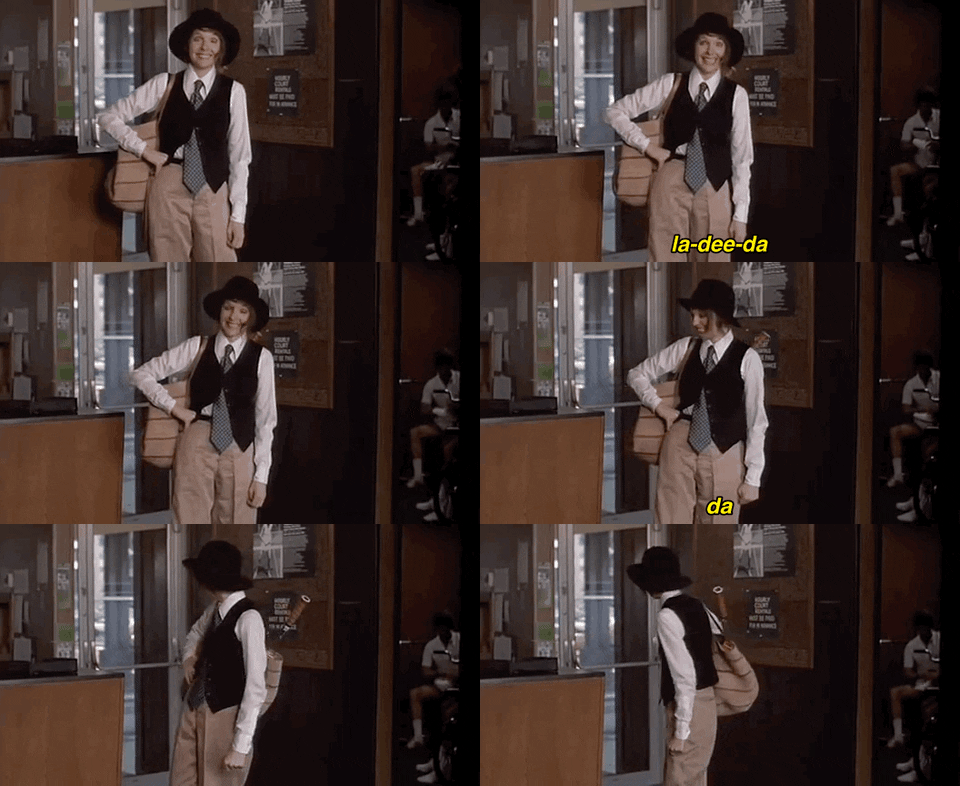
As I then began sputtering out in no particular order All About Eve, The Way We Were, Who’s Afraid Of Virginia Woolf?, Postcards from the Edge and Annie Hall (Note: The latter with the disclaimer that it used to be but now, well, it’s hard to watch, which led to a discussion of why, which I don’t want to get into for various reasons and is the subject of another blog).
I then quickly explained Hitchcock was one of my favorite filmmakers and that despite it not being his most artsy I just love Psycho.
As well as most every Almodóvar movie, and many of the films of Paul Thomas Anderson. But that I couldn’t leave out….Billy Wilder or Scorsese and that even though Gone With The Wind is so problematic from a contemporary lens I loved the book and the film as a teenager, which is ironic because of how pissed I was that BlacKkKlansman didn’t win the best picture Oscar that year over what I judged to be the far more retro Green Book and…
Well, you get it.

I’m a parlor game buzzkill because nothing is simple in my brain. But as a lifelong movie fan, there is especially nothing is simple for me about the movies.
So much to love for so many reasons.
And damn, what kind of gay man would I be if I didn’t include the restored Judy Garland version of A Star Is Born and Jacque Demy’s Umbrellas of Cherbourg?
See, I can’t stop.
Which is sort of the point.
There is something about the movies.
Plays are great, books are wonderful when they are and nothing is better these days than a great season of a streaming show. (Note: Yes, Baby Reindeer and Hacks were fantastic but this year I was riveted to Carmy’s existential crisis all through season three of The Bear and couldn’t care less how many stars his fakakta restaurant got – that wasn’t the point!).
Not to mention music, museums and one of a kind events like Luna, Luna.
But if you’re a pop culture freak of nature of a certain age like I am, films are… well… forever.
Something immersive that’s eternally branded in your mind.
Perhaps it’s because the second golden age of 1970s cinema was where I came of age.

Maybe it’s that movies run such a gamut, or require brain power from totally passive to you better f’n pay attention or you’ll miss something.
It could also be the special kind of escape they provide for a prolonged period of time without anyone else around – at home or in a darkened theatre – the latter being a place you can easily pretend no one else is around as long as no one’s brought their crying kid. #ChildlessCatPeoplePower.
Or thinks it’s their living room. #ShutTheFUp

In the more than a week since my niece asked her question I only today realized none of this matters because left to my own devices (Note: A dangerous place to be) films are my unwinding mechanism.
And there are not just one type nor do they have to be on my aforementioned “favorites”:
- I happened to turn on TCM a few days ago and there were the beginning credits of Silkwood. A bunch of friends worked on it and I hadn’t seen it in years. But I doubted I’d re-watch a story of radiation, friendship and corporate corruption even with the help of Mike Nichols, Meryl Streep and Cher because it’d been a trying week. But it had me. And kept me. Not only did it hold up all these years but I found the sheer unabashed chauvinistic anger at the power of a strong woman like the late Karen Silkwood to be strangely energizing because of how absolutely infuriating and relevant it remains.

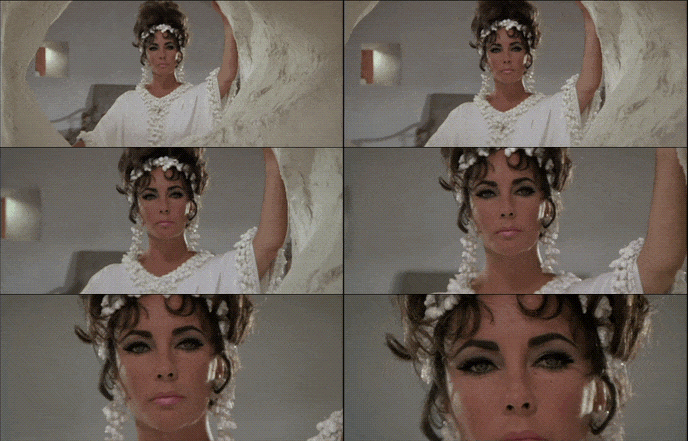
- But that doesn’t mean I wasn’t equally into the new feature-length documentary on MAX entitled, Elizabeth Taylor: The Lost Tapes, a few days before. It’s an actual movie about THE biggest movie star of the 20th century which she narrates via numerous reels of “lost “tapes she recorded in the mid-late sixties for a planned biography that never came to be.
She’s bawdy, funny, smart and clever but what she is more than anything else is honest. It’s a treat to hear the dish on the movies, the life, the triumphs and the tragedies from the source but it’s even better to see it unfold in the filmic images and real-life footage put together in motion picture form by a director as creative as Nanette Burstein.
- I was busy this week but in the last couple of days the air sucked and my sinuses swelled so I chose to stay inside and read once I caught up on some politics (Note: Idiot). At which point, I changed channels and there was another really great contemporary film that should have won the Oscar for best picture – The Social Network. (The King’s Speech? Seriously????).
I know, who wants to see the Mark Zuckerberg story at this point, right? But I’d forgotten how much of an even-handed anti-hero Aaron Sorkin’s script made him and how well David Fincher’s frenetic filmmaking captured what, from our current rear view mirror, seems like a very strangely naïve era we couldn’t quite appreciate at the time. #MoviesCanDoThat.

- Not knowing I’d be writing about movies but still staying hermetically sealed at home I continued, checking out the much maligned recent film The Bikeriders starring Austin Butler and Jodie Comer. Dismissed by many top critics and a few friends, it was bizarre, fascinating, funny and sort of touching. I’m not into 1960’s motorcycle culture and I never imagined an English actress like Comer could so convincingly pull off working class Chicago (Note: Though why not after what she did on “Killing Eve?”) yet it was fascinating. And Mr. Butler is just so much more enjoyable on a motorcycle than slithering his way through sand in Dune 2.

- I guess now is the time where I admit that before I gave in and went outside on a walk/run this afternoon I spent two hours rewatching the critical and audience drubbed film version of Jersey Boys, directed by Clint Eastwood. Yeah, it’s sort of schmaltzy, a little cartoony and was definitely shot on the Warner Bros. backlot.
But jeez, it’s a movie fantasy musical melodrama. And the soooonnnggggs.

Sherry, Walk Like A Man, Big Girls Don’t Cry, Let’s Hang On, Working My Way Back to You… And the Italian guys from the neighborhood I grew up with that I seldom hung out with but loved from afar. Fuggedaboudit….
It was a time capsule back to an imagined version of the life of a real-life singer (Frankie Valli, of The Four Seasons) with movie mobsters, movie people and melodramatic movie heartbreak played against a purposely and infectiously nostalgic movie soundtrack.
It’s not Elizabeth Taylor, nor does it address corporate malfeasance, social media or the evolution of pop culture movements. We have those, as well as many other films, for that.
And for a lot more.
Jersey Boys – “Sherry” (at the White House)




 notes from a chair