Plastic Wrap

Screen Shot 2014-10-26 at 8.04.23 AM

As I sat staring aghast at the before and after pictures of Renee Zellweger that circulated all over social media this week I wondered – am I against plastic surgery or just bad plastic surgery? Or at least the extensive kind since bad is clearly in the eye of the beholder when it applies to things like elective medical procedures and reupholstery which, when you stop to think about it, are sort of the same thing.

For those not up to snuff, some rather shocking photos emerged of Ms. Zellweger at a red carpet event where her face was very much unlike the quite famous one we have all come to know since she emerged seemingly out of nowhere as a full blown movie star in Jerry Maguire – a film where she not only held her own against the megawatt presence of a younger Tom Cruise but matched his charisma frame for frame. Needless to say, anyone who has made following the movies their business or even hobby knows that aside from this being not an easy feat to pull off it is actually pretty near impossible to do against the handful of actors we in the public vaunt into cinema royalty in any given generation.

The making of America's sweetheart

The making of America’s sweetheart

Of course, it’s been almost 20 years since Jerry Maguire and both Ms. Zellweger, all of you and, most importantly, myself are also almost two decades older. Perhaps that is why I was so taken aback by this now unfamiliar image staring at me in the face that was identified as her face. Even though I am more than a decade older than Ms. Zellweger and on a given day absolutely as vain as any movie star I’ve ever met, I couldn’t help wonder why anyone as talented, accomplished and yes – attractive as she – would choose to alter their physical self to such a very large extent.

Honey, we can all tell you've had work

Honey, we can all tell you’ve had work

Then it hit me – if her alterations simply made her look like a younger version of herself rather than an altered version of, let’s say, her distant cousin raised in Slabovia twice removed – would I have been so troubled by it? Or even noticed? I was quick to comment that this new RZ decision was “sad” and wrote/told those within ear or eye shot on social media to “be themselves” and not adhere to the pressure to “do that to yourself.” Well, whom was I kidding? It didn’t seem to matter to me when I met Jane Fonda last year that at 73 she suddenly looked about 20 years younger. Or that somehow, clearly only through exercise and Scientology, 52 year-old Tom Cruise seems permanently frozen at 38. On the other hand, I was appalled several years ago when I saw the shiny, waxily frozen face of Sylvester Stallone to my right waiting for the valet to bring around his car or the alternately scary images of Mickey Rourke, Kim Novak, Barbara Hershey and Burt Reynolds in recent years in photographs, awards shows, on film and yes, regrettably even in person at the supermarket.

Hey Mickey!

Hey Mickey!

Age is a very, very tricky thing, let me tell you. Physically, psychologically – and in all other ways you can think of. But let’s not get into our mutual expiration dates for fear of depressing the hell out of the room and just stick with the outside wrapping. You don’t want to look like you belong in a rocking chair but at the same time you don’t want to live a pathetically striving existence of trying to compete with people 20 years your junior and then lie yourself into thinking that you appear as refreshed as those that age who are not excessively drinking or drugging up daily over the top doses of some lethal co-combinations or quantities of said substances. Stand next to any healthy individual of that age at your age and the lie becomes too obvious. That is, if you choose to live in reality.

OK, we get it, Meryl. You rule.

OK, we get it, Meryl.

Well, luckily the entertainment business has perfected the art of creating alternate realities and we have perfected incorporating what they sell into our everyday existences. With so much available, the fountain of youth is just one more item to be obtained with one, two or three clicks at the most. True – virtues like intellect, humor, love and decency are what we say we want but they can’t stare back at you in the mirror – either rear view, bathroom or vanity style.

Which brings us back to Ms. Zellweger. In answer to the outpouring of…reaction…to her new look, she issued the following series of statements:

“I’m glad folks think I look different! I’m living a different, happy, more fulfilling life, and I’m thrilled that perhaps it shows…

My friends say that I look peaceful. I am healthy. For a long time I wasn’t doing such a good job with that. I took on a schedule that is not realistically sustainable and didn’t allow for taking care of myself. Rather than stopping to recalibrate, I kept running until I was depleted and made bad choices about how to conceal the exhaustion. I was aware of the chaos and finally chose different things.”

Reaction?

Reaction?

That is a lot more than any of us want to know about her life or even have the right to know but let’s not try to pretend it answers the question which is – why does an accomplished, more than reasonably attractive person (Note: I always thought she was flirty and really pretty but lets go with the former) endure the risks of major surgery and perhaps a life-altering change in appearance in order to look…younger? More attractive? Or less or more….???????????

Certainly, Ms. Zellweger is under no obligation to say anything at all. And for those who want to advance arguments, the correct answers are not things like:

  1. She makes her living as an actress and at 45 years old this is the price that must be paid.
  2. Plastic surgery is always a gamble and she just got unlucky. Besides, she doesn’t look all that different.
  3. Why are you specifically raking her over the coals, anyway?

Actors the caliber of RZ play real characters and as they age they have the ability to adapt and become all kinds of more interesting and even older people; to say she doesn’t look all that different is like me trying to pose as a full on Divan rather than a mere Chair; and I am a huge RZ fan not only for her commercial hits like Bridget Jones, Chicago, Jerry Maguire and Cold Mountain but in lesser known films like The Whole Wide World, Nurse Betty and My One and Only. In fact, in the latter 2009 road movie she gives a charming performance as the fictionalized version of actor George Hamilton’s beautiful Southern belle mother who determinedly drives cross country with the younger George in tow as life lessons abound. Watch it on DVD or Netflix and see if you don’t agree.

... this film is from 2009 (yes, that's 5 years ago)

… this film is from 2009 (yes, that’s 5 years ago)

The truth is there is something truly insidious about what the scientific advances in beautifying medical procedures have wrought on our culture. I live in L.A. where so many are surgically enhanced. But this is not limited just to the movies or on the left coast anymore. It’s in most big cities. And smaller ones, too. Go to an upscale restaurant and you see it everywhere. And not just on women. I go to the gym and I see it in the faces of guys I used to know who now have foreheads and cheeks (not to mention other body parts, I presume) that you could bounce a quarter off of. This is the same city I came to more than thirty years ago where I spotted a still dazzling attractive man in his late seventies stumbling a bit tipsy down the streets of Beverly Hills. He was tanned and had deep bags under his eyes and lines on his forehead and cheeks but wouldn’t you know that with his thick black glasses and gray black hair Dean Martin was still devastatingly handsome. And he wasn’t even sober! Not to mention a few years ago at a private screening for eight I also found myself wildly attracted to sixty something year old Helen Mirren, sexy as hell despite wrinkles in her face after a day of filming but with a healthy, quite upright body and refreshingly blunt intellect to match.

What's your shelf life?

What’s your shelf life?

We can dismiss all this by saying these are exceptionally attractive people who have aged well but that doesn’t address the very fact that there is a way to still look great on the outside to both strangers and yourself without going under the knife and taking the risk that if she were not forewarned even your own mother might pass you by on the street. That kind of extreme alteration used to be reserved for fictional characters in soap operas and murder mysteries who had committed a crime and needed to change their identities. Getting older is not a cause for either of those.

... or 1980s stardom

… or 1980s stardom

All of this is not so say one can’t be well groomed and use beauty aids. Do NOT get cute and try to employ the where do you draw the line argument here. You’re in charge of the line and you’re the master (or mistress) of how you look.

Cher, the ultimate show business survivor and, among other things, admitted plastic surgery user, had the best answer to those who questioned her employment of cosmetic procedures to look good and, as she says, “keep the package viable.” And that is:

If I want to put my tits on my back, it’s nobody’s business but my own.

I would only add to that statement: There are lots of people who will still find you equally or even more attractive if you choose NOT to do that. Perhaps even yourself.

And that goes double for anyone else – famous, unknown or even infamous – who might be considering cutting into their face now or at some future date. This gets harder to say as you get older but it’s a lot easier to maintain as an alternative as the years go on.

Depression ≠ Creativity

Screen Shot 2014-08-16 at 11.05.56 PM

I wasn’t going to write about Robin Williams’ death. I mean, do we need one more person weighing in about the actions of someone we were convinced we knew but had never met? But then I thought rather than exploitation this could be an opportunity.

Here’s the dirty little secret about creativity and depression:

It is not true that most artists are depressed nor is it true that one has to suffer to be an artist of any kind. This is a bill of goods we’re usually sold in countless books, plays and movies.

However, what I’ve found through decades of doing creative work is that many depressed people use creativity as an outlet and that many of these people seek to make their living in the entertainment industry. Therefore, it is more than likely that one would come across more individuals battling depression who are in the biz than say – plumbers or dentists or garage mechanics. Not that these professions don’t have their share of people who have battled all kinds of illnesses, including depression.

I am someone who has battled depression on and off for most of my life and only came to fully realize the full extent of that ongoing battle less than a decade ago. Prior to that I just considered myself to be a person who was overly sensitive and prone to sadness. A lot. And usually in private. Not that I didn’t have the capacity to be happy. I did – do. But when the “sadness” kicked in, there was no telling how long it would last, in what way it would manifest itself or the amount of time it would take for me to “choose” to snap out of it.

Living in the shadows

Living in the shadows

Depression is an insidious illness… condition… or whatever you want to call it. And is quite different from mere sadness. In an explanation that is as good as any that I’ve read, a writer friend of mine who went back to school to become a therapist – and is clearly a good one – posted this in the aftermath of Mr. Williams’ death:

Depression is not sadness. Sadness is a rich, deep emotion that is full of life and heart and feeling. Depression is a bleak, numb, overwhelming sense of emptiness and nothingness. It is psychologically painful and can be physically painful. It can be enormously debilitating and can cause one to lose hope.

Certainly, there’s more. My therapist friend followed this explanation by urging people not to lose hope or hurt themselves but instead reach out to the many people and places in the world ready and willing to help.

Of course, many depressed people have done this and have not seen immediate results. Or have gotten better only to relapse. Yet that is the case for numerous conditions and illnesses – from metastatic cancer to the aggravated sciatica nerve you pull out in your back or side. (Note: Yes, I am currently the “you” in the latter category).   So why do so many of us, including quite often the actual person who is clinically depressed, eventually tire and want to just shake a depressive endlessly until they finally agree to cheer up and thus snap out of it?!

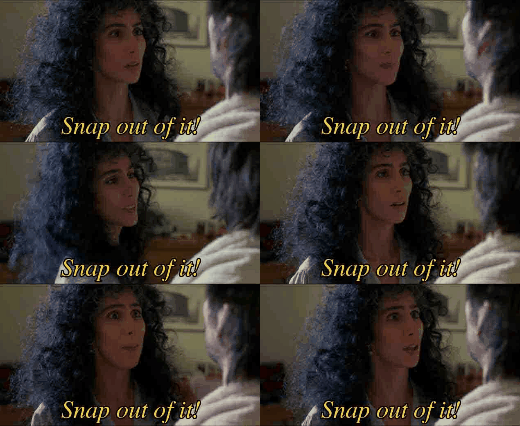
Not going to work.. no matter how hard Cher slaps!

Not going to work.. no matter how hard Cher slaps!

Well, that’s one of the challenges here. Almost everybody, including the patient involved, finally tires of this condition and reacts to it in his or her own individual ways. Among these is withdrawing from the hideously debilitated person – or this hideously debilitating condition – entirely. Which, as we all know, can sometimes yield the worst of outcomes.

I am not writing this to capitalize on Mr. Williams’ death nor to in any way promote myself or my issues. There are better ways to do both as anyone who surfs the web, watches television, or exposes oneself to any news source at all – including this blog – has seen. Rather it’s to reiterate it to all to myself once again. Because dealing with depression is an ongoing education that someone who has it can easily forget to reinforce since it’s so tempting to chalk it all up to just being blue, down or having a bad day.

In the process if even a line of any of this hits home, I’m happy. Well, only as happy as someone like me can be.

….C’mon, I’m only joking!   Well, sort of.

Myths and Truisms in the Arts re: Depression

1. You don’t have to suffer to do great work in either comedy or drama.

... and certainly not to paint a Starry Night

… and certainly not to paint a Starry Night

There’s a way to get in touch with your emotions and not get sucked down with them. You can’t truly, as a writer, present a situation in a thoroughly depressed state anyway. In fact Mr. Williams himself recalled, according to his L.A. Times obit, an acting teacher who years ago once scolded him for being “too vulnerable” in his emotional scene work in class.

Dear boy, said Mr. Williams imitating the teacher in a thick British accent, that was a lovely scene. And your emotions — there was so much of them! But it’s a bit like urinating in brown corduroy pants. You feel wonderful, but we see nothing.

This is not to say that great writers, actors, singers and many other creative people do not tap into deep personal feelings in what they do and remain unaffected. But they also need a bit of distance in order to see the entire reality of what they’re creating. This is a near impossible feat for a person in the throes of clinical depression. And for those few superhuman souls who can surmount the odds and continue to function, it becomes a dangerously slippery slope of existence that can eventually lead to far more troubling results.

2. The brains of clinically depressed people, or those who over a period of time become clinically depressed, are different than those who are non-depressed and often lead to unclear or just plain bad decision-making.

It goes beyond left vs. right

It goes beyond left vs. right

This one really got to me when I first started to do reading on the subject. You mean to say when you’re depressed your brain is literally offor rewired from what it once was if this condition develops over a period of time??? How can that be? Well, rather than me explaining it, take it from the experts we’ve imbedded here.

Expert 1

Expert 2

Expert 3

Now I don’t know about you, but I can’t stand it when someone else tells me to do something I don’t want to do – or deal with an issue I know is wise to avoid. ESPECIALLY, when they tell me it’s for my own good, and MOST ESPECIALLY when they’re right. So finding out that what you 100% think or know you feel deep inside your brain or even soul might not always be the result of clear thinking is, well…let’s say it’s particularly daunting.   Yet in retrospect I realize that my past attitude and behavior towards my own foibles in this area were not unlike the extremely drunk/stoned friend or family member who is utterly convinced they are well enough to drive themselves and you home from their ex-fiancée’s wedding.   Certainly, I would not get in the car with that person. But what happens if you are that person? You can’t stubbornly pretend you don’t have the problem and you certainly can’t always depend on being saved by the actions of someone else you will most certainly choose to ignore if you want a favorable outcome.

3. Art can be great therapy for your mental woes but the entertainment industry does not have a ton to do with art.

It gets hot under those lights...

It gets hot under those lights…

Yes there are elements of it but, on the whole, there is quite a bit more to the biz than that. This makes it quite challenging for artists prone to depression who, we’ve established in #2, certainly don’t want to be told how to live their lives or even what to do by others.

This being the case there are certain questions it helps to ask oneself. Is all your self-esteem entirely tied up with the results of what you do in art and/or the biz? Do you think you’re nothing without a certain kind of attention or success? Are others able to roll with the punches while all you want to do is punch yourself – and repeatedly – when things don’t go exactly your way? A yes answer does not necessarily mean you are clinically depressed but it is also not a sign that you are in a healthy mental state. Consider what active, healthy steps you can take right now to begin to change your mental state. (Note: The correct answer is not always getting a deal, the role or the sale).

and believe me... this doesn't help either.

and believe me… this doesn’t help either.

By the way, it is particularly worth noting that everyone’s artistic career eventually ebbs and flows in popularity, financial success and output. Do an imdb or Wikipedia search of any great “star.” You’ll see many more ups and downs that you imagined. This is particularly true the longer you’re in the game. What is also true is that given advances in medical science there are any number of individuals in their seventies and eighties still doing great work. But with many more failures in their pasts than successes you have in your present. It’s all about how you and your brain decide to look at it.

4. Just because a depressed person is momentarily cheered up by material stuff, or love (in whatever form) or even– dare I say it – faith – does not mean they are cured. Or even okay. What the outside world sees of an individual is not necessarily the inside reality.

What's on the outside doesn't always show you what's underneath

What’s on the outside doesn’t always show you what’s underneath

This truism seems particularly confusing in the case of Mr. Williams. How does someone so jovial, so loved, so successful and recognized, and so wealthy, succumb to….that? It’s complicated. And deceptive. And notoriously elusive in understanding. I hate homilies like don’t judge a book by it’s cover but one of the great ironies of life is that there is more than a grain of truth to even the most overused cliché. If you don’t believe me, go over this list and see how many you really disagree with.

5. Medical care for a mood disorder does not blunt one’s creativity. Nor is it cheating or taking the easy way out. If administered properly it makes the person even more of who they are destined to be. Plus, it can significantly change the course of a drowning person’s life by, in many instances, saving that life.

Remember this is what they are made for!

Remember this is what they are made for!

No one really wants to slow down or admit they have problems of any kind – especially publicly – whether it’s to your friends and family or on the national stage. Not to mention that there are strange moments of really intense and intoxicating emotions associated with these problems that can be oddly difficult to part with.

Still, the chances of controlling any major illness alone without some qualified outside help are about as good as Michelle Bachman successfully running a PFLAG meeting in West Hollywood (Note: Not that we’d need one here). Meaning – it will not end well and any bookie would take that bet.

A parting Note:

Mr. Styron

Mr. Styron

One of our greatest novelists of the 20th century was a man named William Styron. Among other achievements, he won the National Book award for writing the acclaimed 1979 best-seller Sophie’s Choice, an epic story made into a memorable film starring Meryl Streep in the title role for which she won her first best actress Oscar. Mr. Styron later chronicled his 1985 plunge into a near fatal clinical depression and then his successful battle back in Darkness Visible, an exquisite 1990 memoir.

Here is how he chronicled the illness in an article for Vanity Fair.

The pain of severe depression is quite unimaginable to those who have not suffered it, and it kills in many instances because its anguish can no longer be borne. The prevention of many suicides will continue to be hindered until there is a general awareness of the nature of this pain. Through the healing process of time—and through medical intervention or hospitalization in many cases—most people survive depression, which may be its only blessing; but to the tragic legion who are compelled to destroy themselves there should be no more reproof attached than to the victims of terminal cancer.

Mr. Styron could not have been in the best of moods when he wrote Sophie’s Choice – one of the most brilliant and disturbing books of the 20th century – but he was most certainly not in the throes of clinical depression. If he had been, he never could have had the wherewithal to produce such a masterwork. And had he not sought and received treatment after the escalation of his condition in 1985, he would never have been able to write the concise 88 page memoir five years later that grew out of a talk he was asked to give on the subject to doctors at Johns Hopkins School of Medicine after he had recovered. His work and these events all helped usher in a new contemporary understanding of the disease.

This is something to think about for artists and non-artists, depressed as well as non-depressed, people alike.