
Taking a seat
People go into the entertainment business for all sorts of reasons and who’s to say if any one reason is right or wrong. Talent, fame, and communication are the top ones. Equally compelling are: aversion to 9-5 employment, fun, sex, glamour, and money. And finally, there’s my favorite – because it’s the only thing I’m really good at that I don’t hate. Doubtless, there are still more.
I have heard any and all of these from my students – inspiring artists that they are – and none of them surprise me because I’ve also heard every one of them from one other person very close to me…myself.
Yes, aside from knowing early on I had some writing ability, I was also drawn to the biz that is show for lots of unsavory reasons that I suppose I’m not proud of. Except, I sort of am because after decades in and around this world I know I’m not alone. Who of us isn’t occasionally bowled over by the glamour (even when we realize there is a lot less of it than we thought) and reduced to the 9-year old fan we once were or perhaps still are? Is there anyone among us who didn’t at some point want to be heard or noticed in some small way so they could stick their middle finger up at all the doubters or other people who discounted or ignored them? And I can’t imagine there is not a person here that has or will not at least once enjoy certain carnal pleasures and/or attention available to them because of this particular show-y world they chose. (And for those who haven’t cashed in on the latter…oh come on – you know you have!).
None of this negates one’s talent and creativity. The passion for one’s art. The wanting to not only be heard or listened to but – yes, lofty thought – in some big or small way ultimately change the world for the better through what you say. I’ve felt the latter more than once or twice and, especially when I was younger, was absolutely sure that these dreams would indeed come true. And anyway, who is to say they haven’t? It’s not always evident how change happens or who contributed what to the mass success of a project or an artist with even a casual comment or specific creative contribution along the way. You might indeed be famously heard and change things yet you also might never know how much, nor will the many people in the world know. But, I mean – does that negate what you’ve done, your talent or you? Does that make you a failure? I don’t think so. And – for your sake – I certainly hope you don’t think so.

Every now and again, it’s ok!
The biggest and smartest talents among us know this and quickly, even routinely, credit other people for helping them along the road to success in very significant ways – sometimes proclaiming that person or persons were partly (or even in some measure equally) responsible for it. And I actually suspect even the most ego-crazed, conceited nightmares of stars deep down know this too because there is nothing that fuels the egomaniacal fool more than the fear of the world finding out that deep down inside they indeed have been fooling everyone all along and, when the curtain is pulled back, they will be revealed alone as The Emperor’s New Clothes. In other words – nothing.
All of this and more are covered not only in my bi-weekly psychotherapy sessions but also in Twenty Feet From Stardom, a new documentary about some of the most famously unknown background singers in the business. These people, mostly women, sang the most prized choruses or riffs or actual vocals of some of your favorite songs from the 60s through today. In fact, The Rolling Stones, Bruce Springsteen, Luther Vandross, Sting, Elton John, Stevie Wonder, Tina Turner and many, many more are more than happy to let you know (well, to a point, that is) that parts of their records you are singing to (especially the hook/choruses) only really work because they or their producers or managers had the good taste or cash to be able to hire these “unknowns” to add their ample abilities to their final creative project. A project that, ironically, none of these background singers are ever really known for by anyone but this select group.
There used to be this new agey question they asked in the seventies that might just still be around today and it goes like this:
Are you the star of your own movie?
Correct Answer (If You Live in the Real World of Show Business): Well, it depends on what you mean by “star” and “movie.”

Loving Darlene Love
Remember the timeless sixties hit: He’s a Rebel, sung by The Crystals? Uh, that was really background singer Darlene Love singing lead but record producer Phil Spector decided that The Crystals were more marketable (and controllable) so Darlene’s name got erased. How about the gal who famously dueted with Mick Jagger on Gimme Shelter – a song that feels as if it has been used in every other trailer for a Martin Scorsese film in the last 25 years? That gal would be gospel diva Merry Clayton – who memorably wailed the chorus: War, Children – It’s just a shot away, It’s just a shot away! while she was 8 months pregnant and in curlers at 3 am because Mick Jagger and the Stones needed a female belter in their middle-of-the-night recording session and she was game when the call came in an hour before.
There are younger singers like Lisa Fischer, who for decades has sung on many of the most famous records and live performances of Sting, Luther Vandross and Tina Turner, and people like Tata Vega, David Lasly and Charlotte Crossley – names you probably don’t know but whose vocals you remember if you ever heard anything by James Taylor, Bette Midler or Stevie Wonder.
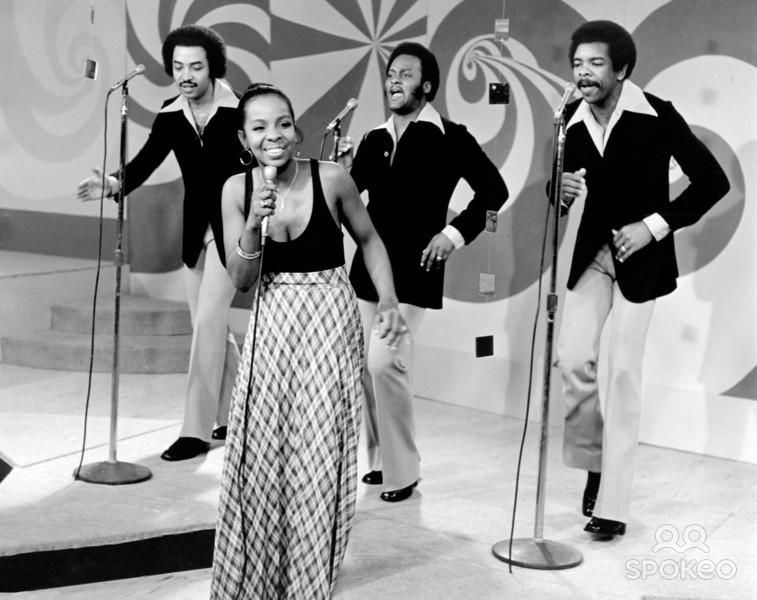
Can you name the Pips?
One watches the singers in this film and audibly gasps that any creative person with that amount of talent could possibly be what the biz routinely labels as an unknown. How does that happen? Well, in the same way other people are known.
But rather than reviewing the film, perhaps its best to cut to the bottom line two questions here:
Q1: Who makes it in the business and who doesn’t? And why? (Ok, that’s already 2 questions)
A1: A small group if you consider the larger percentage. And for many reasons, some of which were stated above.
Q2 (or Bonus Question for those really counting numbers): If I work hard enough, believe in myself and am also super talented by professional standards, as well as my own, doesn’t that guarantee I will make it too?
A2: Well, if making it means becoming commercially successful, famous, a household commodity, or even a wealthy (or financially comfortable) artist who, at the end of the day, is revered by your peers, the answer is, quite simply — No.
Not all all. There is no guarantee, or even likelihood, of anything. At all.
Though (and here’s the killer) it is possible. Confusing? You bet it is.
I once heard Joan Rivers address this question of who makes it or not in an interview and she incorrectly stated: The cream always rises to the top. Well, that might be scientifically true in a coffee test kitchen but it is simply not the case in show business, much as we all would like it to be.

Clouds in my coffee
This is not to say those successful are untalented. But there are usually others far worse but also better than they are. Sting graciously put it much more eloquently in the movie when he answered the question: So many factors – luck, timing…
It is indeed a bitter pill to swallow that you might be much more talented than others in your field and that yes, somehow the dream never happened for you. Oh, you know the one. It’s different for everyone but basically they’re all the same. Getting your work seen and being rewarded accordingly; the recognition; the success, whatever it means to you or others – yada, yada, yada…
No one should suffer under the delusion that the answer lies in fairness because the world SHOULD be fair. It isn’t all of the time. Sometimes it is. Maybe it is all the time and you’re spiritual (which I’m not) and believe none of us can see the true bigger godly picture. But for the rest of us mere mortals – wow – sometimes it really does not seem right or just or, well – happening the way it should. That’s okay. That’s the way that it IS. And there is only one true real response. To keep at it, to keep doing your work – without result – as much as possible, while keeping it real – the best that you can.
I find myself occasionally getting stuck just like everyone else – in the morass of expectation and disappointment and unfulfillment and yes, occasional bitterness. But seldom, at this point in my life, can I stay there long. I know better. I know the truth. That all I have now is all I had when I came in – my talent and what I have to say and that determination to do so. No one can ever take that away from me. But myself, I suppose. Which is the true irony, don’t you think?
I’m reminded of a great scene in the movie Quills – based on Doug Wright’s play. The Marquis de Sade, a controversial writer in his time of sexually explicit material, was finally thrown in prison for his work and all writing instruments (his quills) and paper were taken away from him. What did he do? He opened his veins and used his own blood to write on the prison walls.
No, I wouldn’t advise this. It’s a dramatic illustration. (Sort of like the Bible, but that’s the subject of another discussion).
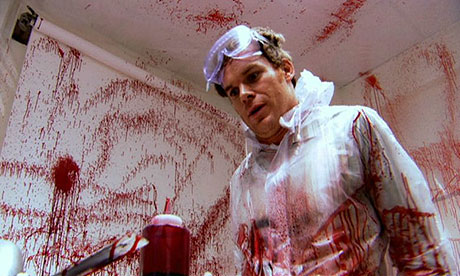
Although, it would be Dexter approved.
You are going along with your own worst enemies and destructive powers by stewing in your own soup of bitterness and resentment. True? Absolutely true.
Everyone can be a writer and filmmaker and pretty much any kind of artist today. Anyone. Thanks to the accessibility of technology. Plus, there are so many more places to be seen. Though ironically there seems less of a chance to reach a mass audience because so many more people can and are trying to with the help of social media and the digital revolution. Why does something go viral? Or hit it big? Or get bought in mass quantities? It’s all sort of the same answer it always was, isn’t it? Because it does. Talent? Sure. But as Sting says, luck and timing? Absolutely.
Some of the odds might be changing in the more traditional real world. For the longest time mainstream Hollywood movies were made mostly by white people – older white males, to be specific. Not that there weren’t women, people of color (and other, ahem, minorities) in various positions helping them. But if you look at the percentages you will see it hasn’t been too encouraging.
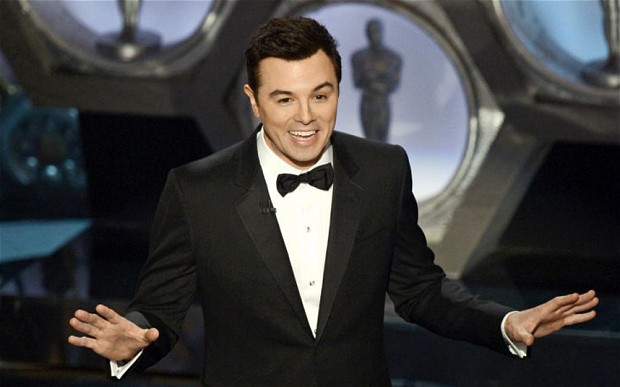
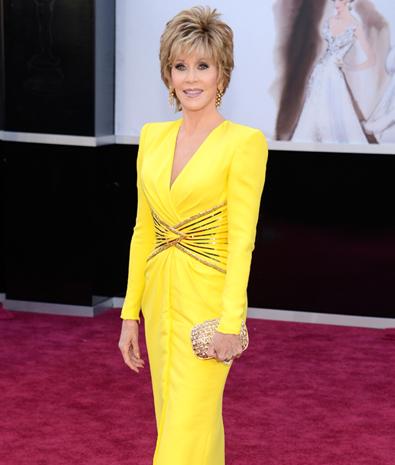
There are, however, recent signs of inclusion from that most exclusive and perhaps elitist of show business organization – the Academy of Motion Picture Arts and Sciences. This select, invited group of several thousand men and women not only make up the industry’s top movie professionals but they also vote each year on the Oscars – the awards everyone likes to say don’t matter but the awards (and show) that most people, in some way, pay attention to.

Diversity?
Right now, women comprise just 23% of all Academy members, but this year 32% of the 2013 inductees (88 of 274 people in all) were women. In addition, this year the total inductees of people under 50 also rose to 35%, which should hopefully begin to equalize the voting power to more contemporary tastes (too bad Brokeback Mountain and Crash aren’t competing next year), since right now only 14% of the total membership of the Academy is under 50. There are even more people of color being invited in, too. The Academy is about 94% white at the moment. But this year only 71% of its new members will be Caucasian. (Okay, that does need to be worked on, but still….)
Clearly, none of us have crystal balls that work or else we wouldn’t have gotten stuck this summer taking a chance on films like The Lone Ranger or Man of Steel (If you haven’t gone – really, you don’t have to). But what is absolutely also known is that if you are not producing material (aka using your talent) you have absolutely no shot at luck or timing or reaching anyone or anything (aka your full potential or desires).
Once when I pondered about taking a job I didn’t really want to do after a long, painful round of unemployment and self-pity, a more experienced person dared to quote this cliché to me – work begets work. Years later, I finally got what was being said. Work of any kind, is a road to something productive and positive and will take you somewhere. Which is better than nowhere – the place where you are now if you’re not working. I loathed discovering this, particularly since I saw it as a little too Power of Positive Thinking for my hip tastes. Still, that doesn’t make it any less true. Then or now.



 notes from a chair