
Everything these days feels like it is a competitive race – presidential politics, entertainment industry awards, and year-end best lists. This is reflected on reality television – which we know isn’t real (don’t we?) but still…
Bravo has created half a network around “Top Chef;” “Project Runway” (when it was on Bravo)” “Top Hair/”Shear Genius” but somehow failed with “Top Design” (was it Jonathan Adler’s signature admonishment “See you later, decorator.” We’ll never know). The Food Network then jumped on the bandwagon with “The Next Food Network Star.” But “Survivor” was really there first on CBS, awarding now convicted felon Richard Hatch with its original million-dollar prize. CBS then upped the ante (in prestige, not ratings) with the perennially Emmy winning competition, “The Amazing Race.” But of course those were all surpassed by “American Idol,” the juggernaut of all television reality competition shows, with or without Simon Cowell.
Except maybe not for long because we now have “The Voice” – the unexpected breakout hit on NBC that seems to have managed a much more improved, kinder and gentler format with actual pop singer/mentors who both perform and guide rather than harshly “judge.” Mr. Cowell himself might prove this all wrong in the fall when his new program “The X Factor” premieres and shows us once again that “mean” brings home the “green” – meaning it makes money and, as LB Mayer or some studio mogul once said, “puts asses in the seats.”
Experience tells us “asses in the seats” is really the bottom line in the entertainment industry. But that’s a cynical view and only partially true because that statement doesn’t address the myriad of ways – both good and bad – you can get those derrieres on their cushions.
As a teacher and mentor, I try not to stress the “asses” reality though I do lament about it more often than I like to admit with my fellow writer friends. I mean, it’s tricky enough to write a good version of anything if you have to worry about the vagaries of the industry and audience when you’re trying to create something real, funny, dramatic or relatable on the page. Not that we create in a bubble. But worrying about writing a really popular script and selling it when you’re writing it is like stressing over what your marriage ceremony is going to be with the person with whom you’ve had only one really good date. You might want it to head that way, and so might he or she – but you’re skipping the best part – the development of the thing.
Unless, of course, money and recognition (fame) is your thing. If so, then you’re in big trouble. Both professionally and romantically.

The whole world is watching...
I don’t know A LOT but one thing I do know is that too many people enter and stay in the industry just to be noticed or to make money. Is this bad, you ask? Well no, not really. It’s motivating. But noticed for what? And by whom? And for how much? The people (or family member?) who ignore you growing up? The talent you don’t really care about or don’t really enjoy doing? The money you are more likely to make on a thousand different other things? Let’s hope not.
Andre Agassi, tennis “Zen master,” (according to Barbra Streisand, and who am I to argue with her) admitted in his autobiography that despite his success at one point he hated tennis and it was only with some reflection later in life that he grew to love it again. He began to hate the very thing he was blessed with a talent for because of all the financial pressures and peer/public expectations. It was no longer fun. Where’s the fun for you? If you can’t have that in your work then what’s the point? If it was never fun and just a means to an end (fame, fortune) then it can really be torture. Not fun? Uh, oh. Fun all the time? Haha!! (said in a sarcastic tone). Nothing is, not even eating pizza. Engagement. Emotionality. Satisfaction. That’s the best and the most you can hope for.
Dorothy Parker once wrote it wasn’t the writing she liked – it was “having written.” Take that how you will. I prefer to think of it as Mrs. Parker liked the result of what she came up with – not the adulation or money that surrounded it. Because truth be told she never made the equivalent of huge Spielberg/Michael Bay money, if that’s what you were thinking. But she was known as the greatest wit of her day, especially among the gang of America’s top wits (the Algonquin Round Table) she hung out with. And there is a lot of satisfaction in that – especially because it forced her to do good work while ENSURING she got the glory and recognition of others at the same time for her talent. She came up with pithy phrases because she could and liked doing it, not because she dreamed one day it could make her famous (who could even dream such a thing?)
And if you think fame lasts: Consider when Barbra Streisand’s name comes up most of my current college students sort of roll their eyes and think about their parents. Or grandparents. Or some funny supporting character actress in “Meet the Fockers!” I know it’s hard to believe but so is Michele Bachmann’s presidential candidacy to some people.
Would that we could all have the perseverance of 19th century French painter George Seurat, a pioneer in creativity who never sold a painting in his life because his style was so new and different and unusual.
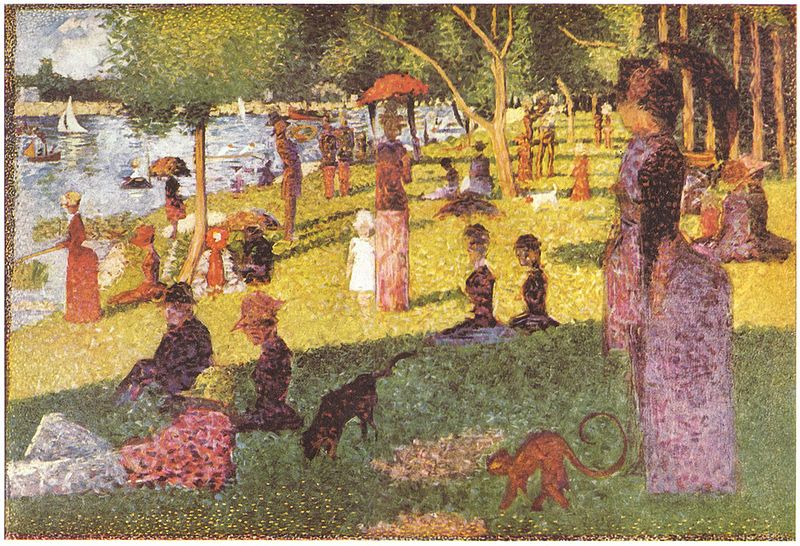
Just another Saturday with ol' George
Most of us need encouragement to nourish the ego and our talent. But that’s not all we need. We also need to work at our talent. That’s part of the reason “The Voice” is so popular right now. Real talent being nurtured, rather than knocked down. Artists onstage dedicated to their craft, all of who seem to be doing it for the right reasons. The winners being mentored by fellow famous artists, all of who seem to be doing it for the right reasons. Yes, the prize is $100,000 and a record deal, but the odds of making that money in a career of music are much, much slimmer and way, way less likely than, say, becoming a plumber or….100,000 other professions. It would seem the reason a 33-year-old father of two and a 41-year old bald headed lesbian (two of the four “Voice” finalists) sang professionally all of their adult lives and continue to sing — the work. Not for all the money they’ve not made so far or the international fame they will now undoubtedly achieve.
Up until a few months ago, none of the four finalists were particularly well-known or even making a particularly great living at what they’re doing. That’s how they landed on a reality show to begin with. But they were still singing because they wanted to. Enjoyed doing it. Maybe even needed to. And it showed through in their work.
The happy byproduct of the last six months for them is that they have made some money and have become a bit famous. But working at their talent, fortified by their love and dedication to it, was what got them there. The same can be said of almost (yeah, there are exceptions, but very few) every successful performer and artist in show business contrary to what you might observe in a lot of “reality” TV. Take a look at the duet between the legendary Stevie Nicks, still making it happen in all her “witchy-ness” at the age of…well, post midlife, and “Voice” winner Javier Colon. Watch how he sings her classic song , “Landslide.” Watch how she guides him through it. Listen to how their voices blend. That doesn’t just happen. It takes hard work, talent AND dedication. Not to fame and money. But at something they both clearly love to do and feel most alive doing. Their art.
http://www.hulu.com/watch/254725/the-voice-javier-colon-and-stevie-nicks-sing-landslide



 notes from a chair