Chair on Chair

Clint Eastwood is an icon.  And if you don’t think so, here is the dictionary.com definition:

Icon:  A person or thing regarded as a representative symbol of something: “icon of manhood.”

No, I did not add the manhood part or appropriate it from some other place to make my point more effectively.  That is the literal, on-the-record given example.

It is dangerous for any one thing or person to be regarded as a gold standard representative symbol of something as Mr. Eastwood proved this past week when he dragged an unwitting Chair onstage in Tampa on the climactic night of the 2012 Republican National Convention.  One reason is that once you’re the international standard for something we all value from your perceived public image, it is inevitable you will one day disappoint.  And that is because the nature of existence is nothing stays the same and that everything in the world is uniquely its own in ways an outsider can never fully know.  An image (or icon) is a mirage – and the very nature of mirage is, it isn’t real.  What it is changes or rearranges, in accordance with the eye or taste of the beholder.  This holds true both for the shelf life of people like Clint Eastwood and for objects such as chairs, who have even less to say about their iconic status than humans do. (Note: “The Eastwood Chair” is now trending internationally and is probably now the most famous chair icon we all know).

Because everything in the world is uniquely its own, this makes it particularly tough for icons – inanimate or living – to be all things to all people.  Why?  Well, for example:

No one human has the same fingerprint.  And as any dog (or any other pet) lover can tell you, no two animals of the same species are exactly the same either.   One can even take this further for, let’s say, ants, who are seldom pets.  I mean, we might not be able to tell the difference between the ants crawling around our backyards or inside our cabinets, but I’d bet that any other ant could. As could another animal/insect of another species.  So how can any one of that or any species ever properly represent all the others not only to their own species but to the rest of the world?

I would argue this is even the same for mass-produced items.  They each have their own microscopic, milli-minutiae quirks that we humans can’t see but that make them who they are.  No item can be exactly what it was when you acquired it or first admired it – or live up to the perception you had of it.   Which is partly because your perception clearly isn’t seeing everything, certainly not as much as what is seen by another like-minded item of its own kind.  Plus, like humans, items also change – if even slightly – as they age.  There is always slight color derivation, a tiny smudge or crack in the armor on the outside.  Or perhaps on the inside, out of view.  I’m reminded of an old Bette Midler monologue that talks about what’s hidden beneath the surface of each and every one of us, no matter how alike we might seem on sight.  One day while walking through the streets of Manhattan, the entertainer ran into a sad, mentally ill lady in a huge Daisy dress who was almost bald and had, substituting for hair, a fried egg on her forehead.  Terrified in those days of her own tenuous emotional balance on reality, Midler mused that she didn’t want to wake up one day and wind up with a fried egg on her own head.  But then, later in her routine, which went from hilarity to poignancy in the space of just a few minutes, she somberly concluded:

“The truth about fried eggs is…everybody gets one.  Some people wear them on the outside.  And some people – they wear them on the inside.”

I prefer mine over easy


Meaning nothing can or should really be set up as an icon for anything. It’s a recipe for disappointment and failure on both our parts because you’re never seeing the real, true picture.  Just as the 82 year-old Mr. Eastwood might now disappoint as the universal hyper symbol of Manhood due to his mocking routine of Pres. Obama, who he imagined was sitting onstage with him yelling unlikely nasty retorts from an empty chair – that particular brand of Chair, which hadn’t chosen the spotlight as Mr. Eastwood clearly did and continues to do, has now become the iconic Zelig of inanimate objects and is engendering all sorts of blowback.  Plucked out of obscurity by one icon, said Chair – which doesn’t have a name but has become an unwitting symbol as “The Eastwood Chair” – has various Twitter handles, Facebook pages, portraits, personalities and doctored images it never sought out to begin with.
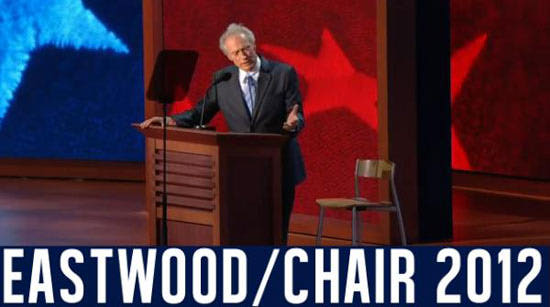
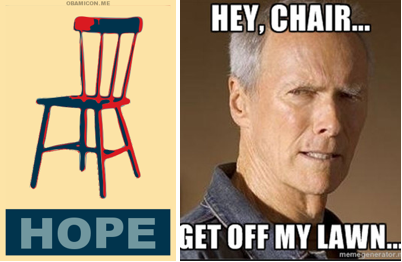
Scouring the web, it is clear this once unknown single piece of furniture enrages, disappoints, is put on a pedestal, is lampooned and is publicly scorned, deified and idolized.  It is now every bit, and perhaps more, iconic than Mr. Eastwood.  This in itself proves the shallowness of iconic status.  Though sometimes it’s about achievement, it can also come when one is in the wrong place at the right time or even the right place at the wrong time.  Even a casual X Factor like birth can have something to do with it.   I mean, ask Prince Harry.

Leave me outta this!

 As an ordinary Chair myself, actually the Pendleton Chair of the Ithaca College L.A. program, it should be understandable that I’m a little sensitive to what would happen if an ordinary Chair suddenly found itself trending worldwide. Though none of the fellow Chairs that I know are iconic symbols, my position does share a dictionary.com definition with what is now the most Famous Chair in the World whose listing fittingly comes first in our dual definitions on dictionary.com.

Chair:  1. A separate seat for one person, typically with a back and four legs.

2. to act as chairperson of or preside over an organization, meeting or public event.

Much like Ms. Midler felt pain for the Lady with the Fried Egg on her head, this week my heart has consistently gone out to what is now the world’s most iconic Chair.  So like any good tribesman, I thought I’d reach out and try to be supportive.  Imagine my surprise when The Eastwood Chair (TEC), quite average and quite happy before it began its meteoric rise to fame just days ago, asked if I’d do its one exclusive interview.

But first, an exclusive with The Chair

Me???  Wasn’t a slightly, well, bigger forum, what was needed?  “No,” replied, TEC, the one thing it didn’t want was to fan the fire.  All it sought was just its real POV out there on the record.  Because the one thing it’s sure of after the last few days is that whatever it says, even if it’s to just me, will gain worldwide traction – at least for a few weeks or so.  The following are TEC’s own words and our conversation verbatim.

Me:  Well, this has been quite a week for you, huh?

TEC:  You could say that.  I can’t really say anything.

Me:  That’s kind of a theme in your life, isn’t it?

TEC: (laughs) I guess so.  I hadn’t meant to put it that way but, there you are…

Me:  Does it bother you that other people are now defining you, who you are, on such a, well, global scale?

TEC:  (seemingly tilts back, then forward again) I was really angry at first.  I mean, I was positioned backstage, providing a service.  I like to think of myself that way – service oriented.  I’m functional.  I don’t crave the spotlight on my own.  Someone might sit on me but that doesn’t mean they are me. To suddenly become the thing that everyone’s making fun of…

Me:  It must be difficult.

TEC:  Well, as they say, I was just “born this way” and living my life.  I didn’t intend for the world to react so extremely to me one way or the other, or use me as an example to make fun of, or idolize or to hate on just because someone else is using me like that and causing them to think that way.

Me:  But isn’t that part of the nature of any chair?  For instance, if someone had you in their house and was really angry, they could throw you across the room and break you if they wanted.

TEC:  (withered look) Wow.  I hadn’t ever thought about…(silence) Yes, I suppose they could.  And that would be awful.  I guess I’ve been lucky so far.  But nobody should be defined as something they aren’t simply because of mistaken identity or because a human needs to work out their “stuff “ in a mean way through you.

Me: Okay, well, not to be mean myself but…isn’t that, according to what you just said, your function?

TEC: I said I’m fuctionAL.  I don’t have one specific function. But in people’s minds now I’m this – “thing.” And it can be real negative in people’s minds.  I just want everyone to know that image, those traits they’re putting on me – the arrogance, the cursing, the awkwardness – they’re fiction.  They’re stereotypes.  They have nothing to do with who I really am deep down.   Depending on who is doing the looking and the sitting, I am lots of things deep down.  I am more than the butt of a joke…

Me:  Butt.  Chair.  That’s funny.

TEC:  I’m not laughing.  Sorry, but…

Me: You said it again.  But.

TEC: These jokes are being used to hurt someone.

Me:  Hurt whom?

TEC: I better shut up.  I don’t want to get too political.

Me:  Oh, come on, your secret’s safe.  Hardly anyone reads the blog compared to, let’s say, your Twitter page.

TEC (chuckles):  You mean Twitter pages, don’t you?  I mean, which one?

Me:  (chuckles back) Well, there’s The Eastwood Chair, The Empty Chair, This Seat is Taken, Obama’s Chair, Invisible Obama….

TEC: Stop, please….

Me:  Well, they all don’t have your exact image.  I take it you’ve seen them?

TEC:  I try to stay away.  Also, I’m sort of limited in what I can see unless someone is sitting on me.

Me: Ah, right.

TEC: But I wouldn’t be honest if I didn’t admit to sneaking a few looks.

Me: Care to elaborate?

TEC:  No.

TEC’s least favorite. “That tramp,” it says.

Me:  Fair enough.

TEC:  I mean, aside from that, I’m not sure it’s exactly safe.  I’m only one chair.

Me:  But an important one.  You could be the Rosa Parks of Chairs, if you chose to be.

TEC: That’s a little grand, don’t you think?

Me:  Maybe so.  I’m not saying you have to be or it’s what you should do or a requirement or…

TEC:  I get it.  It’s okay.  Really.

Me:  You want to talk about Mr. Eastwood?

TEC: Not really.  But I suppose I should.

Me: Are you angry with him?

TEC: Yes.

Me:  I thought you’d hesitate.

TEC:  Why?  I’m in an undisclosed location.  He’ll never find me.

Me:  I found you.

TEC:  Actually, I found you, remember?

Me:  Right.

TEC:  And when we’re done, trust me, you won’t be able to find me again.  No personal offense intended.

Me: None taken.

TEC:  But you will hear about me.  And from me.  A movement is growing.  And it’s about more than chairs, one chair or even all chairs.  See, there’s a network out there protecting the real me because the struggle is really about everything…

Me:  You sure are sounding like Rosa Parks to me.  Or at least one of her disciples.

Silence.  The light hits the top of TEC and it appears several inches taller.

Me:  Care to elaborate just a bit more?

TEC: Okay, so it’s about thinking before you use something innocent solely for your own benefit against its will or feeling.  Or dislike or hate something only because of what you think it is.  Or categorize dishonestly one way before you know it – or even if you do know it.  Cause deep down you know you’re being dishonest.

Me:  Is that what you think Clint Eastwood did? 

TEC:  Eastwood’s 82 years old and a huge movie star.  He’s used to doing anything he wants and he comes from another generation.  It’s more about everyone else and what they say and how they react to what they can plainly see right before their eyes.  And – the truth.  (A beat.)  Though let’s say next time I’m around the rich and famous, I’ll be more prepared and blend in.

Me:  Really.  How can you…

TEC:  We have ways.  I can’t reveal everything.  As they say, ultimately, “A chair is still a chair…

Me:  Even when there’s no one sitting there…”

TEC:  Very good.

Me:  It’s a Hal David lyric from a Burt Bacharach song ,“A House Is Not A Home.”  Mr. David just died this week, so…

TEC: Oh, wow. Sorry.  That’s sad.  I didn’t know.  I really liked his music.

Me:  Well, he was 91 so he did have a great life.

EW: And understood the true meaning of a chair.  Unlike some people.

Me:  Maybe one day they will.

TEC: I hope so.

Me: It’s all in the song, if you think about it.

TEC:  I just wish everyone had slightly better taste in the music they choose to listen to.  You know what I mean?

Day of Reckoning

Just because you’re late to the party doesn’t mean your time there is irrelevant.  That’s what I thought when I finally caught up with “The Dark Knight Rises” this weekend and liked it much more than I’d decided I would.  The reason?  It’s a movie that embodies – or more closely swallows whole and spits right back at you – the year 2012.

The cliché one-liner, if I were still a movie critic as I was 30 years ago, would be “a cautionary tale for our times where the HAVE NOTS rise up against the HAVES.”  No wonder Rush Limbaugh was scared.  But as usual he got it wrong.  “Dark Knight Rises” isn’t at all about the villain being named Bane – the same sounding moniker as Bain Capital, the private equity company that is largely responsible for Mitt Romney’s quarter of a billion dollars worth of wealth.

ehh… not a good look.

In “DKR,” Bane is really a HAVE NOT on steroids – a sort of odd, anti-hero who is mad as hell after a lifetime of living in the margins and watching other people getting a chance to be happy and wealthy and so he decides to destroy everything to punish those who are living large and, well, larger.  It’s about the very small 1% of people who had every advantage that a stacked deck could buy (and then some) and made sure the rest of us didn’t.  If the filmmakers really wanted to make a Romney-Bane connection they would have made the villain a billionaire banker – not the crazy person wreaking havoc on them.

But really — that’s beside the point.  Since in this case the HAVE NOTS are much more evil because they feel nothing.  They are nihilistic because they have finally begun to recognize the almost insurmountable odds against anyone growing up in a prison (literally AND figuratively) of poverty; of hopelessness; and in an unsafe world they’re afraid will forever be against them.  Hopefully, this doesn’t sound familiar to you personally or professionally – but perhaps it does.

In any event, Bane announces to the citizens of Gotham (let’s be real: New York)– “We are liberators” who want to return control of the city “to the people.”  But really this is only to distract them until he can launch a nuclear bomb and destroy everything so the world can start anew.  That’s actually the master plan.  A total wipeout of stasis.  A do-over.  A chance to shake the Etch-A-Sketch screen clean.  Hmm.  Does that sound familiar?

Thanks internet!

Well, I’m at an age where I haven’t had any major ailments – yet.  But I do find myself fantasizing about the idea of trading this body in for a younger model.  This is thinking not unlike the supposed “villains” of “Dark Knight Rises,” instead they want to do it with all of society.  These are people who have waited and waited forever from the sidelines – biding their time until they can trade what’s becoming their unsavlageably messy world in for a younger, cleaner, newer one.  The thinking is – sometimes it gets to the point where things, bodies and/or societies are unfixable and there is no other choice – painful and unfair as it seems.

My analysis is my own, but it certainly explains a lot about the 2012 world to me.  You can feel the fevered pitch in the social and political landscapes.  The bubbling intolerance of the times.  Aside from income inequality, it’s also about the desire of some to go back to the social mores of the fifties – though it’s hard to tell if it’s the 1950s or 1850s – when men and women knew their place and there wasn’t so much, well, talked about publicly.

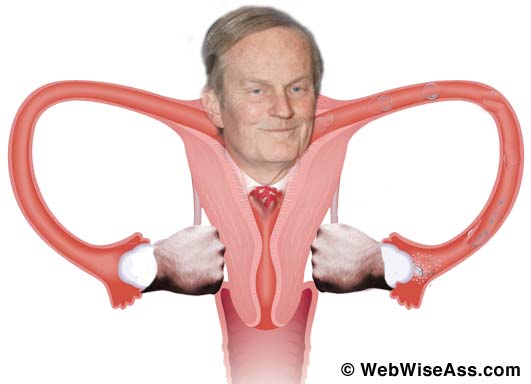
Yes, I’m talking about Mitt Romney and Missouri Congressman Todd Akin, the latter of whom in a television interview coined publicly anew the oxymoron “forcible rape” and more than implied a wacky fringe medical opinion that women who are indeed “forcibly” raped secrete some sort of secret lady potion that prevents them from getting pregnant.  The former has his own awkward reasoning for a 1950s view of women’s choice and a reason to turn the clock back on the Supreme Court ruling of Roe v Wade and assure no female has a choice to a abort a baby in any way, shape or form.

Akin’s report card: F in Biology

But lest anybody get confused, this POV is not solely about religious beliefs.  It’s bigger than that.  It is also about the politicization of that personal morality at a particularly dark time in American culture.  A time when it’s not enough to be able to believe what you believe – you also have to make sure everyone else believes it – or at least is forced to adhere to your doctrine.  As a child in the 60s and 70s, I was brought up to understand that living in the United States meant the opposite.  The whole point was that we were always at least working towards a “live and let live” doctrine that didn’t exist in almost any other country on the globe.  Sure, things weren’t perfect here – but the one virtue we operated on is that our ideal was that you could choose your own morality (well, within reason), find your tribe in some town or city in at least one of the 50 states and no one could really say or threaten to do anything about it.

Now we’re in a global crisis and globally-speaking, it doesn’t feel that way anymore.  And “The Dark Knight Rises” is simultaneously shedding a huge spotlight on it while cashing in on it, both in real life and on the screen.  In the movie perhaps there is an obviousness to the fat cat privileged characters doing charity benefits for the poor saps living well below them in Gotham City but superhero films are nothing if not, in many ways, archetypal.  And anyway, why not since those facts couldn’t be any more obvious in real life?  Turn on the TV, your computer or walk the streets of Manhattan – more than ever before you can feel the money and the lack therof depending where you are geographically.

Perhaps part of the lure of the more popular than ever fantasy movie land genre is the violence and the excess of archetypal behavior.  There certainly always was darkness to the comic book genre where humans have special “powers” that make them different as they focus outside and inside themselves and the fight between “good and evil.”  But Christopher Nolan has taken the “Batman” series to new depths of darkness and desperateness in 2012 Gotham.  Lucky him, he is doing it in a particularly dark and desperate time in the world.  Hmm, lucky him?  Well, maybe.  My students think so.  But with good fortune comes responsibility.  And given the fallout from the film, one could argue he isn’t solely lucky at all.

As I say to my students, you can’t plan where your film (or even television show) will fit in the zeitgeist.  All you can really do is write about what you feel and what you see, especially when it takes a couple of years at minimum from conception of a script to its release date.  Of course, some people have an innate ability to have their hand on the pulse of what is happening and what will be happening because, well, it’s part of their talent and them being who they are.   Madonna used to be like this.  Christopher Nolan still is.

Seeing the writing on the wall.

He has tapped so into the darkness – so much so that not only have his Batman films made a fortune, they have the distinction of having caught the attention of at least one very disturbed individual who appropriated its onscreen nihilism and took it one step further into real life.  This in NO WAY MEANS Nolan and Co. bear any responsibility for the Colorado shootings or that “Dark Knight Rises” should be censored one bit to soften the blow of what’s going on today.  The price of freedom/lack of censorship means that horrible stuff as well as good stuff can happen at any given moment and arise out of any random piece of action we do or art we create.   What it’s ultimately about (and certainly what “Dark Knight Rises” is about) is balance – or light and dark –  of good and evil, or corruption and honor.  And there’s a cost to each when we live in a world that willingly traffics in enough freedom to allow free market indulgences of both.

Which brings us to our financial system.  In the world of “Dark Knight Rises” the HAVE NOTS (meaning most of us) rally together to torture the rich because they know only one thing for certain – the game has been rigged against them.  It’s the ending of the great 1969 Jane Fonda film “They Shoot Horses Don’t They?” where you find out the dance was fixed all along (sorry, spoilers here), or like watching Babe Ruth lose the World Series for the Yankees instead of becoming the hero he became.  Or even worse, watching a hero like Lance Armstrong, who emerges victorious over not only the powers-that-be but over a killer like cancer, give up when the authorities finally manage to prove their case against him.  Or perhaps the most succinct analogy, to borrow from another archetypal pop culture fantasy — it’s like watching as the curtain is pulled back and exposes the fact that the Wizard of Oz is not only not as powerful as was advertised but that, in the end, he really has no power at all.

Pay no attention…

Of course, that is only one side of a story that could be taken two different ways.  For despite its pseudo happy ending coda for the sake of the franchise and studio, Nolan’s final “Batman” film captures the rage and verve or our times perfectly.  Not only for the Have Nots, but — for THE HAVES.

I mean, to hear the haves tell it, there was a long period in our history when people made a lot of money and no one got to know how or how much.  And that was preferable, civil, even moral.  This was also a period when people didn’t do or say so many sexual things en masse for all the world to see and, if they did, all of their sex talk/actions certainly weren’t being publicly accepted by the large mass of the country.  An era where men were men, women were women and it was clear which was which and what the rules were.  And a time when certainly rules that ensured that when people deviated from such behavior that they were punished.  Or at least if not punished, certainly not accepted as engaging in an alternative (read publicly acceptable) lifestyle. (Because let’s face it – anything goes for any of us, but especially the 1%, if we are at least willing to have the courtesy to hide it behind closed doors where it belongs).

One has to feel a bit sorry for those who felt like they played by the rules and came out on the top 1% – rigged game though it might be.  In essence, they achieved quite a lot but in 2012 are forced to live in a world whose majority now pretty much hates them for being so clever.  This is harsh, I know, and truthfully it still doesn’t go against the idea that we 99% don’t hate the rich.  It’s not the rich we really hate.  It’s the system that got them there that we despise and the failure of many of them to recognize and/or admit publicly the corruption and do something about it rather than circling the wagon and protecting their young – as most human beings are want to do when times are hard – that we very much and particularly loathe.

But it is ok to hate Mr. Monopoly.. greedy bastard.

I’m not sure what the answer is to any of this – or if indeed there is one.  Like the movie business, the one thing we know is certain about society, aside from death and taxes, is change.  “Dark Knight Rises” is pretty bold about the change – literally in its computer graphics; creatively in its merger of larger than life comic book superheroes and believably tortured moral human drama; and publicly as a symbol for one of what is turning into a small handful of mass gunmen in America right now who have gone off the deep end.

As a writer I always ask myself and my students – why right now?  Or, more to the point, as a former teacher once commented to me when explaining any good Shakespearean play – “why this day?”  That’s the rule of thumb for fiction.  A story can start a million different ways, so why did it start here?  One can’t help but feel this should be the question we ask ourselves right now about real life in 2012.  In addition to what the ending should be.  As all good writers know, endings dictate beginnings and vice-versa.  So it is only in the understanding of both that we have any insights into what our true Act II struggles are really about.  And if we can begin to identify the real reasons behind out true struggles, perhaps we can begin to write the real ending – the happy ending – that we deserve.

A famous writer (okay, Socrates) once wrote – “The unexamined life is not worth living.”  Liberal or conservative, religious or heathen, moviegoer or pop culture hater – it feels like a good time to take that advice and intelligently move forward.  While we are all still around to do it.

All this from “Dark Knight Rises?”  Perhaps there is some small hope for the movies after all.