
Like sands through the hourglass..
Students often don’t hand in assignments when they’re supposed to. Its seldom cavalier. It’s got to do with fear of being bad in the guise of being “blocked. “ Or being overwhelmed with other things that have a higher priority and forgetting. But it’s usually not done out of spite or as a tactical maneuver to get something else in return (usually). Those qualities are mostly learned in the outside world as we move into adulthood and are utilized even more as the years go on. This common recognition was a big reason for the current sequestration debacle we’re seeing in Washington, DC. Note: In case you don’t quite know what this timely term on the recent news means (I certainly wasn’t sure), it’s simply this – across the board arbitrary federal spending cuts that were mandated into law in 2011 by a bipartisan Congressional committee in the event that the White House and Congress could not agree on a plan to reduce the deficit. Think of it like your parents grounding you for a week if you don’t complete your chores, then for a month plus no TV if you continue to fail to do so, and then for another six months plus no TV, and no computer or video games if the behavior continues. In other words – escalating penalties for not meeting your mutually agreed upon responsibilities by a deadline.
A huge part of going to school or growing up is learning how to be a good kind of adult. Keeping to set goals and being responsible in the work place and in life, as well as navigating both. This means both a good work ethic and a capacity for human decency. Particularly in the case of school, I see this as a 50-50 split of learning through academics and experiences. Sometimes it goes to 80-20. Sometimes the best you can hope for with a student that semester is 20-80 but perhaps in that particular moment in the latter someone’s life experiential learning will be far more important than a mathematical equation or building a marketing plan or structuring out a sentence or first act of a piece of writing.

Anybody home?
The societal construct might see it otherwise but in my years as both a student and a teacher I can categorically state this: A lot of what you learn when you go to college (or any school, including the school of life) is not what’s in a book or article you read for class but what you learn by actually BEING in class. The interaction. And the observation.
From there, some make the leap that since you can “be” and “experience” this same thing in the outside world, college (or any kind of advanced schooling) has little value or is overvalued. Wrong. There are immeasurable benefits to learning in a learning environment where, if run properly, mistakes are assumed and even respected. (Note: The best families are like this too). This is the opposite of, for example, a workplace, where time is money and usually mistakes are to be avoided at all costs. You want the experience of missing a deadline or not doing your best work in college so that in real life you have learned that it is better to keep your promises and give it your all. Because once you’ve had the experience of the former with all the consequences (both long and short term), you realize that the latter is always the better option in the long run.
It is admittedly difficult to keep this straight in a world where sometimes cheating and not keeping commitments seems to work in the favor of some. One needs only to go back to the Washington DC example to see this. Sequestration. The debt ceiling. The GW Bush tax cuts enacted by default. Every month it feels like some deadline has been or will be broken with the threat of Armageddon occurring – an event that never happens, at least so far, unless what Armageddon will be is a slow unraveling of trust in our social and political systems. In that case, and given the undeniable rise in the Earth’s temperatures, Armageddon may be well under way. Time, as they say, will inevitably tell. Which brings us back to deadlines.
Jacob Bernstein – son of writer-director Nora Ephron and Watergate famed reporter Carl Bernstein – wrote a great piece about the last days of his witty and prolific mother for this week’s Sunday NY Times Magazine.

Lady Nora. Click here to read the full piece
In many ways it was about the ultimate and very personal deadline we all face – Death. To put it more bluntly, we all have our own expiration date – not unlike a carton of milk. But unfortunately, an extension of this deadline is not really possible unless one believes that modern medicine and sheer will creates an extension of what you see as your own predetermined end. I like to think of it as a deadline that is open but will occur whether you cooperate or not. Sure, perhaps some cooperation will change the work you’re doing and thus cause your higher power (nee boss) to extend your life deadline, but we all know (or should know) this – that deadline will come and you will expire. The same way a container of milk will go bad even if you extend its life a little by keeping it cold or boiling it within an inch of its life. Note: This kind of talk used to frighten me – for decades. It now is less scary and more of a free-floating anxiety of an assignment I know I will one day finish and also know I have the power to make really good if I just buckle down a little bit and not worry so much.
The glib Ms. Ephron chose not to so much make friends with death but rather to ignore the ominous tenor of it and live her life with a renewed practical edge towards professional and personal productivity. She directed a movie (Julia and Julia), wrote a play, created 200 blog essays, cooked, saw friends, traveled and did many other things in between medical treatments and who knows what else. Perhaps she would have done all of these had she not known she was ill, since she always seemed to be busy. But it is more likely, at least according to her son’s piece and her own writings (I Feel Bad About My Neck), that she recognized the impending deadline of her life, it influenced her and she wrote about it in ways of her own choosing – not letting it dictate the work she was doing but also using it as both material and motivating factor to complete, as much as possible, her ultimate project – herself.
To let a deadline freak you out or to totally ignore it is to deny the table, or framed photo or spot on the wall in front of you as you write this. What’s the old joke: “I took a philosophy class in college – now I can prove the chair across the room isn’t there?” (This is not unlike the Woody Allen joke in Annie Hall: “I was thrown out of N.Y.U. my freshman year for cheating on my metaphysics final…I looked within the soul of the boy sitting next to me”).
It is not good to deny reality too much in the same way it is not good to pretend that the amount of time you have to do something is infinite or endless (choose the world depending on your religious affiliation). Because eventually, the axe will fall and you will find that your time is not only being used unwisely but actually has been squandered on things that, in the end, don’t really have much meaning to you. No one really WANTS to live in this kind of fear but sometimes this fear just happens and it feels far beyond our control.
I only know this because I used to live this way on and off. Luckily, after years of self-examination and the inevitability of my own eventual deadline (hopefully many decades away) I realize that to deny that something is due – an assignment, a piece of writing I want to accomplish, a returned phone call, the book I’ve been meaning to read or the home office I have to get in order (2013 is the year, I promise!) or even my own deadline of my life (help! And to whom is it due – Satan? The Grim Reaper? The God Of Too Many Pizza Slices?) – is to drive myself further down into the abyss. Not to get all Zen, new-agey or 12 step-py, but the first task is to at least acknowledge your avoidance so you can see it out in the open and then begin to deal with it. The second step? Well, that depends on what you like. Here’s what I prefer:
1. Make lists (like this one!). Partly because I like to forget stuff I don’t want to remember. And because – I have no memory.
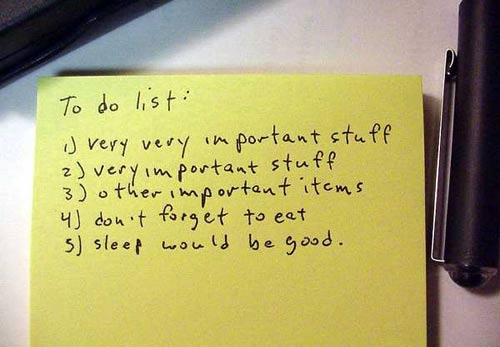
A good start
2. Break large assignments down – This helps A LOT. It’s too daunting to write a whole book, article, or explain everything to your spouse, friend or parent that you need to. What section of it do you deal with first? Second? How many parts are there to the whole? Take it in sections that are guaranteed to get you to the finish line because unlike human beings (yourself included), math doesn’t lie and you will one day be guaranteed to complete the task, or write/say “The End”

leave the 8 ball for last!
3. Reward yourself – also in increments. This includes small rewards and bigger rewards, especially when you finish. It’s the finishing of something (a section or the whole thing) to reward, by the way. Not how good or bad you think it turns out. The truth is – you don’t ever really and truly know the quality except that it feels good to you. We all want approval but the victory is in completion. Some of my best work has not been recognized and some of my only merely good work has. Some of the just okay or occasionally bad work – I’ve been told is good. Which was and was not true, depending on the work and who said it. If you try to separate any of this it’ll drive you crazy anyway. Even more reason to recognize the real reward in doing what you set out to do.BTW, tangible rewards can be – clothing, a cookie, a car, sex, alcohol, mindless television, a trip, sleeping all day, the beach, ignoring your overbearing family or friends for a few days, a spa treatment (real or emotional spa), or a walk in the park or more time than you had planned with your dog or cat or pet snake. It’s mostly about whatever floats your boat.
4. Make a schedule. With a script this helps immensely. How long will the outline take? How many pages a day to the first draft. I used to schedule this way: five days a week work – at least 3 pages per day, five days a week. That was a MINIMUM. Meaning, at the very, very, very least – I’d do 15 pages per week, 60 pages in a month and 120 in two months. Often, I’d go faster. Some days I’d go slower. But it NEVER took longer than that. Ever. Don’t set the deadlines too punitively or you’ll find a way out of it. Better to be disciplined but not school-marmish with yourself. You don’t get karmic points for the amount of self-deprivation that contributed to your accomplishment level
(Note on scheduling: I have been more ambitious on skeds when I had an inevitable deadline from the outside. I can remember sitting down to write the first draft of one script on a vacation from a full time job. A one-week vacation. I knew that technically I had only 9 days to write. I planned out for a month the amount of pages on those ten days, cancelled everything else and had a first draft in 10 days. Twelve pages a day – four hours in the afternoon, two to three at night. It’s intense but not that hard. Also, it helps to be single. Requirements include that you don’t engage with the outside world, including your television set and the web. Don’t worry. They will still be there. You’ll be missed too – but not that much or as much as you think. And Everyone will survive. Especially you)
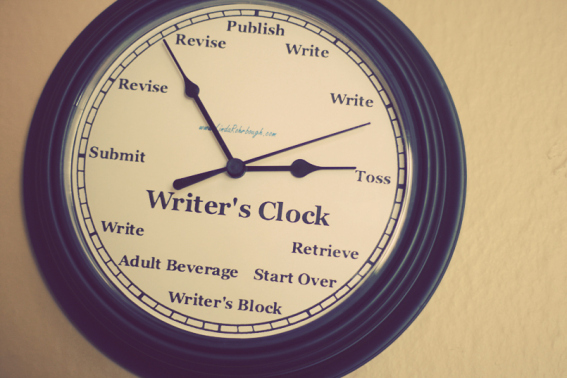
It’s about Adult Beverage time..
5. Accept you can be brilliant, as well as bad, as well as limited, as well as unlimited. Not every day is great. Sometimes they just suck. But not every day will suck. Unless you determinedly decide they will. Some of my best days of accomplishment started out as my worst days of procrastination and self abuse (literally) until I got so disgusted with myself I just didn’t care and decided to dive in. Meaning – it helps sticking it out no matter how painful or a waste of time it might seem. Even if it’s just for a day or a few hours.
Sometimes you can wing it and get lucky and meet the deadline anyway. Or you can miss it and leave it to the fates to work it out and it does. In these cases, I think it’s because people have a vague plan but their experience, creativity and relaxation just allows them to do their best. That’s what I love about blog writing and generally working for yourself, especially when the financial wolf is not knocking at your door and you’re doing your project because you WANT to – not because you HAVE TO. I try to think of every paid project like this too – literally trick my mind into it, pretending it won’t count for anything really or the person I’m reporting to won’t pay much attention even though they say they will. You might be shocked at how easily I can trick my crazy little mind in that moment but we all can easily talk ourselves into all kinds of things. Just go over the myriad of lies you told yourself about one or several former boyfriends, girlfriends or spouses in your life that you convinced yourself were true at the time but turned out to be as false as Nixon’s initial denial of the Watergate break-in and you’ll get the idea.
Of course, there are the moments where you’re so anxious about what you have to do that it’s just a total freak out where your lack of preparation shines through and causes you to be basically – well, fucked.

Yet even then there is solution if you don’t look too hard or too far away. And that is to – own up and be 100% totally yourself. Yeah – just embrace your total lack of prep, your brain freeze, your lack of focus and irresponsibility. This is what happened recently to a young British journalist from BBC radio in the absolute best six and a half minutes I’ve seen in months. Interviewing Mila Kunis during a Disney press junket for Oz, The Great and Powerful, he was clearly unprepared and admitted to being hopelessly nervous. If you have ever seen Notting Hill, imagine the bumbling journalist played by Hugh Grant had a child with the huge movie star he was interviewing played by Julia Roberts and that their son is now in his twenties and interviewing another huge movie star much like his father had many years before. (In fact, the kid looks a bit like a young Hugh Grant). And this is what happened:
NO – This was not rehearsed. This is real. But if the kid is an operator and you can prove that – please don’t tell me. Spend that time meeting some other of the many deadlines you have looming.
Besides, right or wrong it won’t matter. Mila’s Oz made $80 million in 3 days despite what any one critic or audience member like you thinks of it, or its stars or the journalists covering its debut. Plus, this kid is a viral video sensation clearly destined for far bigger things than you and I.
Despite everything, this sometimes happens in life. So be prepared.





 notes from a chair