Modern Love

As I binge watched Amazon’s eight-episode Modern Love series this week I wondered what part of my relationship with my husband would serve as the jumping off point for our episode.

Nothing came to mind.

That is not because there wasn’t drama, comedy, love, hate and everything in between. (Note: Please, we’re talking about two gay men here).  It’s because after celebrating 32 years together this Oct. 24 there are too many stories.

There are also too many risks that the one story I did choose to tell would only come across to the collective YOU as a painfully self-satisfied humble brag.

what can I say?

Maybe something along the theme lines of:

— See, we almost broke up but then a series of inspired events where we both took chances brought us together!

— You think the perfect mate for you will never come along, well let me tell you about how many toads I had to kiss.

— Share your deepest secret publicly with the world and perhaps get some therapy, or meditate, or give someone a chance that you NEVER would have dated or befriended in the past and you too can be as happy as the ME in MY love story.  Why NOT, right?

I just can’t do it for numerous reasons, and one other, which we’ll get to in a minute.

For those unfamiliar with the world of Modern Love (Note: And which of us isn’t in some shape or form in the broader sense), the series is loosely based on real-life love stories that appear in a recurring column in the NY Times Style section.  It began 15 years ago and grew exponentially in popularity.  Four years ago it became a podcast.  This month it debuted as a half-hour streaming show and this past week it was renewed for season two.
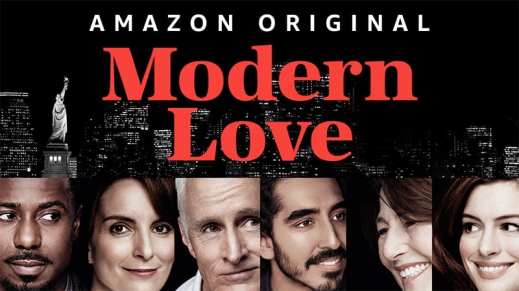
… and that’s not even half the cast!

I guess that means it has good ratings but, seriously, with streaming platforms like Amazon (Note: And Netflix and Hulu and…) we don’t really know.  I mean, would you swear to it?  I certainly wouldn’t.  Maybe it’s a loss leader, like the perfect sized 125 inch Hi-Def TV on sale in limited quantities just to get you into Target on Christmas Day.

Losing interest, already?

Well, don’t.

Before deciding this universe is only for romance novel fans, rom-coms addicts, or those looking for a very special brand of reassuringly Hallmark non-holiday movies (i.e. women and gay men of certain age), not quite.  Actually, not at all.

Modern Love is not necessarily focused on romantic love and not always about happy endings for all concerned.  It can be about weird friendships, familial connections, unsettling dysfunction between parents and kids, old people too close to death’s door or mental illness.  Years ago I read one about a dog that I barely got over, though quickly decided I could have written better from my own experience.   (Note: See humble brag).  Yet on reflection I recently decided the latter was not true, it would have only been different.

Did I mention I love my dog?

The half hour format gives the show a bit of a kick as does the limited space the Times reserves for its frequent Sunday column.  You don’t like that particular story, you won’t be bored or annoyed for long.  But every so often you get whacked upside the head in a great, unexpected way by one of them.

To call them inspiring is to imply too much bathos.  The best ones emerge as unusually true and atypically heartfelt.  In fact, the best ones are the anti rom-com.

This is why actors such as Dev Patel, Catherine Keener, Anne Hathaway, Tina Fey, Jane Alexander, Andrew Scott and Andy Garcia were attracted to emotional season one roles that these days are scarce to sometimes non-existent (Note: Depending on the way you look and your age and your race) on the big screen.
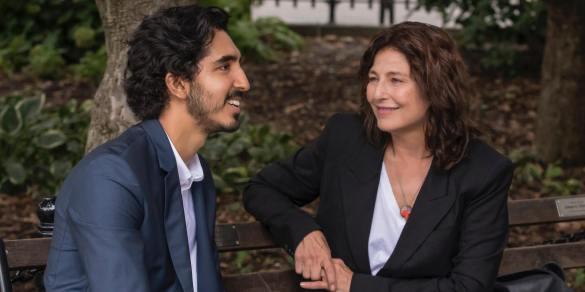
YES, Catherine Keener, YES.

As Martin Scorsese, Francis Ford Coppola and many others have opined in the last few weeks, not everyone – meaning actors AND moviegoers – can fit into the Marvel/DC Universe.

This came into specific focus when I began reading the extremely mixed and varied reactions to Amazon’s eight episodes.  Numerous critics felt at least half of them were flat and phony while others loved most of the entire series.  A reviewer for Entertainment Weekly rated them from best to worst and had the nerve to put MY LEAST FAVORITE at number one.  Imagine!

But that’s the way it is with love, modern or old-fashioned.  What floats your boat is a repellent to someone else.  This is fortunate because if reactions were universal I am fairly confident I would not be in a loving relationship for 32 years.

Very romantic

Which reminds me, towards the end of my binge something happened in my own story that may or may not read like a humble brag but stopped me right in my tracks at the moment.

My husband had come upstairs (Note: No, we didn’t couple binge it together!) for an Energy Drink to sustain him long enough to focus on finishing a chapter for the long overdue textbook he was writing.  He went to the fridge, looked up, poured the drink into a glass and finally noticed I was searching, frantically and frustrated, through the cupboards and drawers for something.

What are you looking for?

Do you have any gum?  I just really need a piece of gum.

Yes, I am addicted to Extra’s sugarless bubble gum.  A nasty habit but certainly better than drugs, McDonald’s or indiscriminate anything at this point in time for me.

Actually, I do.  It just so happens that I keep a secret package downstairs in a drawer in my office for this very reason.

.. and now I’m a puddle #thesweetest

At which point he proceeded to go down and up the stairs in less than a minute and proudly produce that pretty pink pack of overly sweet, plastic-wrapped, chemical deliciousness.

This might not make a good episode of Modern Love but it says everything I could possibly tell you about what might still float your boat after 32 years.
David Bowie – “Modern Love”

Home is where the….?

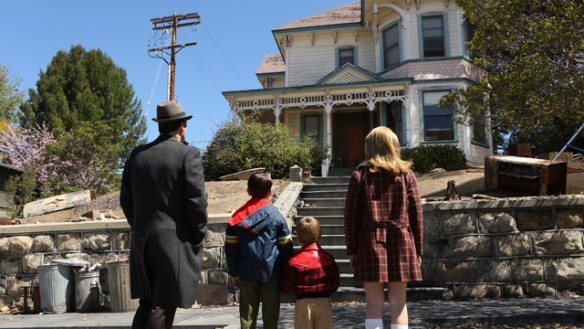
There’s a fascinating movie now available on Amazon entitled The Last Black Man in San Francisco.  It’s a semi-autobiographical story about its star and co-writer Jimmie Fails and his odyssey to reclaim the old Victorian-style house his grandfather built many decades ago in San Francisco.

The film is about many things and is quite artfully done.  But ultimately it very masterfully asks us to consider the loaded and timeless question of:

What is home?

It’s difficult, and short sighted, NOT to think about the answer these days.

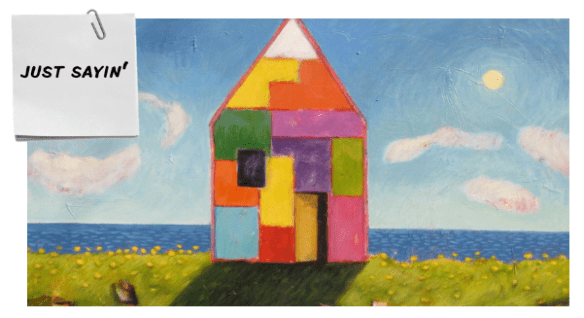
A coat of paint, and a whole lotta heart

The ravages of Hurricane Dorian in the Bahamas, where we’re now being told current estimates of under 100 dead are likely to jump into the 1000s, are seen not only in TV satellite shots of rubble that were once more than habitable houses.  They are equally felt on the faces of every displaced Bahamian staring back at us from the wreckages or through the ache in their voices on radio or through the telephone.

That tone and those images are eerily familiar.  They build from last year’s wildfires in California, the devastation of 2017’s Hurricane Maria in Puerto Rico and Florida (Note: $91.61 billion in damages, according to estimates), which were preceded by Hurricane Irma and Hurricane Harvey earlier that year, which built on various other blizzards, floods, hurricanes and fires in the two years before in the U.S., all of which (and more) harken us back to what feels to be (but surely won’t be) the granddaddy/parent of them all in the U.S., Louisiana’s Hurricane Katrina (2005 and $125 billion in damages).

It is important to note that in human terms, over 150 million people were displaced internationally due to national disasters in just the time period between 2008-2013.  Still, that number doesn’t even include any of the disasters randomly mentioned above.

What she said

Nevertheless, there is ONE bright spot we can safely assume in all of this:

The vast majority of ALL of these people in all of these disasters still have a place in their lives THEY call home.

Last Black Man in San Francisco, a multiple winner at last year’s Sundance Film Festival, forces us to confront our value judgments on where people live and how they live these days.

Sure, an old Victorian townhouse in one of the great urban cities in the US is nice and trendy and all that and more.  Yet it all depends on where that particular piece of brick and metal and neighborhood fall in your personal (and racial) hierarchy and in what year it’s being rated.

How much do you think Don Draper’s whorehouse is going for these days? #stillthinkingaboutit #madmenforever #jonhamm

If you live in a big city it’s likely the hip area you’ve probably overpaid handsomely for was once a slum, an ordinary working class neighborhood or even a downtown factory outlet on the wrong side (or no side) of town.

You may think you’re hip and cool now but the same people who lived in that same place 40 years prior were on the outside world looking in and considered anything but.  Nevertheless, their place might have also been considered a whole lot homier than what you’ve made of it.  Perhaps they themselves were even a lot happier.

And if we were to really stretch the metaphor that could even be said for the guy whose only house consisted entirely of an illegal tent pitched in the alleyway of one of those streets or cul-de-sacs not more than a block from you.

Really?

Yes, truly.

Right, Chairy, it’s real easy to philosophize about all this when YOU’RE writing with a roof over YOUR over-privileged head!!

Well, perhaps.

But no one (Note: Not even Chairy) is advocating living without a bed and/or a place to stay warm or cool, is what most humans want.  It’s just that, well, NOT having these material comforts does not make anyone homeless in the truest sense of the word.

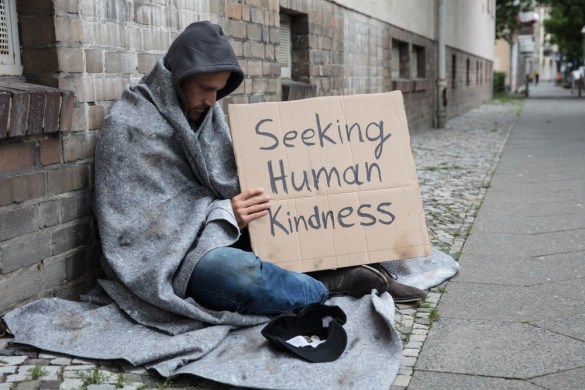
To brand a person as homeless is to dehumanize them.  It is to relegate them to a category of disenfranchised and forces them into some overall sad statistic WE can keep a healthy distance from.

It is to also put them into a group too many of us Americans these days want to keep a distance from.

When people are homeless we assume they lost the home they had, are fleeing some inferior home they occupied in some unwise place or for some unknown reason for which THEY are solely to blame.  Or are not smart enough.  Or were born into a caste system where they never really had the very basic of human needs.

Yes #kindnessalwayswins

Whichever is the case, and in some cases we assume there are many, clearly THEY are not US.  Most certainly they are also lesser than.

The images of so many immigrant families standing on line, or in 2019 American parlance cutting in line, in order to make a life in the United States is our other new version of those people without homes.  Those people who are homeless.

Imagine the effort it takes to leave the place in which you were raised by accident of your birth and come to a strange country where you likely do not speak the language and have few, if any prospects other than the fact that you won’t be murdered in cold blood.

Could YOU make the journey?  Would YOU make the journey?  Finally, WHY would YOU make the journey?

You were born and raised in Honduras, Nicaragua, Syria, Guatemala, et al.  You’d leave everything behind with the pipe dream of making your home in the United States?  What could possibly make you think a homeless person should be lucky enough to be given a HOME in the United States???

Of course, the answer is every one of those people making that journey already have a HOME, i.e. a place where they can feel safe and warm, because they brought it with them from their own country. 

We should all be the Baileys welcoming the Martinis #breadsaltwine

It might not be brick and mortar or discernible by the contents of their suitcases or the money in their wallets.  Sometimes, it is merely a spot where they know they are okay, or will be okay in the face of adversity.  For each and every one of us, home is at least partly that or we are, indeed, the ones who are truly homeless.

As the world shifts, drowns and burns, and the borders of our respective countries of origin are slowly beginning to be sealed off, it’s important we be clear on who and what makes a real home.

As the offspring of two sets of immigrant grandparents, and a member of at least two minority groups still persecuted very actively worldwide, I know how and where I LIVE is not the determinant of who I AM.

… plus it’s not like I have an infinity pool #soLA

I especially know this after buying my first house a mere three years ago in a city prone these days to natural disasters.

If I lost it tomorrow, yes, I’d be devastated.  But I would never consider myself homeless.

Nor should you.  In regards to yourself or anyone else.  And that’s especially true if you right now you are fortunate enough to have any sort of physical roof over your head.

Diana Ross – “Home” (from The Wiz)