Labor of Love

Screen Shot 2014-08-31 at 12.13.33 PM

There’s something so damn ingratiating and infectious about people who love the work that they do and excel at it.

For instance, did you ever go to a restaurant where the waiter treats you like a guest at their home and through sheer force of will and great food manages to make you feel happier than you have all day? How about a classroom where the teacher is so animated you are suddenly fascinated by a subject that you previously would have walked twelve long miles to avoid? Sometimes it’s even a film, TV show or performer putting you under such a spell that you actually forget to check your email, texts or any other form of social media messages for more than two whole hours.

Well, I’m here to tell you singer-songwriter Jason Mraz is exactly that infectious, excellent and just so damned ingratiating whenever he’s performing onstage.

The Chair's attempt at concert photography (call is the Blue period)

The Chair’s attempt at concert photography (call it the Blue period)

Don’t think I’m going all corny on you in either the messaging or the Mraz-ing. Yeah, even Mr. Mraz knows the cynical wrap about him always being Mr. Hippie Positivity and one of the first things he does in his shows is confess that he has more than his share of dark, depressing thoughts daily. But his work, as he sees it, is to take exactly what he’s feeling and make it into something artistic that maybe he, and in turn you and I, can feel good about.

Now, if that’s not a Labor Day weekend message, what is?

I had originally planned to write about the challenges of being part of a minority group this weekend, touching on the uprising of the Black community in Ferguson, MO over the police shooting of an unarmed 17-year-old boy. This would then be tied into the negative blowback Modern Family actress Sofia Vergara received from so many women (and the men who love them) across America for her willingness to flaunt her shimmying body on a 360-degree revolving platform at the Emmy awards. Which would lead into the chastisement I got from certain quarters for supporting her “subversion” of the Latina stereotype in a blog post here last week. This would all then culminate in how whether your minority is Black, Latin or gay like me (Note: I was even going to try to get the Middle East, Israel, Iraq and Isis in there) – the prejudice and marginalization are all various iterations of the same exact issue that, until recognized, will prevent us all from ever truly moving forward as a race, a culture or a planet.
Wow... that's a lot.

Wow… that’s a lot.

I’ll bet now you’re happy that 1. all we’re doing is talking about Jason Mraz and 2. I happened to see him at a two-hour plus concert in Hollywood this weekend.

Except, it’s not quite as simple as that.

Mr. Mraz is one of the few of us lucky enough to have figured out how to merge his job with his passion. It may be difficult to think of him as a worker on Labor Day because he is so wealthy, famous and talented at the relatively young age of 37. Not only is he not in the 47% along with most of the rest of us, he’s in the very elite subset of the upper, upper 1%. The .001% Or the .00001%? I haven’t seen his bank account but two Grammy awards, a 5 and a half acre organic avocado farm near San Diego, a joint ownership in the hugely successful Gratitude Cafe restaurants, one of the most enduring hit singles to ever stay on Billboard’s top 100 chart (76 weeks) and a never-ending concert tour schedule of venues all over the world indicate he’s doing more than okay. Not to mention, his goal to be #RetiredAt40 and spend most of the rest of his time farming – or at least slowing down from the star musician’s life he has carved out for himself over the last decade.

Farmlife with Mr. Mraz

Farmlife with Mr. Mraz

And yet – at essence he’s really just a worker. The fact that he’s treated as something more than that lies at our doorstep– not his. #ThinkAboutIt.

As a writer and a performer on the concert stage whose work has also been seen on television and in the movies, Mr. Mraz is at the very least a member of several or more show business labor unions. But even if he weren’t there is no denying he is an American worker and laborer – that is to say someone who contributes goods and/or services to society and whose efforts should be celebrated. Especially when it’s done exceedingly well.

So, how does one rise to the level of elite worker, which is not the same as asking – how do I become rich and famous? The latter is a byproduct of the profession one chooses to work at, one’s talents and a lot of timing and luck. (Note: And don’t let anyone else tell you any differently).

Well, since he’s obviously on my mind, let’s use Mr. Mraz as an example and have his actions tell us.

ATTITUDE

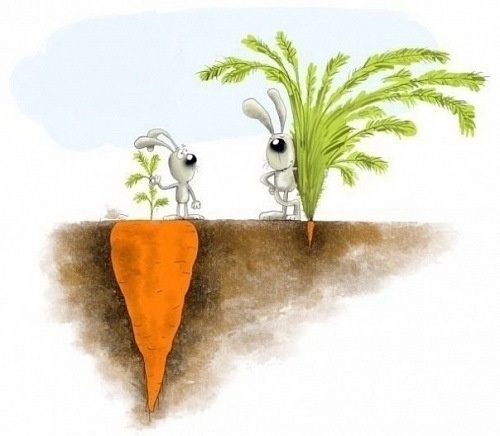
Well... which one is it?

Well… which one is it?

You’d think hard work would be the number one value here but the ability to work hard really begins with your attitude. One of the lessons students get from me when they arrive in L.A. for a semester to do internships in the entertainment industry is that the people you work with will innately know whether you enjoy working there or not. This does not mean that every working moment of your day is a joy or a pleasure or even easy. What it does mean is that somewhere inside you want to dig in and get the job done or you wouldn’t be there in the first place. And whether you’re tired or in a bad mood, once you get going a certain pride in doing what you like takes over and you get caught up in the moment of putting time into a job to the best of your abilities in the given moments you have chosen to put in that day.

Mr. Mraz has mastered this. There’s a joy in his eyes when he performs. When he screws up the lyrics or a technical element of his show doesn’t work, he laughs it off or makes fun of himself. He’s planned out his program but he’s willing to improvise and engage his fellow musicians and his audience even if it means extending the length of his show. Instead of phoning in his performance or duplicating his recordings in front of you, there’s an easiness that assures you that you are in good hands and are about to see something unique because he never does any one song in exactly the same way. In other words, he doesn’t make you feel like he’s doing you a big, fat favor by being there because he wants to be there.

There are only a handful of performers out of the many that I’ve seen live that have the ability to do this. Bruce Springsteen is one. Perhaps surprisingly, the Grateful Dead were another. Bette Midler in her early days was a third. They make you feel as if there is nowhere they’d rather be than doing their work for you when they’re doing that thing they do so well. There’s a spring in their step. And it’s infectious.

WORK ETHIC

Noted writer and social scientist Malcolm Gladwell wrote in his best seller, Outliers, it takes approximately 10,000 hours of dedicated practice to become an expert in your field. Since there are about 8,765 hours in a year and most people put in approximately 2,080 hours at a full time job, this means it takes in the neighborhood of 5-10 years to become any kind of expert in your field.   Other researches have expressed these thoughts though none of them guarantee that expertise will equal financial success or worldwide recognition.
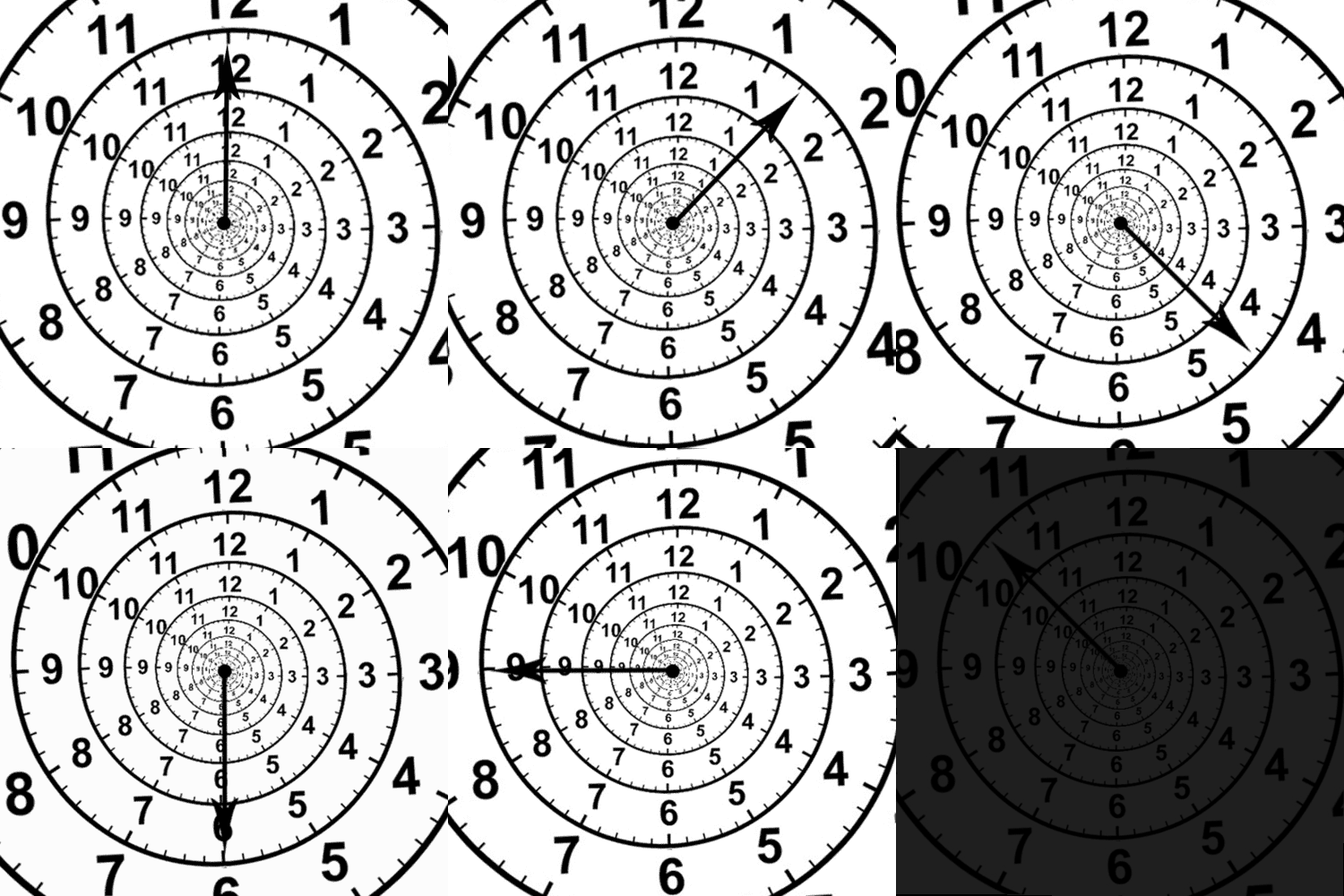
How many hours are you up to?

How many hours have you put in?

It may not be surprising then that for every album released, Mr. Mraz has an estimated 70 leftover songs. This certainly wouldn’t come as a shocker to any writer or observer of pop culture or even dedicated worker of any kind. In fact, Bruce Springsteen himself, flaunting a thick dog-eared songwriting notebook on 60 Minutes some years ago, expressed similar thoughts. The problem is that an expert worker who does what they do well is revealing their final product to you in its most polished form. And when it’s that clear and well done it’s hard to believe it could’ve taken so many other discarded efforts to get to that place.

In Mr. Mraz’s case, this is quite reassuring to me since his seemingly infinite abilities at unforced rhyming and clever world play appear so natural that one assumes they had to be tossed off in numerous fits of immediate, savant-like inspiration. #HeMustBeLackingInOtherAreas.

A LIFE

After all, you gotta share the guacamole with someone!

After all, you gotta share the guacamole with someone!

I once had the false notion that to be that good at what you do took a single-mindedness that precluded anything else in the universe. Meaning that if you were an artist you locked yourself up in a dank room where someone put a tray of gruel outside your door (or you simply found some in a filthy refrigerator) and you were let out only to eat and shower for half an hour spurts each day before being shoved back in and locked up again. A personal life? Travelling? Leisure time connection with family and friends? Are you kidding? Oh no, there’s plenty of time for that later. Maybe. Once all this important stuff is done and I have the chance.

Great workers know this is completely wrong. They might be dedicated and they likely work long hours. But most have some engagement with the world or they could never rise to the levels that they do. In order to be a master inventor or executor of any craft you have to engage with the task and the world it inhabits. And since nothing in the universe exists in a vacuum this means – yeah, you have to participate and get out from behind the locked door.

I don’t know Mr. Mraz and certainly don’t expect any kind of kickback from his manager. Nor do I think every single song or task he takes on is perfection. What I have noticed though is that he has a life. He shows video from his tour to Antarctica, his farm in Bonsall (near San Diego – and it’s not “glamorous”) and frequently appears at benefits for underprivileged youths and the environment. He’s an avid vegan and yoga enthusiast but admits to loving weed and formerly adoring Mimosas and cigarettes. Plus, he’s had lots of girlfriends and more than a few long-term relationships (Note: I had to throw this in because, well…I had to).

Hiss and boo the sixties hippie mentality all you want. But they were THE SIXTIES for a reason.

GENEROSITY

Two is better than one

Two is better than one

No, we did not cover this under the previous Life section. At this weekend’s concert Mr. Mraz spent a huge chunk of his time promoting and sharing the stage with a group of four talented female musicians called Raining Jane, who co-wrote all of the songs on his just released current CD, Yes. I highly recommend the CD. It’s clever, smart and uplifting. It will make you happy, especially in moments when you don’t want to be. You will not want to give in to it but if you keep listening you will. Really good work does this. It wins you over.

Here are some of the song titles: Love Someone, Back to the Earth and Shine. Tell me you don’t want to loathe what you perceive to be sugary and saccharine in our quite ironic world. And…how is that working for you?

I might have had similar feelings, though perhaps not quite as strong, before I took a listen and then attended the show. Not surprisingly JM and Raining Jane took seven years to finish the CD, many of whose songs are performed live on the current 35-city tour. The results of the time and care taken to put it all together show and they just might surprise you.

Of course, that’s what great work and workers do. Every time.

Once again, Mr. Mraz and company are not paying me for what I’m saying. Nor should any of you feel obligated to.

It’s all part of the job I do here.

Depression ≠ Creativity

Screen Shot 2014-08-16 at 11.05.56 PM

I wasn’t going to write about Robin Williams’ death. I mean, do we need one more person weighing in about the actions of someone we were convinced we knew but had never met? But then I thought rather than exploitation this could be an opportunity.

Here’s the dirty little secret about creativity and depression:

It is not true that most artists are depressed nor is it true that one has to suffer to be an artist of any kind. This is a bill of goods we’re usually sold in countless books, plays and movies.

However, what I’ve found through decades of doing creative work is that many depressed people use creativity as an outlet and that many of these people seek to make their living in the entertainment industry. Therefore, it is more than likely that one would come across more individuals battling depression who are in the biz than say – plumbers or dentists or garage mechanics. Not that these professions don’t have their share of people who have battled all kinds of illnesses, including depression.

I am someone who has battled depression on and off for most of my life and only came to fully realize the full extent of that ongoing battle less than a decade ago. Prior to that I just considered myself to be a person who was overly sensitive and prone to sadness. A lot. And usually in private. Not that I didn’t have the capacity to be happy. I did – do. But when the “sadness” kicked in, there was no telling how long it would last, in what way it would manifest itself or the amount of time it would take for me to “choose” to snap out of it.

Living in the shadows

Living in the shadows

Depression is an insidious illness… condition… or whatever you want to call it. And is quite different from mere sadness. In an explanation that is as good as any that I’ve read, a writer friend of mine who went back to school to become a therapist – and is clearly a good one – posted this in the aftermath of Mr. Williams’ death:

Depression is not sadness. Sadness is a rich, deep emotion that is full of life and heart and feeling. Depression is a bleak, numb, overwhelming sense of emptiness and nothingness. It is psychologically painful and can be physically painful. It can be enormously debilitating and can cause one to lose hope.

Certainly, there’s more. My therapist friend followed this explanation by urging people not to lose hope or hurt themselves but instead reach out to the many people and places in the world ready and willing to help.

Of course, many depressed people have done this and have not seen immediate results. Or have gotten better only to relapse. Yet that is the case for numerous conditions and illnesses – from metastatic cancer to the aggravated sciatica nerve you pull out in your back or side. (Note: Yes, I am currently the “you” in the latter category).   So why do so many of us, including quite often the actual person who is clinically depressed, eventually tire and want to just shake a depressive endlessly until they finally agree to cheer up and thus snap out of it?!

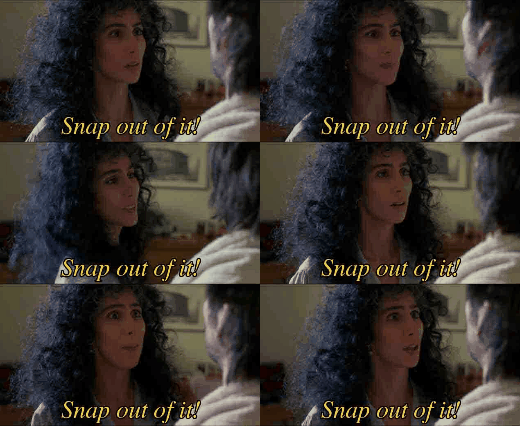
Not going to work.. no matter how hard Cher slaps!

Not going to work.. no matter how hard Cher slaps!

Well, that’s one of the challenges here. Almost everybody, including the patient involved, finally tires of this condition and reacts to it in his or her own individual ways. Among these is withdrawing from the hideously debilitated person – or this hideously debilitating condition – entirely. Which, as we all know, can sometimes yield the worst of outcomes.

I am not writing this to capitalize on Mr. Williams’ death nor to in any way promote myself or my issues. There are better ways to do both as anyone who surfs the web, watches television, or exposes oneself to any news source at all – including this blog – has seen. Rather it’s to reiterate it to all to myself once again. Because dealing with depression is an ongoing education that someone who has it can easily forget to reinforce since it’s so tempting to chalk it all up to just being blue, down or having a bad day.

In the process if even a line of any of this hits home, I’m happy. Well, only as happy as someone like me can be.

….C’mon, I’m only joking!   Well, sort of.

Myths and Truisms in the Arts re: Depression

1. You don’t have to suffer to do great work in either comedy or drama.

... and certainly not to paint a Starry Night

… and certainly not to paint a Starry Night

There’s a way to get in touch with your emotions and not get sucked down with them. You can’t truly, as a writer, present a situation in a thoroughly depressed state anyway. In fact Mr. Williams himself recalled, according to his L.A. Times obit, an acting teacher who years ago once scolded him for being “too vulnerable” in his emotional scene work in class.

Dear boy, said Mr. Williams imitating the teacher in a thick British accent, that was a lovely scene. And your emotions — there was so much of them! But it’s a bit like urinating in brown corduroy pants. You feel wonderful, but we see nothing.

This is not to say that great writers, actors, singers and many other creative people do not tap into deep personal feelings in what they do and remain unaffected. But they also need a bit of distance in order to see the entire reality of what they’re creating. This is a near impossible feat for a person in the throes of clinical depression. And for those few superhuman souls who can surmount the odds and continue to function, it becomes a dangerously slippery slope of existence that can eventually lead to far more troubling results.

2. The brains of clinically depressed people, or those who over a period of time become clinically depressed, are different than those who are non-depressed and often lead to unclear or just plain bad decision-making.

It goes beyond left vs. right

It goes beyond left vs. right

This one really got to me when I first started to do reading on the subject. You mean to say when you’re depressed your brain is literally offor rewired from what it once was if this condition develops over a period of time??? How can that be? Well, rather than me explaining it, take it from the experts we’ve imbedded here.

Expert 1

Expert 2

Expert 3

Now I don’t know about you, but I can’t stand it when someone else tells me to do something I don’t want to do – or deal with an issue I know is wise to avoid. ESPECIALLY, when they tell me it’s for my own good, and MOST ESPECIALLY when they’re right. So finding out that what you 100% think or know you feel deep inside your brain or even soul might not always be the result of clear thinking is, well…let’s say it’s particularly daunting.   Yet in retrospect I realize that my past attitude and behavior towards my own foibles in this area were not unlike the extremely drunk/stoned friend or family member who is utterly convinced they are well enough to drive themselves and you home from their ex-fiancée’s wedding.   Certainly, I would not get in the car with that person. But what happens if you are that person? You can’t stubbornly pretend you don’t have the problem and you certainly can’t always depend on being saved by the actions of someone else you will most certainly choose to ignore if you want a favorable outcome.

3. Art can be great therapy for your mental woes but the entertainment industry does not have a ton to do with art.

It gets hot under those lights...

It gets hot under those lights…

Yes there are elements of it but, on the whole, there is quite a bit more to the biz than that. This makes it quite challenging for artists prone to depression who, we’ve established in #2, certainly don’t want to be told how to live their lives or even what to do by others.

This being the case there are certain questions it helps to ask oneself. Is all your self-esteem entirely tied up with the results of what you do in art and/or the biz? Do you think you’re nothing without a certain kind of attention or success? Are others able to roll with the punches while all you want to do is punch yourself – and repeatedly – when things don’t go exactly your way? A yes answer does not necessarily mean you are clinically depressed but it is also not a sign that you are in a healthy mental state. Consider what active, healthy steps you can take right now to begin to change your mental state. (Note: The correct answer is not always getting a deal, the role or the sale).

and believe me... this doesn't help either.

and believe me… this doesn’t help either.

By the way, it is particularly worth noting that everyone’s artistic career eventually ebbs and flows in popularity, financial success and output. Do an imdb or Wikipedia search of any great “star.” You’ll see many more ups and downs that you imagined. This is particularly true the longer you’re in the game. What is also true is that given advances in medical science there are any number of individuals in their seventies and eighties still doing great work. But with many more failures in their pasts than successes you have in your present. It’s all about how you and your brain decide to look at it.

4. Just because a depressed person is momentarily cheered up by material stuff, or love (in whatever form) or even– dare I say it – faith – does not mean they are cured. Or even okay. What the outside world sees of an individual is not necessarily the inside reality.

What's on the outside doesn't always show you what's underneath

What’s on the outside doesn’t always show you what’s underneath

This truism seems particularly confusing in the case of Mr. Williams. How does someone so jovial, so loved, so successful and recognized, and so wealthy, succumb to….that? It’s complicated. And deceptive. And notoriously elusive in understanding. I hate homilies like don’t judge a book by it’s cover but one of the great ironies of life is that there is more than a grain of truth to even the most overused cliché. If you don’t believe me, go over this list and see how many you really disagree with.

5. Medical care for a mood disorder does not blunt one’s creativity. Nor is it cheating or taking the easy way out. If administered properly it makes the person even more of who they are destined to be. Plus, it can significantly change the course of a drowning person’s life by, in many instances, saving that life.

Remember this is what they are made for!

Remember this is what they are made for!

No one really wants to slow down or admit they have problems of any kind – especially publicly – whether it’s to your friends and family or on the national stage. Not to mention that there are strange moments of really intense and intoxicating emotions associated with these problems that can be oddly difficult to part with.

Still, the chances of controlling any major illness alone without some qualified outside help are about as good as Michelle Bachman successfully running a PFLAG meeting in West Hollywood (Note: Not that we’d need one here). Meaning – it will not end well and any bookie would take that bet.

A parting Note:

Mr. Styron

Mr. Styron

One of our greatest novelists of the 20th century was a man named William Styron. Among other achievements, he won the National Book award for writing the acclaimed 1979 best-seller Sophie’s Choice, an epic story made into a memorable film starring Meryl Streep in the title role for which she won her first best actress Oscar. Mr. Styron later chronicled his 1985 plunge into a near fatal clinical depression and then his successful battle back in Darkness Visible, an exquisite 1990 memoir.

Here is how he chronicled the illness in an article for Vanity Fair.

The pain of severe depression is quite unimaginable to those who have not suffered it, and it kills in many instances because its anguish can no longer be borne. The prevention of many suicides will continue to be hindered until there is a general awareness of the nature of this pain. Through the healing process of time—and through medical intervention or hospitalization in many cases—most people survive depression, which may be its only blessing; but to the tragic legion who are compelled to destroy themselves there should be no more reproof attached than to the victims of terminal cancer.

Mr. Styron could not have been in the best of moods when he wrote Sophie’s Choice – one of the most brilliant and disturbing books of the 20th century – but he was most certainly not in the throes of clinical depression. If he had been, he never could have had the wherewithal to produce such a masterwork. And had he not sought and received treatment after the escalation of his condition in 1985, he would never have been able to write the concise 88 page memoir five years later that grew out of a talk he was asked to give on the subject to doctors at Johns Hopkins School of Medicine after he had recovered. His work and these events all helped usher in a new contemporary understanding of the disease.

This is something to think about for artists and non-artists, depressed as well as non-depressed, people alike.