Serling, Lear & Goldman


No, this is not a law firm.  As far as I know.

These are the names of three show business icons better known as Rod Serling, Norman Lear and William Goldman.

It’s not a good idea to trot out words like icon or legend too often.   You sound like a syndicated talk show host whose sole purpose in life is to overpraise someone more famous in the hopes that it’ll do you some good.

Think Mike Pence whenever he’s in the presence of the Electoral College POTUS.  (Note: And how could you not?)

Let’s hope that’s all he is #Mueller?

Still, there are some cases where the word icon feels exactly right, especially if we are to believe the dictionary definition:

Icon: A representative symbol of something.  Synonym,  idol, paragon, hero. 

Certainly Mr. Serling, Mr. Lear and Mr. Goldman are all of the above and more to most everyone in the writing trade, the entertainment industry and by extension, through the reach of their life’s work, the world.

Hyperbole?  I think not.

Thank you Stefon

In the last several days I was reminded of the gargantuan achievements of these three writers, all born within 10 years of each other, for completely different reasons.

William Goldman, who died this week at the age of 87, was for years the most respected and highest paid screenwriter in the business.  Consider the movies from over 40 years, beginning with Butch Cassidy and the Sundance Kid, then on to All The President’s Men, Marathon Man and The Stepford Wives and then back around to The Princess Bride, Chaplin and Misery and you might begin to get some idea.  If not, you can throw in tons of uncredited rewrites on things like A Few Good Men and Good Will Hunting and perhaps it will get clearer.

The Real Deal

It was William Goldman who introduced the infamous phrase follow the money into the lexicon of political writing via his Oscar-winning screenplay for All the President’s Men.  Peruse his other scripts and you will no doubt find many others.

Just ask Wallace Shawn  #asyouwish

Though none of them will even come close to his three-word perfect summation of the movie business:  Nobody knows anything.

For those not directly involved in the industry, here’s a full sentence of his  elaborating on that thought:  Not one person in the entire motion picture field knows for a certainty what’s going to work.

That and a lot more were written by Mr. Goldman in his 1983 seminal book on navigating Hollywood, Adventures in the Screen Trade.  But more than anything else, those three perfect words – NOBODY. KNOWS. ANYTHING. gave hope, courage and permission to a generation of people starting out in the business, myself included, to soldier on and persevere.

Cheers to you Mr. Goldman

His screenwriting work was brilliant, and he wrote a bunch of fine novels (on some holiday vacation read his first, Boys and Girls Together).  But his ability to so bluntly tell the truth about what he experienced and observed extended far beyond fiction or the movies.  He gave so many of us who had our noses pressed up against the glass the belief that the people we thought we had to impress didn’t have all the answers – we did.  All we had to do was to tell the truth through our work and we had as good of a shot at making it as he did.

Rod Serling and Norman Lear might not seem a natural combination at first mention but when you give it some thought it’s exactly right.  They were born within two years of each other in the 1920s and though Mr. Lear, now 96 and still active, has lived twice as long (Note: Mr. Serling died prematurely at the age of 50,) each writer changed the face of television by being fearless in their own very specific ways.

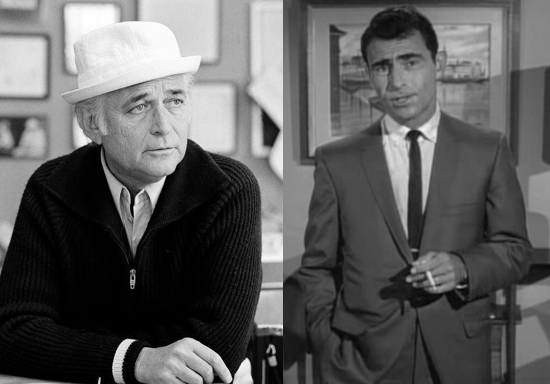
.. and both have a signature look

By his early thirties, Rod Serling was already an accomplished playwright and Emmy award-winning writer devoted to telling meaningful stories that touched on social issues.  Still, he was known in the biz as a bit of an upstart who had grown weary of battling corporate sponsors and executives too timid to support the kind of tales he wanted to tell.

That was when he got the idea to write in the more commercially appealing science fiction genre, grounding his characters in a way so relatable it would enable him the ability to tackle such timely themes as war, racism, class, politics and censorship.

Like you’d ever forget these faces

One can hardly imagine when The Twilight Zone first aired in 1959 that even he could foresee the enduring legacy of that groundbreaking anthology series.  Not only does it still run all over the world more than half a century later, it has been reinvented as a feature film, in numerous television spin-offs and remakes, as well as homaged in the music world.

Most recently, Jordon Peele was announced as the host of a new CBS reboot of The Twilight Zone set to air in 2019.

But perhaps even more impressive is the fact that those three wordsTHE. TWILIGHT. ZONE. – are now embedded as a permanent part of language and pop culture as we know it (Note/Nee: Being an American these days is like living  in The Twilight Zone) that will forever be associated with its writer and onscreen narrator.

It was in that spirit this past week that Ithaca College presented Norman Lear with its annual Rod Serling Award for advancing social justice through popular media.   (Note: Serling taught at the college in the 1970s and his archives are housed there).  As a professor and Chair (Note: Ahem) at the school’s L.A. program, I got to be part of that evening and had a front row seat to Mr. Lear’s sharp as ever comic timing and humility as he got up to the podium at L.A.’s Paley Center to accept.

The man himself, pictured here with Ithaca College’s Park School Dean Diane Gayeski, and One Day at Time colleague Mike Royce

Anyone who has watched television comedy in the last fifty years has likely seen one of Mr. Lear’s shows and the majority of we baby boomers came of age on them.

To watch a first-run episode of All in the Family in the actual era it came of age was to see for the first time in half-hour prime time TV an unvarnished version of ourselves and our extended families in all of our inglorious prejudices, ignorances and, ultimately, humanity.  No one had ever used THOSE WORDS before on the Big Three networks despite the fact that they used them and we heard them every day of our lives.  Heck, no one had ever even heard a toilet flush on TV before the series did it in 1971!

Archie is not that impressed

Mr. Lear also gave us the first upwardly mobile Black family (The Jeffersons), the first TV comedy episode to ever deal with abortion (Maude) and the first divorced prime time mom of the era (One Day At A Time).  (Note: The latter also recently rebooted on Netflix). The fact is if we don’t see an immediate connection between the subjects tackled by the fictional law partners, Serling and Lear, it is merely due to our own shortcomings, not theirs

Among the unplanned comic gems during Mr. Lear’s acceptance speech at the Paley was the moment when his iPhone began to audibly ring.  He stopped mid-speech, instantly reached into his pocket and saw it was a family member, began a conversation with her, and, without missing a beat, put it on speakerphone so the rest of us NOT at the podium could hear.  Most actors, not to mention us non-96 year old pros and non-pros, couldn’t rehearse this and get it right (especially the speaker part) never much less be funny in our ad-libs to a faceless voice.

More skillful, however, was what came next. After he said of his TV work: I didn’t do it alone  he went on to reassure his many admirers that he really is only a person who gets up in the morning, eats, goes to the bathroom and then goes to sleep at night – just like they do.

Don’t mind me.. getting emotional over here

Then suddenly he, and then the room, fell dead silent as he contemplated this for a few VERY long moments.   As we all got concerned something was wrong, he finally looked down, then right back out at us, and said:

You know, everything in life led me to this moment.  Isn’t that something?

At which point he let some more time go by, evoking more silence once again, until he reiterated:  And to this one.

Then once more again, echoing:

And that one.  Everything you have done before has brought YOU right here…..Think about it.

One couldn’t help but wonder if what he was really telling us was that taking in the moment, really feeling it, and then sharing those feelings with others, was not only the key to his art but the secret to life.

Of course whether that’s true or not is in the eye of the beholder. Since, let’s face it, nobody knows anything.

“Those Were The Days” –  Theme from All in the Family


Not a Happy Camper

I never thought I’d be inspired by a quote from a military guy.  I’m the least military that you can be.  Order me to do something and I’ll do the opposite.

This goes as far back as I can remember.   When my parents ordered me to go to the sleepaway camp they were about to register me for when I was 11 years old, I looked at them steely-eyed for a good long 10 seconds.  Then I told them I’d run away and come home every single day I was there no matter how many times they brought me back.  If they didn’t let me in, I’d find friends or relatives to stay with.  If they wouldn’t have me, I’d sleep on the streets.  And I would have had they not relented.

Does it look like I’m screwing around mom??

This was not merely because I was defiant.  In actuality, I was a bit of a wuss considering I came of age in the sixties and seventies.  I was scared to take drugs, never cut school or lied to my Mom AND didn’t figure out sex until I was out of my teenage years (Note: And, ahem, even beyond).

What I did have were good instincts.  This has helped me through my entire life when facing big decisions.  And when you’re 11 years old there is no bigger decision than sleepaway camp.

It’s all very dramatic

I knew that as an uncoordinated, sports-hating, mouthy, stubborn, sassy pants who was secretly attracted to boys but didn’t yet have a word for it, I would never survive what I even then considered the camps.  They might be right for some kids but for me – no way.  It wasn’t even on the table.  I knew the difference between right and wrong deep down in my soul and this was definitely WRONG.

Here’s what Gen. Marty Dempsey, former chairman of the Joint Chiefs of Staff, tweeted out several days ago:

The art of decision-making. When making big decisions, block out the background noise, take stock in what you know, check your instincts, and then decide. It’s important to remember that just because something is loud and repetitious doesn’t mean it’s right… …more than any other feedback, in a world of intense scrutiny and super-charged emotion, how we make important choices tells us who we are and what we hold most important.

This deserves the Meryl seal of approval

This might seem a strange way to get everyone to VOTE but I don’t think so.  You are at the precipice faced by many 11 year olds.  Sleepaway camp or NO sleep away camp.

Of course I realize that not every kid is fortunate or unfortunate enough to have the option.  I also get that local charities raise money just so these kids can get away for a month or two in the summer and enjoy themselves.

Or be tortured.

I imagine my letters from camp would have been exactly like this (from the brilliant Lin Manuel Miranda)

The point is that in a perfect world, the one where EVERY KID has AN OPTION, there will be a significant number, likely more than you think, that would vote to reject the camps and instead choose the steamy city streets.

The world is composed of camp kids and CAMP(Y) kids, if you get the drift, and each one is entitled to some say in creating a life that reflects their reality.

When we’re 11 years old, we don’t always get this choice.  But once we turn 18, we ALWAYS get a VOTE.

ALWAYS.

That is, unless we CHOOSE not to.

Sure, we live in a messy, turbulent world, particularly at the moment, where the choices available are not always the best.

This is real. #tuneout #tunein

You can have what’s in the box or what’s behind the curtain and they both feel like booby prizes, especially since once you accept one you also have to pay taxes on it. #NoDeal.

But, well, you don’t really think I wanted to stay home with my mother when I was 11 years old in the heat of NYC, do you?  Still, it was way, way, wayyyyy better than being stuck up in the woods having to play baseball everyday.  Or sleep in a barracks without being able to listen to my beloved movie soundtrack of Mary Poppins.

Oh Chairy, you flatter me so

Not to mention, that summer I learned how to roller skate (Note: With a metal key), and made friends with a brother and sister who had just that summer moved into my neighborhood.

I even learned that contrary to the custom in my family, you don’t always call your adult friends’ mothers by their first names.  In fact, I will never forget the expression on the face of that brother and sister’s Mom when I casually addressed her as Pat and she turned to ME steely-eyed and said, Call me, MRS. Marshall.

I’ll just show myself out #SorryMrsMarshall

To this day I am very careful when addressing those older than myself to always err on the side of formality.   At least, at first.    And you’d be surprised how much it’s helped.  Whenever I dated anyone, their parents ALWAYS loved me.

No one is saying that there are not moments to abstain from action or refrain from even voicing your opinion.  But this is not one of them.

Some moments in your life it is best simply sit back and follow the lead of those older and more experienced than yourself.

self awareness is also key

Then there are other times, the ones where you are REQUIRED to speak up for own self-preservation.

Or risk being sent to a CAMP that is wrong for you.  One that goes against EVERYTHING you innately are.

Colonel Bogey March