Magic Meryl

You could do worse in quarantine than spending four and a half hours with your spouse and Meryl Streep.  But that’s what happened this weekend and, in a word, it was glorious.

Me, all weekend

No, I’m not just saying this because I’m a gay guy.  I mean, of course that’s part of it.  We gays like strong, insanely talented performers, especially women, who in real life speak out and don’t take crap from anyone. 

But that’s not really THE reason.

It’s mostly because, well, with Meryl you know you’ll always be well taken care of, always in good hands.  Quibble if you must with any one of her movies or performances (Note:  For the record, I have ZERO quibbles) but that’s like saying you had a bad piece of chocolate.

… and I would watch that too!

Some brands might be better than others, but ultimately are any of them ever anything but delicious?

Which brings us to Netflix’s The Prom and HBO Max’s Let Them All Talk.

Here’s what to know.  Both are now streaming, both feature HER in light and dark polar opposite characters that suck you instantly under her spell and, at just over two hours apiece, both enable you to avoid thinking about Covid-19 or quarantine or President #Loser even just once.

Isn’t that what the movies and movie acting are all about?

That, and extremely dramatic entrances #Miranda4Ever

Yeah, well tell that to the two idiot NY Times film critics A.O. Scott and Manohla Dargis who recently wrote a long list/article on the Times’ 25 Greatest Actors of the 21st century and very purposely left HER off it.

Forget what she did in Devil Wears Prada, The Iron Lady and even Julie and Julia.  It’s Keanu Reeves who is the fourth great actor of the 2000s for what he does in all those John Wick movies because the way he embodies this slightly ridiculous action hero…is just beautiful to watch.

Uh yeah, same here Meryl.

But I digress, and no, I’m not kidding.  They actually DID write that. 

This is what happens when you are so universally lauded for your artistic abilities decade after decade.  Some credentialed naysayer, and often more than one, will eventually come around and consider you less than just because THEY can.

We’ll stand up for you Meryl!

This is pretty much what goes on in The Prom, but with a lot more at stake than a list.  It’s loosely based on the true story of a lesbian high school student and her girlfriend who were told by the small-minded powers in their town that they were unwelcome at prom.

Is the exclusion of Streep from that dumb list the same thing as the hurtful homophobia we gay people all often endure at various points in childhood at the hands of those in power?

No, it’s a METAPHOR.  And yet, when you think about it, it’s not exactly dissimilar.  It’s just that when you’re an educated adult and your life is good, it hurts a lot less.

Which doesn’t mean it’s fair, or that it doesn’t hurt at all. 

She’ll get over it, I’m sure

Marginalization is ALWAYS meant to hurt on some level, especially when it’s made publicly and the target is that big.

Interestingly, Streep plays a two-time Tony winner in The Prom whose awful Broadway show has closed after horrible reviews and, in a fit of total self-absorption, travels to middle-America with some theatre folk to help our gay heroine simply to garner HERSELF great press and the chance at a third Tony award.

It’s a film musical based on a Broadway musical and it’s total cotton candy, the kind that you could easily be sick from after more than a few helpings.  But anchored by Streep (Note: Or do we keep calling her Meryl?) the whole thing manages to work, and often work really well.

I mean, how bad could this be?

Her performance is not a cartoon but an aptly etched musical type with a soul.  She’s ridiculous and over-the-top but with some vestiges of humanity that manage to peek through as she throws her endless colorful coats around in any number of songs or slams her Tony awards down on a hotel counter as the ultimate power play.

Who else but SHE could make us believe that?  Not many.  I venture to say, not even Keanu.

And yet in Let Them All Talk there she is again as a literate, whispery Pulitzer Prize-winning novelist in stylish oversized glasses, hair tastefully pinned back, who invites two female college chums she hasn’t seen in over 30 years to sail with her on a luxury boat to see her accept yet another literary award.

Add in Candy and Dianne and.. is this gay heaven?

This is a woman who saves it for the page vs. the stage and exhibits such control that she barely seems to exist to the outside world, other than on or through the pages she writes.

Still, she’s a huge presence, oppressive really, to almost everyone around her, especially those she claims to love.  That anyone tolerates her at all is a testament to just how much any of we humans are capable of enduring when we fear speaking up what we truly feel.

Or perhaps it’s just a testament to age.

And please.. we all know Meryl is ageless

For in Let Them All Talk, SHE, Dianne Wiest and Candice Bergen play three woman in their seventies whose behavior and selves are anything but caricature.  We might not know them thoroughly or the exact details of the events in the past that drove them apart but we realize enough to get how real the pained humor between them is.  And how much worse what’s NOT being said would be.

It’s an enigmatic story and film whose power isn’t the blow by blow of what happened but more about our reactions in the present to the ways we continue to behave.

Bonus… it’s Meryl on a boat! #queenmary #queenmeryl

Streep/Meryl or whomever you imagine her to be renders an entirely different kind of famous artist than who she is in real life or what she evoked in The Prom.  It’s a hopelessly internal type who has a whole lot to say about ART and it’s lasting effect on us as people and if she wasn’t such a turn-off perhaps more than one or two people in her life would actually be listening.

But of course WE do listen because by the end of the journey we realize this gal was, indeed, human.  And that everything we didn’t want to believe that came out of her mouth made a whole lot of existential sense – actually too much sense.

I can only thing of one actor in the 21st century who does this so consistently every time they’re at bat regardless of what list anyone chooses to put them on.

And it’s not Keanu Reeves.

“It’s Not About Me” – Meryl Streep (from The Prom)

The Truth About Mank

The best stories are the personal ones and your version of your truths – as you see, feel or overall experience them – will make your best stories.

This in no way means that any great story you tell needs to be true in the traditional sense, or even needs to be one you’ve experienced first-hand.  In fact, all it really requires is for you to capture the spirit of what you believe is the absolute truth in that moment.     

This time.. we can handle it Jack

That is the selling point.  If you truly would swear to it down deep in your soul (Note: Or convincingly appear to until the point that you actually do) and can trim enough fat off so that it is boiled down into something simple and essential, well, chances are you will convince more people than you can imagine along the way.

This goes for everything from vacuum cleaner sales and earnestly told short stories to public charlatans seeking to lead, and then perhaps to re-lead, nations of, say, 330.6 million people.

I’ve been preaching this to my writing students and to myself for years.  (Note: Not the faux leading part). A philosophical truth might not be reliable, but certainly YOUR truth is.  How can it not be if you’re truly being honest with yourself?

Also important

If this sounds a little pretentious, well…that’s absolutely correct!  You can’t have deep thoughts about anything without being a little full of YOURSELF.

Objectively speaking.

This seems an excellent way to approach watching the infinitely watchable, fascinating, occasionally infuriating and impressively resonant new Netflix film, Mank. 

Cheers to Mank

Directed by David Fincher and first written by his late journalist father Jack Fincher almost 30 years ago, Mank purports to tell the origin story of what many critics still see as the greatest film ever made, Citizen Kane.

Long credited as the brilliant auteur work of its then 24 year-old director, producer, star and co-writer, Orson Welles, Mank tells us a different story.

It is the story of how Hollywood screenwriter Herman J. Mankiewicz, an alcoholic and affably brilliant rogue/mensch among his fellow ink-stained wretches, came to write (Note: Well, actually dictate) the classic screenplay, to a secretary without Welles anywhere in sight while bedridden in a full leg cast.

More to the point, it is the story of how Kane’s “fictionalized” anti-hero, publishing magnate Charles Foster Kane, was based on Mankiewicz’s volatile friendships with and remembrances of William Randolph Hearst, the real publishing magnate, and his longtime mistress and muse, the actress/singer/dancer Marion Davies.

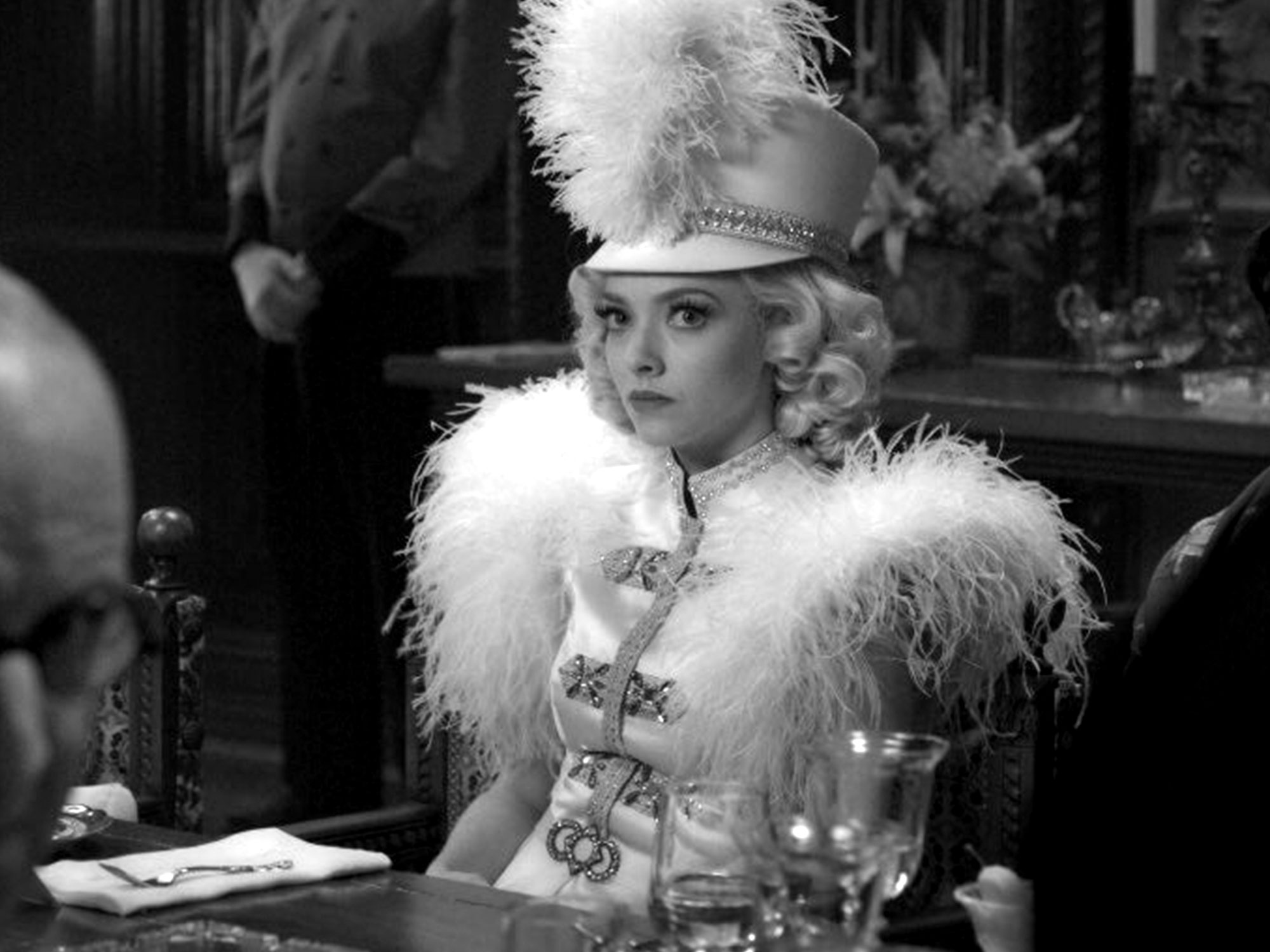
… played by almost shoe-in for an Oscar nod, Amanda Seyfried

The elder Fincher wrote his screenplay all that time ago as a “retirement project” and based large chunks of it on Pauline Kael’s famous two-part 1971 New Yorker essay, Raising Kane, which itself purported to be the true story behind the making of the classic film, with great anecdotes s and scads of research to back it up.

However, over the years much of that article has, if not disproven, then heavily debated, though in no way does that make what’s contained in it any less true or false.  As Ms. Kael herself admits at one point in her extremely long, yet never thoroughly engrossing account: 

When you write straight reporting about the motion-picture business, you’re writing satire.

It’s a good point

In fairness to Ms. Kael, because who would dare not be, (Note: Certainly not myself) in this quote she was referring not so much to the facts of her story but to the relationships between the suits/studios and the various creative artists (nee, the crazies, as she admiringly puts it) who worked for them and, often, were smarter than they were.

Of course, smarter does not necessarily mean savvier or better able to function in the real world.  What Mank, Ms. Kael, both Finchers (Jack AND David), and even Orson Welles himself, all too painfully knew and demonstrate in their work is that you can have all the talent, best answers and most amusing bon mots in the world, and still not wind up on top.

On the other hand, neither will anyone else.  Because NO ONE ultimately gets to be in the number one slot, whatever one deems that to be, all of the time. It depends where you enter their story and what you see as the end to that particular motion picture.

Which is certainly the case for Mr. Kane

Legend has always had it that brash boy wonder egomaniac Welles was destroyed by the Hollywood moguls who resented his talent even as they fed on it. 

But what we learn in Mank is that even though the former might have been true what also might be is that Welles’ ego was so large that even directing, producing and starring in Citizen Kane wasn’t enough for him.  He demanded and ultimately received co-writing credit on a film in which he never wrote a word. 

Conversely, Mank also lets us know that no writer really does it alone.  Despite all the public denials in the world, legendary scribes like Mankiewicz, and even we lesser ones, WILL pilfer our truths from ANYONE while swearing up and down to EVERYONE else that it’s merely our imaginations that are Just. That. Good.

Truth bombs

That’s what Mankiewicz (Note: Mank to his friends, most notably Marion Davies) did with the Kane/Hearst story, according to the Finchers, or at least according to the film they’ve just made about it.

In fact, his real life remembrances of Hearst and Davies, not to mention those of Hollywood moguls like Louis B. Mayer and Irving J. Thalberg, are the most intriguing sections of the Mank story.

We watch as he parties with them, works with them, gets sloppy drunk on their liquor, and gambles away the overly generous paychecks they offer, in part only for the mere presence of his wit and wisdom.

.. and drink he does

We also watch as he grows intellectually, morally and finally physically disgusted by who he realizes, in the events leading up to World War II, these people and himself truly are.  Yet by this time it’s far too late to do much of anything lasting about it except for drinking.  Or so he thinks.  Until Orson Welles enters his life.

Which does not mean he ever stops drinking.  It only means that in either a blatant, or pained act of revenge and/or justice, he can finally start writing.  Again. 

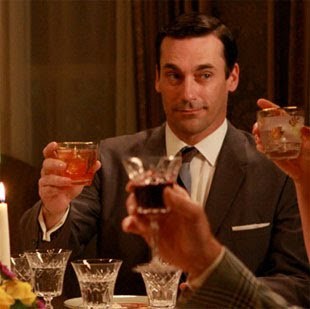
Don Draper would approve

Like all Hollywood biopics, or historical stories based on real-life people and/or events, much will be made on what in Mank is false or simply approximates the truth.

But that’s an unanswerable, losing proposition and entirely misses the point of the film and the thousands of stories like it.

Anything may or may not seem real onscreen, on the stage or in the pages of a book or even newspaper, but the fact is that none of it absolutely is.

It’s how those facts are arranged, and what they tell us about ourselves, the characters we’re watching and reading, AND the folks who made them up.

That’s where the real truth lies, if there is any to be had at all.

If Only You Could Save Me – Adryon de León (from Mank soundtrack)